- Company Articles
- Industry articles
- Industry standards
- Supplier Audit Checklist for 2040 National Standard Profile Quality Assurance

Supplier Audit Checklist for 2040 National Standard Profile Quality Assurance
Related Product
2040 National Standard Profile
45° external bending joint, used for 45° external connection of two aluminum pipes.
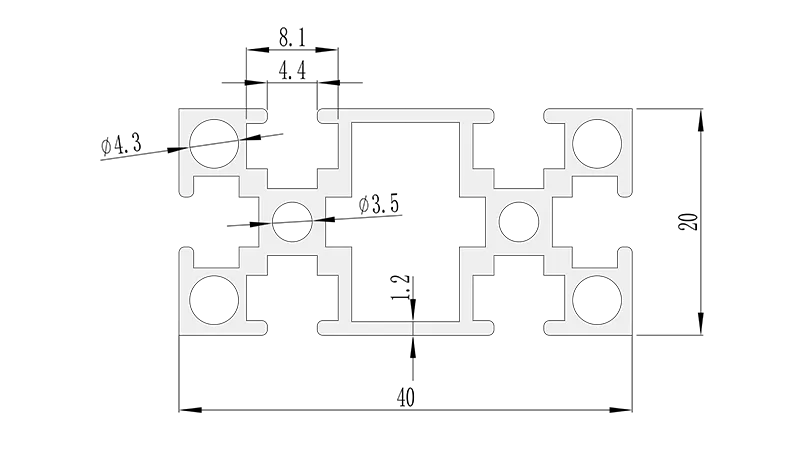
In the fast-paced world of manufacturing, automation, and industrial design, the backbone of reliable operations often lies in the smallest details—like the aluminum profiles that form the structure of workbenches, material racks, conveyor systems, and countless other industrial setups. Among these, the 2040 national standard profile stands out as a workhorse: versatile, durable, and universally recognized for its balance of strength and adaptability. Whether you're building a lean production line, assembling a sturdy workbench, or designing an automated material handling system, the quality of your 2040 national standard profile directly impacts efficiency, safety, and long-term cost-effectiveness. But here's the truth: even the most reputable suppliers can fall short of expectations without rigorous oversight. That's why a well-crafted supplier audit isn't just a box-ticking exercise—it's your first line of defense against costly delays, faulty products, and compromised operations. Let's dive into a comprehensive checklist that transforms vague "quality checks" into actionable steps, ensuring your supplier delivers 2040 profiles (and their accompanying aluminum profile accessories) that meet not just standards, but your team's trust.
Why This Checklist Matters: Beyond the Blueprint
Imagine partnering with a supplier who promises "top-tier" 2040 national standard profiles, only to receive shipments with inconsistent dimensions, rough edges, or weak structural integrity. For a small manufacturer, this could mean reworking an entire batch of workbenches. For a large-scale production facility, it might delay a critical assembly line launch. The 2040 profile isn't just metal—it's the foundation of your operations. A shoddy profile undermines everything built on top of it, from employee safety to customer satisfaction. This checklist isn't about nitpicking; it's about preserving the reliability your team depends on. It turns abstract "quality" into concrete, verifiable actions, so you can confidently say, "This supplier gets it."
Pre-Audit Preparation: Laying the Groundwork for Success
Before stepping foot in your supplier's facility, preparation is key. Think of it like planning a road trip: you wouldn't hit the highway without checking the map, fuel, and weather. The same logic applies here—skipping pre-audit steps leaves you vulnerable to missing critical red flags.
1. Align on Requirements: Speak the Same Language
Start by documenting your exact needs for the 2040 national standard profile. This includes dimensional tolerances (length, width, wall thickness), mechanical properties (tensile strength, hardness), surface finish (anodized, powder-coated, or mill finish), and any custom modifications (e.g., pre-drilled holes for aluminum profile accessories). Share this document with the supplier before the audit. A supplier who struggles to understand or commit to these details is already a warning sign.
2. Review Documentation: Paper Trails Tell the Truth
Request pre-audit documents to assess their commitment to quality. Key items include:
- Certifications for 2040 national standard profile compliance (e.g., GB/T standards in China)
- Raw material purchase records (to verify aluminum alloy grade—typically 6061 or 6063 for extrusion profiles)
- Quality control reports from recent production runs of similar aluminum extrusion profiles
- Employee training records for operators handling extrusion and inspection processes
3. Set Audit Goals: Know What You're Hunting For
Define clear objectives. Are you verifying consistency across batches? Assessing their ability to scale production? Ensuring compliance with environmental standards? Write these down and share them with your audit team. Without goals, you'll wander the facility, noting trivial details while missing critical flaws.
On-Site Manufacturing Process Evaluation: The Heart of Quality
The extrusion floor is where the 2040 national standard profile comes to life—and where most quality issues begin. A walkthrough here isn't just about watching machines run; it's about observing the culture of quality. Do operators care about precision? Is there a system to catch defects early?
1. Extrusion Process: From Billet to Profile
Start at the extrusion press. Ask to see the billet heating process—aluminum billets must be heated to precise temperatures (around 480–520°C for 6063 alloy) to ensure uniform flow during extrusion. If the temperature fluctuates wildly, the profile may warp or develop internal stress cracks. Next, check the die setup: the die is the mold that shapes the aluminum into the 2040 profile's cross-section. Look for signs of wear or damage—scratches or dents on the die will transfer to the profile's surface, leading to rough edges or uneven dimensions.
Watch the extrusion speed. Too fast, and the profile may cool unevenly; too slow, and production efficiency drops. A reputable supplier will have calibrated speed settings based on the profile's complexity and wall thickness. Also, observe the quenching process (rapid cooling after extrusion). For 6063 aluminum extrusion profiles, proper quenching ensures the material reaches the T5 or T6 temper, critical for mechanical strength.
2. In-Process Quality Control: Catching Issues Early
Quality shouldn't be an afterthought. Look for in-line inspection stations where operators measure critical dimensions (using calipers, micrometers, or coordinate measuring machines) at regular intervals—ideally every 30 minutes or after every 50 profiles. Ask to see their inspection logs: Are they checking for twists, bends, or dimensional (deviation)? A profile that's 0.2mm off spec might seem minor, but in a workbench assembly with dozens of profiles, those add up, leading to misaligned shelves or unstable structures.
Also, check how they handle defects. If a profile fails inspection, is it immediately quarantined, or does it get mixed back into the production line? A supplier that tolerates "minor" defects is a supplier that will eventually send those defects to your facility.
Material Sourcing and Traceability: Know Your Aluminum's Roots
A 2040 national standard profile is only as good as the aluminum it's made from. Even the best extrusion process can't fix subpar raw materials. Dive into their material sourcing practices to ensure you're getting the alloy you paid for.
1. Aluminum Alloy Verification: The Right Mix Matters
Request a certificate of analysis (COA) for the aluminum alloy used in their 2040 profiles. For most industrial applications, 6063-T5 is standard—it offers excellent extrudability and corrosion resistance. The COA should list elemental composition: silicon (0.2–0.6%), iron (≤0.35%), copper (≤0.1%), magnesium (0.45–0.9%), zinc (≤0.1%), and manganese (≤0.1%). If the alloy is off—say, too much iron—you'll end up with brittle profiles prone to cracking under load.
2. Traceability: From Mine to Profile
Ask to trace a batch of 2040 profiles back to the original aluminum ingot. Reputable suppliers will use batch codes that link to raw material suppliers, melt dates, and extrusion runs. This isn't just about quality—it's about accountability. If a defect is found months later, traceability lets you pinpoint whether it was a one-off issue or a systemic problem with a specific material batch.
Testing and Inspection Protocols: Prove It, Don't Just Promise It
A supplier might claim their 2040 national standard profiles meet all standards, but words mean nothing without data. Evaluate their testing processes to ensure they're rigorous enough to catch issues before profiles leave the facility.
| Testing Category | Key Checks for 2040 Profiles | Acceptance Criteria | Verification Method |
|---|---|---|---|
| Dimensional Accuracy | Width (20mm), height (40mm), wall thickness (1.2–2.0mm), straightness (<0.5mm/m) | Within ±0.1mm for critical dimensions; ±0.2mm for non-critical | Calipers, micrometers, straightedge, or CMM for high-precision batches |
| Mechanical Properties | Tensile strength (>180MPa), yield strength (>110MPa), elongation (>8%) | Meets GB/T 6892-2015 standards for 6063-T5 | Tensile testing machine; sample coupons from each batch |
| Surface Finish | Anodized layer thickness (8–12μm), no scratches, pits, or discoloration | Uniform color; no visible defects under 400 lux lighting | Visual inspection, thickness gauge for anodized layers |
| Corrosion Resistance | Salt spray test performance (for outdoor or humid environments) | No white rust after 48 hours; no red rust after 1000 hours | Neutral salt spray (NSS) test per ASTM B117 |
*Table: Critical testing checks for 2040 national standard profile quality assurance.
Beyond the Lab: Real-World Simulation
Some defects only reveal themselves under real-world stress. Ask if the supplier conducts assembly tests—e.g., building a small workbench using their 2040 profiles and aluminum profile accessories (like brackets, connectors, or hinges) to check fit and stability. A profile that looks perfect on paper might wobble when assembled, exposing poor dimensional consistency.
Compliance and Continuous Improvement: Quality as a Habit
Quality isn't static—it requires ongoing effort. Assess whether the supplier is committed to compliance and learning from past mistakes.
1. Certifications: More Than Just Stickers
Check for relevant certifications: ISO 9001 (quality management), ISO 14001 (environmental management), and specific industry certifications (e.g., automotive or aerospace standards if applicable). But don't stop at the certificate—ask how they implement these standards daily. For example, ISO 9001 requires a documented corrective action process for defects. Review records of past non-conformities: Did they identify root causes? Implement fixes? Prevent recurrence?
2. Feedback Loops: Listening to Customers
Talk to the supplier's quality manager about customer feedback. How do they handle complaints about 2040 profiles? Do they track issues (e.g., "profile warpage in batch #2305") and use that data to improve processes? A supplier that dismisses feedback or blames customers is a supplier that will never get better.
Post-Production and Logistics: Protecting Quality Until Delivery
Even a flawless 2040 national standard profile can be ruined by poor handling after production. Evaluate how the supplier packages, stores, and ships their products.
1. Packaging: Defense Against Damage
Profiles should be wrapped in protective film to prevent scratches, bundled with non-marring straps, and packed in crates or pallets that prevent bending during transit. Check if they use moisture barriers for anodized profiles (to avoid water spots) or anti-corrosion paper for bare aluminum extrusion profiles.
2. Storage: Keeping Profiles in Prime Condition
Visit their warehouse. Are profiles stored horizontally on racks (to prevent warping) or haphazardly stacked? Is the area dry (to avoid rust on uncoated profiles) and well-ventilated? A disorganized warehouse is a red flag—if they don't care about storage, they won't care about your order.
3. Delivery Reliability: On-Time, Every Time
Ask for delivery performance data from the past six months: What's their on-time delivery rate? How do they handle delays (e.g., weather, machine breakdowns)? A supplier that misses deadlines regularly will disrupt your production schedule, costing you time and money.
Final Thoughts: Building Trust Through Rigor
Choosing a supplier for 2040 national standard profiles isn't just a transaction—it's a partnership. A weak audit might save time today, but it (buries hidden risks) that could derail your operations tomorrow. By following this checklist, you're not just checking boxes; you're building a foundation of trust. You're ensuring that the aluminum extrusion profiles and aluminum profile accessories arriving at your facility are consistent, reliable, and ready to perform. Because in manufacturing, the difference between a smooth production line and a costly disaster often comes down to the quality of the profiles holding it all together.
So take the time to audit thoroughly. Ask tough questions. Demand proof. Your team, your customers, and your bottom line will thank you.