- Company Articles
- Industry articles
- Industry standards
- Surface Hardness of 3030 National Standard Profile A: Resistance to Scratches & Wear

Surface Hardness of 3030 National Standard Profile A: Resistance to Scratches & Wear
Related Product
3030 National Standard Profile A
Workbench, production line, logistic rack, warehouse rack Industry: Manufacturer workshop, Automobile, Electronic, Assembling, logistic
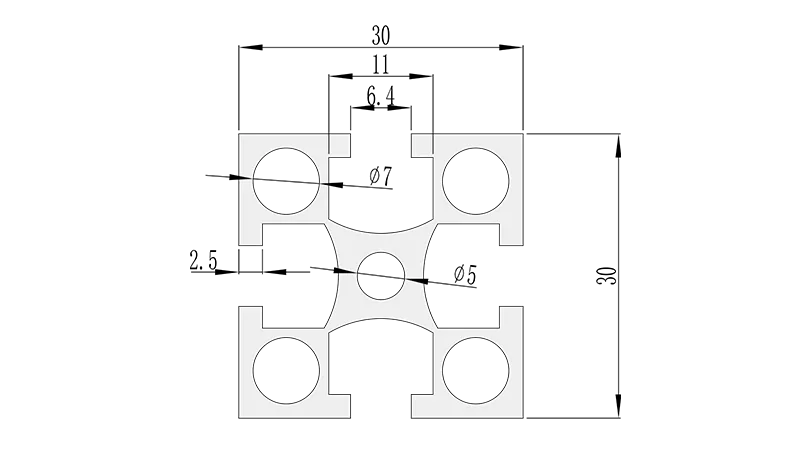
If you've ever stepped onto a factory floor, wandered through a warehouse, or even peeked into a busy workshop, you've likely encountered the backbone of modern industrial setups: aluminum profiles. These sleek, modular structures form the frames of workbenches, the rails of material racks, and the supports of conveyor systems, quietly keeping operations running smoothly. Among the most versatile and widely used of these profiles is the 3030 National Standard Profile A—affectionately called "3030A" by manufacturers and engineers. But what makes this unassuming 30mm x 30mm extrusion stand out in a sea of industrial materials? Today, we're zeroing in on one of its most critical features: surface hardness, and how it translates to impressive resistance against scratches and wear. Whether you're building a lean system, setting up a durable workbench, or stocking a material rack that needs to withstand daily abuse, understanding 3030A's surface properties could be the difference between a setup that lasts months and one that endures for years.
What is 3030 National Standard Profile A, Anyway?
Before we dive into surface hardness, let's get to know 3030A a little better. At its core, this profile is a product of precision engineering: a 30mm by 30mm cross-section extrusion made from high-grade aluminum alloy, typically 6063 or 6061. These alloys are chosen for their winning combo of strength, lightweight design, and corrosion resistance—qualities that make 3030A ideal for everything from small workbenches to large-scale production lines. The "national standard" label ensures consistency in dimensions, material quality, and performance, so whether you buy it from one supplier or another, you know what you're getting.
Think of 3030A as the Swiss Army knife of aluminum profiles. Its square shape makes it easy to connect with aluminum profile accessories—things like 90° connectors, end caps, and brackets—allowing for endless configurations. Need a workbench? Bolt a plywood or metal top to a frame of 3030A. Building a material rack? Assemble vertical posts and horizontal rails with three-way joints. Even in lean systems, where adaptability and efficiency are king, 3030A shines: it's light enough to reconfigure when production needs change, yet strong enough to support heavy loads without bending or warping.
Surface Hardness: More Than Just a Number
Surface hardness is one of those terms that sounds technical, but it's actually pretty intuitive: it's how well a material resists being dented, scratched, or worn down when something rubs against it. For 3030A, this isn't just a nice-to-have feature—it's a make-or-break quality. Imagine a workbench where tools are constantly dropped, or a material rack where boxes are slid in and out daily; a soft surface would quickly turn into a mess of scratches and dents, compromising both functionality and appearance.
So, how is hardness measured? The most common method is the Rockwell hardness test, where a tiny diamond or steel ball is pressed into the material with a specific force, and the depth of the indentation is measured. For aluminum profiles like 3030A, we use the Rockwell B (HRB) scale, which is designed for softer metals. A typical 3030A profile scores between HRB 55 and 60 on this scale—firm enough to resist everyday impacts, but not so brittle that it cracks under stress. To put that in perspective: a HRB 55-60 rating means 3030A is harder than many plastics (which might score HRB 30-40) and even some lower-grade steels, but still lightweight enough to keep assembly and installation manageable.
Scratch Resistance: Keeping Surfaces Smooth (Even When Accidents Happen)
Let's talk about scratches—the bane of any industrial surface. Whether it's a wrench slipping off a workbench, a metal part dragging across a rail, or a forklift grazing a rack, scratches happen. The question is: will they leave a permanent mark, or will the surface bounce back? That's where 3030A's surface hardness comes into play.
Scratch resistance is closely tied to surface hardness. A harder surface is less likely to be penetrated by sharp or rough objects, meaning scratches stay shallow or nonexistent. To test this, manufacturers often use the pencil hardness test: pencils of increasing hardness (from soft 6B to hard 9H) are pressed against the surface at a 45° angle and pushed forward. A profile with good scratch resistance, like 3030A, typically resists scratches from pencils up to 4H or 5H. For context, a 4H pencil is harder than a standard wooden pencil (which is around 2H), so 3030A can handle contact with tools, metal edges, and even some industrial cleaners without showing marks.
Why does this matter in real life? Let's take that workbench we mentioned earlier. Picture a technician assembling circuit boards: they're setting down screwdrivers, pliers, and small metal components all day. A softer profile might get etched with tiny scratches every time a tool slips, creating grooves that trap dirt, oil, or debris. Over time, these grooves could even damage delicate parts placed on the bench. But with 3030A, the surface stays smooth and clean, making cleanup easier and reducing the risk of snags or damage to sensitive items. Even in high-traffic areas, like near conveyor belts or loading docks, 3030A's scratch resistance ensures the profile retains its professional look—no more unsightly marks that make your workspace feel run-down.
Wear Resistance: Enduring the Grind of Daily Use
If scratches are the "sudden jolt" of surface damage, wear is the "slow burn." Wear happens when two surfaces rub against each other repeatedly, gradually wearing away material. Think of a material rack where boxes are slid in and out multiple times a day, or a lean system where parts glide along rails—over weeks and months, this friction can take a toll on softer materials. But 3030A? It's built to outlast this grind.
Wear resistance depends on a few factors: surface hardness, material composition, and even surface treatments like anodizing (a process that adds a protective oxide layer to aluminum). For 3030A, the combination of its alloy makeup (6063/6061) and inherent hardness means it loses very little material over time, even under constant friction. To quantify this, manufacturers use tests like the Taber Abrasion Test, where a rotating abrasive wheel rubs against the surface under a set load, and the weight loss is measured. 3030A typically loses less than 5 mg of material per 1000 cycles—compare that to softer plastics, which might lose 20 mg or more, and you see why durability matters.
Let's bring this to life with an example: material rack B (3 row and 3 floor), a common storage solution in warehouses. This rack, often built with 3030A and aluminum profile accessories like cross-braces and rail guides, holds everything from heavy metal parts to bulk packages. Every time a worker loads a box onto the rack, the box's edges rub against the 3030A rails. Over weeks, this repeated contact could wear down softer profiles, creating uneven surfaces that make sliding boxes harder (or even dangerous). But with 3030A, the rails stay smooth and even, ensuring boxes glide easily and the rack maintains its structural integrity. In lean systems, where downtime equals lost productivity, this consistency is gold: no more stopping to fix warped rails or replace worn-out sections—3030A just keeps going.
Real-World Testing: How 3030A Stacks Up
Numbers and tests are great, but what do they look like in practice? Let's break down the data with a closer look at 3030A's performance in key durability tests. The table below summarizes typical results for surface hardness, scratch resistance, and wear resistance—metrics that directly impact how well the profile holds up in industrial settings.
| Test Type | Standard Method | Typical Result for 3030A | What This Means for You |
|---|---|---|---|
| Rockwell Hardness (Surface) | ASTM E18 (HRB Scale) | HRB 55–60 | Resists dents from tools, dropped parts, and light impacts. A 55 HRB score means it's harder than most plastics and comparable to some low-carbon steels. |
| Pencil Hardness (Scratch Resistance) | ISO 15184 | 4H (no visible scratch) | Won't scratch from contact with 4H pencils (harder than standard wood pencils), metal tools, or rough box edges. |
| Taber Abrasion (Wear Resistance) | ASTM D4060 (1 kg load, CS-10 wheel) | <5 mg weight loss per 1000 cycles | Minimal material loss under friction—ideal for high-traffic areas like material racks or conveyor rails. |
| Cross-Cut Adhesion (Surface Treatments) | ISO 2409 | Rating 0 (no peeling) | If anodized or coated, the surface layer bonds tightly to the aluminum, preventing flaking that could lead to scratches. |
These results aren't just lab trivia—they translate to real-world reliability. For instance, the HRB 55–60 hardness means a 3030A workbench can handle a 5-pound wrench being dropped from waist height without denting. The 4H pencil resistance ensures that sliding a steel ruler across the surface won't leave a mark. And the low Taber wear rate? That's why a material rack built with 3030A will still look and function like new after a year of daily use, while a rack made with a softer profile might need replacement rails.
Aluminum Profile Accessories: The Unsung Heroes of Durability
3030A might be the star, but it rarely works alone. Aluminum profile accessories are the supporting cast that help maximize its scratch and wear resistance, turning a simple extrusion into a robust system. Let's take a quick tour of the most important accessories and how they complement 3030A's surface hardness:
- End Caps: These small plastic or metal caps snap onto the ends of 3030A, covering the raw, cut edges of the extrusion. Without them, those edges could chip, catch on clothing or materials, or even scratch other parts of the profile. End caps smooth things out, acting as a first line of defense against accidental damage.
- Edge Protectors: For profiles used in high-contact areas (like the edges of a workbench), rubber or plastic edge protectors add a cushion. They absorb impacts from dropped tools or sliding parts, reducing the risk of scratches on the 3030A surface.
- Anodized Connectors: When joining 3030A rails or posts, connectors made from anodized aluminum (which has a harder surface than raw aluminum) prevent galling—the wear that happens when two metal surfaces rub together under pressure. This keeps joints tight and reduces stress on the profile itself.
- Sliding Rail Guides: In material racks or conveyors, plastic or metal rail guides attach to 3030A, creating a smooth surface for items to slide on. By taking the brunt of the friction, these guides protect the 3030A rails from wear, extending their lifespan.
In short, accessories don't just make 3030A easier to assemble—they make it tougher. A well-equipped 3030A setup, with the right end caps, connectors, and protectors, can outlast a bare-bones frame by years.
Why 3030A is a Cornerstone of Lean Systems
Lean systems are all about efficiency: eliminating waste, reducing downtime, and maximizing productivity. In this context, durability isn't a luxury—it's a necessity. A setup that breaks down or needs frequent repairs is a waste of time and money, which is why 3030A is a favorite in lean environments.
Consider a typical lean system: a series of connected workstations, material racks, and conveyors where parts move seamlessly from one step to the next. If the frame of this system is made from a soft, easily scratched profile, here's what happens: Scratches trap dirt, making cleanup slower. Wear on rails causes jams, halting production. Dents weaken the structure, requiring frequent reinforcements. None of this aligns with lean principles. But with 3030A, these issues vanish. Its scratch resistance keeps surfaces clean and easy to sanitize (critical in food or medical manufacturing). Its wear resistance ensures conveyors and racks stay aligned, preventing jams. And its overall durability means the system needs minimal maintenance, freeing up workers to focus on value-adding tasks instead of repairs.
Even better, 3030A's modularity fits lean's "adapt or die" ethos. When production needs change—say, a new product line requires a wider workbench or a taller material rack—3030A frames can be disassembled, reconfigured, and reassembled with new aluminum profile accessories. No need to buy entirely new equipment; just repurpose what you have. This flexibility, paired with its long lifespan, makes 3030A a cost-effective choice for lean systems that need to evolve without sacrificing reliability.
The Bottom Line: 3030A is Built to Last
At the end of the day, 3030 National Standard Profile A isn't just another aluminum extrusion. It's a testament to how thoughtful engineering—focused on details like surface hardness—can transform a simple material into a workhorse of industrial design. Its ability to resist scratches and wear isn't just about looking good (though that's a bonus); it's about reliability, cost savings, and peace of mind. Whether you're building a workbench that sees daily tool abuse, a material rack that holds heavy loads, or a lean system that can't afford downtime, 3030A delivers where it counts.
So the next time you're planning an industrial setup, don't just think about dimensions or cost—think about surface hardness. Think about the scratches that won't happen, the wear that won't accumulate, and the years of service you'll get from a profile that's built to endure. With 3030 National Standard Profile A, you're not just buying aluminum—you're investing in durability.