- Company Articles
- Industry articles
- Industry standards
- Sustainability of 3060 National Standard Profile A: Reusability in Lean Manufacturing

Sustainability of 3060 National Standard Profile A: Reusability in Lean Manufacturing
Related Product
3060 National Standard Profile A
Workbench, production line, logistic rack, warehouse rack Industry: Manufacturer workshop, Automobile, Electronic, Assembling, logistic
Walk into any modern manufacturing facility today, and you'll likely hear two words echoing through the production lines:
sustainability
and
efficiency
. These aren't just buzzwords—they're the backbone of a industry grappling with rising material costs, stricter environmental regulations, and a growing consumer demand for eco-conscious practices. For plant managers, engineers, and operations teams, the challenge isn't just about meeting quotas anymore; it's about building systems that can adapt, reduce waste, and stand the test of time. That's where lean manufacturing comes in—and at the heart of lean's sustainable evolution lies a quiet hero: the 3060 National Standard Profile A.
Lean Manufacturing: More Than Just Efficiency
Lean manufacturing has long been celebrated for its focus on eliminating waste—whether that's excess inventory, unnecessary movement, or idle time. But in recent years, "lean" has taken on a deeper meaning. Today, it's not just about streamlining processes; it's about rethinking the very materials that power those processes. Traditional manufacturing setups often rely on fixed, one-and-done structures: steel frames welded into place, wooden workbenches that splinter after a few years, or plastic components that crack and end up in landfills. These aren't just inefficient—they're unsustainable.
The problem? When a production line needs to reconfigure for a new product, or a workbench wears out, those old materials are often discarded. That's a double hit: companies lose money on replacement costs, and the planet bears the burden of excess waste. According to the EPA, manufacturing accounts for nearly 20% of all waste generated in the U.S.—and a significant portion of that comes from single-use or non-recyclable production equipment. Lean manufacturing, when done right, should minimize this. But to do that, it needs the right building blocks.
Meet the 3060 National Standard Profile A: A Material Built for Adaptability
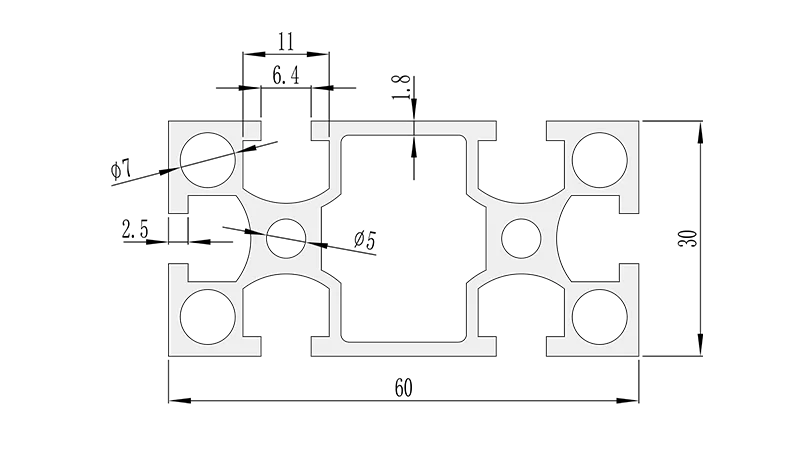
Enter the 3060 National Standard Profile A—an aluminum extrusion profile designed with one goal in mind: reusability. If you're not familiar with aluminum extrusion, think of it as the manufacturing equivalent of shaping playdough with a cookie cutter. Aluminum is heated, then pushed through a die to create long, uniform shapes with precise cross-sections. The result? A lightweight, durable material that's infinitely customizable. But the 3060 Profile A takes this a step further. As part of the national standard series, it's engineered to work seamlessly with a range of aluminum profile accessories, from connectors to end caps, making it a modular solution for everything from workbenches to material racks.
What sets the 3060 Profile A apart? Let's break it down. First, it's made from high-grade aluminum, which is not only strong (it can support heavy loads without bending) but also corrosion-resistant—critical for factories where moisture or chemicals might be present. Second, its T-slot design (those grooves running along its length) allows for quick, tool-free assembly. Unlike welded steel, which requires a grinder and a welder to modify, the 3060 Profile A can be taken apart and reassembled in minutes using simple fasteners. And third, it's part of a standardized system. That means if you need to extend a workbench, add a shelf to a material rack, or even build an entirely new production cell, you can use the same profiles and accessories you already have. No need to buy new materials—just repurpose what's already in your facility.
Reusability in Action: How 3060 Profile A Cuts Waste
Disassembly Without Destruction
Let's say your factory needs to shift from assembling small electronics to larger appliances. Your old workbench, built with welded steel, is too low and too narrow. With traditional materials, you'd likely have to cut the steel frame apart, which renders it useless for future projects. The wood top, if it's worn, would end up in the trash. The cost? Not just the price of a new workbench, but the labor to remove the old one and the environmental impact of sending scrap metal and wood to a landfill.
Now imagine that workbench is built with 3060 Profile A. To adjust its height, you simply loosen the aluminum profile connectors, reposition the legs, and tighten them back up. Need a wider surface? Add another section of 3060 Profile A using T-slot bolts. The old components aren't destroyed—they're repurposed. Even better, if that workbench is eventually retired, the aluminum profiles can be stripped down, cleaned, and used to build something entirely new: a material rack, a conveyor frame, or a storage shelf. There's no waste, just adaptation.
Modularity: The Key to Longevity
The 3060 Profile A's real superpower is its modularity. Unlike custom-made steel or plastic parts, which are designed for a single task, this aluminum extrusion profile is part of a system. It works with standardized aluminum profile accessories—think corner codes, end caps, and T-slot nuts—that are interchangeable across hundreds of applications. For example, the same 3060 Profile A used in a workbench can be paired with roller track connectors to build a flow rack, or with caster wheels to create a mobile trolley. This isn't just convenient for factory managers; it's a sustainability game-changer.
Consider this: A study by the Aluminum Association found that aluminum extrusion profiles have a reuse rate of over 85% in manufacturing settings, compared to just 40% for traditional steel structures. Why? Because steel, once welded, is hard to separate without damaging the material. Aluminum, on the other hand, can be disassembled and reassembled repeatedly without losing structural integrity. The 3060 Profile A, with its standardized dimensions and accessory compatibility, takes this even further. It's not just a profile—it's a kit of parts that grows with your needs.
Comparing Traditional vs. 3060 Profile A: The Sustainability Scorecard
| Category | Traditional Steel/ Wood Structures | 3060 National Standard Profile A |
|---|---|---|
| Reusability Rate | Low (40% or less; often discarded after one use) | High (85%+; can be disassembled and repurposed repeatedly) |
| Waste Generated | High (scrap metal, splintered wood, non-recyclable plastics) | Low (minimal waste; aluminum is 100% recyclable) |
| Assembly/Disassembly Time | Long (requires welding, cutting, or gluing; permanent once built) | Short (tool-free assembly with T-slot accessories; no permanent modifications) |
| Lifespan | 5-7 years (prone to rust, rot, or cracking) | 15+ years (corrosion-resistant aluminum; replaceable accessories extend life) |
| Environmental Impact | High (high carbon footprint from production; waste ends in landfills) | Low (aluminum production uses 95% less energy than steel; recyclable indefinitely) |
Real-World Impact: A Case Study in Lean Manufacturing
Company:
PrecisionTech, a mid-sized electronics manufacturer in Ohio
Challenge: Needed to reconfigure 3 production lines every 6 months for new product launches, leading to high waste and replacement costs.
Solution: Replaced all steel workbenches, material racks, and trolleys with 3060 National Standard Profile A and aluminum profile accessories.
Results:
- Waste reduction: 62% decrease in manufacturing waste (from 12 tons/year to 4.5 tons/year).
- Cost savings: $45,000/year in replacement material costs and labor for reconfiguration.
- Lifespan extension: Average equipment lifespan increased from 4 years to 18 years.
- Employee feedback: "We used to dread reconfiguring lines because it meant breaking down old steel frames. Now, we just swap out the profiles and keep going. It's like building with giant Legos!" – Maria Gonzalez, Production Supervisor.
Challenge: Needed to reconfigure 3 production lines every 6 months for new product launches, leading to high waste and replacement costs.
Solution: Replaced all steel workbenches, material racks, and trolleys with 3060 National Standard Profile A and aluminum profile accessories.
Results:
- Waste reduction: 62% decrease in manufacturing waste (from 12 tons/year to 4.5 tons/year).
- Cost savings: $45,000/year in replacement material costs and labor for reconfiguration.
- Lifespan extension: Average equipment lifespan increased from 4 years to 18 years.
- Employee feedback: "We used to dread reconfiguring lines because it meant breaking down old steel frames. Now, we just swap out the profiles and keep going. It's like building with giant Legos!" – Maria Gonzalez, Production Supervisor.
PrecisionTech's story isn't unique. Across industries—automotive, aerospace, medical devices—manufacturers are waking up to the benefits of modular aluminum profiles. The 3060 Profile A, in particular, has become a go-to choice because it balances strength (it can support up to 500 lbs per linear foot) with flexibility. For companies committed to lean principles, it's not just a material upgrade; it's a cultural shift toward sustainability.
Beyond Reusability: The Ripple Effects of Sustainable Materials
The sustainability benefits of the 3060 Profile A go beyond just reusing parts. Aluminum, as a material, is inherently eco-friendly. Producing aluminum from recycled scrap uses 95% less energy than producing it from raw bauxite ore, according to the Aluminum Extruders Council. That means every time you reuse a 3060 Profile A instead of buying a new steel component, you're not just saving money—you're slashing your carbon footprint.
Then there's the issue of maintenance. Steel rusts, wood rots, plastic fades and cracks. Each of these issues requires frequent repairs or replacements, which add up in terms of time, money, and waste. The 3060 Profile A, with its corrosion-resistant aluminum and durable finish, needs minimal upkeep. A quick wipe-down with a damp cloth is often enough to keep it looking and performing like new. And when accessories like connectors or end caps wear out? They're cheap and easy to replace, without having to scrap the entire profile.
Supporting Lean's "Continuous Improvement" Mindset
Lean manufacturing thrives on continuous improvement—the idea that no process is ever "perfect." The 3060 Profile A embodies this philosophy. It doesn't lock you into a single design; it invites experimentation. Want to test a new workflow? Build a prototype material rack with 3060 profiles in an afternoon. If it works, keep it. If not, take it apart and try again. This flexibility encourages teams to innovate without fear of wasting resources—a cornerstone of lean thinking.
Challenges and How to Overcome Them
Of course, transitioning to 3060 Profile A isn't without its hurdles. The upfront cost of aluminum extrusion profiles can be higher than traditional steel or wood. For small manufacturers on tight budgets, this can be a barrier. But here's the thing: that initial investment pays off quickly. As PrecisionTech's case study shows, the long-term savings in replacement costs, labor, and waste disposal often offset the upfront price within 12–18 months.
Another challenge? Training. Employees used to working with welded steel or prefab plastic structures may need time to learn how to assemble and disassemble aluminum profiles. But with the right training (many aluminum profile suppliers offer free workshops), teams quickly adapt. After all, using T-slot bolts and connectors is far simpler than welding—and far less dangerous.
The Future of Lean Manufacturing: Building a Circular Economy
The 3060 National Standard Profile A isn't just a trend; it's part of a larger movement toward circular manufacturing—an economy where resources are reused, recycled, and repurposed instead of discarded. As governments around the world crack down on waste and carbon emissions, and as consumers increasingly choose brands with strong sustainability credentials, manufacturers can't afford to stick with outdated, wasteful materials.
Looking ahead, we can expect to see even more innovation in aluminum extrusion profiles. New alloys will make them lighter and stronger. Smart accessories with IoT sensors could monitor wear and tear, alerting teams when a connector needs tightening or a profile needs cleaning. And as the 3060 Profile A becomes more mainstream, prices will likely drop, making it accessible to even more manufacturers.
Conclusion: The 3060 Profile A—A Sustainable Foundation for Lean
At the end of the day, sustainability in manufacturing isn't about grand gestures. It's about the small, everyday choices that add up: the materials we use, the way we build our workspaces, and how we adapt to change. The 3060 National Standard Profile A represents that choice. It's a material that doesn't just support lean manufacturing—it redefines it, turning "eliminate waste" from a (slogan) into a tangible reality.
For factory managers, engineers, and anyone who cares about building a more sustainable future, the message is clear: the next generation of lean manufacturing isn't just about efficiency. It's about reusability. And at the heart of that reusability? Profiles like the 3060 National Standard Profile A—quiet, unassuming, and ready to build a better, greener industry.