- Company Articles
- Industry articles
- Industry standards
- Sustainability of 4040r EU Standard Aluminum Profile: Reusability in Manufacturing

Sustainability of 4040r EU Standard Aluminum Profile: Reusability in Manufacturing
Related Product
4040R EU Standard Aluminum Profile
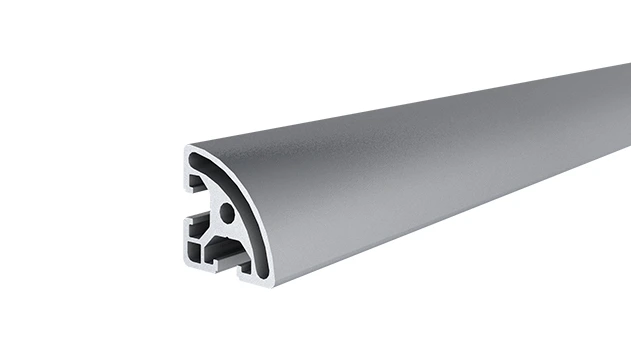
4040R is a 4.00x4.00 CM fractional 40 series square extrusion T-slot profile with two side open T-slots, each side with 4.00cm face,the other side is round face. The profile has align-a-grooves to assist in aligning connecting profiles.
In today's manufacturing landscape, the pressure to balance productivity with environmental responsibility has never been greater. Factories and production facilities worldwide are rethinking old habits—moving away from the "use-and-discard" mindset that once dominated industrial processes and toward systems built on sustainability. At the heart of this shift lies a quiet revolution: the adoption of materials and designs that prioritize reusability, durability, and minimal waste. One such material leading this charge is the 4040r EU Standard Aluminum Profile, a workhorse of modern manufacturing that's proving sustainability and efficiency can go hand in hand.
But what makes this specific aluminum profile so special? Why are manufacturers swapping out traditional steel frames, plastic components, and one-time-use fixtures for something that, at first glance, might seem like just another metal bar? The answer lies in its unique combination of material properties, modular design, and alignment with lean manufacturing principles. In this article, we'll dive deep into the sustainability story of the 4040r EU Standard Aluminum Profile, exploring how its reusability is transforming production floors, reducing environmental impact, and even boosting the bottom line for forward-thinking manufacturers.
The 4040r EU Standard Aluminum Profile: More Than Just a Metal Bar
Let's start with the basics: What exactly is the 4040r EU Standard Aluminum Profile? Put simply, it's a type of extruded aluminum product defined by its dimensions (40mm x 40mm cross-section) and compliance with European union standards for quality and safety. But to call it "just a metal bar" would be like calling a Swiss Army knife "just a blade"—its true value lies in its versatility and intentional design.
Aluminum extrusion, the process used to create profiles like the 4040r, involves pushing heated aluminum through a die to form complex cross-sectional shapes. For the 4040r, this results in a lightweight yet sturdy frame with a distinctive T-slot design running along its length. These slots are more than just a design quirk; they're the secret to the profile's modularity. Using simple aluminum profile accessories—like connectors, brackets, and end caps—manufacturers can assemble, disassemble, and reconfigure the 4040r into almost any structure imaginable: workbenches, material racks, conveyor systems, machine guards, and even custom production cells. Unlike welded steel frames, which are fixed once built, or plastic components that degrade over time, the 4040r-based structures are meant to evolve with a facility's needs.
But why "4040r"? The "r" often denotes a specific variation, such as rounded edges (a safety feature in busy workplaces) or reinforced walls for added strength. This attention to detail—balancing durability with practicality—makes the 4040r a favorite in industries ranging from automotive and electronics to pharmaceuticals and logistics. It's not just about what it is, but how it's used: as a blank canvas for manufacturing creativity, with sustainability built into every slot and connector.
Aluminum: The Sustainable Core of the 4040r
At the heart of the 4040r's sustainability story is aluminum itself—a material with a resume that reads like a sustainability dream. Unlike steel, which requires intensive mining and high-energy processing, or plastic, which relies on fossil fuels and often ends up in landfills, aluminum is infinitely recyclable. That's right: once aluminum is produced, it can be melted down and reused repeatedly without losing any of its structural integrity. In fact, recycling aluminum uses just 5% of the energy required to produce new aluminum from raw bauxite ore. For manufacturers, this translates to a material that's not just durable but also inherently circular—closing the loop on waste.
But the 4040r takes this a step further. While many aluminum products are designed for single-use (think beverage cans, which are recycled but not "reused" in their original form), the 4040r is engineered for reusability first. A 4040r frame built today might start as a workbench in an electronics assembly line. In a year, when the production line is retooled for a new product, that same frame can be disassembled, its components cleaned, and then reassembled into a material rack for storing inventory. A few years later, it might find new life as a guard rail around a robotic cell. This "second life" potential drastically reduces the need for new materials, cutting down on both resource extraction and manufacturing emissions.
Consider this: A traditional steel workbench, once welded into place, is effectively permanent. If the production line changes, the bench is either left to gather dust (wasting space and resources) or cut up and sent to a scrapyard (generating waste and emissions from transport and recycling). In contrast, a 4040r workbench can be taken apart in hours, with its components stored compactly until needed again. For large manufacturers with frequent reconfigurations—like those producing consumer electronics, where product cycles can be as short as six months—this flexibility is a game-changer for reducing waste.

Design for Reusability: How the 4040r Adapts to Change
Sustainability isn't just about using eco-friendly materials—it's about designing products that resist becoming waste in the first place. The 4040r excels here, thanks to a modular design philosophy that prioritizes adaptability. Let's break down the key features that make reusability possible:
- T-Slot Flexibility: The T-slots running along the 4040r's length allow for quick, tool-free adjustments. Using aluminum profile accessories like sliding nuts and bolts, manufacturers can attach shelves, panels, or tools at any point along the profile—no drilling or welding required. This means a workbench built for assembling small circuit boards can easily be modified to hold larger components by simply repositioning its shelves.
- Standardized Accessories: The EU standardization of the 4040r ensures that accessories—from 90° aluminum profile connectors to end caps—are interchangeable across brands and suppliers. This means a manufacturer isn't locked into a single vendor; if a bracket breaks or a new component is needed, it can be sourced easily, extending the life of the entire structure.
- Lightweight Strength: Aluminum is about one-third the weight of steel, making 4040r structures easy to move and reconfigure without heavy machinery. This not only saves time during line changes but also reduces the risk of damage during disassembly—another win for longevity.
- Corrosion Resistance: Unlike steel, aluminum naturally forms a protective oxide layer that resists rust and corrosion. This makes the 4040r suitable for use in damp or dusty environments (like warehouses or food processing facilities) without degrading over time. Even in harsh conditions, a quick wipe-down is often all it takes to keep a 4040r profile in working order for decades.
To put this into perspective, imagine a small automotive parts manufacturer that produces custom brackets for electric vehicles. As client demands shift, the factory needs to reconfigure its assembly stations every few months. With traditional steel workstations, this would mean hiring welders to modify frames or purchasing new ones—costing time, money, and generating waste. With 4040r profiles, the process is different: A team of two workers can disassemble the old stations in a day, sort the profiles and accessories, and reassemble them into new configurations by the end of the week. No new materials, no waste, just adaptability.
Lean Systems and the 4040r: A Match Made in Sustainable Manufacturing
For manufacturers familiar with lean system principles—focused on minimizing waste ("muda") and maximizing value—the 4040r is more than a material choice; it's a lean tool. Lean manufacturing teaches us that waste comes in many forms: overproduction, excess inventory, unnecessary motion, and yes, even unused or discarded equipment. The 4040r directly addresses several of these waste streams by enabling flexible, on-demand production setups that adapt to actual needs, not just projected ones.
Take, for example, the concept of "just-in-time" (JIT) production, a cornerstone of lean systems. JIT requires production lines to be nimble, able to scale up or down quickly based on demand. A 4040r-based workbench or material rack can be expanded with additional profiles and accessories when orders spike, then downsized when demand slows—no need to invest in permanent infrastructure that sits idle during lulls. This reduces the waste of "overprocessing" (building more capacity than needed) and "unutilized talent" (workers waiting for fixed equipment to be modified).
Another lean principle is "respect for people," which includes creating safe, ergonomic work environments. The 4040r's lightweight design and modularity make it easy to adjust workbench heights, add anti-fatigue mats, or reposition tools to reduce worker strain. Unlike fixed steel structures, which force workers to adapt to the equipment, 4040r systems adapt to the workers—boosting morale and productivity while cutting down on workplace injuries (and the waste of downtime they cause).
Perhaps most importantly, lean systems aim to eliminate "defects"—and in the context of sustainability, a "defect" could be a product or material that doesn't meet its full lifecycle potential. The 4040r, with its reusability and durability, is the opposite of a defect. It's a material designed to meet not just today's needs, but tomorrow's, next year's, and beyond. In this way, it's a physical embodiment of the lean mindset: doing more with less, and making every resource count.
From Workbenches to Material Racks: Real-World Reusability in Action
Talk of sustainability and lean principles is helpful, but nothing illustrates the 4040r's impact like real-world applications. Let's look at two common uses—workbenches and material racks—and see how reusability plays out in practice.
Workbenches: The Backbone of Flexible Production
A typical manufacturing workbench is where the magic happens—assembly, testing, packaging, and more. Traditionally, these benches are built to fixed specifications: a certain height, a specific number of shelves, maybe a built-in vice or tool rack. But when production needs change—say, a new product is taller, or a process requires more workspace—the bench becomes obsolete. Enter the 4040r workbench.
A 4040r workbench starts with a frame of interconnected profiles, joined by aluminum profile connectors. The top might be a plywood or aluminum honeycomb panel, secured via T-slot bolts. Shelves, tool holders, and even lighting can be added using brackets that slide into the T-slots. When the product line shifts, the shelves can be moved up or down, the top panel swapped for a larger one, or the entire bench disassembled and rebuilt in a new location. One electronics manufacturer in Germany, for instance, reports reusing 4040r profiles from old workbenches to build testing stations for new smartphone models—saving over €15,000 in new equipment costs in a single year.
Material Racks: Storing More, Wasting Less
Material racks are another area where the 4040r shines. In warehouses and production facilities, these racks hold everything from raw materials to finished goods. Traditional racks are often made of steel, bolted or welded into place, and sized for a specific type of inventory. When product sizes change (e.g., a new component is bulkier), the racks can't adapt, leading to wasted space or the need for costly replacements.
4040r material racks, by contrast, are built to evolve. Using adjustable shelves and vertical supports connected via 90° or 135° aluminum profile connectors, these racks can be resized in minutes. A rack that once held small plastic parts can be reconfigured with wider shelves to hold larger metal components, or taller supports to stack pallets. Even better, if a rack is no longer needed in one area, it can be disassembled and reassembled in another—say, from the assembly line to the shipping department—without losing structural integrity.
One automotive parts supplier in Spain shared a story that perfectly illustrates this: When the company shifted from producing parts for gasoline cars to electric vehicles, many of its old steel material racks were too small for the larger battery components. Instead of scrapping them, the company replaced the steel with 4040r profiles and aluminum accessories. The new racks were not only lighter and easier to move but also adjustable—meaning they could grow with future battery designs. The result? A 40% reduction in waste from rack disposal and a 30% decrease in the time needed to set up new storage areas.
Aluminum Profile Accessories: The Unsung Heroes of Reusability
While the 4040r profile itself is the star of the show, it couldn't achieve its reusability without a supporting cast: aluminum profile accessories. These small, often overlooked components—connectors, brackets, end caps, and hinges—are what turn individual profiles into functional, adaptable systems. Think of them as the "Lego bricks" of the manufacturing world: simple on their own, but powerful when combined.
Take the 90° aluminum profile connector, for example. This small, lightweight piece allows two 4040r profiles to be joined at a right angle—no welding, no drilling, just a few bolts. If a structure needs to be reconfigured, the connector is loosened, the profiles are repositioned, and the bolts are tightened again. Over time, this connector might be used in a workbench, then a material rack, then a conveyor frame—each time extending the life of the profiles it joins.
End caps are another unsung hero. These plastic or aluminum caps fit snugly into the ends of 4040r profiles, preventing dust, debris, and moisture from entering the T-slots. This might seem trivial, but it's critical for reusability: a profile with clean, undamaged slots will last longer and work better with accessories over time. End caps also add a safety element, covering sharp edges and reducing the risk of injury during handling—another way they contribute to the profile's longevity.
Even something as simple as a hinge accessory can transform a static 4040r frame into a foldable workstation or a flip-up shelf, saving space when not in use. When the workstation is no longer needed, the hinge is detached, and the profiles are repurposed elsewhere. It's these small, thoughtful accessories that make the 4040r ecosystem so robust—and so sustainable.
How Does the 4040r Compare to Traditional Materials?
To truly appreciate the 4040r's sustainability, it helps to compare it to the materials it's replacing. Let's stack it up against two common alternatives: steel and plastic.
| Metric | 4040r Aluminum Profile | Traditional Steel | Plastic Components |
|---|---|---|---|
| Recyclability | Infinitely recyclable; retains 100% of properties | Recyclable but requires high energy; quality degrades over time | Mostly non-recyclable; often ends up in landfills |
| Reusability | Highly reusable; modular design allows repeated disassembly/reassembly | Low; welded structures are hard to modify or repurpose | Low; prone to cracking, warping, or degradation with use |
| Weight | Lightweight (1/3 steel's weight); easy to handle and move | Heavy; requires machinery for repositioning | Light but less durable; may bend under heavy loads |
| Corrosion Resistance | High; natural oxide layer prevents rust | Low; requires painting or coating to resist rust | High, but prone to UV damage and chemical degradation |
| Energy Use (Production) | Low for recycled aluminum (5% of primary production energy) | High; mining and smelting require significant energy | High; derived from fossil fuels, energy-intensive to produce |
As the table shows, the 4040r outperforms steel and plastic in nearly every sustainability category. Steel, while strong, is heavy and energy-intensive to produce and recycle. Its welded structures are also rigid, making reusability difficult. Plastic, meanwhile, offers lightweight convenience but at the cost of durability and recyclability—most plastic components degrade after a few uses and end up in landfills or oceans.
The 4040r, by contrast, hits the sweet spot: strong enough for industrial use, light enough to handle manually, infinitely recyclable, and designed to be reused again and again. For manufacturers, this translates to lower long-term costs (less spending on new materials), reduced waste disposal fees, and a smaller carbon footprint—proving that sustainability can be a competitive advantage, not just a buzzword.
The Future of Manufacturing: Where 4040r and Sustainability Meet
As manufacturing continues to evolve—driven by trends like automation, smart factories, and the circular economy—the role of the 4040r EU Standard Aluminum Profile is only set to grow. Imagine a future where production facilities are not just places of work, but hubs of resource efficiency: where 4040r profiles are tracked via RFID tags, allowing manufacturers to monitor their lifecycle and ensure they're reused to their full potential. Where 3D-printed aluminum profile accessories (made from recycled aluminum, of course) allow for even more customization, reducing the need for mass-produced parts. Where the 4040r is integrated with IoT sensors that alert maintenance teams when a connector is loose or a profile is showing signs of wear—extending its lifespan even further.
Already, we're seeing glimpses of this future. Some manufacturers are experimenting with "profile banks"—centralized storage areas where used 4040r components are cleaned, inspected, and cataloged for reuse across the facility. Others are partnering with aluminum suppliers to take back old profiles at the end of their lifecycle, ensuring they're recycled into new extrusions rather than being wasted. These practices not only reduce environmental impact but also create a culture of sustainability that permeates every level of the organization.
At the end of the day, the 4040r EU Standard Aluminum Profile is more than a material—it's a symbol of a manufacturing industry in transition. It represents a shift from short-term thinking to long-term stewardship, from waste to wisdom. For manufacturers willing to embrace it, the 4040r isn't just a way to build better workbenches or material racks; it's a way to build a better future—one where sustainability and productivity aren't competing goals, but two sides of the same coin.
Conclusion: Reusability as the New Standard
The 4040r EU Standard Aluminum Profile may not grab headlines like electric vehicles or solar panels, but its impact on manufacturing sustainability is undeniable. By combining the inherent benefits of aluminum—lightweight strength, infinite recyclability—with a modular design built for reusability, it's proving that even the most basic components of production can drive meaningful change.
For manufacturers, the message is clear: sustainability isn't about grand gestures; it's about the everyday choices—the materials we use, the designs we adopt, the way we build and rebuild our production systems. The 4040r embodies this ethos, offering a practical, cost-effective path to reducing waste, cutting emissions, and building more resilient operations.
As we look ahead, one thing is certain: the factories of tomorrow won't just be measured by how much they produce, but by how efficiently they use resources. In that future, the 4040r EU Standard Aluminum Profile won't be an exception—it will be the standard. And that's a future worth building.