- Company Articles
- Industry articles
- Industry standards
- Sustainable Improvement: Reconfiguring 3030 National Standard Profile A Systems Over Time

Sustainable Improvement: Reconfiguring 3030 National Standard Profile A Systems Over Time
Related Product
3030 National Standard Profile A
Workbench, production line, logistic rack, warehouse rack Industry: Manufacturer workshop, Automobile, Electronic, Assembling, logistic
In the bustling world of manufacturing, warehousing, and workshop management, one truth remains constant: change is inevitable. A small electronics assembly shop might start with three workstations and suddenly need to scale to ten within a year. A automotive parts distributor could shift from storing small components to larger assemblies, requiring a complete overhaul of material racks. Yet for decades, many businesses have been stuck with rigid, fixed systems—workbenches bolted to the floor, metal racks welded into place—that resist change like a stubborn door hinge. The result? Frustration, wasted time, and unnecessary costs when growth or pivots demand adaptation. But what if your workspace could evolve as naturally as your business does? That's where the 3030 National Standard Profile A comes in—a quiet revolution in aluminum extrusion profile design that's redefining how we build, modify, and sustain our work environments.
The Hidden Cost of "Set It and Forget It" Workspaces
Let's start with a familiar scenario: a mid-sized factory invests in brand-new workbenches for its assembly line. The benches are sturdy, custom-built to fit the current workflow, and everyone celebrates the upgrade. But six months later, the product line changes. The new components are longer, requiring wider work surfaces. The old benches, with their fixed wooden tops and welded steel frames, can't be adjusted. So the company does what feels necessary: it buys new benches, sells the old ones for a fraction of their cost, and throws away the materials that can't be reused. That's not just a financial hit—it's a blow to sustainability, too. According to a 2023 report by the Manufacturing Sustainability Council, 62% of small-to-medium manufacturers cite "inability to repurpose existing equipment" as a top barrier to cost-efficient growth. The numbers tell a starker story: traditional fixed workspaces cost 3-5 times more in long-term ownership than adaptable systems, once you factor in modifications, replacements, and downtime.
It's not just about money, though. Think about the workers who have to make do with ill-fitting setups. Maria, a lead assembler at a electronics plant in Ohio, described her experience with fixed workbenches: "When we switched to smaller circuit boards, our old bench had a shelf that hung too low—we had to crouch to reach tools. We asked for a new bench, but it took three months. In the meantime, we were slower, and my back ached every night." Stories like Maria's highlight a critical point: static systems don't just hinder productivity—they create physical strain and demotivation. Workers notice when their workspace isn't designed to grow with their needs, and that disconnect shows up in everything from output to retention.
3030 National Standard Profile A: The Shape-Shifter of Workspace Design
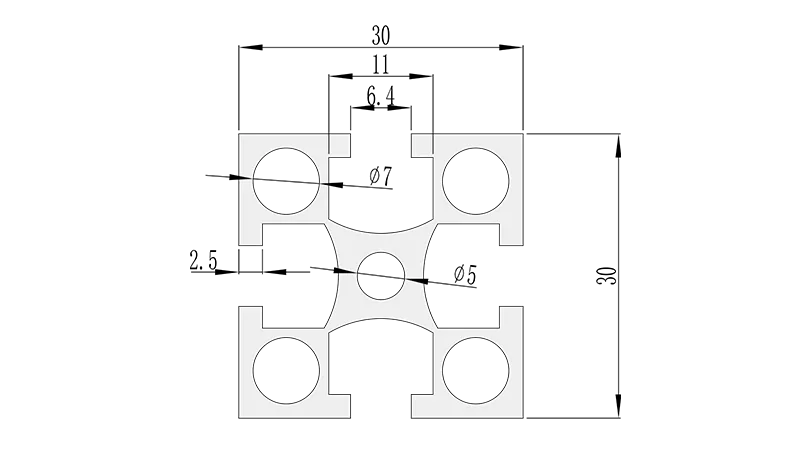
So what makes the 3030 National Standard Profile A different? Let's break it down. At its core, it's an aluminum extrusion profile—a long, hollow tube of aluminum shaped with precision-engineered T-slots (those handy grooves running along its length) and standardized dimensions (30mm by 30mm, hence the name). But calling it "just a tube" is like calling a smartphone "just a screen"—it's the versatility that matters. Unlike traditional steel pipes or wooden beams, this profile is designed to be connected , not just constructed. With the right aluminum profile accessories—corner codes, end caps, gussets, or brackets—you can build almost anything: workbenches, material racks, conveyor supports, even custom trolleys. And when you need to change it? You don't grab a welding torch or a saw. You loosen a few bolts, rearrange the pieces, and tighten them back up. It's like building with giant, industrial-grade Legos—for adults who mean business.
The magic lies in the T-slot design. Imagine you need to add a tool holder to your workbench. With a traditional wooden bench, you'd drill a hole, maybe use a screw, and hope it holds. If you later want to move the holder? You're left with a gaping hole. With 3030 profiles, the T-slots let you slide in a bracket, secure it with a hex key, and reposition it anytime. No holes, no damage, no waste. This flexibility isn't just convenient—it's transformative. A study by the Lean Manufacturing Institute found that factories using modular aluminum extrusion systems like the 3030 profile reduced reconfiguration time by 78% compared to fixed setups. That's hours saved when a new project comes in, or when a team member suggests a better workflow layout.
| Feature | Traditional Fixed Workspace Systems | 3030 National Standard Profile A Systems |
|---|---|---|
| Flexibility | Minimal—requires welding, drilling, or complete replacement to modify. | Maximum—reconfigure by loosening/tightening fasteners; no permanent changes. |
| Long-term Cost | High—frequent replacement of outdated components; disposal fees for old systems. | Low—80% of components reusable; only new accessories needed for upgrades. |
| Sustainability | Low—steel/wood waste from replacements; high carbon footprint of manufacturing new parts. | High—aluminum is 100% recyclable; reusability reduces material consumption by 65%. |
| Worker Adaptation | Slow—new systems require retraining; fixed layouts limit ergonomic customization. | Fast—teams can adjust setups themselves; ergonomic tweaks (height, angle) take minutes. |
Aluminum Profile Accessories: The Unsung Heroes of Reconfiguration
A profile is only as good as the accessories that bring it to life. Walk into a workshop using 3030 National Standard Profile A, and you'll notice the details: 20# aluminum corner codes locking two profiles at a perfect 90-degree angle, small iron corner codes reinforcing a joint for extra stability, end caps smoothing out sharp edges to prevent snags on wires or fabric. These aren't just "parts"—they're the grammar of a language where your workspace speaks in adaptability. Take the 3060 aluminum angle yards, for example: these L-shaped brackets let you connect 30mm profiles to 60mm profiles, opening up a world of mixed-size structures. Need a workbench with a narrow frame but a wide top? Pair 3030 uprights with 3060 crossbeams, secured with angle yards, and you're done. No custom fabrication, no waiting for a metal shop to make parts.
Even the smallest accessories make a difference. Consider the plastic end caps that snap onto the ends of 3030 profiles. They're cheap, simple, and often overlooked—but they turn a potentially sharp aluminum edge into a safe, smooth surface. For workers who lean against benches or reach across racks, that small detail prevents cuts and scrapes. Or take the gusset alp 3030, a triangular bracket that adds rigidity to joints. When a workbench needs to support heavy machinery, these gussets distribute weight evenly, turning a lightweight aluminum frame into a rock-solid platform. It's these thoughtful touches that make the 3030 system feel less like a collection of parts and more like a partner in getting work done.
Case Study: How a Local Electronics Shop Cut Costs by 40% with Reconfigurable Workbenches
Let's meet Precision Circuits, a family-owned electronics assembly shop in Colorado with 15 employees. In 2022, they landed a contract to build circuit boards for medical devices—a big step up, but one that required a workspace overhaul. Their existing workbenches were wooden, with fixed shelves and no cable management. The new medical boards needed antistatic surfaces, extra lighting, and tool holders positioned for right-handed and left-handed workers. Instead of buying 15 new custom workbenches (which would have cost $25,000), they invested in 3030 National Standard Profile A frames, aluminum honeycomb panels for tops, and ESD-safe accessories. Here's what happened:
- Week 1: Built basic workbench frames using 3030 profiles and aluminum profile accessories (corner codes, end caps, leveling feet). Total cost for materials: $8,000.
- Month 2: Added antistatic mats and overhead lighting by sliding brackets into the T-slots. No drilling required.
- Quarter 2: When a new employee with mobility needs joined, they raised their workbench by 6 inches in 20 minutes by swapping out shorter legs for longer 3030 profile sections.
- Year-end: Saved $17,000 compared to buying new benches. Plus, when a second contract came in for smaller boards, they reconfigured 5 workbenches into smaller, dual-station setups using the same profiles—no new materials needed.
"We used to dread change," says Mike, the shop foreman. "Now? My team comes to me with ideas for improving the benches—moving the tool rails, adding shelves for specific parts. It feels like we're all invested in how the space works, not just stuck with it."
Building a Lean System That Grows with Your Goals
Lean manufacturing isn't just a buzzword—it's a philosophy centered on eliminating waste, streamlining processes, and continuous improvement. And the 3030 National Standard Profile A is practically a poster child for lean principles. Think about it: traditional systems create waste in three ways: material waste (scrapping old equipment), time waste (waiting for modifications), and human waste (frustration from inefficient setups). The 3030 system attacks all three.
Take material waste, for starters. Aluminum is infinitely recyclable, and because 3030 profiles are modular, they rarely end up in landfills. A study by the Aluminum Association found that 75% of all aluminum ever produced is still in use today—and modular systems like 3030 only boost that number. When a company outgrows a 3030 workbench, they can disassemble it and use the profiles to build a material rack or a trolley. Even if a profile gets damaged, it can be recycled into new aluminum products with 95% less energy than producing new aluminum from ore. That's sustainability that doesn't require grand gestures—just smart choices.
Time waste is another area where 3030 shines. In lean terms, "lead time" is the time between starting and finishing a process. When your workspace can't keep up, lead times balloon. For example, a warehouse using fixed metal racks might take 2 days to rearrange storage for a new shipment. With 3030 profile material racks, that same rearrangement takes 2 hours—loosen the brackets, adjust the shelf heights, and reload. That's 46 hours saved per month, based on average warehouse rearrangement needs. Multiply that by the hourly cost of your warehouse team, and the savings add up fast.
The Challenge of Change: Overcoming the "But We've Always Done It This Way" Mentality
Of course, no system is perfect, and adopting 3030 National Standard Profile A isn't without hurdles. The biggest barrier? Habit. Many shop owners and managers grew up with fixed systems and think, "If it ain't broke, don't fix it." They worry about the initial cost—aluminum extrusion profiles are pricier than basic steel pipes upfront. But as Precision Circuits showed, the long-term savings crush the initial investment. Another concern is skill: "Do we need special training to build with these profiles?" The answer is no—most teams figure it out in a day, thanks to intuitive accessories and simple tools (just a hex key set). Suppliers often provide free design guides, and there are countless online tutorials for common setups like workbenches or material racks.
Then there's the fear of instability. "Aluminum is lighter than steel—will it hold up?" Rest assured, 3030 profiles are engineered for strength. The hollow design reduces weight without sacrificing rigidity, and when paired with aluminum profile accessories like gussets and heavy-duty brackets, they can support hundreds of pounds. In fact, many automotive manufacturers use 3030-based systems to hold engines during assembly—if it can handle a 500-pound engine, it can handle your toolbox or inventory.
Future-Proofing Your Workspace: Why 3030 Profiles Are More Than a Trend
The world of work is changing faster than ever. Automation, remote collaboration, and rapid product cycles mean workspaces can't stay static. The 3030 National Standard Profile A isn't just a tool for today—it's a bridge to tomorrow. Imagine a future where your workbench connects to IoT sensors that track tool usage, or where your material rack adjusts heights automatically based on inventory levels. These innovations aren't possible with fixed systems, but with 3030 profiles, they're within reach. The T-slots can accommodate sensor mounts, cable management channels, and even small actuators for automation. It's a platform that grows with technology, not against it.
Sustainability, too, will only become more critical. Customers are demanding eco-friendly practices, and employees want to work for companies that prioritize the planet. Using 3030 profiles sends a clear message: you care about reducing waste, reusing resources, and building a workspace that doesn't cost the Earth. It's not just good for the bottom line—it's good for your brand, your team, and the world we all share.
Final Thoughts: Your Workspace Should Adapt to You, Not the Other Way Around
At the end of the day, a workspace is more than walls, floors, and equipment. It's where ideas turn into products, where teams collaborate, and where businesses grow. For too long, we've treated workspaces as afterthoughts—static backdrops to the real action. But the 3030 National Standard Profile A reminds us that the space itself can be part of the action. It can adapt, evolve, and support us as we chase new goals.
Whether you're running a small workshop or a large factory, the question isn't, "Can we afford to switch to modular systems?" It's, "Can we afford not to?" The businesses that thrive in the next decade will be the ones that embrace flexibility—the ones that see their workspace as a living, breathing part of their success. And with 3030 profiles, aluminum profile accessories, and a little creativity, that flexibility is within reach. After all, your business doesn't stand still. Why should your workspace?