- Company Articles
- Industry articles
- Industry standards
- Sustainable Manufacturing: Recyclable Aluminum in 3030 National Standard Profile A

Sustainable Manufacturing: Recyclable Aluminum in 3030 National Standard Profile A
Related Product
3030 National Standard Profile A
Workbench, production line, logistic rack, warehouse rack Industry: Manufacturer workshop, Automobile, Electronic, Assembling, logistic
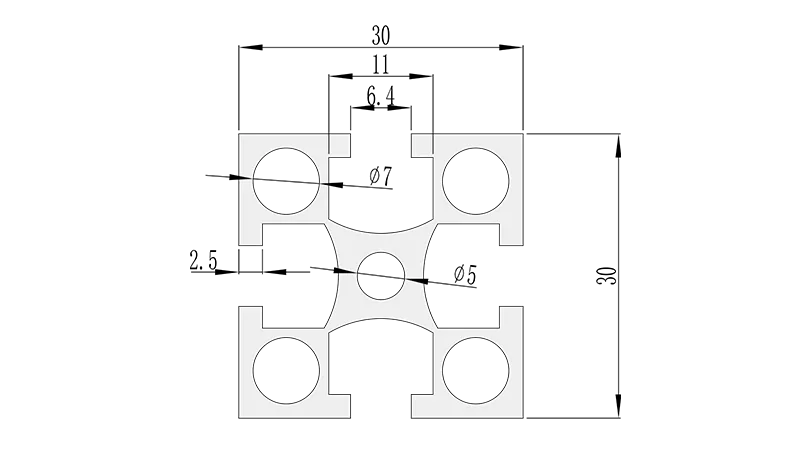
Walk into any modern factory today, and you'll likely hear the same buzzwords: "sustainability," "waste reduction," "circular economy." These aren't just corporate catchphrases—they're urgent priorities. As manufacturers face mounting pressure to cut carbon footprints and minimize waste, the materials they rely on have become a critical piece of the puzzle. Enter aluminum extrusion profiles, and more specifically, the 3030 National Standard Profile A. This unassuming yet versatile component is quietly transforming production floors, proving that efficiency and environmental responsibility don't have to be at odds.
Why Aluminum? The Sustainable Backbone of Modern Manufacturing
Aluminum has long been celebrated for its strength-to-weight ratio, but its true superpower lies in recyclability. Unlike plastic, which degrades with each reuse, or even steel, which loses structural integrity after multiple recycles, aluminum can be melted down and reshaped repeatedly without compromising quality. In fact, recycling aluminum uses just 5% of the energy required to produce it from raw ore—a statistic that makes sustainability managers' ears perk up. For manufacturers aiming to close the loop on waste, this alone makes aluminum a standout choice.
But not all aluminum profiles are created equal. The 3030 National Standard Profile A, a staple in the aluminum extrusion profile family, takes this sustainability a step further. Designed with standardized dimensions (30mm x 30mm) and a T-slot structure, it's built for adaptability—meaning it can evolve with your production needs instead of ending up in a landfill when workflows change.
3030 National Standard Profile A: More Than Just a "Profile"
What makes the 3030 profile a game-changer? Let's start with its design. The T-slot grooves running along its length aren't just for show—they're the secret to its flexibility. Using simple aluminum profile accessories like bolts, brackets, and end caps, workers can assemble everything from workbenches to material racks in hours, not days. No welding, no specialized tools—just a few hand tools and a vision. This modularity cuts down on assembly waste (no excess metal shavings or unused parts) and makes reconfiguration a breeze.
Take, for example, a lean system on the factory floor. Lean manufacturing thrives on eliminating waste, and the 3030 profile fits right in. A production line that once relied on fixed steel workbenches (heavy, hard to modify, and prone to rust) can now switch to 3030-based workstations. Need to add a shelf for new tools? Slide an aluminum bracket into the T-slot. Want to adjust the height for ergonomic needs? Swap out the legs with longer ones. When the product line retires, instead of scrapping the entire bench, you can disassemble the profile and repurpose it into a parts cart or a material rack. It's sustainability in action—extending the lifecycle of every component.
Comparing Materials: Why 3030 Aluminum Stands Out
Still on the fence? Let's put the 3030 National Standard Profile A head-to-head with traditional manufacturing materials. The table below breaks down how it stacks up against steel tubing and plastic extrusions in key sustainability and performance metrics:
| Material | Recyclability Rate | Weight (per meter) | Assembly Time (Basic Structure) | Reconfigurability | Environmental Impact (Production) |
|---|---|---|---|---|---|
| 3030 Aluminum Extrusion Profile | 95%+ (infinite recycling) | 0.8-1.2 kg | 2-3 hours | High (no permanent modifications) | Low (5% energy vs. primary production) |
| Steel Tubing | 60-70% (loses strength after 2-3 recycles) | 2.5-3.0 kg | 4-6 hours (requires welding) | Low (welded joints are permanent) | High (high energy use in production) |
| Plastic Extrusion | 5-10% (downcycled to lower-quality products) | 0.5-0.7 kg | 1-2 hours | Medium (prone to cracking with reuse) | Very High (non-biodegradable, toxic additives) |
The numbers speak for themselves. Aluminum's recyclability, lightweight design, and reconfigurability make it the clear winner for sustainable operations. And when paired with aluminum profile fixings—like corrosion-resistant screws and reusable brackets—its lifespan stretches even further.
Real-World Impact: From Waste to "Wow"
Let's ground this in a real story. A mid-sized automotive parts manufacturer in Ohio recently made the switch to 3030 profiles for their assembly workstations. Previously, they used wooden workbenches that warped in the factory's humidity, requiring replacement every 2-3 years. Steel racks held components, but reconfiguring them meant cutting and rewelding—generating metal waste and downtime.
After installing 3030-based workbenches and material racks, the results were striking: assembly time for new workstations dropped by 40%, and they eliminated 80% of wood and steel waste from replacements. When they redesigned a production line six months later, they reused 90% of the original aluminum profiles by swapping out accessories. Best of all, when they recycled their old steel racks, the scrapyard paid them for the aluminum—turning waste into revenue. "It's not just about being green," said their operations manager. "It's about being smart with our resources."
The Future of Manufacturing: Sustainable by Design
The 3030 National Standard Profile A isn't just a material—it's a mindset. It represents a shift from "use and discard" to "design for reuse." As suppliers continue to innovate, we're seeing even greener iterations: profiles made with recycled aluminum (up to 70% post-consumer content), and extrusion processes powered by solar and wind energy. Aluminum profile accessories are also getting an eco-makeover, with biodegradable plastics and recycled steel components becoming standard.
For manufacturers ready to embrace sustainability, the message is clear: you don't have to choose between efficiency and the environment. With tools like the 3030 National Standard Profile A, you can build production lines that adapt, evolve, and recycle—proving that the future of manufacturing is not just productive, but planet-friendly too.