- Company Articles
- Industry articles
- Industry standards
- Swivel Stem Caster Wheel with Brake: Load Testing Standards & Certifications

Swivel Stem Caster Wheel with Brake: Load Testing Standards & Certifications
Related Product
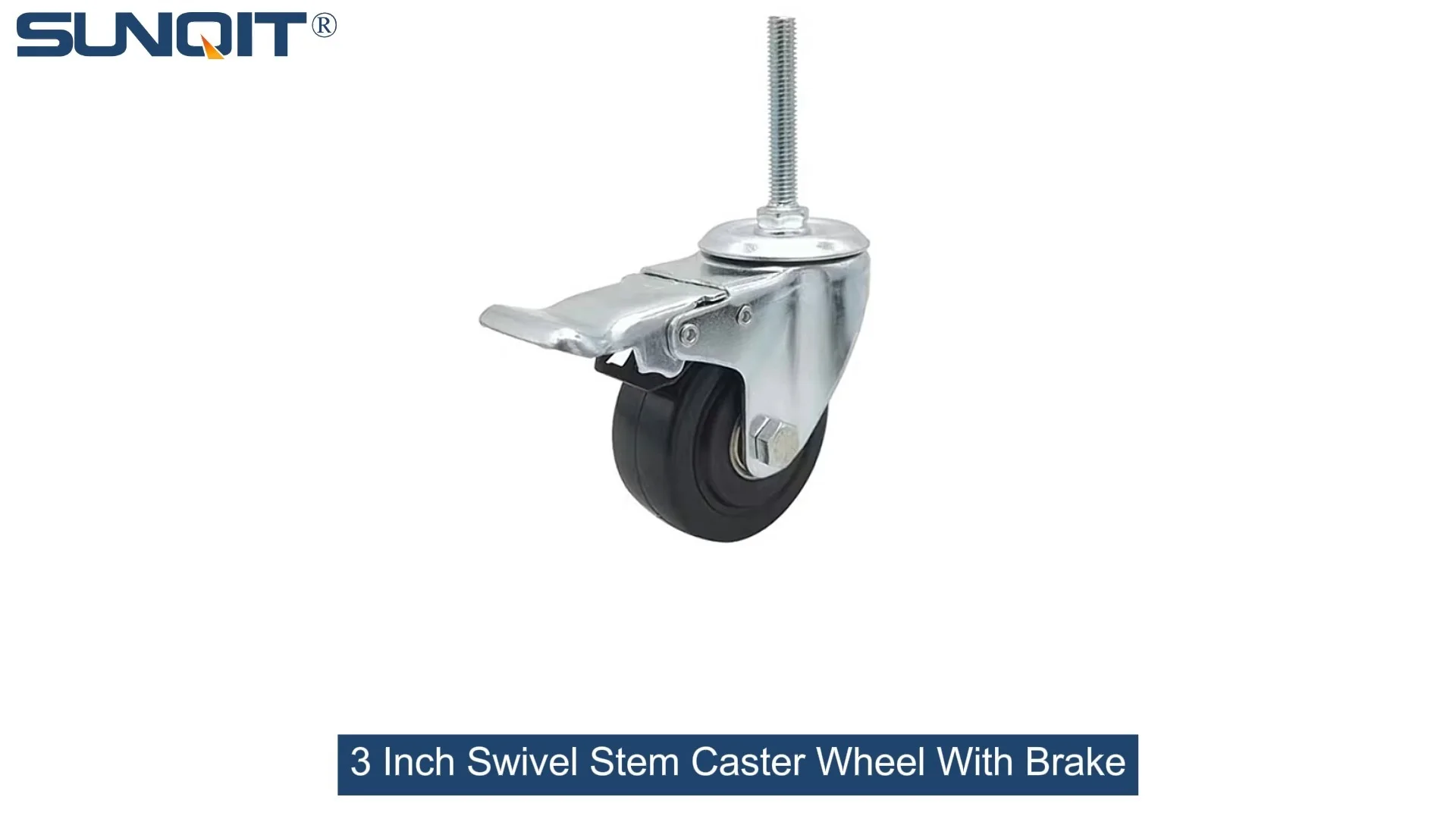
Swivel Stem Caster Wheel with Brake
360 Degree Swivel Stem Caster with brake. Threaded-post mount design, castors diameter 3 inch.Each swivel caster wheels loading 70KGS. Heavy enough and widely suit for carts, chairs, cabinet, flow rack, workbench, turnover rolley.
Let's start with a scenario we've all encountered, even if we don't realize it: You're in a busy warehouse, and a colleague needs to reposition a heavy workbench stacked with tools. They grab the handle, give it a gentle push, and the whole thing glides smoothly—until they hit a bump. Suddenly, the workbench lurches, tools shift, and they have to scramble to steady it. What made the difference between a smooth move and a near-accident? Chances are, it was the quality of the caster wheels underneath—specifically, whether those swivel stem caster wheels with brakes were built to handle the load.
In manufacturing, logistics, and even offices, swivel stem caster wheels with brakes are the unsung heroes of mobility. They let us move heavy equipment with ease, lock it securely in place when needed, and keep workflows running without a hitch. But here's the thing: not all caster wheels are created equal. The difference between a reliable caster and one that fails mid-shift often comes down to something invisible but critical: load testing. Today, we're diving into why load testing matters, the standards that govern it, the certifications that prove compliance, and how it all impacts the tools and systems we rely on daily—from the workbench in your garage to the lean system on a factory floor.
What Are Swivel Stem Caster Wheels with Brakes, Anyway?
Before we get into testing, let's make sure we're on the same page about the star of the show: the swivel stem caster wheel with brake. At its core, it's a wheel mounted on a frame (called a yoke), connected to a stem that attaches to equipment—think workbenches, carts, or machinery. The "swivel" part means the wheel can rotate 360 degrees, making it easy to maneuver tight corners. The "stem" is the metal rod that screws or bolts into the equipment, holding everything together. And the "brake"? That's the lever, pedal, or foot plate that locks the wheel in place, preventing unwanted movement when the equipment needs to stay put.
These casters aren't just about convenience—they're about safety and efficiency. A well-designed caster wheel distributes weight evenly, reduces strain on workers, and ensures equipment stays stable whether it's moving or stationary. But to do that reliably, it needs to handle the weight it's rated for—no exceptions. That's where load testing comes in.
Why Load Testing Isn't Optional: Safety, Durability, and Trust
Imagine buying a ladder rated for 200 pounds, only to have it collapse when you step on it with 180 pounds of tools. You'd be furious—and rightfully so. The same logic applies to caster wheels. Load testing is how manufacturers prove their casters can handle the weight they claim, day in and day out, without bending, breaking, or failing.
Here's why that matters:
Safety first:
A caster that can't handle its load might bend, causing the equipment to tip. In a factory, that could mean damaged products, broken machinery, or worse—injuries to workers. Even a small caster failure on a medical cart or a warehouse trolley can have big consequences.
Durability and cost:
Cheap, untested casters wear out faster. They might start squeaking, locking up, or failing after a few months, forcing you to replace them. Over time, that's more expensive than investing in a certified, load-tested caster upfront.
Compliance and trust:
In regulated industries—like healthcare, aerospace, or automotive—equipment often needs to meet strict safety standards. Load testing certifications are proof that a caster meets those standards, giving buyers confidence that they're not cutting corners.
So, what exactly happens during a load test? Let's break down the key types of tests manufacturers run.

The Ins and Outs of Load Testing: What Gets Measured?
Load testing for swivel stem caster wheels with brakes isn't a one-and-done process. It involves multiple tests to simulate real-world conditions. Here are the most critical ones:
Static Load Test:
This test checks how much weight a caster can support when it's
not moving
. The caster is mounted to a test rig, and a steady weight is applied—often 1.5 to 2 times the rated load—for a set period (usually 24 to 72 hours). Engineers then check for deformation: Did the stem bend? Did the wheel crack? If the caster holds without permanent damage, it passes.
Dynamic Load Test:
Now, let's add movement. In dynamic testing, the caster is attached to a platform that rolls back and forth on a track while carrying a load (typically the rated weight). The test runs for thousands of cycles to simulate months of use. Engineers monitor for wear: Do the wheels start to flat-spot? Does the swivel mechanism get stuck? Does the brake still lock securely after repeated use?
Impact Load Test:
Life isn't always smooth. Pallets get dropped, carts hit curbs, and equipment bumps into walls. Impact testing mimics these sudden jolts by dropping a weight onto the caster or slamming it into a barrier at low speed. The goal? Ensure the caster doesn't shatter, the brake doesn't fail, and the stem stays firmly attached to the equipment.
Brake Performance Test:
The brake is just as important as the wheel. This test checks if the brake can hold the rated load on different surfaces—smooth concrete, rough asphalt, even wet floors. Engineers apply the brake, then try to push or pull the equipment. If it moves more than a few inches, the brake isn't up to snuff.
These tests might sound technical, but they're designed to answer a simple question: Can this caster wheel do its job safely, no matter what the day throws at it? To ensure consistency, these tests are governed by strict standards.

Global Standards: Who Sets the Rules for Load Testing?
Load testing isn't arbitrary. Around the world, organizations like ISO, ANSI, and TUV have developed standards to ensure caster wheels are tested the same way, no matter where they're made. Let's take a closer look at the most common standards you'll encounter:
Each standard has its nuances. For example, ISO 10528 is widely adopted globally and focuses on general industrial use, while ANSI/ASME ICWM-2018 is more common in North America and includes stricter impact testing for rough environments. TUV standards, on the other hand, often add environmental tests—like exposing casters to dust or moisture—to ensure they hold up in harsh conditions.
But here's the good news: Most reputable manufacturers design their casters to meet multiple standards. That way, a swivel stem caster wheel with brake certified to ISO 10528 and ANSI/ASME can be used in both European and North American facilities without issues.
| Standard | Governing Body | Key Test Focus | Typical Load Range | Common Applications |
|---|---|---|---|---|
| ISO 10528 | International Organization for Standardization (ISO) | Static load, dynamic load, swivel resistance, brake efficiency | Up to 5,000 kg per caster | Industrial machinery, heavy-duty trolleys |
| ANSI/ASME ICWM-2018 | American National Standards Institute (ANSI) | Impact load, brake holding force, durability (cycle testing) | Up to 2,700 kg per caster | Warehouse equipment, material handling carts |
| TUV Rheinland | TUV Rheinland (European certification body) | Environmental resistance (dust, moisture), fatigue testing | Varies by product; often aligned with ISO | Medical equipment, food processing machinery |
| CSA B354.6 | Canadian Standards Association (CSA) | Static load, dynamic load, brake safety for institutional use | Up to 1,500 kg per caster | Hospital beds, school furniture |

Certifications: What Do Those Labels Actually Mean?
You've seen the labels: "ISO Certified," "CE Marked," "ANSI Compliant." But what do they really tell you? Let's decode the most common certifications for swivel stem caster wheels with brakes:
ISO 9001:
This isn't a load test certification, but it's worth mentioning. ISO 9001 is a quality management standard that ensures the manufacturer has processes in place to consistently produce reliable products. If a caster supplier is ISO 9001 certified, it means their testing and production are documented, repeatable, and focused on quality.
CE Marking:
Required for products sold in the European union, the CE mark indicates that the caster meets EU safety, health, and environmental requirements. For casters, that often includes compliance with ISO 10528 or other EU-specific load standards.
UL Listing:
Underwriters Laboratories (UL) is a U.S.-based safety organization. A UL listing for casters means they've been tested for fire safety, electrical insulation (important for ESD workbenches or medical equipment), and load capacity.
TUV Certification:
As mentioned earlier, TUV Rheinland and other TUV bodies test products for safety and performance. A TUV mark on a caster wheel is a strong indicator that it's been rigorously tested for durability and load handling, especially in specialized industries like healthcare or automotive.
So, when you're shopping for swivel stem caster wheels with brakes, don't just look at the "rated load" number. Check for certifications from these organizations. They're your guarantee that the caster wasn't just tested once in a lab—it was tested to meet global standards for safety and reliability.
Real-World Impact: How Load-Tested Casters Power Lean Systems and Workbenches
Let's bring this back to the real world. Where do these load-tested, certified casters actually get used? Two big examples are workbenches and lean systems—cornerstones of efficient manufacturing and logistics.
Take a typical workbench in an electronics factory. It might hold sensitive components, tools, and even small assembly machines. If the swivel stem caster wheels with brakes underneath aren't load-tested, the bench could wobble, causing components to fall or tools to slip. Over time, that leads to wasted materials, slower assembly times, and frustrated workers. A certified caster, though, keeps the bench stable when locked and easy to move when needed—supporting the "lean" principle of minimizing waste and maximizing efficiency.
Lean systems, which focus on streamlining workflows, rely heavily on mobility. Trolleys, racks, and even entire production lines need to be reconfigured quickly to adapt to new orders. If the caster wheels on those trolleys fail under load, the whole system grinds to a halt. Imagine a warehouse using turnover trolleys to move inventory: if a caster bends under the weight of boxes, the trolley gets stuck, delaying shipments and disrupting schedules. Load-tested casters prevent that, keeping the lean system running smoothly.
Even in smaller settings—like a home workshop or a retail stockroom—quality casters make a difference. A workbench with cheap caster wheels might start to sink or tilt after a few months of use, making it hard to work on. But one with certified, load-tested swivel stem casters? It stays level, moves easily, and lasts for years—proving that even the smallest components can have a big impact on productivity.
Choosing the Right Caster: What to Look For
So, you're in the market for swivel stem caster wheels with brakes. How do you pick the right one? Here's a quick checklist:
1. Know your load:
Calculate the total weight of the equipment plus its typical load. Divide that by the number of casters (usually 4) to get the minimum load rating per caster. Always round up—if you need 250 lbs per caster, buy one rated for 300 lbs to be safe.
2. Check the environment:
Will the caster be used indoors (smooth concrete) or outdoors (rough asphalt)? Wet floors? Chemical exposure? Look for casters with materials (like stainless steel or polyurethane wheels) that can handle those conditions.
3. Look for certifications:
As we discussed, ISO, CE, or UL marks are a good sign. Ask the supplier for test reports if you're unsure.
4. Don't forget caster accessories:
The brake mechanism, stem type, and even the wheel material matter. A brake that's hard to engage or a stem that doesn't fit your equipment will frustrate users, no matter how well the caster is load-tested.
5. Buy from a reputable supplier:
A reliable caster supplier will be transparent about their testing processes and certifications. They'll also help you choose the right caster for your needs, not just sell you the most expensive option.
Final Thoughts: The Small Part That Makes a Big Difference
Swivel stem caster wheels with brakes might seem like small, parts—but they're the foundation of safe, efficient mobility in countless industries. Load testing and certifications aren't just boxes to check; they're proof that a manufacturer cares about safety, durability, and their customers' success.
The next time you push a trolley, reposition a workbench, or even roll a chair across the floor, take a second to look at the casters. Chances are, the smooth, stable movement you take for granted is thanks to rigorous load testing and global standards. And when you're in the market for new casters? Remember: investing in a certified, load-tested option isn't just about avoiding failures—it's about building a workflow that's safer, more efficient, and ready to handle whatever comes next.
After all, in a world where every second and every dollar counts, the right caster wheel can be the difference between a day that flows and a day that falls apart.