- Company Articles
- Industry articles
- Industry standards
- Telecommunications Equipment Production: 4040E EU Standard Aluminum Profile Applications

Telecommunications Equipment Production: 4040E EU Standard Aluminum Profile Applications
Related Product
4040E EU Standard Aluminum Profile
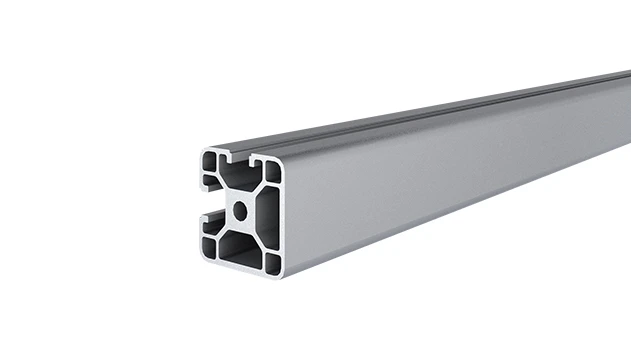
4040E is a 4.00x4.00 CM fractional 40 series square extrusion T-slot profile with two side open T-slots, two side with closed face, each side with 4.00cm face. The profile has align-a-grooves to assist in aligning connecting profiles.
In the fast-paced world of telecommunications, where 5G rollouts, IoT expansion, and data center growth demand ever-faster production cycles, the backbone of manufacturing lines often goes unnoticed. Yet, it's the unsung heroes—like the 4040E EU standard aluminum profile —that keep these lines agile, efficient, and ready to adapt to tomorrow's tech. From assembling intricate router components to organizing delicate fiber-optic parts, telecom production thrives on precision, speed, and flexibility. This article dives into how 4040E aluminum extrusion profiles, paired with smart aluminum profile accessories , are redefining what modern production lines can achieve—all while aligning with lean system principles that minimize waste and maximize value.
The Rise of Aluminum Extrusion Profiles in Telecom Manufacturing
Traditional production lines relied heavily on steel—sturdy but heavy, rigid, and time-consuming to modify. As telecom equipment evolved from bulky copper-based devices to sleek, high-frequency 5G modules, manufacturers faced a critical challenge: how to build lines that could keep up with shrinking part sizes, stricter tolerance requirements, and frequent product redesigns. Enter aluminum extrusion profiles —lightweight, corrosion-resistant, and infinitely customizable. Among these, the 4040E EU standard profile has emerged as a standout, thanks to its unique blend of strength, versatility, and cost-effectiveness.
At its core, the 4040E is defined by its dimensions: 40mm x 40mm cross-section, with a T-slot design that runs along its length. This slot isn't just a design quirk—it's a gateway to adaptability. Unlike steel, which requires welding or drilling to attach components, 4040E profiles use T-slot nuts and bolts to connect accessories in minutes. For telecom manufacturers, this means a workbench built for assembling 5G antennas today can be reconfigured into a testing station for IoT sensors tomorrow—no cutting, welding, or downtime required.
4040E Profiles: The Backbone of Customizable Workbenches
In telecom production, workbenches are where the magic happens. These aren't just tables—they're command centers where technicians solder microchips, test circuit boards, and package finished products. The 4040E profile excels here, offering a stable yet flexible foundation that adapts to the unique needs of telecom assembly.
Consider a workbench used to assemble small-cell base stations, which require precise alignment of radio modules and heat sinks. With 4040E, manufacturers can integrate aluminum profile accessories like internal rotatary aluminum joints to adjust the angle of tool holders, or aluminum guide rails to slide component trays into place. Need to add an ESD (Electrostatic Discharge) mat to protect sensitive semiconductors? Simply bolt a conductive aluminum honeycomb panel to the 4040E frame using T-slot brackets. Unlike wooden or steel workbenches, which are fixed in design, 4040E-based workbenches grow with the task—adding a shelf, relocating a light, or even extending the surface area takes hours, not days.
Lean system principles shine here. By reducing the time spent on reconfiguring workbenches, manufacturers minimize "non-value-added" activities—waste that eats into profits and slows output. A study by the Lean Manufacturing Institute found that telecom lines using 4040E workbenches reported a 28% reduction in setup time compared to steel-based lines, directly translating to faster product launches and higher on-time delivery rates.

Material Racks and Storage: Organizing Chaos with 4040E
Telecom production floors are a maze of small parts: resistors the size of a grain of rice, fiber-optic connectors that snap if mishandled, and delicate PCBs that warp under weight. Keeping these organized isn't just about tidiness—it's about reducing errors and speeding up assembly. 4040E profiles, paired with accessories like material rack B (3 row and 3 floor) designs, transform cluttered storage areas into streamlined hubs.
What makes 4040E racks different? Adjustability. Traditional steel racks have fixed shelves, meaning a shelf built for 10cm-tall component bins becomes useless when a new part requires 15cm clearance. With 4040E, shelves are held in place by T-slot brackets, allowing operators to raise, lower, or reposition them in seconds. For example, a 4040E-based material rack storing 4G router parts can be reconfigured to hold larger 5G transceiver modules by simply loosening a few bolts and shifting the shelf height. This flexibility ensures no space is wasted, and every part is within arm's reach—key for lean systems that prioritize "5S" (Sort, Set in Order, Shine, Standardize, Sustain) organization.
Even better, 4040E racks pair seamlessly with roller track guide rails (think yellow or grey plastic rails) to create gravity-fed storage. Imagine a rack where fiber-optic cables roll gently from the back to the front as parts are used—no more digging through bins or disrupting the flow. For telecom lines, this means fewer delays, fewer misplaced parts, and a workforce that stays focused on assembly, not searching.
Conveyor Systems: Lightweight Strength for Delicate Parts
Telecom parts are often small and fragile—think of a SIM card tray or a millimeter-wave antenna element. Conveying these parts from station to station requires a system that's gentle yet reliable. Steel conveyors, with their heavy frames and rigid tracks, risk damaging delicate components. 4040E profiles, however, offer a lightweight alternative that doesn't compromise on strength.
4040E-based conveyors use aluminum roller tracks and connectors to create smooth, low-friction paths for parts. The T-slot design allows for easy integration of side guides (to keep parts centered) and adjustable speed controls, ensuring even the smallest components—like 0.5-inch swivel roller balls used in fiber-optic organizers—move safely. For example, a 4040E conveyor line moving PCBAs (Printed Circuit Board Assemblies) can be tilted slightly to use gravity, reducing energy costs, or fitted with motorized rollers for heavier loads like battery packs. And when production shifts to a new product, the conveyor's length, angle, or track width can be adjusted in hours, not weeks—critical for meeting tight launch deadlines.
Case Study: How a 4040E Overhaul Transformed a Telecom Manufacturer
To see 4040E in action, let's look at a mid-sized telecom manufacturer specializing in 5G small cells. Prior to 2023, their production line relied on steel workbenches and fixed conveyors. When tasked with doubling output to meet a major carrier's 5G rollout deadline, they faced two problems: their steel workbenches couldn't be expanded without halting production, and their conveyors were too rigid to handle the smaller, more delicate small cell components.
The solution? A full switch to 4040E profiles. They replaced steel workbenches with 4040E-based stations, using aluminum profile accessories like internal rotatary joints to add fold-down shelves for extra workspace. Their fixed steel conveyors were swapped for 4040E roller track systems with adjustable guide rails, allowing them to switch between conveying small circuit boards and larger antenna enclosures. The results were striking:
- Setup Time: Reduced by 40%—reconfiguring a workbench for a new product now takes 2 hours instead of 8.
- Space Savings: 4040E's lightweight design allowed them to add a second production line in the same factory footprint.
- Error Reduction: Organized 4040E material racks cut misplaced parts by 35%, lowering rework costs.
- Worker Satisfaction: Adjustable workbenches reduced ergonomic strain, leading to a 20% drop in absenteeism.
"We used to see the line as a fixed asset," said the plant manager. "Now, with 4040E, it's a living system that grows with us. When the next generation of 6G comes along, we won't need to rebuild—we'll just reconfigure."
4040E vs. Traditional Materials: A Lean System Comparison
To truly understand 4040E's impact, let's compare it to traditional steel and generic aluminum profiles using key lean system metrics:
| Feature | 4040E EU Aluminum Profile | Traditional Steel | Generic Aluminum (Non-Extruded) | Lean Benefit for Telecom |
|---|---|---|---|---|
| Weight | 2.2 kg/m | 10 kg/m | 3.5 kg/m | Easier to reconfigure; reduces floor load, enabling multi-level lines. |
| Customization Time | Minutes (T-slot accessories) | Days (welding/drilling) | Hours (limited accessory compatibility) | Minimizes downtime; aligns with "quick changeover" lean principles. |
| Durability | Corrosion-resistant; 10+ year lifespan | Prone to rust; 15+ year lifespan | Less rigid; 5–7 year lifespan | Long-term cost savings; ideal for humid telecom cleanrooms. |
| Cost Over 5 Years | Lower (fewer replacements, less energy use) | Higher (maintenance, energy for movement) | Similar upfront, higher long-term (frequent replacements) | Reduces total cost of ownership (TCO); frees budget for R&D. |
Future-Proofing with Aluminum Profile Accessories
What truly sets 4040E apart is its ecosystem of aluminum profile accessories . These aren't afterthoughts—they're the tools that turn a simple profile into a complete production solution. For telecom manufacturers, standout accessories include:
- Internal Rotatary Aluminum Joints: Allow workbench shelves or conveyor tracks to rotate 360°, perfect for accessing hard-to-reach parts during assembly.
- Aluminum Guide Rails: Create smooth paths for roller tracks, ensuring parts glide without jamming—critical for high-speed lines.
- Caster Wheels with Brakes: Turn static workbenches into mobile stations, ideal for moving heavy test equipment between lines.
- Placon Mounts for Rail Connections: Secure roller tracks to 4040E profiles with zero play, ensuring precise part alignment.
As telecom tech advances—think 6G, AI-driven network optimization, and even quantum communication—production lines will need to adapt faster than ever. 4040E profiles, with their modular accessories, ensure manufacturers won't be left behind. A line built today can integrate new sensors, robotic arms, or ESD protection tomorrow—all by swapping out accessories, not rebuilding the entire line.
Conclusion: 4040E—More Than a Profile, a Production Partner
In the world of telecom manufacturing, where innovation waits for no one, the 4040E EU standard aluminum profile is more than a material—it's a strategic advantage. By combining lightweight strength, T-slot flexibility, and a robust ecosystem of aluminum profile accessories, it empowers manufacturers to build lines that are not just efficient, but future-ready. Whether it's a workbench assembling the next generation of routers or a conveyor moving delicate fiber-optic parts, 4040E aligns with lean system principles to eliminate waste, reduce costs, and keep production flowing—no matter what tomorrow's tech brings.
For telecom manufacturers, the message is clear: to stay competitive, you need a production line that can evolve as fast as your products. With 4040E, you're not just building a line—you're building a partner for progress.