- Company Articles
- Industry articles
- Industry standards
- Temperature Resistance of 3060 National Standard Profile A in Industrial Settings

Temperature Resistance of 3060 National Standard Profile A in Industrial Settings
Related Product
3060 National Standard Profile A
Workbench, production line, logistic rack, warehouse rack Industry: Manufacturer workshop, Automobile, Electronic, Assembling, logistic
Walk into any industrial facility—whether it's a automotive plant humming with welding torches, a food processing warehouse with blast freezers, or an electronics factory with precision assembly lines—and you'll notice an unsung hero: the structures holding everything together. From workbenches to material racks, conveyor supports to safety barriers, these components face a silent but relentless challenge: temperature extremes. A poorly chosen material might warp under high heat, crack in the cold, or degrade over time, bringing production to a grinding halt. That's where 3060 National Standard Profile A comes in. More than just an aluminum extrusion profile, it's a workhorse built to thrive where other materials falter, making it a cornerstone of reliable industrial infrastructure.
What is 3060 National Standard Profile A? A Quick Primer
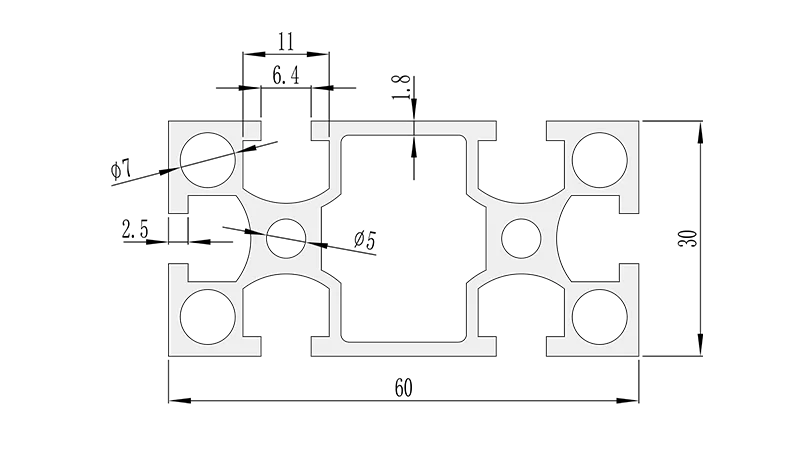
Before diving into its temperature resilience, let's clarify what 3060 National Standard Profile A actually is. Part of the broader family of aluminum profile products, this specific extrusion is defined by its dimensions: 30mm in width and 60mm in height, following China's national standards for industrial aluminum profiles. Unlike generic aluminum pipes or basic steel bars, it's engineered with a hollow, rectangular cross-section reinforced by internal ribs—a design that balances strength, weight, and thermal stability.
What sets it apart from other aluminum extrusion profiles? For starters, it's made from 6063-T5 aluminum alloy, a material prized in industrial settings for its excellent combination of mechanical strength and corrosion resistance. But where it truly stands out is in its ability to handle temperature swings that would leave weaker materials compromised. This isn't just about "withstanding heat" or "resisting cold"—it's about maintaining structural integrity, dimensional stability, and performance, day in and day out, in environments that test the limits of industrial equipment.
The Science Behind the Heat: Why It Doesn't Warp When Others Do
To understand 3060 National Standard Profile A's temperature resistance, we need to look at three key factors: material composition, extrusion engineering, and thermal properties. Let's break them down.
Material Composition: Alloys That Fight the Heat
At its core, 6063-T5 aluminum alloy is a blend of aluminum, magnesium, and silicon—elements chosen specifically for their thermal resilience. Magnesium boosts strength without adding weight, while silicon enhances formability during extrusion. The "T5" designation refers to the heat treatment process: the profile is solution-heat-treated, quenched, and then artificially aged to lock in hardness and stability. This treatment creates a microstructure that resists softening at high temperatures, a critical trait for industrial environments where ambient heat can climb above 100°C. Extrusion Design: Shape Matters for Thermal Stability
The hollow, ribbed design of 3060 National Standard Profile A isn't just for looks. Those internal ribs act as heat sinks, distributing temperature evenly across the profile's surface and preventing hotspots that could cause warping. Unlike solid steel bars, which conduct heat unevenly and retain it longer, the hollow structure allows for airflow (when used in open systems), further aiding in temperature regulation. This design also minimizes thermal expansion—a common issue in rigid materials. When heated, aluminum expands, but the profile's geometry allows for controlled expansion without distorting the overall structure. Thermal Conductivity: Cooling When It's Hot, Insulating When It's Cold
Aluminum is known for its high thermal conductivity, which sounds like a drawback in hot environments. But here's the twist: 3060 National Standard Profile A uses this trait to its advantage. In high-heat settings—like near industrial ovens or welding stations—the profile quickly dissipates heat across its surface, preventing localized overheating. In cold environments, when paired with aluminum profile accessories like insulated panels or thermal wraps, its conductivity can be mitigated, keeping internal temperatures stable. This balance makes it versatile across temperature extremes.
At its core, 6063-T5 aluminum alloy is a blend of aluminum, magnesium, and silicon—elements chosen specifically for their thermal resilience. Magnesium boosts strength without adding weight, while silicon enhances formability during extrusion. The "T5" designation refers to the heat treatment process: the profile is solution-heat-treated, quenched, and then artificially aged to lock in hardness and stability. This treatment creates a microstructure that resists softening at high temperatures, a critical trait for industrial environments where ambient heat can climb above 100°C. Extrusion Design: Shape Matters for Thermal Stability
The hollow, ribbed design of 3060 National Standard Profile A isn't just for looks. Those internal ribs act as heat sinks, distributing temperature evenly across the profile's surface and preventing hotspots that could cause warping. Unlike solid steel bars, which conduct heat unevenly and retain it longer, the hollow structure allows for airflow (when used in open systems), further aiding in temperature regulation. This design also minimizes thermal expansion—a common issue in rigid materials. When heated, aluminum expands, but the profile's geometry allows for controlled expansion without distorting the overall structure. Thermal Conductivity: Cooling When It's Hot, Insulating When It's Cold
Aluminum is known for its high thermal conductivity, which sounds like a drawback in hot environments. But here's the twist: 3060 National Standard Profile A uses this trait to its advantage. In high-heat settings—like near industrial ovens or welding stations—the profile quickly dissipates heat across its surface, preventing localized overheating. In cold environments, when paired with aluminum profile accessories like insulated panels or thermal wraps, its conductivity can be mitigated, keeping internal temperatures stable. This balance makes it versatile across temperature extremes.
High-Temperature Havens: Where 3060 Profile A Shines
Let's ground this in real-world scenarios. Industrial settings rarely stay at room temperature, and 3060 National Standard Profile A has proven its mettle in some of the hottest.
Automotive Manufacturing: Paint Shops and Curing Ovens
In automotive plants, paint curing ovens are a critical step—vehicles enter these chambers at temperatures up to 180°C for 20–30 minutes to set the paint. The conveyor systems and racks holding these vehicles must maintain precise alignment; even a 1mm warp could throw off the entire process. 3060 Profile A is a staple here. Its 6063-T5 alloy retains over 80% of its yield strength at 150°C, meaning the racks and supports don't bend or sag, even after years of daily exposure. Food Processing: Baking Lines and Sterilization Zones
Bakeries and snack factories often have production lines that swing from extreme heat to moderate cold. Think of a cookie production line: dough moves through ovens at 220°C, then into cooling tunnels at 20°C. The material racks and conveyor supports here can't rust (like steel) or degrade (like plastic). 3060 Profile A's corrosion resistance (thanks to its aluminum makeup) and thermal stability make it ideal. A bakery in Jiangsu Province, for example, replaced its steel racks with 3060-based systems five years ago; today, the profiles show no signs of warping, even in the oven-adjacent zones. Electronics Assembly: Solder Reflow and Component Testing
In electronics manufacturing, reflow soldering ovens heat circuit boards to 250°C to melt solder paste. The workbenches and component feeders around these ovens must stay rigid to ensure precise placement of tiny parts. 3060 Profile A's low thermal expansion rate (23.6 μm/m·°C, for the technically inclined) means it expands and contracts minimally, keeping tools and fixtures aligned. One electronics manufacturer in Guangdong reported a 40% reduction in rework errors after switching to 3060-based workstations, citing improved stability in high-heat zones.
In automotive plants, paint curing ovens are a critical step—vehicles enter these chambers at temperatures up to 180°C for 20–30 minutes to set the paint. The conveyor systems and racks holding these vehicles must maintain precise alignment; even a 1mm warp could throw off the entire process. 3060 Profile A is a staple here. Its 6063-T5 alloy retains over 80% of its yield strength at 150°C, meaning the racks and supports don't bend or sag, even after years of daily exposure. Food Processing: Baking Lines and Sterilization Zones
Bakeries and snack factories often have production lines that swing from extreme heat to moderate cold. Think of a cookie production line: dough moves through ovens at 220°C, then into cooling tunnels at 20°C. The material racks and conveyor supports here can't rust (like steel) or degrade (like plastic). 3060 Profile A's corrosion resistance (thanks to its aluminum makeup) and thermal stability make it ideal. A bakery in Jiangsu Province, for example, replaced its steel racks with 3060-based systems five years ago; today, the profiles show no signs of warping, even in the oven-adjacent zones. Electronics Assembly: Solder Reflow and Component Testing
In electronics manufacturing, reflow soldering ovens heat circuit boards to 250°C to melt solder paste. The workbenches and component feeders around these ovens must stay rigid to ensure precise placement of tiny parts. 3060 Profile A's low thermal expansion rate (23.6 μm/m·°C, for the technically inclined) means it expands and contracts minimally, keeping tools and fixtures aligned. One electronics manufacturer in Guangdong reported a 40% reduction in rework errors after switching to 3060-based workstations, citing improved stability in high-heat zones.
Cold Comfort: Performing When Temperatures Plummet
It's not just heat that tests industrial materials—cold can be equally brutal. Freezers, cold storage warehouses, and cryogenic testing facilities demand materials that don't become brittle or lose strength in sub-zero temperatures. Here again, 3060 National Standard Profile A delivers.
Refrigerated Warehouses: -20°C and Beyond
Cold storage facilities for food, pharmaceuticals, and chemicals often operate at -10°C to -30°C. Steel structures here are prone to condensation, leading to rust and degradation over time. Plastic extrusions become brittle and crack under impact. 3060 Profile A, however, remains ductile even at low temperatures—the aluminum alloy's microstructure doesn't become brittle, and its smooth surface resists condensation buildup when paired with anti-corrosive aluminum profile accessories like anodized brackets. A pharmaceutical warehouse in Shanghai uses 3060-based racking in its -25°C vaccine storage area; after three years, the racks show no signs of degradation, unlike the steel predecessors that needed replacement every 18 months. Cold Chain Logistics: Mobile Temperature Extremes
Refrigerated trucks and shipping containers face not just cold, but constant vibration and temperature fluctuations as they move from hot loading docks to freezing transport. 3060 Profile A is increasingly used in the shelving and partitioning systems of these vehicles. Its lightweight nature reduces fuel consumption, while its thermal stability ensures shelves don't shift or warp when temperatures swing from 30°C (on the tarmac) to -15°C (in transit). A logistics company in Zhejiang noted that using 3060 profiles reduced cargo damage by 25% in its cold chain fleet, as the stable shelving prevented goods from shifting during transport.
Cold storage facilities for food, pharmaceuticals, and chemicals often operate at -10°C to -30°C. Steel structures here are prone to condensation, leading to rust and degradation over time. Plastic extrusions become brittle and crack under impact. 3060 Profile A, however, remains ductile even at low temperatures—the aluminum alloy's microstructure doesn't become brittle, and its smooth surface resists condensation buildup when paired with anti-corrosive aluminum profile accessories like anodized brackets. A pharmaceutical warehouse in Shanghai uses 3060-based racking in its -25°C vaccine storage area; after three years, the racks show no signs of degradation, unlike the steel predecessors that needed replacement every 18 months. Cold Chain Logistics: Mobile Temperature Extremes
Refrigerated trucks and shipping containers face not just cold, but constant vibration and temperature fluctuations as they move from hot loading docks to freezing transport. 3060 Profile A is increasingly used in the shelving and partitioning systems of these vehicles. Its lightweight nature reduces fuel consumption, while its thermal stability ensures shelves don't shift or warp when temperatures swing from 30°C (on the tarmac) to -15°C (in transit). A logistics company in Zhejiang noted that using 3060 profiles reduced cargo damage by 25% in its cold chain fleet, as the stable shelving prevented goods from shifting during transport.
How It Stacks Up: A Comparison of Industrial Materials
To truly appreciate 3060 National Standard Profile A's temperature resistance, let's compare it to common alternatives. The table below highlights key thermal properties across materials used in industrial structures:
| Material | Max Operating Temp (°C) | Min Operating Temp (°C) | Thermal Expansion Rate (μm/m·°C) | Common Limitations in Extreme Temps |
|---|---|---|---|---|
| 3060 National Standard Profile A (Aluminum 6063-T5) | 150 (continuous); 200 (short-term) | -40 | 23.6 | Minimal; slight softening above 200°C |
| Mild Steel | 300 (continuous) | -20 | 11.7 | Rusts in humid cold; becomes brittle below -20°C |
| Plastic Extrusions (PVC) | 60 | 0 | 80–100 | Warps above 60°C; cracks below 0°C |
| Stainless Steel (304) | 870 (continuous) | -270 | 17.3 | Heavy; high thermal conductivity causes rapid temperature swings |
| Standard Aluminum Pipe (1050-H14) | 100 | -20 | 23.8 | Softens at >100°C; lacks structural rigidity of 3060 profile |
The takeaway? While stainless steel can handle higher temperatures, it's heavy and expensive, making it overkill for most structural applications. Mild steel struggles with corrosion and brittleness in the cold. Plastic is out of the question for high heat. 3060 National Standard Profile A hits the sweet spot: it balances temperature resistance, weight, cost, and durability, making it the pragmatic choice for most industrial settings.
Building a Complete System: Aluminum Profile Accessories for Thermal Harmony
A profile is only as good as the system it's part of. 3060 National Standard Profile A doesn't work alone—it's paired with aluminum profile accessories designed to match its thermal resilience. From brackets to connectors, these components ensure the entire structure performs as a unit, even in temperature extremes.
Connectors and Brackets: No Weak Links
The joints in an industrial structure are often the first to fail under thermal stress. That's why manufacturers offer specialized aluminum profile accessories like 90° aluminum profile connectors and 45° aluminum profile connectors, made from the same 6063-T5 alloy as the 3060 profile. These connectors use T-slot fastening, which allows for slight movement during thermal expansion without loosening—a critical feature in environments with temperature swings. Panels and Covers: Insulation and Protection
For settings where temperature control is paramount, accessories like aluminum honeycomb panels or insulated plastic covers can be attached to 3060 profiles. In cold storage, these panels add an extra layer of insulation, reducing heat transfer and lowering energy costs. In high-heat areas, heat-resistant ceramic coatings (applied to the profile and accessories) can extend the system's max operating temperature by 50°C or more. Wheels and Casters: Mobility Without Compromise
Even mobile structures—like turnover trolleys or adjustable workbenches—rely on 3060 Profile A and its accessories. Heavy-duty casters with heat-resistant rubber wheels (rated to 120°C) ensure trolleys can move smoothly from cold storage to hot production lines without the wheels melting or cracking. A automotive parts supplier in Hubei uses 3060-based trolleys with these casters to transport components from the warehouse (-5°C) to the welding shop (150°C), and reports zero caster failures in two years of operation.
The joints in an industrial structure are often the first to fail under thermal stress. That's why manufacturers offer specialized aluminum profile accessories like 90° aluminum profile connectors and 45° aluminum profile connectors, made from the same 6063-T5 alloy as the 3060 profile. These connectors use T-slot fastening, which allows for slight movement during thermal expansion without loosening—a critical feature in environments with temperature swings. Panels and Covers: Insulation and Protection
For settings where temperature control is paramount, accessories like aluminum honeycomb panels or insulated plastic covers can be attached to 3060 profiles. In cold storage, these panels add an extra layer of insulation, reducing heat transfer and lowering energy costs. In high-heat areas, heat-resistant ceramic coatings (applied to the profile and accessories) can extend the system's max operating temperature by 50°C or more. Wheels and Casters: Mobility Without Compromise
Even mobile structures—like turnover trolleys or adjustable workbenches—rely on 3060 Profile A and its accessories. Heavy-duty casters with heat-resistant rubber wheels (rated to 120°C) ensure trolleys can move smoothly from cold storage to hot production lines without the wheels melting or cracking. A automotive parts supplier in Hubei uses 3060-based trolleys with these casters to transport components from the warehouse (-5°C) to the welding shop (150°C), and reports zero caster failures in two years of operation.
From Factory Floors to Testimonials: Real-World Results
Numbers and specs tell part of the story, but the real proof is in how 3060 National Standard Profile A performs for industrial operators. Here's what a few have to say:
"We run a snack production line with ovens at 200°C and cooling tunnels at 10°C. Our old steel racks warped within a year, and plastic ones cracked in the cold. Since switching to 3060 profiles five years ago, we've replaced zero racks. The structures look as good as new, and we haven't had a single production delay due to equipment failure. It's been a game-changer for our maintenance costs." — Production Manager, Jiangsu Snack Factory
"In our electronics plant, precision is everything. The reflow ovens hit 250°C, and the circuit boards can't shift. We tried steel workbenches, but they conducted too much heat, making the boards warp. 3060 profiles keep the work surface stable, and the T-slot accessories let us adjust fixtures easily. Our defect rate dropped by 35% in the first six months." — Engineering Lead, Guangdong Electronics Manufacturer
"Cold storage is tough on equipment. Our steel racks rusted so badly we had to replace them every two years. 3060 aluminum profiles don't rust, and they don't bend when we load pallets in -20°C. We've had the same racks for four years now, and they still look brand-new. The ROI was clear within 18 months." — Warehouse Supervisor, Shanghai Pharmaceutical Distributor
Conclusion: More Than a Profile—A Foundation for Reliability
In industrial settings, temperature resistance isn't a "nice-to-have"—it's a necessity. Downtime from warped racks, cracked workbenches, or failed conveyor supports costs time, money, and productivity. 3060 National Standard Profile A rises to this challenge, blending the strength of aluminum extrusion profiles with the thermal stability of 6063-T5 alloy and a design optimized for industrial stress. Whether in sweltering paint shops, freezing warehouses, or environments that swing between the two, it delivers consistency, durability, and peace of mind.
Paired with the right aluminum profile accessories, it becomes more than just a material—it's a complete solution for building industrial systems that last. For manufacturers, distributors, and operators looking to future-proof their facilities, 3060 National Standard Profile A isn't just an option. It's the standard.