- Company Articles
- Industry articles
- Industry News
- The Future of Lean Production: Aluminum Workbench A's Place in Smart Factories

The Future of Lean Production: Aluminum Workbench A's Place in Smart Factories
Related Product
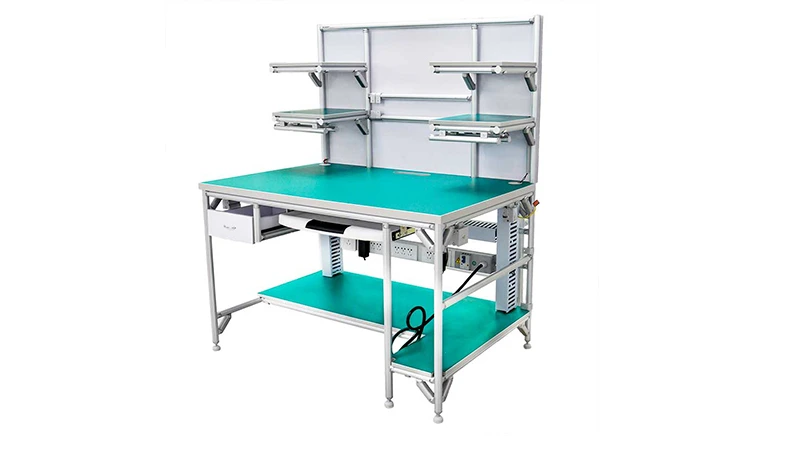
Aluminum Workbench A
Aluminum tube workbench is more flexible and durable, compared with traditional PE/ABS coated steel tube. It is easy to assemble, anti corrosion, rust protection, and recycle use after disassemble.
Introduction: Where Lean Meets Smart
Walk into any modern factory today, and you'll notice a quiet revolution unfolding. The clunky, rigid production lines of the past are giving way to spaces that feel almost… alive. Workers move with purpose, materials glide seamlessly from station to station, and every tool seems to adapt to the task at hand. This isn't just progress—it's the marriage of lean production, a philosophy built on eliminating waste, and smart manufacturing, where data and flexibility drive efficiency. At the heart of this transformation? Tools that don't just serve a function, but evolve with the needs of the people using them. Enter Aluminum Workbench A—a humble yet powerful player that's redefining how factories operate in the age of smart production.
For decades, lean production has been the gold standard for efficiency. Born from the Toyota Production System, it taught us to spot waste in all its forms: wasted time, wasted movement, wasted materials. But as factories embrace Industry 4.0—with IoT sensors, automation, and real-time data—lean has had to grow up. It's no longer enough to "do more with less"; today's manufacturers need to "do more, faster, with adaptability." That's where Aluminum Workbench A steps in. Crafted with precision and designed for the future, it's not just a workbench. It's a bridge between the tried-and-true principles of lean and the dynamic demands of smart factories.
The Evolution of Lean: From Static to Adaptive
Let's rewind a bit. Traditional lean production relied heavily on standardized workflows. Factories were optimized for a single product, with fixed workstations and rigid material paths. If a product design changed or demand shifted, reconfiguring the line meant days—sometimes weeks—of downtime, not to mention costly overhauls. Workers often found themselves constrained by tools that couldn't keep up with their ingenuity, leading to frustration and, yes, more waste.
Then came the era of smart factories. Suddenly, production lines needed to handle small-batch orders, customize products on the fly, and pivot at a moment's notice. Static workbenches and one-size-fits-all setups became liabilities. Manufacturers began asking: What if our tools could adapt as quickly as our data? What if a workstation could be reconfigured in hours, not days? What if every element of the production line worked in harmony, feeding data back to optimize itself?
This is where Aluminum Workbench A makes its mark. Built with aluminum lean pipe and aluminum profile—the unsung heroes of modular design—it embodies the new lean: adaptive, human-centered, and future-ready. Unlike traditional steel workbenches that are heavy and fixed, this workbench is a chameleon. Its frame, made from lightweight yet durable aluminum lean pipe, connects with precision-engineered aluminum profile accessories, allowing workers to adjust height, add shelves, or reposition tools in minutes. No welding, no specialized tools—just a few simple joints and a vision for how the workflow should flow.

Aluminum Workbench A: Design That Puts People First
Modularity: The Power to Adapt
Imagine a workstation that starts as a simple assembly table but can transform into a testing station, a packaging hub, or even a temporary storage unit—all in the span of a coffee break. That's the reality with Aluminum Workbench A. Its secret lies in the aluminum lean pipe and aluminum profile system that forms its core. These materials are lightweight (aluminum is 30% lighter than steel) but incredibly strong, capable of supporting heavy equipment without bending or warping. The joints, precision-machined from high-grade aluminum, lock securely in place yet release easily when reconfiguration is needed. This means a team lead can walk over, loosen a few connectors, and reposition the workbench to accommodate a new product line before the morning meeting ends.
Take Maria, a production supervisor at a mid-sized electronics plant. Last month, her team was tasked with assembling a new line of smart thermostats—smaller, more delicate than their usual products. Instead of ordering a new workstation, she grabbed a few extra aluminum profile accessories, adjusted the height of Aluminum Workbench A to reduce worker strain, and added a custom shelf for tiny components. "It used to take a week to get a new bench approved and delivered," she says. "Now? I can have the line reconfigured by lunch. The workers love it—they feel like they have control over their space, and that makes them more invested in the process."
ESD Protection: Safeguarding Sensitive Work
In industries like electronics or medical device manufacturing, static electricity is the silent enemy. A single static discharge can fry a microchip, render a sensor useless, or even compromise a patient's safety. That's why ESD compliance isn't just a nice-to-have—it's a necessity. Aluminum Workbench A doesn't just meet ESD standards; it integrates them into its design. The work surface is made from a specialized anti-static material that dissipates static charges, while the aluminum frame acts as a grounded conductor, ensuring any buildup is safely channeled away. For workers handling sensitive components, this isn't just a feature—it's peace of mind.
Jake, an electronics assembler, recalls a close call before his factory switched to Aluminum Workbench A. "I was working on a batch of circuit boards, and static from the old wooden bench zapped one. We had to scrap the whole batch—costing the company thousands. Now, with the ESD workstation, I don't worry. The surface feels different, smoother, and the little grounding light on the side lets me know it's working. It's one less thing to stress about, so I can focus on getting the job right."
Durability: Built to Last (and Last)
Lean production isn't just about eliminating waste in the short term—it's about sustainability, too. A workstation that needs to be replaced every few years is a waste of resources, plain and simple. Aluminum Workbench A is built with longevity in mind. Aluminum, by nature, resists corrosion and rust, even in humid or dusty factory environments. The aluminum profile accessories, from brackets to shelves, are coated with a scratch-resistant finish that stands up to daily wear and tear. And because it's modular, you don't have to replace the entire bench when a component wears out—just swap in a new part. This not only reduces waste but also cuts long-term costs, a win-win for both the factory and the planet.

Integration with the Smart Factory Ecosystem
A workstation can't exist in a vacuum—not in a smart factory. Aluminum Workbench A shines because it plays well with others, seamlessly integrating with key components like flow racks, conveyors, and data-tracking systems to create a cohesive, waste-free workflow.
Flow Racks: Materials That Come to You
In traditional setups, workers often spend precious minutes walking to and from storage areas to fetch materials—a classic example of "motion waste" in lean terms. Flow racks solve this by bringing materials directly to the workstation, using gravity to feed components as they're needed. Aluminum Workbench A is designed to connect with flow racks effortlessly. The aluminum profile frame can be fitted with custom brackets that align perfectly with the rack's rails, ensuring materials glide smoothly from storage to assembly without a hitch.
At a automotive parts plant in Michigan, the team paired Aluminum Workbench A with flow racks loaded with small plastic components. "Before, workers were walking 20 feet each way to get parts—hundreds of times a day," says Tom, the plant's lean coordinator. "Now, the flow rack sits right next to the workbench, and parts roll down as they're used. We tracked it: that's 12 hours of saved time per worker per week. That's time they can spend on actual assembly, not walking."
Conveyors: Seamless Movement from Station to Station
Smart factories thrive on automation, and conveyors are the arteries that keep materials flowing. Aluminum Workbench A is designed to integrate with both manual and automated conveyors, creating a continuous loop from production to packaging. The workbench's height can be adjusted to match conveyor belts, eliminating the need for workers to lift heavy items onto or off the line—another win for ergonomics and safety. In some setups, sensors under the workbench can even trigger the conveyor to start or stop based on workflow, ensuring materials arrive exactly when they're needed, no sooner, no later.
| Feature | Traditional Workbench | Aluminum Workbench A |
|---|---|---|
| Material | Wood or steel; heavy, prone to rust | Aluminum lean pipe and profile; lightweight, corrosion-resistant |
| Flexibility | Fixed design; requires replacement for new tasks | Modular; reconfigurable with basic tools in minutes |
| ESD Compliance | Often unprotected; requires add-on mats | Built-in anti-static surface and grounded frame |
| Integration with Smart Systems | Limited; no built-in sensor mounting or conveyor alignment | Compatible with flow racks, conveyors, and IoT sensors |
| Lifespan & Sustainability | 5-7 years; difficult to repair, often ends up in landfill | 15+ years; modular parts replaceable, aluminum fully recyclable |
The Numbers Speak: Real-World Impact
It's one thing to talk about features; it's another to see results. Let's look at a case study from a consumer electronics manufacturer that adopted Aluminum Workbench A across three production lines. The results? Staggering.
First, setup time for new product lines dropped by 78%. Previously, reconfiguring a line took 40 hours; with Aluminum Workbench A, it took just 9 hours. Why? Because the modular design eliminated the need for welding or custom fabrication. Second, worker fatigue decreased significantly. By adjusting the workbench height and integrating it with conveyors, the average number of ergonomic injuries (like back strain) fell by 42% in the first six months. Third, waste reduction hit 33%. The ESD protection reduced component damage by 29%, and the flow rack integration cut material waste from overproduction by 35%—since materials arrived only as needed, there was less excess inventory sitting idle.
"We thought we were already lean," says the plant manager, Raj. "But Aluminum Workbench A showed us we were still stuck in old habits—using tools that fought against our goals instead of supporting them. The ROI? We recouped the cost in under a year, and now we're rolling it out to all our facilities."
The Future: Where Aluminum Workbench A Leads
So, what's next for Aluminum Workbench A and the future of lean production? As smart factories become more connected, we can expect even deeper integration with IoT and AI. Imagine a workbench that learns from its users: sensors track how workers move, which tools are used most often, and when bottlenecks occur, then suggest adjustments—like repositioning a shelf or changing the conveyor speed—to optimize flow. Aluminum's conductivity makes it an ideal platform for embedding these sensors, turning the workbench into a data hub that feeds insights directly to factory management systems.
Sustainability will also play a bigger role. Aluminum is 100% recyclable, and as manufacturers push for net-zero goals, workbenches that can be disassembled, reused, and recycled will become the norm. Aluminum Workbench A is already ahead of the curve here, with a design that minimizes waste from the start—no excess packaging, no non-recyclable components, just durable, reusable parts.
But perhaps the most exciting future is one where the workbench becomes even more human-centric. As cobots (collaborative robots) become common on factory floors, Aluminum Workbench A can adapt to work alongside them, with custom mounting points for robot arms and sensors that ensure safe, efficient collaboration between humans and machines. It's not about replacing workers—it's about giving them tools that make their skills more powerful, their days less stressful, and their work more meaningful.
Conclusion: More Than a Workbench—A Partner in Progress
Lean production has always been about people: empowering them to eliminate waste, work smarter, and take pride in their craft. In the age of smart factories, that mission hasn't changed—it's just gotten more tools. Aluminum Workbench A isn't just a tool, though. It's a partner in that mission. It's the quiet enabler that lets workers adapt, innovate, and thrive in a world where change is the only constant.
As we look to the future of manufacturing, one thing is clear: the factories that succeed will be those that put flexibility, sustainability, and people at the center. Aluminum Workbench A, with its aluminum lean pipe and profile design, ESD protection, and seamless integration with smart systems, is leading the way. It's not just building better products—it's building better workplaces. And in the end, that's the most valuable waste we can eliminate: the waste of human potential.
So the next time you walk into a smart factory, take a closer look at the workbenches. Chances are, you'll see Aluminum Workbench A standing there—quiet, adaptable, and ready to shape the future of lean production, one reconfiguration at a time.