- Company Articles
- Industry articles
- Industry News
- The History of Aluminum Workbench D: Evolution in Industrial Workstation Design

The History of Aluminum Workbench D: Evolution in Industrial Workstation Design
Related Product
Aluminum Workbench D
Aluminum tube workbench is more flexible and durable, compared with traditional PE/ABS coated steel tube. It is easy to assemble, anti corrosion, rust protection, and recycle use after disassemble.
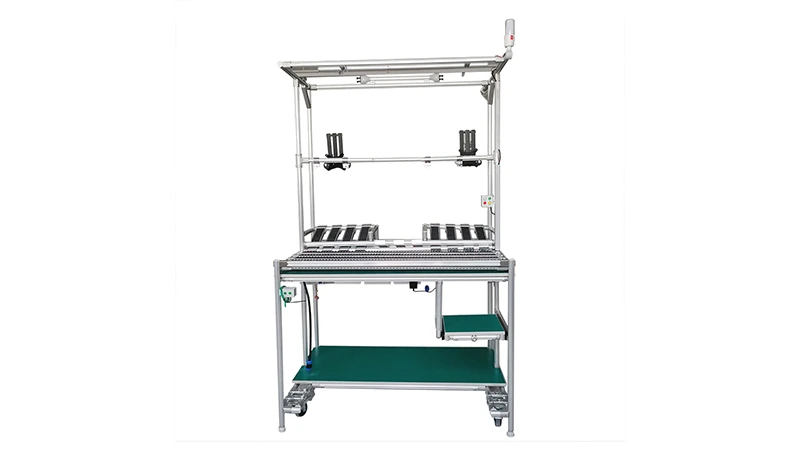
Walk into any modern factory or workshop today, and you'll likely spot a familiar sight: sleek, silver workstations that seem to effortlessly adapt to the chaos of production. These aren't just tables—they're the unsung heroes of industrial efficiency, and few embody this evolution more than the Aluminum Workbench D. To truly appreciate its impact, we need to rewind to a time when workbenches were heavy, rigid, and about as adaptable as a brick wall. Let's journey through the decades to understand how this unassuming piece of equipment transformed from a basic wooden slab into a cornerstone of lean manufacturing, driven by innovations in materials, design, and a relentless focus on the people who use it every day.
The Early Days: Workbenches as Static Giants
Picture a factory floor in the 1940s. The air is thick with the smell of sawdust and machine oil, and the workstations are as sturdy as they are immovable. Most are made of solid hardwood—oak or maple—built to withstand the pounding of hammers, the scraping of tools, and the weight of heavy parts. They're massive, often custom-built for a single task, and once installed, they might stay in the same spot for decades. A worker assembling small mechanical parts would stand at the same height all day; if the next shift needed to use the bench for a taller task, tough luck—adjustments meant hiring a carpenter to saw and sand, a luxury few factories could afford.
Then came the post-WWII manufacturing boom. Factories churned out everything from appliances to automobiles, and suddenly, rigidity became a liability. A single production line might switch from assembling radios to televisions in months, but the workbenches couldn't keep up. Steel workbenches emerged as a "modern" alternative—stronger than wood, but even heavier. Moving one required a forklift, and customizing it meant welding on new parts, a process that left permanent scars and often rendered the bench useless for future tasks. Waste was everywhere: time wasted on reconfiguring workspaces, money wasted on replacing outdated benches, and energy wasted by workers straining to adapt to poorly designed stations.
By the 1970s, manufacturers were starting to ask: What if workbenches could evolve with their needs? What if they were lightweight enough to move, sturdy enough to last, and flexible enough to adapt without a welder or a saw? The answer, it turned out, lay in a material that was already revolutionizing industries from aerospace to construction: aluminum.
Aluminum: The Material That Changed Everything
Aluminum wasn't new, but its potential in industrial design was just beginning to be unlocked. Unlike wood, it wouldn't warp or rot; unlike steel, it was 30% lighter and resistant to corrosion. Best of all, it could be shaped into precise, consistent forms through a process called extrusion—pushing heated aluminum through a die to create long, uniform profiles. This was a game-changer. Suddenly, manufacturers could produce aluminum extrusion profiles with built-in channels, slots, and mounting points, turning a simple metal tube into a modular building block.
The aluminum extrusion profile became the backbone of early modular workbenches. Imagine a T-shaped groove running along the length of the profile—this "T-slot" allowed workers to slide in bolts, brackets, or accessories without drilling holes or welding. Need a tool holder? Screw it into the T-slot. Want to add a shelf? Slide on a bracket and tighten a knob. It was like building with industrial Legos, and factories loved it. But early aluminum workbenches still had flaws: they were often flimsy, with joints that loosened over time, and the profiles were limited in size and strength. They were a step forward, but not yet the solution manufacturers needed.
Enter the 1990s, a decade defined by the rise of lean manufacturing. Companies like Toyota popularized the idea of "lean systems"—eliminating waste, streamlining workflows, and empowering workers to improve processes. Suddenly, workbenches weren't just surfaces to work on; they were critical tools for reducing waste and boosting productivity. A lean system demanded workstations that could adapt in hours, not days, and that's where the Aluminum Workbench D was born.

The Birth of Aluminum Workbench D: Lean, Modular, Human-Centered
Designers at leading industrial suppliers began with a simple question: What do workers actually need from a workbench? They spent months observing factories, talking to assembly line workers, supervisors, and maintenance teams. The feedback was clear: workers wanted something sturdy but movable, customizable but not complicated, and built to last without constant repairs. Aluminum Workbench D was their answer—a workstation designed not just for machines, but for the people operating them.
Let's break down its key innovations:
1. The Single-Deck, No-Caster Foundation
Unlike bulkier models with built-in wheels, Aluminum Workbench D was designed as a "single deck without caster" base (a nod to practicality—casters add cost and complexity for stationary tasks). Instead, it featured a rigid, flat surface supported by thick-walled aluminum extrusion profiles, ensuring stability even when loaded with heavy tools or parts. The deck itself, often made of aluminum honeycomb panel (lightweight but incredibly strong), resisted dents and scratches, making it ideal for high-traffic work areas.
2. T-Slot Profiles and Aluminum Profile Accessories
The real magic was in the frame: heavy-duty aluminum profiles with T-slots running along every edge. This meant workers could attach aluminum profile accessories —tool hooks, monitor mounts, bin rails, even small conveyors—in minutes. No more waiting for maintenance to drill holes; a hex key and a few bolts were all you needed. One assembly line worker at a electronics plant recalled: "We used to spend half a day reconfiguring our old steel bench for a new product. With Workbench D? We swapped out the tool holders and added a parts bin rail in 20 minutes. It felt like we'd been given a superpower."
3. Ergonomics by Design
Early workbenches forced workers into one-size-fits-all postures, leading to fatigue and injuries. Aluminum Workbench D changed that. Its legs, made of adjustable aluminum extrusion profiles, could be raised or lowered by up to 12 inches, letting tall and short workers alike find their ideal height. The deck edges were rounded to prevent wrist strain, and the surface was coated with a non-slip finish to keep parts from sliding. Even the color—often a soft gray or blue—was chosen to reduce eye strain under factory lights.
4. Durability That Stands the Test of Time
Aluminum's natural resistance to rust and corrosion made Workbench D a hit in environments like food processing or automotive plants, where spills and moisture were common. Unlike wood, it didn't absorb oil or chemicals, so a quick wipe with a cloth kept it clean. And when a part did wear out—say, a bracket or a knob—replacement was easy: just order a new aluminum profile accessory and snap it into place. No need to replace the entire bench.

Aluminum Workbench D and the Lean Revolution
To understand why Aluminum Workbench D became a staple in lean systems, let's look at a real-world example: a mid-sized automotive parts manufacturer in Michigan. In 2005, the plant was struggling with long setup times between product runs. Their old steel workbenches took 8 hours to reconfigure for a new part, eating into production time and frustrating workers. Then they switched to Aluminum Workbench D.
The results were staggering. Setup time dropped to 45 minutes, thanks to the modular accessories and tool-less adjustments. Workers, now able to customize their stations, reported a 15% increase in productivity and fewer complaints of back pain. The plant manager summed it up: "Lean is about respecting people and eliminating waste. Workbench D does both. It lets our team focus on building great parts, not fighting with their workstations."
This story isn't unique. Across industries, Aluminum Workbench D became a symbol of lean thinking: it reduced waste by eliminating the need for custom-built benches, improved flow by adapting to changing workflows, and empowered workers to take ownership of their spaces. It wasn't just a tool—it was a partner in continuous improvement.
Why Lean Systems Love Aluminum Workbench D
- Modularity: Swap accessories in minutes to match new tasks, reducing downtime.
- Lightweight Strength: Move the bench with a team of two, no forklift needed—perfect for rearranging production lines.
- Durability: Lasts 10+ years with minimal maintenance, reducing waste from replacements.
- Ergonomics: Happy, healthy workers are more engaged and productive—key to lean success.
From Workbench D to the Future: What's Next?
Today, Aluminum Workbench D has evolved even further. Newer models integrate smart features: built-in USB ports for charging tools, LED task lights that adjust to ambient brightness, and even sensors that track usage and suggest ergonomic adjustments. The aluminum extrusion profile itself has gotten stronger and lighter, thanks to advanced alloys, and aluminum profile accessories now include 3D-printed custom parts for niche tasks.
But the core philosophy remains the same: design for people, not just production. As manufacturing shifts toward automation and AI, the human element is more important than ever. Workers aren't replaced by machines—they're partners with them, and their workstations need to bridge the gap between human skill and technological precision. Aluminum Workbench D, with its adaptability and focus on ergonomics, is poised to lead this next chapter.
Looking ahead, we might see workbenches made from recycled aluminum extrusion profiles, further reducing environmental impact, or benches that connect to factory management systems to share data on usage and efficiency. But no matter how it evolves, the spirit of Workbench D—practical, people-first, and endlessly adaptable—will remain the heart of industrial workstation design.
The Legacy of Aluminum Workbench D
It's easy to overlook a workbench. It doesn't make noise or flash lights; it just sits there, quietly supporting the work of millions. But Aluminum Workbench D is more than metal and bolts. It's a testament to how great design can transform industries by putting people first. From the heavy wooden slabs of the past to the modular, lean-friendly stations of today, it's a story of progress—one that reminds us that the best tools aren't just built for tasks; they're built for the humans who perform them.
So the next time you walk into a factory, take a moment to look at the workbenches. Chances are, you'll see a little bit of Workbench D in each one—a legacy of innovation, adaptability, and respect for the people who keep the world building.
| Feature | 1940s Wooden Workbench | 1970s Steel Workbench | Aluminum Workbench D (2020s) |
|---|---|---|---|
| Material | Solid hardwood | Carbon steel | Aluminum extrusion profile |
| Weight | 500+ lbs (immovable) | 800+ lbs (requires forklift) | 150-200 lbs (movable by 2 people) |
| Customization | Permanent (requires carpentry) | Welding required (permanent) | Tool-less (using aluminum profile accessories ) |
| Lean Compatibility | Low (high waste, rigid) | Medium (strong but inflexible) | High (modular, adaptable, waste-reducing) |