- Company Articles
- Industry articles
- Industry standards
- The Importance of 2040 National Standard Profile in Lean Six Sigma Projects

The Importance of 2040 National Standard Profile in Lean Six Sigma Projects
Related Product
2040 National Standard Profile
45° external bending joint, used for 45° external connection of two aluminum pipes.
In the world of manufacturing and process improvement, Lean Six Sigma stands as a beacon of efficiency, quality, and waste reduction. It's a methodology that doesn't just tweak processes—it transforms them, turning chaotic workflows into streamlined systems that deliver value with pinpoint precision. But here's the thing: even the most well-designed Lean Six Sigma strategy can stumble if the physical infrastructure supporting it isn't up to par. That's where unsung heroes like the 2040 National Standard Profile come into play. This unassuming aluminum extrusion profile might not grab headlines, but in the hands of Lean Six Sigma practitioners, it becomes a cornerstone of adaptive, efficient, and high-quality operations. Let's dive into why this specific profile matters, how it aligns with Lean and Six Sigma principles, and why it's become a go-to choice for teams aiming to build processes that stand the test of time.
Understanding Lean Six Sigma: More Than Just a Methodology
Before we unpack the role of the 2040 National Standard Profile, let's ground ourselves in what Lean Six Sigma truly entails. At its core, Lean Six Sigma is a marriage of two powerful approaches: Lean, which focuses on eliminating waste (or "muda") and creating smooth, value-driven flow; and Six Sigma, which zeroes in on reducing variation and defects to near-perfection (think 3.4 defects per million opportunities). Together, they aim to answer a simple question: How do we deliver the right product, at the right time, with the right quality—while using the least amount of resources?
To achieve this, Lean Six Sigma projects often rely on tools like value stream mapping, 5S (Sort, Set in Order, Shine, Standardize, Sustain), Kanban systems, and DMAIC (Define, Measure, Analyze, Improve, Control). But here's the critical link: all these tools depend on a physical workspace that can adapt to changing needs, support consistent workflows, and minimize unnecessary steps. A rigid, one-size-fits-all workbench, a clunky material rack, or a conveyor system that can't keep up with demand—these aren't just inconveniences. They're barriers to Lean Six Sigma success. This is where modular, flexible infrastructure becomes non-negotiable.
What Is the 2040 National Standard Profile?
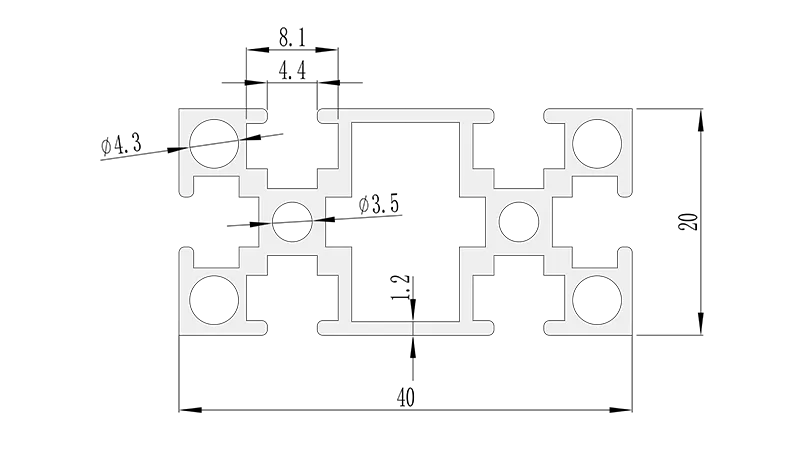
Let's start with the basics: the 2040 National Standard Profile is a type of aluminum extrusion profile, part of a broader family of aluminum profiles designed for structural and industrial use. As the name suggests, its dimensions are roughly 20mm in width and 40mm in height (though exact specs can vary slightly by manufacturer, adhering to national standards for consistency). What makes it unique is its "T-slot" design—a longitudinal groove running along its length that allows for easy attachment of accessories like brackets, connectors, and panels. This might sound simple, but that T-slot is the key to its versatility.
Aluminum extrusion profiles like the 2040 are created by forcing heated aluminum through a die, resulting in a consistent, precision-engineered shape. This process ensures that every 2040 profile is identical in dimensions and strength, a trait that aligns perfectly with Six Sigma's emphasis on reducing variation. The material itself—aluminum—brings additional benefits: it's lightweight yet surprisingly strong, corrosion-resistant, and recyclable, making it both practical for industrial use and sustainable for long-term projects.
But why "national standard"? In manufacturing, consistency is king. National standards ensure that profiles from different suppliers are interchangeable, meaning a 2040 profile from one vendor will fit seamlessly with aluminum profile accessories from another. This interoperability eliminates the frustration of mismatched parts and reduces lead times—a small detail that has a big impact on Lean projects, where delays can derail entire workflows.
How the 2040 Profile Supports Lean Principles
1. Eliminating Waste: The Lean Way
Lean manufacturing identifies eight types of waste, from overproduction to unnecessary motion. The 2040 National Standard Profile directly targets several of these, starting with "inventory waste." Traditional infrastructure—like custom-welded steel workbenches or fixed material racks—often requires businesses to stockpile spare parts or entire replacement units, tying up capital and storage space. The 2040 profile, however, is modular. Instead of storing a whole new workbench, you can stock a few extra profiles and aluminum profile accessories (like 90° aluminum profile connectors or end caps) and assemble exactly what you need, when you need it. This "just-in-time" approach to infrastructure cuts inventory costs and frees up warehouse space for value-adding activities.
Then there's "motion waste"—the time and energy workers spend reaching, bending, or walking to access tools or materials. A poorly designed workbench might force an operator to stretch across a cluttered surface, while a misaligned flow rack could require constant adjustments to keep materials moving. The 2040 profile's flexibility lets teams design ergonomic workspaces tailored to human movement. For example, a workbench built with 2040 profiles can be adjusted to the perfect height, with tool holders and bins mounted directly into the T-slots at arm's reach. Similarly, a flow rack constructed with 2040 profiles can be angled to ensure materials glide smoothly to the point of use, reducing the need for manual handling.
2. Enabling Flow: From Bottlenecks to Smooth Sailing
One of Lean's core goals is to create "flow"—the uninterrupted movement of products or information from start to finish. Bottlenecks kill flow, and all too often, bottlenecks are caused by inflexible infrastructure. Imagine a production line where a conveyor system can't be extended to accommodate a new step, or a material rack that's too narrow to hold a larger batch of components. These are not just minor hiccups; they're disruptions that ripple through the entire value stream.
The 2040 profile solves this by acting as a "building block" for customizable flow systems. Take flow racks, for instance. A flow rack built with 2040 profiles can be adjusted in height, width, and depth to match the size of the materials being transported. Add roller tracks (another key accessory) into the T-slots, and suddenly you have a gravity-fed system that moves components from receiving to assembly without manual pushing. Even better, if production needs change—say, a new product with larger parts is introduced—the rack can be reconfigured in hours, not weeks. This agility ensures that flow is maintained, even as the business evolves.
3. Flexibility: Adapting to Change
In today's fast-paced manufacturing environment, change is constant. Customer demands shift, product designs evolve, and new regulations are introduced. Lean Six Sigma projects must be able to pivot quickly, and their infrastructure needs to keep up. The 2040 National Standard Profile thrives in this dynamic landscape because it's not just a static structure—it's a system that can be modified, extended, or repurposed with minimal effort.
Consider a scenario where a team implements a new Kanban system to manage inventory. Initially, they might need a small Kanban board mounted on a 2040 workbench. As the system scales, they can add more profiles to expand the board, or even build a separate rack for Kanban bins—all without purchasing new equipment. Similarly, a cross-functional team might need a temporary assembly station for a special project. With 2040 profiles and a few casters (yes, even casters can be attached via T-slots), they can build a mobile workstation that's moved to the production floor in minutes and disassembled just as easily when the project ends. This kind of flexibility turns "what if" into "we can," empowering teams to experiment and improve without being limited by their tools.
Enhancing Six Sigma Quality with the 2040 Profile
While Lean focuses on waste reduction, Six Sigma is all about quality—specifically, reducing defects and variation to ensure consistent output. Here again, the 2040 National Standard Profile shines, thanks to its precision engineering and standardized design.
Six Sigma projects often involve tight tolerances. For example, in electronics manufacturing, a workbench that wobbles by even a few millimeters can lead to misaligned circuit boards and costly defects. The 2040 profile's extrusion process ensures that every piece has uniform dimensions, so when you build a workbench or material rack, it's stable and level. Aluminum's rigidity adds to this stability; unlike plastic or wood, it doesn't warp or flex under load, ensuring that measurements and alignments stay consistent over time.
Another Six Sigma principle is "control"—the ability to monitor and maintain process improvements. The 2040 profile supports this by making it easy to integrate quality control tools directly into the workspace. For instance, a team might mount a digital caliper holder, a defect-tracking board, or even a small inspection camera onto a 2040 workbench using T-slot accessories. By keeping these tools within arm's reach and consistently positioned, operators are more likely to use them, reducing the risk of human error and ensuring that quality checks become a natural part of the workflow.
Comparing 2040 with Other Aluminum Profiles: Why Size Matters
The 2040 National Standard Profile isn't the only aluminum extrusion profile on the market. There's the smaller 2020 profile (20mm x 20mm), the medium-sized 3030 (30mm x 30mm), and larger options like the 4080. Each has its place, but the 2040 strikes a unique balance that makes it ideal for Lean Six Sigma projects. Let's break this down with a comparison:
| Profile Type | Dimensions (WxH) | Load Capacity (Approx.) | Common Applications | Lean Six Sigma Advantage |
|---|---|---|---|---|
| 2020 National Standard Profile | 20mm x 20mm | Light (up to 50kg per linear meter) | Small shelving, electronic enclosures, lightweight workstations | Ultra-lightweight, ideal for low-load, space-constrained areas |
| 2040 National Standard Profile | 20mm x 40mm | Medium (up to 150kg per linear meter) | Workbenches, flow racks, material handling trolleys, assembly stations | Balances strength and size; versatile for most shop floor needs |
| 3030 National Standard Profile | 30mm x 30mm | Medium-High (up to 200kg per linear meter) | Heavy-duty workbenches, machine guards, industrial racks | Higher load capacity but bulkier; overkill for many Lean projects |
The 2040's sweet spot is its combination of size and strength. At 20mm x 40mm, it's compact enough to fit into tight spaces (like between production lines) but sturdy enough to support most shop floor equipment, from tools to small assemblies. This versatility means teams don't have to compromise—they can build a lightweight mobile trolley one day and a robust workbench the next, using the same base profile. For Lean Six Sigma projects, which often require balancing multiple priorities (space, cost, functionality), this flexibility is invaluable.
The Ecosystem: Aluminum Profile Accessories and the 2040 Profile
A profile is only as good as the accessories that bring it to life. The 2040 National Standard Profile's T-slot design works hand-in-hand with a wide range of aluminum profile accessories, turning a simple extrusion into a fully functional system. Let's explore a few key accessories and how they enhance Lean Six Sigma workflows:
90° Aluminum Profile Connectors
These small but mighty brackets let you join two 2040 profiles at a right angle, forming the corner of a workbench, rack, or frame. What makes them Lean-friendly is their tool-free assembly (many use cam levers or set screws), so teams can adjust structures on the fly without waiting for maintenance. This speed is critical during 5S implementation, where the "Set in Order" phase often involves rapid reconfiguration of workspaces.
End Caps
These simple plastic or aluminum caps fit over the ends of 2040 profiles, covering sharp edges and preventing dust or debris from collecting in the T-slots. While this might seem like a minor detail, it directly supports the "Shine" (cleanliness) phase of 5S, reducing the time spent cleaning workspaces and creating a safer environment for operators.
Gussets and Reinforcement Plates
For heavier loads or high-stress applications (like a workbench supporting a industrial printer), gussets add extra stability by reinforcing joints. This is where Six Sigma's focus on reliability comes in—by ensuring that structures can handle the demands of daily use, gussets prevent unexpected failures and keep processes running smoothly.
Casters and Wheels
Attach casters to a 2040 frame, and suddenly you have a mobile workstation or material trolley. This mobility is a game-changer for "pull" systems, where materials are delivered directly to the point of use. For example, a trolley loaded with components can be rolled to an assembly line as needed, eliminating the waste of workers walking to a distant stockroom.
The beauty of this ecosystem is that it's modular. You don't need to buy a pre-built workstation—you can mix and match accessories to create exactly what your process requires. This not only reduces costs but also encourages teams to take ownership of their workspace, a key driver of sustained Lean Six Sigma success.
Real-World Impact: A Case Study
Let's bring this to life with a hypothetical (but realistic) case study. Imagine a small automotive parts manufacturer struggling with two common issues: high defect rates on their assembly line and excessive inventory of custom workbenches. Their Lean Six Sigma team decides to tackle both problems using the 2040 National Standard Profile.
First, the defect issue. The team discovers that the existing workbenches are wooden, prone to warping, and lack proper tool organization. Operators often have to reach across cluttered surfaces, leading to misaligned parts. The team replaces the wooden benches with 2040 profile workbenches, adding T-slot tool holders, a small parts bin, and a built-in level to ensure stability. Within weeks, defect rates drop by 30%—a direct result of the stable, organized workspace.
Next, the inventory problem. The company used to order custom steel racks for each new product line, resulting in a warehouse full of unused racks when products were discontinued. The team replaces these with 2040 profile flow racks, which can be disassembled and reconfigured for new products. They also stock a small inventory of 2040 profiles and aluminum profile accessories instead of whole racks. Inventory costs plummet by 40%, and the warehouse frees up space for a new Kanban system.
Six months later, the team reports another unexpected benefit: employee engagement has improved. Workers appreciate the flexibility of the new infrastructure—they can adjust their workbenches to their height, add accessories as needed, and even help design new setups. This sense of ownership leads to more suggestions for improvement, creating a culture of continuous improvement that's the hallmark of successful Lean Six Sigma programs.
Overcoming Challenges: Implementing 2040 Profiles in Your Project
Like any tool, the 2040 National Standard Profile isn't a magic bullet. Implementing it effectively requires planning and foresight. Here are a few common challenges and how to address them:
Initial Cost vs. Long-Term ROI
Aluminum profiles can cost more upfront than wood or basic steel. But consider the long-term savings: modularity reduces replacement costs, standardization cuts inventory, and flexibility extends the lifespan of your infrastructure. Most teams find that the ROI becomes clear within 6–12 months.
Training Teams to Use Accessories
While 2040 profiles are easy to assemble, some team members might be intimidated by new tools or accessories. Host a short workshop with hands-on practice—letting operators build a simple trolley or shelf helps them see how easy it is. Many suppliers also offer free design tools or templates to simplify the process.
Ensuring Compatibility
Not all "2040" profiles are created equal. Stick to national standard profiles to ensure compatibility with accessories from different suppliers. Ask for certification or samples before ordering to avoid mismatched parts.
Looking Ahead: The Future of 2040 Profiles in Lean Six Sigma
As manufacturing evolves—with trends like Industry 4.0, automation, and sustainability taking center stage—the 2040 National Standard Profile is poised to play an even bigger role. Imagine a smart factory where 2040 workbenches are equipped with IoT sensors (mounted via T-slots) that monitor tool usage and alert teams to maintenance needs. Or where profiles are recycled and repurposed as production needs change, aligning with circular economy goals.
Lean Six Sigma itself is also evolving, with a greater focus on agility and employee empowerment. The 2040 profile's ability to support rapid change and hands-on problem-solving makes it a natural fit for this new era. It's not just a tool for building structures—it's a tool for building resilient, adaptable teams.
Conclusion: The Unsung Hero of Lean Six Sigma
In the grand scheme of Lean Six Sigma, the 2040 National Standard Profile might seem like a small detail. But as any practitioner knows, the difference between success and failure often lies in the details. This unassuming aluminum extrusion profile embodies the principles of Lean (waste reduction, flexibility) and Six Sigma (precision, quality) in a way that few other tools can. It's modular, standardized, and adaptable—qualities that turn abstract process improvements into tangible, everyday reality.
Whether you're building a workbench, a flow rack, or a mobile trolley, the 2040 profile isn't just about holding things up. It's about holding up the promise of Lean Six Sigma: a workplace where every process adds value, every defect is prevented, and every team member has the tools to succeed. So the next time you walk through a well-organized production floor, take a closer look at the structures around you. Chances are, there's a 2040 profile working quietly in the background—proof that even the smallest tools can drive the biggest improvements.