- Company Articles
- Industry articles
- Industry standards
- The Importance of 4040F EU Standard Aluminum Profile in Building Reconfigurable Production Systems

The Importance of 4040F EU Standard Aluminum Profile in Building Reconfigurable Production Systems
Related Product
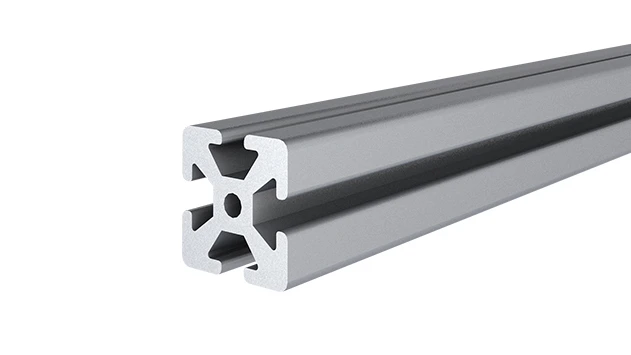
4040F EU Standard Aluminum Profile
4040F is a 4.00x4.00 CM fractional 40 series square extrusion T-slot profile with four side open T-slots, each side with 4.00cm face. The profile has align-a-grooves to assist in aligning connecting profiles.
In today's manufacturing landscape, where customer demands shift overnight and product lifecycles grow shorter by the month, the ability to adapt is no longer a luxury—it's a survival skill. Traditional production lines, bolted down and rigid, struggle to keep pace. They're expensive to overhaul, slow to retool, and often become obsolete before they've even paid for themselves. This is where reconfigurable production systems (RPS) step in: flexible, modular setups that can be adjusted, expanded, or repurposed with minimal downtime. And at the heart of these systems lies a quiet workhorse: the 4040F EU Standard Aluminum Profile.
You might not notice it at first glance, but this unassuming aluminum extrusion profile is the backbone of modern, agile manufacturing. It's the reason a electronics plant can switch from assembling smartwatches to fitness trackers in a week, or why a automotive supplier can scale up production of electric vehicle parts without rebuilding their entire workshop. Let's dive into why the 4040F profile has become indispensable for anyone building reconfigurable production systems.
What Makes Reconfigurable Production Systems So Critical Today?
Think about the last time you ordered a custom product online—maybe a personalized phone case or a made-to-measure piece of furniture. Chances are, that product was built on a production line that wasn't designed specifically for it. Reconfigurable production systems (RPS) make that possible. Unlike fixed systems, which are engineered for one product and one product only, RPS are built to evolve. They use modular components that can be rearranged, added to, or repurposed as needs change.
The benefits are clear: reduced downtime during product transitions, lower upfront costs (since you're not building a new line from scratch), and the ability to experiment with new products without major risk. But for RPS to work, they need a foundation that's both strong and flexible. Enter aluminum extrusion profiles—and specifically, the 4040F EU Standard.
The 4040F EU Standard Aluminum Profile: A Closer Look
At first glance, the 4040F might look like just another aluminum bar. But its design is the result of decades of refining what manufacturers actually need on the factory floor. Let's break down its key features:
Dimensions That Strike the Perfect Balance
The "4040" in its name refers to its cross-section: 40mm by 40mm. This size hits a sweet spot for most industrial applications. It's sturdy enough to support heavy equipment—think workbenches loaded with tools or roller tracks carrying bulky components—but not so large that it wastes space or adds unnecessary weight. Compare that to smaller profiles like the 2020 (20mm x 20mm), which is great for lightweight tasks but can't handle heavy loads, or larger ones like the 8080, which might be overkill for most reconfigurable setups.
EU Standards: Consistency You Can Trust
The "EU Standard" label isn't just a marketing term. It means the 4040F profile adheres to strict European manufacturing norms for material quality, dimensional accuracy, and safety. That consistency is critical when building modular systems. Imagine trying to assemble a workbench with parts from different suppliers, only to find the holes don't line up or the connectors don't fit—frustrating, right? With EU-standard profiles, you know that a bracket designed for 4040F will work with any 4040F profile, no matter which supplier you buy it from.
T-Slot Design: The Secret to Its Flexibility
The real magic of the 4040F lies in its T-shaped slots (or "T-slots") running along all four sides. These slots act like a universal interface for aluminum profile accessories—connectors, brackets, shelves, wheels, you name it. Instead of welding or drilling holes (which would lock the profile into one configuration), you can slide a bolt or clip into the T-slot, tighten it, and you're done. Need to move a shelf up by 10cm? Loosen the bolt, adjust, and retighten. Want to add a roller track to one side? Snap on a connector and slide the track into place. It's this tool-free adjustability that makes the 4040F a cornerstone of reconfigurable systems.

Aluminum Profile Accessories: Turning a Profile Into a System
A 4040F profile on its own is just a piece of metal. But when paired with the right aluminum profile accessories, it transforms into something far more powerful. Let's look at a few key accessories that make reconfigurable systems possible:
- Connectors: These are the glue that holds everything together. 90° aluminum profile connectors let you join two profiles at a right angle (perfect for building workbench frames), while 135° connectors add flexibility for corner designs. There are even swivel connectors that let parts rotate, ideal for adjustable shelves or tiltable work surfaces.
- Brackets and Plates: Need to mount a tool holder or a monitor arm to your workbench? Brackets slide into the T-slots and provide a stable base. Plates can be used to create shelves or tabletop surfaces, turning a simple frame into a functional workspace.
- Casters: Add wheels to a 4040F frame, and suddenly your stationary workbench becomes a mobile cart. This is game-changing for lean systems, where materials need to flow smoothly from one workstation to the next.
The beauty of these accessories is that they're designed to work seamlessly with the 4040F's T-slots. You don't need special tools or expertise—just a few minutes to assemble, disassemble, or reconfigure. It's like building with advanced Lego bricks, but for grown-ups running factories.
From Workbenches to Roller Tracks: Real-World Applications of 4040F
Let's get concrete. How do manufacturers actually use the 4040F profile in their reconfigurable systems? Here are three common applications that highlight its versatility:
1. Modular Workbenches for Lean Production
A workbench is the heart of any assembly line, and with 4040F, it's a heart that can adapt. Picture a workbench built with 4040F frames, topped with a durable aluminum honeycomb panel. The T-slots along the sides let workers add tool hooks, parts bins, or even a monitor arm for digital work instructions. Need to lower the height for a shorter operator? Swap out the legs for longer ones. Want to add a shelf for extra storage? Slide in a bracket and attach the shelf—no drilling required. When the product line changes, the workbench can be disassembled and rebuilt into a new configuration, saving thousands of dollars compared to buying a new bench.
2. Roller Tracks for Smooth Material Flow
In lean manufacturing, keeping materials moving is key to reducing waste. Roller tracks—used to slide parts from one workstation to the next—are often built with 4040F profiles. The profile provides a sturdy rail, while plastic or steel roller track guide rails (like the yellow or grey ones you might see) snap into the T-slots. If a production line needs to be rerouted, the roller track can be disassembled and reassembled along a new path in hours, not days. And because 4040F is strong enough to support heavy loads, even bulky items like engine components can glide smoothly along these tracks.
3. Agile Storage Racks for Dynamic Inventory
Warehouses and production floors need storage that can keep up with changing inventory. 4040F-based racks are perfect for this. Unlike fixed metal shelving, these racks can be adjusted on the fly—add a shelf, remove a divider, or even change the height of each level to fit different-sized bins. Some manufacturers even add casters to turn static racks into mobile units, making it easy to bring materials directly to the assembly line when needed.
How 4040F Compares to Other Aluminum Profiles
Not all aluminum profiles are created equal. To understand why 4040F is so popular, let's compare it to two other common EU standard profiles: the 3030 (30mm x 30mm) and the 2020 (20mm x 20mm).
| Profile Type | Dimensions (mm) | Max Load Capacity (kg/m) | Best For |
|---|---|---|---|
| 4040F EU Standard | 40x40 | Up to 300 | Workbenches, roller tracks, heavy-duty racks, lean system frames |
| 3030 EU Standard | 30x30 | Up to 150 | Lightweight shelving, small carts, machine guards |
| 2020 EU Standard | 20x20 | Up to 50 | Prototyping, small parts storage, DIY projects |
As the table shows, 4040F offers the best balance of strength and versatility for most industrial reconfigurable systems. It can handle heavy loads without being overly bulky, making it the go-to choice for everything from workbenches to roller tracks.
The Long-Term Benefits: Why 4040F Saves Time, Money, and Headaches
Choosing the 4040F profile isn't just about solving today's problems—it's about future-proofing your production line. Here are three long-term benefits that make it a smart investment:
Cost Savings Through Reusability
Traditional production lines are one-and-done. When a product is discontinued, the line is often scrapped. With 4040F-based systems, components can be reused. A workbench from a smartphone assembly line can become a testing station for drones, or a roller track can be repurposed to feed materials to a new machine. This reusability slashes capital expenses over time.
Scalability for Growing Businesses
As your business grows, so can your production system. Need to add a third shift? Simply bolt on more 4040F frames and extend your roller tracks. Launching a new product line? Repurpose existing components and add a few new accessories. There's no need to pause operations for weeks while a new line is built—expansion happens incrementally, with minimal disruption.
Sustainability Through Recyclability
Aluminum is 100% recyclable, and recycling it uses just 5% of the energy needed to produce new aluminum. When a 4040F profile finally reaches the end of its life (which could be decades), it can be melted down and turned into a new profile—no waste, no guilt. For manufacturers aiming to reduce their carbon footprint, this is a huge win.
Conclusion: 4040F—The Backbone of Modern Manufacturing Agility
In a world where change is the only constant, the 4040F EU Standard Aluminum Profile isn't just a component—it's a strategic advantage. Its combination of strength, flexibility, and compatibility with aluminum profile accessories makes it the ideal building block for reconfigurable production systems. Whether you're building a lean workbench, a dynamic roller track, or an entire assembly line that can pivot with market demands, 4040F delivers the adaptability manufacturers need to stay competitive.
So the next time you walk through a factory and see a production line that seems to "flow" with changing needs, take a closer look. Chances are, you'll spot the 4040F profile hard at work—quietly, reliably, and always ready for whatever comes next.