- Company Articles
- Industry articles
- Industry standards
- The Role of 2040 National Standard Profile in Circular Economy Manufacturing

The Role of 2040 National Standard Profile in Circular Economy Manufacturing
Related Product
2040 National Standard Profile
45° external bending joint, used for 45° external connection of two aluminum pipes.
In an era where industries worldwide are grappling with the dual challenges of meeting production demands and reducing environmental impact, the concept of circular economy manufacturing has emerged as more than just a buzzword—it's a critical pathway to sustainability. At its core, circular economy manufacturing seeks to redefine the traditional "take-make-dispose" model by designing systems that minimize waste, maximize resource efficiency, and promote the reuse and recycling of materials. Yet, for many manufacturers, the question remains: what tools and materials can turn this vision into tangible, everyday practice? Enter the 2040 National Standard Profile—a seemingly unassuming component that's quietly revolutionizing how factories, workshops, and production lines approach sustainability.
Understanding Circular Economy Manufacturing: Beyond the Basics
Before diving into the specifics of the 2040 National Standard Profile, it's essential to ground ourselves in what circular economy manufacturing truly entails. Unlike the linear model, which treats resources as infinite and waste as inevitable, circular manufacturing is built on three principles:
reduce
(minimize resource use),
reuse
(extend product lifecycles), and
recycle
(recover materials for new use). For manufacturers, this means rethinking everything from product design to production infrastructure.
One of the biggest sources of waste in manufacturing isn't raw materials or energy—it's the inflexibility of the tools and systems themselves. A workbench that can't adapt to a new product line, a material rack that becomes obsolete when production scales, or a conveyor system that's too rigid to reconfigure—all these lead to unnecessary disposal, replacement costs, and environmental harm. This is where modular, sustainable materials like the 2040 National Standard Profile come into play: they're designed to evolve with changing needs, rather than being discarded when those needs shift.
The 2040 National Standard Profile: A Closer Look
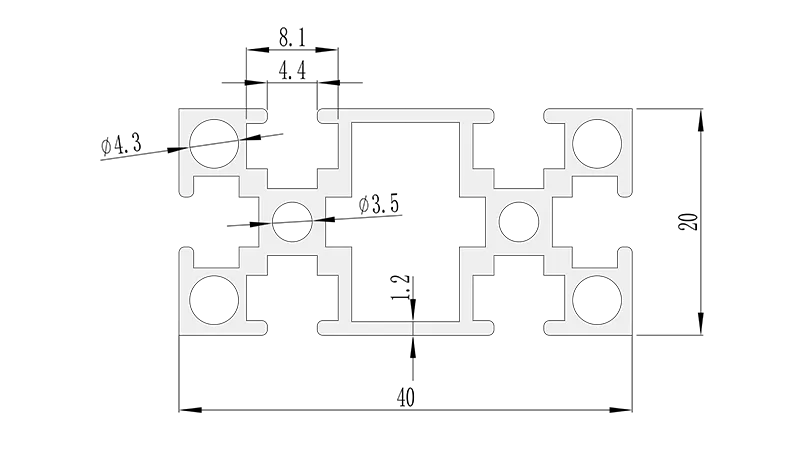
So, what exactly is the 2040 National Standard Profile? At its simplest, it's a type of aluminum extrusion profile—a lightweight, durable structural component used to build everything from workbenches and material racks to production line frames and turnover trolleys. The "2040" designation refers to its dimensions: 20mm in width and 40mm in height, making it a versatile middle-ground option for both light and medium-duty applications. But its true value lies not just in its size, but in its adherence to national standards, which ensure consistency, compatibility, and quality across manufacturers and suppliers.
Unlike generic or non-standardized materials, the 2040 National Standard Profile is engineered for interoperability. This means that profiles from different suppliers (as long as they meet the national standard) can work seamlessly with one another, along with a wide range of aluminum profile accessories like connectors, brackets, and end caps. This standardization is a game-changer for circular manufacturing: it eliminates the "vendor lock-in" that often forces companies to stick with a single supplier, and it ensures that components can be reused or repurposed even if the original manufacturer changes.
Aluminum Extrusion Profile: The Sustainable Backbone
The 2040 National Standard Profile is part of a broader family of aluminum extrusion profiles—materials that have long been celebrated for their sustainability credentials. Aluminum, by nature, is a champion of circularity: it's 100% recyclable, and recycling it requires just 5% of the energy needed to produce new aluminum from raw bauxite ore. This translates to a 95% reduction in carbon emissions, making aluminum extrusion profiles a far greener alternative to steel, plastic, or wood.
But sustainability isn't just about recyclability—it's also about durability. The 2040 National Standard Profile, made from high-grade aluminum alloy, boasts impressive strength-to-weight ratios. It's corrosion-resistant, meaning it holds up in harsh factory environments without needing frequent replacements. Unlike wood, which can warp or rot, or plastic, which degrades under heat and stress, aluminum extrusion profiles have lifespans measured in decades, not years. This longevity directly reduces the need for new materials, keeping waste out of landfills and lowering the overall environmental footprint of manufacturing operations.
Modularity and Lean Systems: A Match Made in Manufacturing Heaven
Circular economy manufacturing and lean manufacturing go hand in hand—both aim to eliminate waste, though lean focuses more on operational efficiency and circularity on resource preservation. The 2040 National Standard Profile excels at supporting both, thanks to its modular design. Lean systems thrive on flexibility: the ability to rearrange workstations, adjust material flow, and adapt to changing production schedules. Traditional fixed infrastructure (think welded steel workbenches or bolted-down racks) makes this nearly impossible without significant downtime and cost.
With the 2040 National Standard Profile, however, flexibility becomes second nature. Using simple aluminum profile accessories—like 90° aluminum profile connectors, T-slot brackets, or end caps—manufacturers can assemble, disassemble, and reconfigure structures in hours, not days. A workbench used for assembling small electronics today can be taken apart tomorrow and rebuilt as a material rack for automotive parts. A three-row, three-floor material rack can be modified to add extra shelves or adjust shelf heights as inventory needs change. This adaptability eliminates the "waste of overproduction" and "waste of waiting" that plague rigid systems, aligning perfectly with lean principles.
Consider a typical production line: when a new product is introduced, the workflow often changes. With traditional setups, this might require purchasing new workbenches or modifying existing ones with cutting or welding—processes that generate waste and disrupt production. With 2040 profile-based workbenches, operators can simply reposition the aluminum extrusion profiles, swap out accessories, and have the new workstation ready in minutes. This not only saves time and money but also reduces the demand for new raw materials, keeping the circular economy cycle intact.
Aluminum Profile Accessories: The Unsung Heroes of Reusability
While the 2040 National Standard Profile is the star of the show, its supporting cast—aluminum profile accessories—deserves equal recognition. These small, often overlooked components are what make the system truly modular and reusable. Take, for example, the internal straight aluminum joint: a simple, yet ingenious connector that allows two 2040 profiles to be joined end-to-end with minimal effort. Or the gusset alp 2020, a small bracket that reinforces corners, adding stability without permanent attachment. Even something as basic as a 2020 aluminum profile end cap plays a role, protecting the profile's ends from damage and ensuring safe handling during disassembly.
What makes these accessories so critical for circularity is their standardization. Because the 2040 National Standard Profile adheres to strict, accessories from different suppliers are interchangeable. This means manufacturers aren't tied to a single vendor for replacement parts, reducing supply chain risks and ensuring that even older profiles can be reused with new accessories. For instance, a 2040 profile purchased five years ago can still be paired with a newly bought 45° aluminum profile connector, ensuring the system remains adaptable long-term.
Perhaps most importantly, these accessories require no specialized tools to use. Unlike welding or drilling, which demand skilled labor and generate waste (like metal shavings or welding fumes), assembling with aluminum profile accessories is as simple as tightening a bolt with a hex key. This democratizes the reconfiguration process, empowering frontline operators to make adjustments as needed, rather than relying on maintenance teams. The result? Faster adaptation, less downtime, and a workforce more engaged in continuous improvement—all hallmarks of lean, circular manufacturing.
Comparing Materials: How 2040 Profile Stacks Up on Sustainability
To truly appreciate the 2040 National Standard Profile's role in circular economy manufacturing, it helps to compare it to other common materials used in factory infrastructure. Let's take a closer look at how it measures up against steel, wood, and plastic in key sustainability metrics:
| Sustainability Metric | 2040 National Standard Profile (Aluminum) | Steel | Wood | Plastic |
|---|---|---|---|---|
| Recyclability Rate | 95%+ (recycled aluminum uses 5% of primary production energy) | 85% (but recycling requires high energy; quality degrades with each cycle) | Biodegradable, but recycling wood into structural material is limited | 5-10% (most plastic isn't recycled; downcycled into lower-quality products) |
| Energy Use in Production | High for primary aluminum, but 95% reduction for recycled content | High (mining, smelting, rolling require significant energy) | Moderate (logging, processing), but deforestation is a concern | Moderate to high (derived from fossil fuels; production emits greenhouse gases) |
| Lifespan (Factory Use) | 20-30 years (corrosion-resistant, low maintenance) | 15-25 years (prone to rust without coating; heavy, harder to handle) | 5-10 years (susceptible to moisture, pests, warping) | 3-8 years (degrades under UV light, heat, and chemical exposure) |
| Reusability | Excellent (easily disassembled and repurposed with accessories) | Poor (welded or bolted structures are hard to disassemble; often cut/scrapped) | Limited (nails/screws damage wood; reuse often requires cutting down to size) | Poor (adhesives or welding make disassembly difficult; prone to cracking when reused) |
| Cost Over Time (Total Lifecycle) | Higher upfront, but lower long-term (reusability, low maintenance, recyclability) | Moderate upfront, high long-term (replacement costs, maintenance, disposal fees) | Low upfront, high long-term (frequent replacement, disposal) | Lowest upfront, highest long-term (short lifespan, disposal costs, environmental harm) |
As the table shows, the 2040 National Standard Profile outperforms other materials in nearly every category that matters for circular economy manufacturing. Its recyclability, combined with its modularity and long lifespan, makes it a clear choice for companies looking to reduce their environmental impact while improving operational efficiency.
Real-World Impact: A Case Study in Circular Manufacturing
To put these benefits into perspective, let's consider a real-world example: a mid-sized electronics manufacturer based in Guangdong, China, that recently transitioned its production line infrastructure to 2040 National Standard Profile systems. Prior to the switch, the company relied on welded steel workbenches, wooden material racks, and plastic conveyor guides—all of which had become outdated as the company expanded its product line to include larger devices.
The challenges were significant: steel workbenches couldn't be adjusted to accommodate taller components, wooden racks were warping from warehouse humidity, and plastic guides were cracking under the weight of heavier circuit boards. The company was spending nearly ¥200,000 annually on replacing damaged infrastructure and modifying workstations. Worse, the rigid setup meant that introducing a new product line took 4-6 weeks of downtime, during which old structures were scrapped and new ones built—a process that generated over 5 tons of waste per year.
After consulting with a 2040 national standard profile supplier, the company invested in aluminum extrusion profile workbenches, material racks, and conveyor components. The results were striking:
- Waste reduction: By reusing 2040 profiles and accessories, the company cut infrastructure-related waste by 85%. Old steel and wood structures were recycled, and plastic waste from broken guides dropped to near-zero.
- Downtime reduction: New product line transitions now take 2-3 days instead of weeks, as workstations are reconfigured rather than replaced.
- Cost savings: Annual infrastructure replacement costs fell by ¥150,000, and energy costs for manufacturing setup decreased by 12% due to reduced welding and cutting.
- Employee satisfaction: Operators reported less fatigue from adjusting workbench heights and easier access to materials, leading to a 10% improvement in productivity.
Overcoming Barriers: Addressing the "But It Costs More" Objection
Despite its clear benefits, some manufacturers hesitate to adopt 2040 National Standard Profile systems due to upfront costs. It's true: aluminum extrusion profiles and accessories often have a higher initial price tag than steel, wood, or plastic. However, this narrow focus on upfront cost ignores the total cost of ownership (TCO)—a critical metric in circular economy manufacturing.
When factoring in lifespan (20+ years for aluminum vs. 5-10 for plastic/wood), reusability (aluminum can be repurposed indefinitely), and recyclability (aluminum retains value even at end-of-life), the TCO of 2040 profile systems is significantly lower. For example, a steel workbench might cost ¥500 upfront, but need replacement every 8 years, totaling ¥1,250 over 20 years. An aluminum extrusion profile workbench might cost ¥800 upfront, but last 20 years with no replacement needed—and at the end of its life, the aluminum can be recycled for 30-40% of its original value.
Another barrier is the perception that modular systems are "less sturdy" than fixed ones. This couldn't be further from the truth. When properly assembled with high-quality aluminum profile accessories, 2040 National Standard Profile structures meet or exceed the load-bearing capacities of steel for most factory applications. The key is working with reputable 2040 profile suppliers who provide engineering support and quality materials—like anodized aluminum extrusion profiles that resist scratches and corrosion.
The Future of Circular Manufacturing: Where 2040 Profile Leads
As governments worldwide tighten environmental regulations and consumers demand more sustainable products, the role of the 2040 National Standard Profile in circular economy manufacturing will only grow. Emerging trends are set to amplify its impact:
- Innovations in aluminum extrusion: New alloys are making aluminum extrusion profiles even lighter and stronger, expanding their use into heavy-duty applications previously dominated by steel.
- Digital tools for modular design: 3D modeling software tailored to 2040 profile systems allows manufacturers to plan, test, and optimize configurations virtually before assembly, reducing trial-and-error waste.
- Circular supply chains: Suppliers are increasingly offering take-back programs for used aluminum extrusion profiles, ensuring they're recycled or refurbished rather than discarded.
- Policy support: Governments are introducing tax incentives for companies that adopt circular manufacturing practices, including the use of recyclable materials like aluminum.
Conclusion: The 2040 Profile as a Catalyst for Change
The 2040 National Standard Profile may seem like a small piece of the manufacturing puzzle, but its impact on circular economy manufacturing is profound. By combining sustainability (via aluminum's recyclability and durability), flexibility (through modular design and accessories), and efficiency (by supporting lean systems), it addresses the core challenges of modern manufacturing: how to do more with less, adapt to change, and leave a lighter footprint on the planet.
For manufacturers ready to embrace circularity, the message is clear: the future isn't in rigid, disposable infrastructure. It's in systems that grow, evolve, and endure—systems built on materials like the 2040 National Standard Profile. As the electronics manufacturer in our case study discovered, the investment isn't just in aluminum extrusion profiles and accessories; it's in a more resilient, sustainable, and prosperous future for both business and the planet.
In the end, circular economy manufacturing isn't about sacrifice—it's about smarter design. And the 2040 National Standard Profile is leading the way.