- Company Articles
- Industry articles
- Industry standards
- The Role of 2040 National Standard Profile in Flexible Conveyor Systems

The Role of 2040 National Standard Profile in Flexible Conveyor Systems
Related Product
2040 National Standard Profile
45° external bending joint, used for 45° external connection of two aluminum pipes.
Introduction: The Need for Flexibility in Modern Material Handling
Walk into any thriving manufacturing plant, distribution center, or e-commerce warehouse today, and you'll notice a common theme: change. Production lines shift to meet new product demands, seasonal spikes require reconfigured workflows, and evolving customer expectations demand faster, more adaptable material handling. In this environment, rigid, one-size-fits-all conveyor systems—a staple of industrial operations for decades—are quickly becoming obsolete. They're expensive to modify, time-consuming to reconfigure, and often fail to keep up with the pace of modern business.
Enter flexible conveyor systems: modular, adaptable setups designed to grow, shrink, and reshape alongside your operations. At the heart of these systems lies a critical component that often goes unnoticed but makes all the difference: aluminum extrusion profiles. And among these profiles, one stands out for its versatility and practicality in conveyor applications: the 2040 National Standard Profile.
In this article, we'll explore how this unassuming aluminum extrusion has become a cornerstone of flexible conveyor design, revolutionizing how businesses handle materials, optimize workflows, and stay competitive in a fast-changing world. We'll dive into its features, its seamless integration with aluminum profile accessories, its role in supporting roller tracks, and why it's become a go-to choice for engineers and operations managers alike.
What Is the 2040 National Standard Profile?
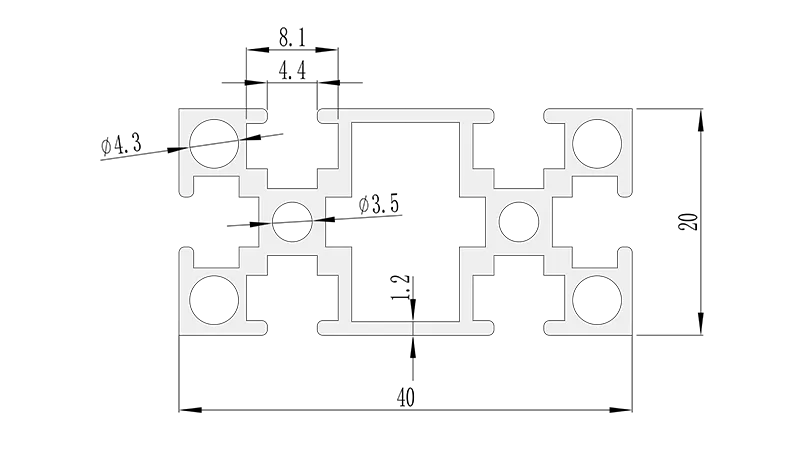
Let's start with the basics: What exactly is the 2040 National Standard Profile? Put simply, it's a precision-engineered aluminum extrusion defined by its dimensions—20 millimeters in width and 40 millimeters in height—and adherence to national manufacturing standards. This means every 2040 profile, regardless of the supplier, follows consistent specifications for slot size, wall thickness, and tolerances, ensuring compatibility across brands and applications.
Aluminum extrusion is the process that gives this profile its unique shape. Heated aluminum billets are forced through a die, creating a continuous length of material with a uniform cross-section—in this case, a rectangular profile with T-shaped slots running along its length. These T-slots are the profile's secret weapon: they allow for quick, tool-free attachment of accessories like brackets, connectors, and sensors, eliminating the need for welding or drilling and making reconfiguration a breeze.
But the 2040 profile isn't just about dimensions and slots. Its aluminum composition—typically 6063-T5, a common alloy in industrial applications—strikes a perfect balance between strength and weight. At just 1.2 to 1.5 millimeters in wall thickness (depending on the specific variant), it's lightweight enough for manual handling during assembly but strong enough to support heavy loads, making it ideal for conveyor frames that need to withstand the daily grind of material transport.
What sets the "national standard" aspect apart? In an industry where custom profiles were once the norm, standardization brings reliability. Engineers and purchasers know exactly what they're getting: a profile that fits with off-the-shelf accessories, works with existing tools, and can be sourced from multiple suppliers without compatibility issues. This standardization reduces lead times, lowers costs, and minimizes the risk of project delays—all critical factors in today's fast-paced operations.
Core Features of the 2040 National Standard Profile
To understand why the 2040 National Standard Profile is so valuable in conveyor systems, let's break down its key features and how they translate to real-world benefits:
T-Slot Design: The Backbone of Modularity
The T-slots running along the 2040 profile's length are more than just a design quirk—they're the foundation of its flexibility. These slots, typically 6mm or 8mm wide (depending on the standard), accept T-slot nuts, bolts, and brackets that slide into place and lock securely with a simple turn of a wrench. This means you can attach roller track brackets, side guides, or even sensors at any point along the profile, no pre-drilled holes required. Need to move a roller track 10 inches to the left to accommodate a wider product? Just loosen the bolts, slide the bracket, and re-tighten. It's that easy. Lightweight Yet Durable
Aluminum is inherently lighter than steel, and the 2040 profile leverages this to full advantage. A 1-meter length weighs roughly 0.8 to 1.2 kilograms, making it easy for a single worker to carry and assemble—no heavy lifting equipment needed. But don't let its weight fool you: aluminum's natural corrosion resistance means it holds up in harsh environments, from dusty warehouses to humid production floors, without rusting or degrading. This durability translates to longer system lifespans and lower maintenance costs over time. Precision Manufacturing
As a national standard profile, the 2040 extrusion is produced to tight tolerances. This precision ensures that every piece fits together seamlessly. Whether you're connecting two profiles at a 90-degree angle with a corner bracket or extending a conveyor section with a straight connector, there's no wiggle room or misalignment. This consistency reduces assembly time and ensures the final system operates smoothly, with minimal vibration or jamming—critical for conveyor systems moving delicate or high-value products. Cost-Effective Scalability
Unlike custom steel fabrication, which requires specialized tools and skilled labor, the 2040 profile is designed for mass production. This makes it affordable to purchase in bulk, and its modularity means you only buy what you need—no over-investing in oversized frames or unnecessary components. When your operation grows, you can simply add more profiles and accessories, rather than replacing the entire system. It's a "pay-as-you-grow" model that aligns with modern business budgets.
The T-slots running along the 2040 profile's length are more than just a design quirk—they're the foundation of its flexibility. These slots, typically 6mm or 8mm wide (depending on the standard), accept T-slot nuts, bolts, and brackets that slide into place and lock securely with a simple turn of a wrench. This means you can attach roller track brackets, side guides, or even sensors at any point along the profile, no pre-drilled holes required. Need to move a roller track 10 inches to the left to accommodate a wider product? Just loosen the bolts, slide the bracket, and re-tighten. It's that easy. Lightweight Yet Durable
Aluminum is inherently lighter than steel, and the 2040 profile leverages this to full advantage. A 1-meter length weighs roughly 0.8 to 1.2 kilograms, making it easy for a single worker to carry and assemble—no heavy lifting equipment needed. But don't let its weight fool you: aluminum's natural corrosion resistance means it holds up in harsh environments, from dusty warehouses to humid production floors, without rusting or degrading. This durability translates to longer system lifespans and lower maintenance costs over time. Precision Manufacturing
As a national standard profile, the 2040 extrusion is produced to tight tolerances. This precision ensures that every piece fits together seamlessly. Whether you're connecting two profiles at a 90-degree angle with a corner bracket or extending a conveyor section with a straight connector, there's no wiggle room or misalignment. This consistency reduces assembly time and ensures the final system operates smoothly, with minimal vibration or jamming—critical for conveyor systems moving delicate or high-value products. Cost-Effective Scalability
Unlike custom steel fabrication, which requires specialized tools and skilled labor, the 2040 profile is designed for mass production. This makes it affordable to purchase in bulk, and its modularity means you only buy what you need—no over-investing in oversized frames or unnecessary components. When your operation grows, you can simply add more profiles and accessories, rather than replacing the entire system. It's a "pay-as-you-grow" model that aligns with modern business budgets.
Integration with Aluminum Profile Accessories: A System That Works Together
A profile is only as good as the accessories that bring it to life, and the 2040 National Standard Profile shines here thanks to its compatibility with a wide range of aluminum profile accessories. These accessories—from connectors to end caps—turn individual profiles into fully functional conveyor systems, and they do so with minimal effort. Let's look at some key accessories and how they enhance the 2040 profile's role in conveyors:
Connectors: Building the Frame
Conveyor systems need structure, and connectors are the glue that holds the 2040 profile's frame together. 90-degree corner brackets, for example, let you join two profiles at a right angle to create the side rails of a conveyor. 45-degree brackets add flexibility for angled sections, while straight connectors extend the length of the frame. Many of these connectors are designed for tool-free assembly: simply slide them into the T-slots, tighten a knob, and you're done. This speed of assembly is a game-changer during system setup or reconfiguration. End Caps and Covers: Protecting and Polishing
Sharp edges on aluminum profiles can pose safety risks, especially in busy workplaces. End caps—plastic or aluminum caps that snap onto the ends of the 2040 profile—eliminate this hazard, covering exposed edges and preventing debris from entering the T-slots. T-slot rubber seal covers, another common accessory, fill in unused slots to keep out dust and grime, ensuring the profile remains easy to adjust over time. These small touches might seem minor, but they contribute to a safer, more professional-looking system. Roller Track Brackets: Supporting the Conveyor Surface
The conveyor's "working surface" is often a roller track—a series of rotating rollers that allow materials to glide along the system. To mount these roller tracks to the 2040 profile, you need specialized brackets. Roller track placon mounts, for example, are designed to attach directly to the profile's T-slots, providing a stable base for the track. Some mounts are adjustable, letting you tilt the roller track slightly to control material flow speed—a useful feature for fragile items like electronics components. Gussets and Reinforcements: Adding Strength Where It Matters
While the 2040 profile is strong on its own, heavier loads or longer spans may require extra support. Gussets—triangular brackets that reinforce corner joints—distribute weight evenly, preventing bending or warping under stress. For conveyor systems moving heavy pallets or machinery parts, these reinforcements are critical to ensuring the frame doesn't fail over time. And because they're designed for the 2040 profile, they attach easily via T-slots, no welding required.
Conveyor systems need structure, and connectors are the glue that holds the 2040 profile's frame together. 90-degree corner brackets, for example, let you join two profiles at a right angle to create the side rails of a conveyor. 45-degree brackets add flexibility for angled sections, while straight connectors extend the length of the frame. Many of these connectors are designed for tool-free assembly: simply slide them into the T-slots, tighten a knob, and you're done. This speed of assembly is a game-changer during system setup or reconfiguration. End Caps and Covers: Protecting and Polishing
Sharp edges on aluminum profiles can pose safety risks, especially in busy workplaces. End caps—plastic or aluminum caps that snap onto the ends of the 2040 profile—eliminate this hazard, covering exposed edges and preventing debris from entering the T-slots. T-slot rubber seal covers, another common accessory, fill in unused slots to keep out dust and grime, ensuring the profile remains easy to adjust over time. These small touches might seem minor, but they contribute to a safer, more professional-looking system. Roller Track Brackets: Supporting the Conveyor Surface
The conveyor's "working surface" is often a roller track—a series of rotating rollers that allow materials to glide along the system. To mount these roller tracks to the 2040 profile, you need specialized brackets. Roller track placon mounts, for example, are designed to attach directly to the profile's T-slots, providing a stable base for the track. Some mounts are adjustable, letting you tilt the roller track slightly to control material flow speed—a useful feature for fragile items like electronics components. Gussets and Reinforcements: Adding Strength Where It Matters
While the 2040 profile is strong on its own, heavier loads or longer spans may require extra support. Gussets—triangular brackets that reinforce corner joints—distribute weight evenly, preventing bending or warping under stress. For conveyor systems moving heavy pallets or machinery parts, these reinforcements are critical to ensuring the frame doesn't fail over time. And because they're designed for the 2040 profile, they attach easily via T-slots, no welding required.
The 2040 Profile in Action: Building Flexible Conveyor Systems
Now that we understand the 2040 profile's features and its compatibility with accessories, let's explore how it plays a central role in constructing flexible conveyor systems. We'll focus on two key components: the conveyor frame and the roller track, and how the profile ties them together.
Constructing the Conveyor Frame
Every conveyor system starts with a frame—the skeleton that supports the roller track, motors (if powered), and any additional components like side guides or guards. The 2040 profile is ideal for this job because it balances strength, weight, and adaptability. Imagine a small electronics manufacturer that needs a conveyor to move circuit boards from assembly to testing. The production line is compact, so the conveyor can't be too wide, but it needs to support lightweight (yet delicate) boards. The 2040 profile's 20x40mm dimensions are perfect here: narrow enough to fit in tight spaces, but tall enough to provide stability. Engineers would start by cutting 2040 profiles to the desired length for the frame's sides and cross-braces, then connect them using 90-degree corner brackets and T-slot bolts. The result is a lightweight frame that's easy to maneuver into place and sturdy enough to support the roller track above. Now, fast-forward six months: the manufacturer lands a contract for a larger circuit board, requiring a wider conveyor. Instead of scrapping the original frame, they simply add two more 2040 profiles to the sides, extending the width by 40mm, and attach new cross-braces. The T-slots make it easy to reposition the roller track brackets, and the modular frame adapts without a hitch. This kind of scalability is impossible with a welded steel frame, which would require cutting, re-welding, and repainting—costing time and money. Supporting Roller Tracks: The Conveyor's "Moving Surface"
The roller track is where the magic happens: it's the surface that actually moves materials along the conveyor. Roller tracks come in various designs—from gravity-fed (sloped to let items slide) to powered (with motors turning the rollers)—but in both cases, they need a stable, adjustable base. That's where the 2040 profile comes in. Roller tracks are typically mounted to the conveyor frame using brackets that attach to the 2040 profile's T-slots. For example, a plastic roller track guide rail (yellow or grey, as noted in the keyword list) might be secured to the profile using roller track placon mounts for aluminum profile flat. These mounts slide into the T-slots and lock in place, allowing precise alignment of the track. If the manufacturer needs to adjust the track's height to match a neighboring workbench, they can use taller brackets or shims—all without modifying the profile itself. In a warehouse setting, gravity-fed roller tracks are common for moving boxes or totes. The 2040 profile's lightweight nature makes it easy to angle the frame slightly (using adjustable feet or incline brackets), creating the slope needed for gravity to do the work. And because the profile is corrosion-resistant, it holds up even in damp environments where steel might rust, ensuring the roller track glides smoothly for years. Powered Conveyors: Adding Motors and Controls
For heavier loads or longer distances, powered conveyors are necessary. Here, the 2040 profile's role expands to supporting motors, gearboxes, and control systems. Motor mounts can be attached directly to the profile via T-slots, positioned exactly where needed to drive the roller track. The profile's rigidity ensures minimal vibration, preventing wear on moving parts and extending the motor's lifespan. And if the conveyor needs a variable speed control, a small electrical box can be mounted to the frame using bracket accessories—no need for custom enclosures.
Every conveyor system starts with a frame—the skeleton that supports the roller track, motors (if powered), and any additional components like side guides or guards. The 2040 profile is ideal for this job because it balances strength, weight, and adaptability. Imagine a small electronics manufacturer that needs a conveyor to move circuit boards from assembly to testing. The production line is compact, so the conveyor can't be too wide, but it needs to support lightweight (yet delicate) boards. The 2040 profile's 20x40mm dimensions are perfect here: narrow enough to fit in tight spaces, but tall enough to provide stability. Engineers would start by cutting 2040 profiles to the desired length for the frame's sides and cross-braces, then connect them using 90-degree corner brackets and T-slot bolts. The result is a lightweight frame that's easy to maneuver into place and sturdy enough to support the roller track above. Now, fast-forward six months: the manufacturer lands a contract for a larger circuit board, requiring a wider conveyor. Instead of scrapping the original frame, they simply add two more 2040 profiles to the sides, extending the width by 40mm, and attach new cross-braces. The T-slots make it easy to reposition the roller track brackets, and the modular frame adapts without a hitch. This kind of scalability is impossible with a welded steel frame, which would require cutting, re-welding, and repainting—costing time and money. Supporting Roller Tracks: The Conveyor's "Moving Surface"
The roller track is where the magic happens: it's the surface that actually moves materials along the conveyor. Roller tracks come in various designs—from gravity-fed (sloped to let items slide) to powered (with motors turning the rollers)—but in both cases, they need a stable, adjustable base. That's where the 2040 profile comes in. Roller tracks are typically mounted to the conveyor frame using brackets that attach to the 2040 profile's T-slots. For example, a plastic roller track guide rail (yellow or grey, as noted in the keyword list) might be secured to the profile using roller track placon mounts for aluminum profile flat. These mounts slide into the T-slots and lock in place, allowing precise alignment of the track. If the manufacturer needs to adjust the track's height to match a neighboring workbench, they can use taller brackets or shims—all without modifying the profile itself. In a warehouse setting, gravity-fed roller tracks are common for moving boxes or totes. The 2040 profile's lightweight nature makes it easy to angle the frame slightly (using adjustable feet or incline brackets), creating the slope needed for gravity to do the work. And because the profile is corrosion-resistant, it holds up even in damp environments where steel might rust, ensuring the roller track glides smoothly for years. Powered Conveyors: Adding Motors and Controls
For heavier loads or longer distances, powered conveyors are necessary. Here, the 2040 profile's role expands to supporting motors, gearboxes, and control systems. Motor mounts can be attached directly to the profile via T-slots, positioned exactly where needed to drive the roller track. The profile's rigidity ensures minimal vibration, preventing wear on moving parts and extending the motor's lifespan. And if the conveyor needs a variable speed control, a small electrical box can be mounted to the frame using bracket accessories—no need for custom enclosures.
Beyond Conveyors: 2040 Profile in Workbenches and Material Handling
While its role in conveyors is critical, the 2040 National Standard Profile's versatility extends beyond material transport. It's also a popular choice for building workbenches, turnover trolleys, and material racks—completing the "circle" of material handling by connecting conveyor systems to the workstations where products are assembled, inspected, or packed.
Take a workbench, for example. In many manufacturing settings, workbenches need to be custom-height, with built-in storage, tool holders, and even integrated conveyor extensions for moving parts to and from the bench. The 2040 profile's modularity makes it easy to build a bench that fits these needs. The frame can be constructed with 2040 profiles cut to the desired height, with a plywood or aluminum top secured via T-slot brackets. Tool hooks, shelves, and even small roller tracks (for feeding parts from the main conveyor) can be added anywhere along the profile, adapting to the worker's specific tasks.
Turnover trolleys—used to transport materials between workstations—benefit similarly. A trolley frame built with 2040 profiles is lightweight enough to push by hand but strong enough to carry heavy loads. Casters (another keyword from the list) can be attached to the bottom using caster installation bases, and the T-slots allow for adjustable shelves or dividers to organize different parts. When not in use, the trolley can even be disassembled and stored compactly—something you can't do with a welded steel trolley.
Comparing Profiles: Why 2040 Stands Out for Conveyors
The 2040 National Standard Profile isn't the only aluminum extrusion on the market. So why is it so widely used in flexible conveyors? Let's compare it to two other common profiles—the 3030 and 4040 National Standard Profiles—to see how it stacks up:
| Profile Type | Dimensions (WxH) | Typical Weight (kg/m) | Max Load Capacity (kg/m) | Best For | Common Conveyor Applications |
|---|---|---|---|---|---|
| 2040 National Standard Profile | 20mm x 40mm | 0.8–1.2 | 50–80 | Medium-weight loads, compact spaces | Electronics assembly lines, small-part conveyors, workbench integration |
| 3030 National Standard Profile | 30mm x 30mm | 1.0–1.4 | 80–120 | Heavy-duty loads, square frames | Pallet conveyors, industrial material handling |
| 4040 National Standard Profile | 40mm x 40mm | 1.5–2.0 | 120–200 | Very heavy loads, large systems | Warehouse distribution conveyors, automotive part transport |
As the table shows, the 2040 profile hits a sweet spot between the smaller 3030 and larger 4040 profiles. Its 20x40mm dimensions make it narrower than the square profiles, ideal for tight spaces like electronics assembly lines where floor space is limited. Yet it still supports enough weight (50–80 kg/m) for most small to medium-sized products, from circuit boards to packaged goods.
For conveyor systems, this balance of size and strength is critical. A 4040 profile would be overkill for a lightweight electronics conveyor, adding unnecessary weight and cost. A 3030 profile, while strong, is square and may not fit as easily into compact layouts. The 2040's rectangular shape also offers more surface area for mounting accessories—useful for attaching side guides or sensors along the conveyor's length.
In short, the 2040 profile isn't the "best" profile for every job—but for the flexible, medium-duty conveyor systems that power most modern manufacturing and warehousing operations, it's often the perfect fit.
Real-World Benefits: Why Businesses Choose the 2040 Profile
To truly understand the impact of the 2040 National Standard Profile, let's look at how it benefits real businesses across industries:
Reduced Downtime During Reconfiguration
A automotive parts supplier recently shared how switching to a 2040 profile-based conveyor system cut reconfiguration time by 75%. Previously, changing their conveyor layout to accommodate a new part required cutting and welding steel frames, taking 8 hours and halting production. With the 2040 profile, the same reconfiguration takes 2 hours: workers loosen the T-slot bolts, adjust the frame, reposition the roller track, and tighten everything back up. The result? Less downtime, happier customers, and more flexibility to take on rush orders. Lower Labor Costs
A small e-commerce fulfillment center was struggling with high labor costs from manually moving packages between packing stations. They invested in a gravity-fed conveyor system built with 2040 profiles and roller tracks. The system was assembled by two warehouse staff in a single day (no specialized contractors needed), and it reduced the need for 3 manual material handlers. Within 3 months, the system paid for itself in labor savings. Improved Safety
A food processing plant needed a conveyor system that could be easily cleaned to meet hygiene standards. Steel conveyors were prone to rust, creating bacteria traps, and were heavy to disassemble for cleaning. The 2040 profile's aluminum construction is corrosion-resistant, and its modular design allows workers to quickly remove roller tracks and wash the frame with pressure hoses. This not only improved safety but also helped the plant pass its annual health inspection with zero violations. Sustainability
As businesses focus more on sustainability, the 2040 profile's aluminum composition is a win. Aluminum is 100% recyclable, and because the profile is modular, components can be reused or repurposed when the system is retired. A furniture manufacturer, for example, recently dismantled an old conveyor system and reused 80% of the 2040 profiles to build workbenches for a new production line, reducing waste and lowering material costs.
A automotive parts supplier recently shared how switching to a 2040 profile-based conveyor system cut reconfiguration time by 75%. Previously, changing their conveyor layout to accommodate a new part required cutting and welding steel frames, taking 8 hours and halting production. With the 2040 profile, the same reconfiguration takes 2 hours: workers loosen the T-slot bolts, adjust the frame, reposition the roller track, and tighten everything back up. The result? Less downtime, happier customers, and more flexibility to take on rush orders. Lower Labor Costs
A small e-commerce fulfillment center was struggling with high labor costs from manually moving packages between packing stations. They invested in a gravity-fed conveyor system built with 2040 profiles and roller tracks. The system was assembled by two warehouse staff in a single day (no specialized contractors needed), and it reduced the need for 3 manual material handlers. Within 3 months, the system paid for itself in labor savings. Improved Safety
A food processing plant needed a conveyor system that could be easily cleaned to meet hygiene standards. Steel conveyors were prone to rust, creating bacteria traps, and were heavy to disassemble for cleaning. The 2040 profile's aluminum construction is corrosion-resistant, and its modular design allows workers to quickly remove roller tracks and wash the frame with pressure hoses. This not only improved safety but also helped the plant pass its annual health inspection with zero violations. Sustainability
As businesses focus more on sustainability, the 2040 profile's aluminum composition is a win. Aluminum is 100% recyclable, and because the profile is modular, components can be reused or repurposed when the system is retired. A furniture manufacturer, for example, recently dismantled an old conveyor system and reused 80% of the 2040 profiles to build workbenches for a new production line, reducing waste and lowering material costs.
Conclusion: The 2040 Profile—A Foundation for the Future of Material Handling
In a world where adaptability is key to survival, the 2040 National Standard Profile has emerged as more than just a component—it's a strategic asset. Its modular design, compatibility with aluminum profile accessories, and role in supporting roller tracks and conveyors make it a cornerstone of flexible material handling systems. Whether you're a small manufacturer looking to streamline assembly or a large warehouse aiming to keep up with e-commerce demand, this unassuming aluminum extrusion offers the flexibility, durability, and cost-effectiveness you need to stay ahead.
As we look to the future—with Industry 4.0, automation, and smart factories on the horizon—the 2040 profile is poised to play an even bigger role. Its T-slots are ready to integrate with IoT sensors that monitor conveyor performance, its lightweight design works with collaborative robots (cobots) that load and unload materials, and its modularity ensures it can adapt to whatever new technologies come next.
So the next time you walk through a warehouse or manufacturing plant and see a conveyor system effortlessly moving products, take a closer look at the frame. Chances are, you'll spot the 2040 National Standard Profile—quietly doing its job, making flexibility possible, and proving that sometimes, the most innovative solutions are the ones that fit seamlessly into the systems we rely on every day.