- Company Articles
- Industry articles
- Industry standards
- The Role of 4080B EU Standard Aluminum Profile in Smart Factory Construction

The Role of 4080B EU Standard Aluminum Profile in Smart Factory Construction
Related Product
4080B EU Standard Aluminum Profile
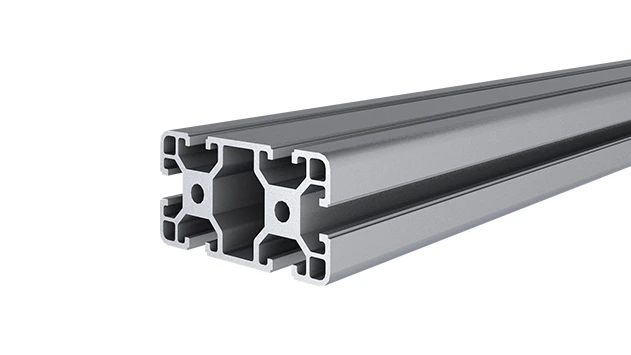
4080B is a 4.00x8.00 CM fractional 40 series square extrusion T-slot profile with two side open T-slots, each side with 4.00cm face, two side with 8.00cm face. The profile has align-a-grooves to assist in aligning connecting profiles.
Introduction: The Changing Landscape of Modern Manufacturing
In the age of Industry 4.0, smart factories are no longer a distant vision but a tangible reality reshaping how products are designed, built, and delivered. These advanced manufacturing facilities thrive on flexibility, connectivity, and efficiency—powered by automation, IoT sensors, and real-time data analytics. Yet, beneath the high-tech surface of robotics and AI lies a critical, often overlooked foundation: the physical infrastructure that supports these systems. From workbenches and material racks to conveyor systems and assembly lines, the structural backbone of a smart factory must be as adaptable and innovative as the technology it houses. This is where the 4080B EU Standard Aluminum Profile emerges as a game-changer, offering a modular, durable, and future-ready solution to the unique challenges of modern manufacturing.
Today's manufacturers face unprecedented pressure to adapt. Consumer demands for customization, shorter product lifecycles, and rapid time-to-market mean production lines can no longer remain static. A factory that builds smartphones today might need to reconfigure for wearables next quarter, or shift from mass production to small-batch, personalized orders overnight. Traditional infrastructure—welded steel frames, fixed concrete workstations, or one-size-fits-all conveyor belts—simply can't keep up. They're heavy, time-consuming to modify, and often require specialized labor to reconfigure, leading to costly downtime and missed opportunities.
Enter aluminum extrusion profiles, and in particular, the 4080B EU Standard Aluminum Profile. Designed with modularity and versatility in mind, this engineered material has quickly become the backbone of smart factory construction. Its unique combination of strength, lightweight design, and compatibility with a vast array of aluminum profile accessories makes it ideal for creating everything from workbenches and material racks to automated guided vehicle (AGV) pathways and robot mounting frames. In this article, we'll explore how the 4080B profile is transforming smart factory infrastructure, why it's preferred over traditional materials, and how it integrates seamlessly with lean manufacturing principles to drive efficiency and innovation.
Understanding the 4080B EU Standard Aluminum Profile: More Than Just Metal
At first glance, the 4080B EU Standard Aluminum Profile might seem like just another piece of metal, but its design and engineering tell a different story. Let's start with the basics: the "4080B" refers to its dimensions—40mm in width and 80mm in height—while "EU Standard" ensures compliance with strict European norms for quality, safety, and dimensional accuracy. But what truly sets it apart is the process by which it's made: aluminum extrusion. Unlike steel, which is often cut or bent into shape, aluminum extrusion involves forcing heated aluminum alloy through a die to create a continuous profile with a specific cross-sectional shape. This method allows for intricate, consistent designs—including the signature T-slots that run along the length of the profile—without sacrificing structural integrity.
Key Features of 4080B Aluminum Profile:
- Dimensions: 40mm (width) x 80mm (height), with a wall thickness optimized for balance between weight and strength.
- T-Slots: Precisely machined grooves along the profile's length, designed to accept bolts, nuts, and aluminum profile accessories like brackets, joints, and panels.
- Material: Typically made from 6063-T5 aluminum alloy, known for its excellent corrosion resistance, thermal conductivity, and formability.
- Surface Finish: Anodized or powder-coated for enhanced durability and aesthetic appeal, with options for ESD (electrostatic discharge) protection in sensitive environments.
To appreciate why this matters, compare it to traditional steel framing. Steel is strong, but it's heavy—making reconfiguration labor-intensive and costly. It also rusts without proper coating, a significant drawback in factories with high humidity or exposure to coolants and lubricants. Plastic profiles, on the other hand, are lightweight but lack the load-bearing capacity needed for heavy machinery or industrial workbenches. The 4080B profile strikes a perfect balance: it's 30% lighter than steel (reducing installation and reconfiguration effort) while offering comparable strength, thanks to the inherent properties of aluminum alloy and the structural efficiency of its extrusion design.
The T-slots are perhaps the profile's most innovative feature. These grooves act as built-in connection points, allowing users to attach aluminum profile accessories—such as brackets, hinges, panels, or conveyor tracks—without welding or drilling. A simple T-bolt, nut, and washer are all that's needed to secure components, making assembly and disassembly fast and tool-friendly. This modularity is a cornerstone of smart factory design: if a workbench needs to be extended, or a material rack repositioned, workers can simply loosen the bolts, adjust the structure, and retighten—no cutting, welding, or specialized skills required. It's like building with industrial-grade Lego blocks, but for factories.

Why 4080B Stands Out: Advantages for Smart Factory Infrastructure
The 4080B EU Standard Aluminum Profile isn't just a material choice—it's a strategic investment in a factory's ability to adapt and grow. Let's break down its key advantages and how they address the specific needs of smart manufacturing:
1. Unmatched Modularity and Rapid Reconfiguration
In a smart factory, downtime is the enemy. Every minute a production line is idle due to reconfiguration costs money and delays. The 4080B profile's modular design eliminates this problem. With its T-slot system and compatible aluminum profile accessories—such as internal rotatary aluminum joints, parallel aluminum joint A, or 90° aluminum crossing joints—workers can reconfigure workstations, material racks, or conveyor systems in hours, not days. For example, a workbench (like the "Workbench E (Single Deck-Without Caster)" from many lean system suppliers) built with 4080B profiles can be easily extended by adding extra sections, or modified to include tool holders, monitor mounts, or ESD mats, all without altering the core structure.
This flexibility is especially critical for industries like electronics manufacturing, where product sizes and assembly processes change frequently. A smartphone assembly line using 4080B-based workstations can quickly adjust to larger tablet sizes by adding extension profiles, or integrate new testing equipment by attaching brackets to the T-slots. Compare this to a traditional wooden or steel workbench, which would require sawing, drilling, or welding—tasks that demand skilled labor and disrupt production for days.
2. Strength Without the Weight
Aluminum is inherently lighter than steel, but the 4080B profile's extrusion design maximizes strength while minimizing mass. The 6063-T5 aluminum alloy used in its construction has a tensile strength of around 210 MPa (megapascals)—strong enough to support heavy machinery, tooling, or stacked materials—yet weighs just 2.3 kg per meter (depending on wall thickness). This lightweight nature offers two key benefits: easier handling during installation and reconfiguration, and reduced strain on floors and support structures. In smart factories where AGVs or automated carts move materials between stations, lighter infrastructure also means less wear and tear on floor surfaces and vehicle components, lowering maintenance costs over time.
Consider a material rack, such as "Material Rack B (3 Row and 3 Floor)" commonly supplied by lean system suppliers. Built with 4080B profiles, this rack can hold hundreds of kilograms of components while remaining light enough for two workers to reposition manually, without the need for forklifts or cranes. This not only speeds up layout changes but also improves workplace safety by reducing the risk of injuries from heavy lifting.
3. Durability and Longevity
Smart factories are long-term investments, and their infrastructure must stand the test of time. The 4080B profile delivers here, too. Aluminum's natural resistance to corrosion means it won't rust, even in humid or chemical-exposed environments (a common issue in food processing or pharmaceutical manufacturing). Its anodized or powder-coated finish adds an extra layer of protection, preventing scratches, dents, or discoloration from daily use. Unlike plastic profiles, which can warp under heat or UV exposure, or wood, which rots or splinters, 4080B aluminum profiles maintain their structural integrity for decades, making them a cost-effective choice over the long term.
This durability is backed by real-world performance. Factories using 4080B profiles report infrastructure lifespans of 10–15 years, with minimal maintenance beyond occasional tightening of bolts. Even in high-traffic areas, such as near roller track conveyor systems (using components like "Plastic Roller Track Guide Rail Yellow" or "Aluminum Guide Rail A"), the 4080B's robust construction resists dents and bending, ensuring consistent performance.
4. Sustainability and Cost Efficiency
Sustainability is no longer a buzzword in manufacturing—it's a business imperative. Aluminum is 100% recyclable, and recycling it requires just 5% of the energy needed to produce new aluminum. This makes the 4080B profile an eco-friendly alternative to steel (which is also recyclable but requires more energy to process) or plastic (which often ends up in landfills). For smart factories aiming to reduce their carbon footprint, switching to aluminum extrusion profiles is a tangible step toward sustainability.
Beyond environmental benefits, 4080B also offers long-term cost savings. While the upfront cost of aluminum profiles may be higher than wood or low-grade steel, their durability, reusability, and low maintenance needs offset this initial investment. A 4080B-based workstation can be disassembled, moved, and reassembled multiple times over its lifespan, whereas a wooden workbench might need to be replaced entirely after a single reconfiguration. Additionally, the ability to reuse aluminum profile accessories—joints, brackets, casters—across different projects further reduces waste and costs.
Real-World Applications: How 4080B Transforms Smart Factory Infrastructure
The 4080B EU Standard Aluminum Profile isn't just a theoretical solution—it's a practical tool used daily in factories worldwide. Let's explore some of its most common applications, and how they enhance smart factory operations:
Workbenches: The Heart of Assembly and Testing
Workbenches are the workhorses of any factory, and in smart manufacturing, they need to be more than just flat surfaces. They must integrate tools, monitors, power supplies, ESD protection, and even IoT sensors. 4080B profiles excel here, providing a sturdy, customizable frame for workbenches of all types. For example, an ESD workstation (like the "ESD Workstation Wholesale" models offered by lean system suppliers) built with 4080B profiles can include integrated grounding strips (connected via T-slot brackets), adjustable height settings (using caster wheels and leveling feet), and built-in cable management (routed through the profile's hollow interior).
The "Workbench E (Single Deck-Without Caster)" is a prime example. Its frame, constructed from 4080B profiles, supports a durable aluminum honeycomb panel top, while T-slots along the sides allow for easy attachment of tool hooks, bins, or LED task lights. Workers can adjust the height by swapping out leg profiles, or add a second deck for extra storage—all without modifying the original structure. In electronics manufacturing, where ESD protection is critical, 4080B profiles can be anodized with conductive coatings, ensuring static charges are safely dissipated to the ground.
Material Racks and Storage Systems
Efficient material handling is the backbone of lean manufacturing, and 4080B profiles make it easier than ever to build custom storage solutions. "Material Rack B (3 Row and 3 Floor)" is a popular design among lean system suppliers, and for good reason: its 4080B frame provides the strength to hold heavy components, while adjustable shelf heights (via T-slot brackets) allow for flexible storage of different-sized parts. Unlike fixed steel racks, these can be reconfigured to accommodate new inventory sizes or seasonal demand spikes, ensuring optimal use of warehouse space.
For dynamic storage—where materials need to flow quickly to production lines—4080B profiles are often paired with roller tracks, such as "38 Aluminum Roller Track Yellow" or "40 Steel Roller Track Black ESD Wheel." These tracks, mounted to 4080B frames, create gravity-fed flow racks that ensure first-in, first-out (FIFO) inventory management, reducing waste and improving order accuracy. The T-slot system makes it easy to adjust track angles or add dividers, adapting to different container sizes or material weights.
Conveyor and Material Handling Systems
In smart factories, automated material handling is essential for efficiency. Conveyor systems, roller tracks, and AGV pathways must be durable, precise, and adaptable—qualities the 4080B profile delivers. For example, roller track systems (using components like "Roller Track Placon Mount for Aluminum Profile High" or "End Support for Roller Track Placon Mount with Stop") are often built with 4080B frames, providing a stable base for the rollers while allowing for easy adjustments to track width or height. This is critical for ensuring smooth movement of products between assembly stations, even as product sizes change.
AGV pathways are another area where 4080B shines. By using 4080B profiles to create guide rails or boundary markers, factories can quickly redefine AGV routes to accommodate new production layouts. The lightweight nature of aluminum also means these pathways can be installed without heavy equipment, and modified on the fly as needs evolve. For manual material handling, 4080B profiles are used to build turnover trolleys and hand trucks (like "Hand Trolley A" or "Turnover Trolley and Rack"), which are lightweight yet strong enough to carry heavy loads, reducing worker fatigue and improving productivity.
Custom Machinery Frames and Enclosures
Smart factories rely on specialized machinery—from robotic arms to testing equipment—and these machines need sturdy, precise frames. The 4080B profile's dimensional accuracy (thanks to EU standards) and rigidity make it ideal for building custom machine frames. For example, a vision inspection station used in quality control can be constructed with 4080B profiles, providing a stable platform for cameras, lighting, and conveyors, while the T-slots allow for easy integration of sensors or adjustment of component positions.
Machine enclosures, designed to protect workers from moving parts or contain dust, are another common application. 4080B profiles form the frame, with panels (aluminum, acrylic, or polycarbonate) attached via T-slot brackets. These enclosures can be quickly modified to add access doors, viewing windows, or ventilation, ensuring compliance with safety standards while adapting to new machinery requirements.
Comparing 4080B to Other Profiles: Why It's the Smart Choice
While there are many aluminum extrusion profiles on the market—such as 2020, 3030, or 4040 EU Standard Aluminum Profiles—the 4080B stands out for its balance of size, strength, and versatility. To understand why, let's compare it to two common alternatives: the smaller 4040A EU Standard Aluminum Profile and traditional steel framing, using a table to highlight key differences:
| Feature | 4080B EU Standard Aluminum Profile | 4040A EU Standard Aluminum Profile | Traditional Steel Framing |
|---|---|---|---|
| Dimensions | 40mm x 80mm | 40mm x 40mm | Varies (typically 50mm x 50mm angle iron) |
| Weight per Meter | ~2.3 kg | ~1.5 kg | ~4.0 kg (steel angle iron) |
| Max Load Capacity (Horizontal Beam) | ~500 kg (depending on span) | ~300 kg (depending on span) | ~800 kg (but heavier and harder to handle) |
| Modularity | High (T-slots, compatible with all aluminum profile accessories) | High (but smaller T-slots limit accessory size) | Low (requires welding or drilling for modifications) |
| Corrosion Resistance | Excellent (anodized/powder-coated aluminum) | Excellent (same material) | Poor (requires painting/coating; rusts easily) |
| Reconfiguration Time | Hours (using hand tools) | Hours (but limited by smaller size) | Days (requires welding, cutting, repainting) |
The table above illustrates why the 4080B is often the preferred choice for medium to heavy-duty applications in smart factories. While the 4040A is lighter and more cost-effective for smaller projects (like small tool racks or light-duty workbenches), its smaller size limits load capacity and the range of aluminum profile accessories it can support. Traditional steel framing, meanwhile, offers higher load capacity but at the cost of weight, corrosion resistance, and flexibility—making it impractical for dynamic, fast-changing environments.
For example, a "Material Rack B (3 Row and 3 Floor)" built with 4080B profiles can safely hold heavier components than one built with 4040A, while remaining easier to reconfigure than a steel rack. Similarly, a conveyor system using 4080B frames can support longer spans between supports, reducing the number of posts needed and freeing up floor space for other equipment—an essential advantage in crowded smart factories.
Choosing the Right Supplier: Partnering for Success
While the 4080B EU Standard Aluminum Profile is a powerful tool, its effectiveness depends on partnering with the right lean system supplier. A reputable supplier doesn't just sell profiles—they provide expertise, a wide range of compatible aluminum profile accessories, and support to ensure your infrastructure meets your specific needs. Here are key factors to consider when selecting a supplier:
- Product Range: Look for suppliers offering a comprehensive lineup of 4080B profiles, aluminum extrusion profiles, and accessories—including joints, brackets, casters, roller tracks, and workbench components. This ensures compatibility and reduces the need to source from multiple vendors.
- Quality Compliance: Verify that the supplier's 4080B profiles meet EU standards (EN 755-9 for aluminum extrusions) and are certified for strength, dimensional accuracy, and surface finish. This is critical for ensuring safety and performance in industrial applications.
- Technical Support: A good supplier should offer design assistance, including CAD drawings, load capacity charts, and assembly guides. This is especially valuable for complex projects like custom conveyor systems or machinery frames.
- Lead Times and Inventory: Smart factories can't afford long waits for components. Choose a supplier with local inventory and fast shipping to minimize downtime during reconfiguration or expansion.
- Customization Options: While standard profiles meet most needs, some projects require custom lengths, finishes, or accessories. Suppliers offering cutting, drilling, or anodizing services can save time and ensure precise results.
By partnering with a reliable lean system supplier, manufacturers can ensure they have access to not just high-quality 4080B profiles, but also the expertise and support needed to maximize their investment. Whether you're building a single workbench or an entire production line, the right supplier becomes an extension of your team, helping you design infrastructure that grows with your factory.
Future-Proofing Smart Factories: The Role of 4080B in Industry 4.0 and Beyond
As we look to the future, the role of the 4080B EU Standard Aluminum Profile in smart factory construction will only grow. Industry 4.0 is evolving into Industry 5.0, which emphasizes human-machine collaboration, sustainability, and resilience—and the 4080B profile aligns perfectly with these goals.
One emerging trend is the integration of IoT and smart sensors into factory infrastructure. With its T-slot system, the 4080B profile is uniquely suited to house sensors for monitoring temperature, vibration, or load levels in real time. For example, a material rack built with 4080B profiles could include weight sensors (attached via T-slot brackets) that alert workers when inventory is low, or vibration sensors that detect imbalances in rotating machinery. This data can then be fed into the factory's IoT platform, enabling predictive maintenance and data-driven decision-making.
Sustainability will also drive innovation in aluminum extrusion profiles. Manufacturers are already exploring recycled aluminum alloys with the same strength as primary aluminum, reducing the carbon footprint of 4080B profiles even further. Additionally, modular designs will become more sophisticated, with "plug-and-play" accessories that integrate renewable energy solutions—such as solar panels mounted on 4080B-based frames—to power small equipment or lighting in the factory.
Finally, the rise of digital twins—virtual replicas of physical factories—will rely on accurate, standardized infrastructure like the 4080B profile. By using CAD models of 4080B profiles and accessories, manufacturers can simulate production line changes in the virtual world before implementing them physically, reducing risk and ensuring optimal performance. This digital-physical integration is only possible with modular, standardized components that behave predictably in both realms.
Conclusion: Building the Future, One Profile at a Time
In the fast-paced world of smart manufacturing, the difference between success and failure often lies in the details—the foundation upon which innovation is built. The 4080B EU Standard Aluminum Profile is more than just a building material; it's a catalyst for change, enabling factories to adapt, grow, and thrive in an era of constant evolution. Its modularity, strength, and sustainability make it the ideal choice for constructing workbenches, material racks, conveyor systems, and custom machinery frames that can keep pace with the demands of Industry 4.0 and beyond.
Whether you're a small contract manufacturer or a global automotive giant, investing in 4080B profiles means investing in flexibility, efficiency, and future readiness. It's a choice that reduces downtime, lowers costs, and empowers your team to innovate without being limited by rigid infrastructure. As smart factories continue to redefine manufacturing, the 4080B profile will remain a silent but essential partner, supporting the technology, people, and processes that drive the industry forward.
So, the next time you walk through a smart factory—admiring the robots, the AI-powered systems, and the seamless production flow—take a moment to look closer at the structures supporting it all. Chances are, you'll see the 4080B EU Standard Aluminum Profile, quietly proving that sometimes, the most innovative solutions are the ones that form the foundation.