- Company Articles
- Industry articles
- Industry standards
- Top 5 Applications of 2040 National Standard Profile in 3C Manufacturing

Top 5 Applications of 2040 National Standard Profile in 3C Manufacturing
Related Product
2040 National Standard Profile
45° external bending joint, used for 45° external connection of two aluminum pipes.
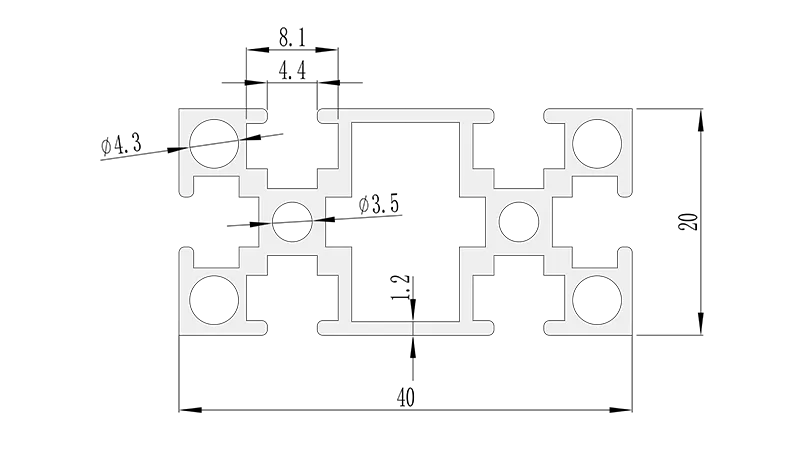
The 3C manufacturing industry—encompassing computers, communication devices, and consumer electronics—thrives on speed, precision, and adaptability. In a sector where product lifecycles shrink by the month and customization demands grow daily, the tools and infrastructure that support production lines must be just as flexible. Enter the 2040 National Standard Profile: a lightweight, durable, and highly modular aluminum extrusion profile that has become a backbone for modern 3C factories. Its unique T-slot design, compatibility with a wide range of aluminum profile accessories, and balance of strength and versatility make it a go-to choice for solving some of manufacturing's biggest challenges. Let's dive into the top five ways this unassuming aluminum profile is transforming 3C production floors.
1. Custom Workbenches: The Heart of Assembly Lines
Walk into any 3C assembly plant, and you'll notice one piece of equipment everywhere: the workbench. From smartphone motherboard assembly to laptop screen mounting, operators rely on workbenches to hold tools, components, and semi-finished products. But in an industry where no two production runs are identical, a one-size-fits-all workbench simply won't cut it. This is where the 2040 National Standard Profile shines.
Unlike traditional wooden or steel workbenches, which are heavy, fixed, and hard to modify, 2040 profile-based workbenches are built for customization. The profile's T-slot grooves run along its length, allowing aluminum profile accessories like brackets, shelves, tool holders, and even monitor arms to be attached and repositioned in seconds—no welding or drilling required. Need to add a small parts bin to the left side? Slide a bracket into the T-slot and tighten a screw. Want to raise the work surface by 10cm for taller operators? Swap out the leg brackets for longer ones. This flexibility ensures that every workbench can be tailored to the specific task at hand, whether it's intricate circuit board assembly or bulk packaging.
Durability is another key advantage. 3C manufacturing involves constant movement—tools being set down, parts being slid across surfaces, and occasional bumps. The 2040 profile, made from high-grade aluminum extrusion, resists scratches and corrosion, ensuring the workbench stays functional for years. Its lightweight nature also means that even fully loaded workbenches can be moved (with the addition of casters, another accessory that slots easily into the T-slots) when production lines need to be reconfigured for a new product launch.
Ergonomics, too, play a role. Poorly designed workbenches lead to operator fatigue and increased errors, but with 2040 profile, height-adjustable legs and tiltable work surfaces are simple to implement. For example, a workbench used for soldering might have a heat-resistant top and a built-in LED light bar (mounted via T-slot brackets) to illuminate fine details, while one used for packaging could include a lower shelf for boxes and a footrest bar. The result? Happier, more productive operators—and fewer mistakes in the final product.
| Feature | Traditional Steel Workbench | 2040 Profile Workbench |
|---|---|---|
| Weight | Heavy (hard to move) | Lightweight (easily repositioned) |
| Customization | Limited (requires welding/drilling) | Unlimited (T-slot accessories for quick changes) |
| Durability | Prone to rust if not painted | Corrosion-resistant aluminum |
| Ergonomics | Fixed height and layout | Adjustable height, tilt, and accessory placement |
For 3C manufacturers, this translates to faster setup times, reduced downtime when switching products, and a work environment that adapts to operators—not the other way around. It's no wonder that 2040 profile workbenches have become a staple in factories producing everything from smartwatches to gaming laptops.
2. Material Racks and Storage: Organizing the Chaos of Small Parts
3C products are made up of hundreds, if not thousands, of tiny components: screws, capacitors, connectors, and semiconductors, to name a few. Keeping these parts organized and easily accessible is critical to maintaining production speed and accuracy. Misplaced parts lead to delays, while overstocked shelves waste valuable floor space. Material racks built with 2040 National Standard Profile offer a solution that's both modular and space-efficient.
Traditional storage solutions for 3C parts often involve rigid steel racks or plastic bins stacked haphazardly. While steel racks are strong, they're difficult to reconfigure—if you need to add a shelf or adjust the height between levels, you're looking at hours of work with a wrench and a level. Plastic bins, on the other hand, are lightweight but lack structural support, making them unsuitable for heavier items like tool cases or bulk component boxes.
2040 profile material racks strike the perfect balance. Using a combination of vertical 2040 posts and horizontal crossbars, these racks can be built to any height or width, with shelf levels spaced exactly to fit the parts they'll hold. The T-slot design allows for quick adjustments: if a new component arrives in a taller box, simply loosen the shelf brackets, slide them up, and retighten. Aluminum profile accessories like dividers and bin holders can be added to separate small parts, while label holders (another T-slot accessory) ensure that every bin is clearly marked—no more hunting for the right resistor or connector.
One common setup in 3C factories is a multi-tiered material rack, where each level is dedicated to a specific stage of production. For example, the bottom level might hold bulk components (like circuit boards), the middle level small parts bins, and the top level finished subassemblies ready for the next station. Because 2040 profile is lightweight, even tall racks can be moved with minimal effort using caster wheels (yet another accessory that attaches via T-slots), making it easy to reposition storage closer to the assembly line when needed.
Durability isn't compromised for flexibility, either. The 2040 profile's aluminum extrusion is surprisingly strong—able to support up to 50kg per linear meter when properly braced—making it suitable for heavy items like power tools or metal molds. And unlike steel, it won't rust or corrode, even in the humid environments common in electronics manufacturing (where controlled humidity prevents static damage to components).
For 3C manufacturers, the benefits are clear: better organization, faster access to parts, and storage that grows and changes with production needs. Whether it's a small benchtop rack for daily-use components or a large floor-standing unit for bulk storage, 2040 National Standard Profile material racks turn chaos into order.
3. Conveyor Systems and Flow Racks: Streamlining Material Flow
In lean manufacturing, the goal is to eliminate waste—including wasted time spent moving materials from one station to another. In 3C factories, where products move through dozens of assembly steps, efficient material flow is essential to meeting tight deadlines. Conveyor systems and flow racks are the backbone of this process, and the 2040 National Standard Profile is increasingly becoming the frame of choice for these systems.
Flow racks, which use gravity to slide products along roller tracks, are a staple in 3C assembly lines. They allow components to "flow" from the back of the rack (where new stock is loaded) to the front (where operators pick them up), ensuring first-in, first-out (FIFO) inventory management and reducing the need for manual lifting. Similarly, conveyor systems—whether belt, roller, or chain-driven—transport semi-finished products between stations, from soldering to testing to packaging.
Building these systems with 2040 profile offers several advantages over traditional steel framing. First, it's lightweight, which reduces the load on the factory floor and makes installation easier. Second, the T-slot design simplifies integrating roller tracks, conveyor belts, and guides. Roller track connectors, for example, can be slid into the T-slots and secured, allowing the roller track to be aligned perfectly with the conveyor path. If a product's dimensions change—say, a new smartphone model is slightly thicker—the roller track spacing can be adjusted by moving the connectors, no cutting or welding required.
Flexibility is another key benefit. 3C production lines often need to be reconfigured for new products, and 2040 profile-based conveyors and flow racks can be disassembled and reassembled in hours, not days. Need to add a 90-degree turn to a conveyor line? Swap out a straight section for a corner module built with 2040 profile and roller track connectors. Want to extend a flow rack by two meters? Add more profile sections and roller tracks. This adaptability ensures that material handling systems can keep up with the industry's rapid pace of change.
Cost-effectiveness also plays a role. Traditional steel conveyor frames require custom fabrication, which is expensive and time-consuming. 2040 profile, by contrast, is mass-produced and available off the shelf, with aluminum profile accessories (like joints and brackets) that are standardized and affordable. This reduces both upfront costs and lead times, making it easier for small and medium-sized 3C manufacturers to invest in efficient material handling.
In short, 2040 National Standard Profile isn't just a building material—it's a tool for creating lean, responsive production lines. By streamlining material flow, it helps 3C factories reduce waste, boost productivity, and stay competitive in a fast-moving market.
4. Assembly Line Jigs and Fixtures: Precision Where It Matters Most
In 3C manufacturing, precision is non-negotiable. A misaligned screw hole in a smartphone case or a poorly seated connector in a laptop can render the entire product defective. To ensure consistency, assembly lines rely on jigs and fixtures—tools that hold, position, and guide components during manufacturing. These tools must be accurate, repeatable, and easy to adjust for different product models. The 2040 National Standard Profile, with its rigidity and modular design, is ideal for building these critical tools.
Jigs and fixtures come in all shapes and sizes: from simple clamping devices that hold circuit boards during soldering to complex positioning tools that align multiple components at once. What they all have in common is the need for stability and precision. 2040 profile, with its aluminum extrusion construction, offers excellent rigidity—minimizing vibration and flex during use, which is essential for tasks like drilling or adhesive application. Its uniform dimensions (thanks to standardized national production) ensure that jigs built from 2040 profile are consistent, part after part.
The T-slot design is again a game-changer here. Engineers can attach locators, clamps, and sensors directly to the profile using aluminum profile accessories, and their positions with micron-level accuracy. For example, a jig used to align a camera module with a smartphone housing might have adjustable pins that slide along the T-slots, allowing operators to tweak the alignment by fractions of a millimeter until perfect. When a new phone model is introduced, the same jig can be modified by swapping out pins or adjusting clamps—no need to build an entirely new tool.
Speed of development is another advantage. Traditional jigs are often machined from solid blocks of metal, which takes days or weeks to produce. With 2040 profile, engineers can prototype a new jig in hours by cutting profile sections to length and assembling them with joints and brackets. This rapid prototyping allows for faster testing and iteration, which is critical in an industry where product designs change constantly.
Even high-precision tasks benefit from 2040 profile jigs. For example, in semiconductor packaging, where components are smaller than a grain of rice, jigs built with 2040 profile can be paired with precision-machined aluminum profile accessories to achieve tolerances as tight as ±0.05mm. And because the profile is lightweight, these jigs are easy to mount on automated assembly machines, reducing the load on robotic arms and improving cycle times.
For 3C manufacturers, the result is fewer defects, faster time-to-market for new products, and lower tooling costs. In an industry where quality and speed are everything, 2040 National Standard Profile jigs and fixtures are a competitive edge.
5. Testing and Inspection Stations: Ensuring Quality in Every Unit
Before a 3C product reaches the consumer, it must pass rigorous testing: for functionality, durability, and safety. From stress-testing smartphone screens to checking laptop battery life, testing stations are where quality is ensured. These stations need to be stable, configurable, and equipped to hold testing equipment—requirements that the 2040 National Standard Profile meets with ease.
Testing stations vary widely depending on the product. A laptop testing station might include a power supply, a display tester, and a keyboard input simulator, while a smartwatch station could have sensors for measuring water resistance and shock absorption. Regardless of the equipment, the station itself must provide a stable platform and easy access to the product being tested.
2040 profile-based testing stations are built to accommodate this diversity. The profile's T-slot grooves allow testing equipment—like probes, cameras, and clamps—to be mounted at precise angles and heights. For example, a camera testing station might have a 2040 frame with adjustable arms holding light sources and image sensors, all positioned to capture the phone's screen from multiple angles. If a new phone model has a larger screen, the arms can be slid along the T-slots to widen the testing area.
Stability is critical during testing. Even minor vibrations can throw off sensitive measurements (like touchscreen response time or microphone sensitivity). The 2040 profile's rigid aluminum extrusion, combined with heavy-duty feet (another T-slot accessory), minimizes movement, ensuring accurate results. And because the profile is non-conductive, it won't interfere with electronic testing equipment—a must in electronics manufacturing.
Ergonomics also play a role in testing stations. Operators often spend hours a day loading and unloading products, so the station must be comfortable to use. 2040 profile allows for easy adjustment of the testing platform height, as well as the addition of features like anti-fatigue mats or footrests. This reduces operator strain and ensures consistent testing quality, even during long shifts.
Finally, like all 2040 profile applications, testing stations are easy to reconfigure. When a new product is introduced, the station can be modified to accommodate new testing equipment or procedures—no need to build a new station from scratch. This flexibility is invaluable in 3C manufacturing, where testing requirements evolve as products become more advanced.
In the end, testing and inspection are the last line of defense against defective products. By providing stable, configurable, and ergonomic testing stations, the 2040 National Standard Profile helps 3C manufacturers deliver the high-quality products consumers expect.
Conclusion: The 2040 Profile—A Foundation for 3C Manufacturing's Future
The 3C manufacturing industry is defined by constant change: new technologies, shifting consumer demands, and ever-shorter product lifecycles. To keep up, factories need tools and infrastructure that are flexible, durable, and adaptable. The 2040 National Standard Profile, with its T-slot design, compatibility with aluminum profile accessories, and balance of strength and lightweight, has emerged as a cornerstone of modern 3C production.
From custom workbenches that adapt to operator needs to material racks that organize chaos, from conveyor systems that streamline flow to jigs that ensure precision, and testing stations that guarantee quality—the 2040 profile touches every aspect of the manufacturing process. It's not just a building material; it's a catalyst for efficiency, innovation, and lean manufacturing.
As 3C products continue to evolve—becoming smaller, smarter, and more complex—the demand for flexible manufacturing solutions will only grow. The 2040 National Standard Profile, with its endless customization possibilities, is poised to meet that demand, helping factories around the world build better products, faster. For 3C manufacturers looking to stay ahead of the curve, investing in 2040 profile isn't just a choice—it's a necessity.