- Company Articles
- Industry articles
- Industry standards
- Understanding 2040 National Standard Profile: Material Composition & Durability

Understanding 2040 National Standard Profile: Material Composition & Durability
Related Product
2040 National Standard Profile
45° external bending joint, used for 45° external connection of two aluminum pipes.
Walk into any modern workshop, manufacturing plant, or even a DIY enthusiast's garage, and you'll notice a common thread: the rise of modular, adaptable structures. From workbenches that hold precision tools to material racks that organize parts, these setups are the backbone of efficient workflows. At the heart of many of these systems lies a quiet workhorse: the aluminum profile. And among the most widely used and versatile of these profiles is the 2040 National Standard Profile. But what makes it so special? Let's dive into its material makeup, why it's built to last, and how it fits into the bigger picture of industrial and commercial design.
What Exactly Is the 2040 National Standard Profile?
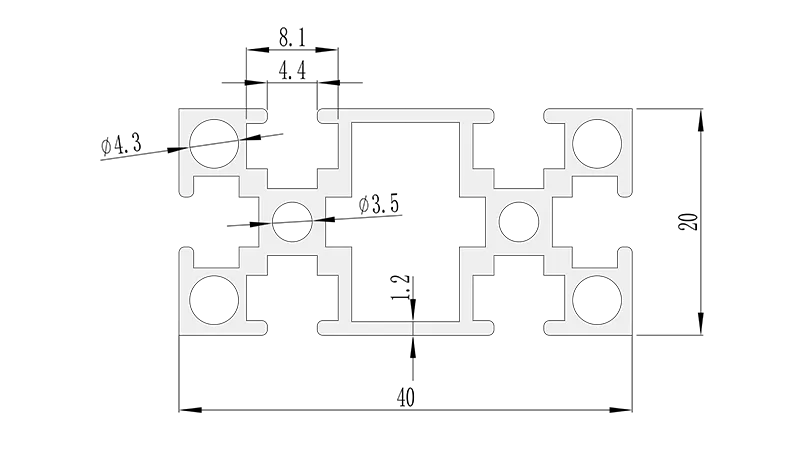
First things first: let's decode the name. The "2040" in 2040 National Standard Profile refers to its cross-sectional dimensions—typically 20mm in width and 40mm in height. This compact yet robust size is a sweet spot for balancing strength, weight, and flexibility, making it ideal for a wide range of applications. The "National Standard" tag means it adheres to strict, standardized specifications set by industry authorities, ensuring consistency in dimensions, material quality, and performance across manufacturers. Think of it as a universal building block: no matter which supplier you buy it from, the 2040 profile will fit with compatible accessories, making modular design a breeze.
Unlike custom-made metal parts that require welding or complex fabrication, the 2040 National Standard Profile is designed for simplicity. Its T-slot design—longitudinal grooves running along its length—lets you slide in bolts, brackets, or panels without drilling new holes. This means you can assemble, disassemble, or reconfigure structures in minutes, not hours. Whether you're building a small workbench for a home garage or a large-scale material handling system in a factory, this profile adapts to your needs.
Material Composition: Why Aluminum? And Which Alloy?
At its core, the 2040 National Standard Profile is made from aluminum—and not just any aluminum. Most manufacturers use 6063 aluminum alloy, a heat-treatable alloy that's become the gold standard for extrusion profiles. Why 6063? Let's break down its composition and why it matters.
Aluminum alloys are mixtures of pure aluminum and small amounts of other elements to enhance specific properties. In 6063, the key alloying elements are magnesium (Mg) and silicon (Si), usually in a ratio of about 1:2. This combination gives the alloy two critical advantages: excellent extrudability and balanced mechanical properties. Extrusion is the process where heated aluminum billets are pushed through a die to form the profile's shape, and 6063 flows smoothly through dies, even with complex T-slot designs. This ensures the 2040 profile has precise dimensions and clean, consistent edges—no rough spots or uneven surfaces that could weaken the structure.
But extrudability alone isn't enough. The 2040 profile needs to support weight, resist bending, and stand up to daily wear. Here's where 6063's mechanical properties shine: after heat treatment (a process called "aging"), it achieves a tensile strength of around 180-210 MPa (megapascals) and a yield strength of 110-145 MPa. For context, that means it can withstand significant pulling or bending forces before deforming permanently. It's also relatively lightweight—about 2.7 g/cm³, roughly one-third the weight of steel—so structures built with 2040 profiles are easy to move (if needed) without sacrificing stability.
Another key benefit of 6063 aluminum is its corrosion resistance. Unlike steel, which rusts when exposed to moisture, aluminum forms a thin, protective oxide layer on its surface when it reacts with oxygen. This layer self-heals if scratched, preventing further corrosion. For indoor use (like workshops or factories), this is more than enough. For outdoor applications, many manufacturers add anodization—a process that thickens this oxide layer—making the profile even more resistant to rain, humidity, or chemicals.
Durability: How the 2040 Profile Stands the Test of Time
Durability isn't just about strength—it's about how well a material holds up under real-world conditions. Let's look at the factors that make the 2040 National Standard Profile a long-lasting choice.
1. Load-Bearing Capacity: Strong Enough for Heavy Work
A common question is, "How much weight can a 2040 profile support?" The answer depends on how it's used—whether it's a single horizontal beam, a vertical support, or part of a framed structure. As a general rule, a 1-meter length of 2040 profile (with a typical wall thickness of 1.5-2mm) can safely support 20-30 kg when mounted horizontally with supports at both ends. For vertical use (like legs on a workbench), it can handle even more—often 100 kg or more per leg, depending on the number of legs and how they're braced.
This strength comes from both the alloy and the profile's shape. The 20x40mm cross-section is inherently rigid: the wider 40mm side resists bending along its length, while the narrower 20mm side adds stability against twisting. When combined with aluminum profile accessories like corner brackets or gussets, the load capacity increases even more. For example, adding a 90° aluminum profile connector at a joint reinforces the structure, preventing flexing under heavy loads.
2. Resistance to Wear and Tear
In busy environments—think assembly lines where parts slide across surfaces, or workshops where tools are dropped—the 2040 profile holds up surprisingly well. Aluminum's natural oxide layer protects against scratches, and if the profile is anodized, this layer becomes harder and more resistant to abrasion. Even without anodization, the smooth surface of the 2040 profile is easy to clean; a quick wipe with a damp cloth removes dust, oil, or grease, preventing buildup that could corrode the material over time.
Unlike wood, which warps with humidity, or steel, which dents under impact, aluminum is resilient. It's ductile enough to absorb minor impacts without cracking, and its low thermal expansion rate means it won't warp in extreme temperatures—whether it's a hot factory in summer or a cold storage facility in winter.
3. Longevity: A Profile That Grows With Your Needs
Durability isn't just about surviving the present—it's about adapting to the future. The 2040 National Standard Profile's modular design extends its lifespan by letting you reconfigure it as your needs change. Maybe you start with a small workbench, but later need to add shelves or extend the length. With T-slot accessories, you can do that without replacing the entire structure. This "build once, adapt forever" approach means your initial investment in 2040 profiles keeps paying off for years, reducing waste and saving money in the long run.
Applications: Where You'll Find the 2040 National Standard Profile
The 2040 profile's versatility makes it a staple in countless industries. Here are some common uses where it truly shines:
- Workbenches: From small, single-deck workbenches (like Workbench E, a popular model without casters) to large, multi-level assembly stations, the 2040 profile forms the frame. Its strength supports heavy tools, while T-slots let you attach vises, lights, or storage bins.
- Material Racks: Need to organize parts or raw materials? The 2040 profile is perfect for building Material Rack B (a 3-row, 3-floor design) or custom shelving. Pair it with roller tracks or swivel roller balls, and you've got a smooth, efficient system for moving items.
- Conveyor Systems: Light-duty conveyors often use 2040 profiles as side rails, supporting roller tracks or belts. The T-slots make it easy to mount guides or stops, ensuring items move along the correct path.
- Machine Guards: In factories, safety is key. The 2040 profile can be built into protective barriers around machinery, with panels or mesh inserted into the T-slots to prevent accidents.
- Retail Displays: Even outside industrial settings, the 2040 profile shines. Its sleek, modern look makes it ideal for custom retail shelves or product displays, which can be quickly updated for seasonal promotions.
Aluminum Profile Accessories: The Perfect Partners for 2040
A profile is only as good as the accessories that bring it to life. The 2040 National Standard Profile works seamlessly with a range of aluminum profile accessories, turning it from a simple beam into a fully functional structure. Let's highlight a few must-have accessories:
- End Caps: These plastic or aluminum caps fit snugly into the ends of the profile, covering sharp edges and preventing dust or debris from getting inside the T-slots. 2020 National Standard Profile end caps are a common choice, as they're designed to match the profile's dimensions.
- Connectors: 90° aluminum profile connectors, 45° connectors, and three-way connectors let you join profiles at different angles without welding. Many are designed to fit inside the T-slots, keeping the structure neat and avoiding protruding parts.
- Panels and Plates: Aluminum honeycomb panels or plywood sheets can be attached to the profile using T-slot nuts and bolts, creating work surfaces or shelving. The panels add rigidity to the structure while providing a flat, stable surface.
- Casters: For mobile structures like carts or workbenches, casters are a game-changer. Flat swivel castor wheels with brakes lock into place when needed, while rigid casters keep the structure moving straight. Just bolt them to the profile's base using caster accessories like mounting plates.
The beauty of these accessories is their universality. Since the 2040 profile follows national standards, accessories from different suppliers work together. This means you're not locked into one brand—you can mix and match to get the best quality or price for your project.
How Does 2040 Compare to Other Profiles? A Quick Look
With so many aluminum profiles on the market, how does the 2040 National Standard Profile stack up? Let's compare it to two common alternatives: the smaller 2020 National Standard Profile and the larger 4040 profile.
| Feature | 2020 National Standard Profile | 2040 National Standard Profile | 4040 National Standard Profile |
|---|---|---|---|
| Dimensions (WxH) | 20x20mm | 20x40mm | 40x40mm |
| Typical Load Capacity (Horizontal, 1m length) | 10-15 kg | 20-30 kg | 40-50 kg |
| Best For | Light-duty structures (shelving for small parts, display stands) | Medium-duty applications (workbenches, material racks, conveyors) | Heavy-duty use (machine frames, large storage systems) |
| Weight (per meter) | ~0.3 kg | ~0.5 kg | ~1.0 kg |
As the table shows, the 2040 profile hits the middle ground: stronger than the 2020 but lighter and more flexible than the 4040. For most workshops, factories, or DIY projects, this balance is exactly what's needed. It's strong enough to handle daily use but not so heavy that it's hard to work with.
Conclusion: Why the 2040 National Standard Profile Is Here to Stay
The 2040 National Standard Profile isn't just another piece of metal—it's a testament to smart design and material science. By combining 6063 aluminum alloy's strength and corrosion resistance with a modular T-slot design, it offers a level of versatility that's hard to beat. Whether you're building a simple workbench or a complex material handling system, it adapts to your needs, saves time on assembly, and lasts for years.
In a world where efficiency and flexibility are more important than ever, the 2040 profile stands out as a reliable, cost-effective solution. Its adherence to national standards ensures consistency, while its compatibility with aluminum profile accessories opens up endless possibilities. So the next time you walk into a workshop or factory and spot those sleek, modular structures, take a closer look—chances are, you're looking at the 2040 National Standard Profile, quietly working behind the scenes to make work easier, faster, and more organized.