- Company Articles
- Industry articles
- Industry standards
- Understanding 4080A EU Standard Aluminum Profile: Material Grades & Certification

Understanding 4080A EU Standard Aluminum Profile: Material Grades & Certification
Related Product
4080A EU Standard Aluminum Profile
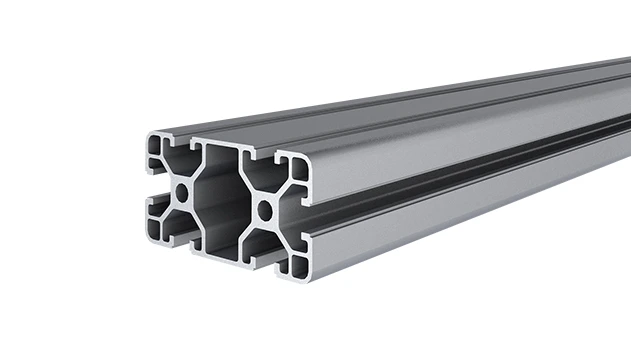
4080A is a 4.00x8.00 CM fractional 40 series square extrusion T-slot profile with two side open T-slots, each side with 4.00cm face, two side with 8.00cm face. The profile has align-a-grooves to assist in aligning connecting profiles.
Understanding 4080A EU Standard Aluminum Profile: Material Grades & Certification
Walk into any modern factory, warehouse, or production facility, and you'll quickly spot the unsung heroes keeping operations running smoothly: the structures that organize workflows, support tools, and move materials. From the workbench where an assembler spends eight hours a day to the material rack stacked with components, these aren't just metal frames—they're engineered systems. And for many manufacturers, the backbone of these systems is the aluminum extrusion profile. Specifically, profiles like the 4080A EU Standard Aluminum Profile have become indispensable, blending strength, flexibility, and compliance to meet the demands of today's fast-paced industries.
But what exactly makes the 4080A EU Standard Aluminum Profile stand out? Why do lean system suppliers and manufacturers alike prioritize it for critical applications? In this article, we'll dive deep into its design, material composition, certification, and real-world impact, showing how this unassuming piece of aluminum plays a pivotal role in building efficient, reliable production lines.
What Is the 4080A EU Standard Aluminum Profile?
Let's start with the basics: the name itself. "4080A" refers to the profile's dimensions—40 millimeters in width and 80 millimeters in height—while "EU Standard" signals compliance with strict European manufacturing and safety regulations. But numbers and labels only tell part of the story. What truly defines this profile is its T-slot design: a series of grooves (or "slots") running along its length that allow accessories like brackets, connectors, and shelves to be attached without welding or drilling. This modularity is a game-changer for industries where adaptability is key—think automotive plants retooling for new models or electronics factories scaling production for a hot new device.
Unlike generic aluminum bars, the 4080A is an aluminum extrusion profile, meaning it's formed by forcing heated aluminum alloy through a die to create its precise cross-section. This process ensures uniformity in shape and strength, making each profile consistent and reliable. And because it's part of the EU standard lineup, manufacturers can trust that it meets rigorous benchmarks for quality, safety, and environmental responsibility—something we'll explore more later when we talk about certification.
Material Grades: The Science Behind 4080A's Strength
An aluminum profile is only as good as the alloy it's made from. For the 4080A EU Standard Aluminum Profile, the material grade is the foundation of its performance. Most commonly, this profile is crafted from 6063 aluminum alloy—a magnesium-silicon alloy prized in extrusion for its excellent formability, corrosion resistance, and smooth surface finish. Why 6063? Let's break it down:
- Extrudability: 6063 alloy flows easily through extrusion dies, allowing for complex cross-sections like the T-slots in 4080A. This precision ensures every profile has consistent dimensions, which is critical for modular systems where parts must fit together seamlessly.
- Strength-to-Weight Ratio: While not the strongest aluminum alloy (that title might go to 7075, used in aerospace), 6063 strikes a perfect balance for industrial applications. It's lightweight enough to be reconfigured by a single worker but strong enough to support heavy loads—think a workbench loaded with power tools or a material rack stacked with metal components.
- Corrosion Resistance: Factories are tough environments, with exposure to oils, coolants, and humidity. 6063's natural resistance to corrosion means 4080A profiles won't rust or degrade over time, reducing maintenance costs and extending the lifespan of equipment like turnover trolleys or roller tracks.
But alloy alone isn't enough—heat treatment (or "temper") further refines the 4080A's properties. The two most common tempers for this profile are T5 and T6:
- T5 Temper: After extrusion, the profile is artificially aged at room temperature or slightly elevated heat. This process strengthens the alloy without making it overly brittle, making T5 4080A ideal for general-purpose applications like light-duty workbenches or storage racks.
- T6 Temper: For higher-performance needs, T6 temper involves solution heat treatment (heating to a specific temperature, then quenching) followed by artificial aging. This results in a stronger, harder profile—perfect for heavy-duty use, such as supporting conveyor systems or material racks holding bulk inventory.
Choosing between T5 and T6 depends on the application. A lean system supplier might recommend T6 for a material rack designed to hold 50kg per shelf, while T5 would suffice for a workbench where the primary load is a technician's tools. Either way, the 6063 alloy ensures the 4080A profile delivers consistent, reliable performance.
Certification: Why EU Standards Matter for Manufacturers
When a manufacturer orders 4080A profiles, they're not just buying metal—they're buying compliance. The "EU Standard" label isn't a marketing gimmick; it's a promise that the product meets strict regulations set by the European union, and these certifications have ripple effects across industries worldwide. Let's unpack the key certifications that make 4080A a trusted choice:
CE Marking
The CE mark is perhaps the most recognizable certification for products sold in the EU. For construction products like aluminum profiles, it indicates compliance with the Construction Products Regulation (CPR), which sets safety, health, and environmental requirements. To earn the CE mark, 4080A profiles must undergo testing for mechanical strength, fire resistance, and chemical emissions. This isn't just about legality—it's about safety. A CE-marked 4080A profile used in a workbench ensures that the structure won't collapse under load, protecting workers and preventing costly downtime.
RoHS Compliance
The Restriction of Hazardous Substances (RoHS) directive limits the use of six hazardous materials (like lead, mercury, and cadmium) in electrical and electronic equipment. While 4080A itself isn't an electronic component, it's often used in systems that interact with sensitive electronics—think an ESD workstation in a semiconductor factory. RoHS compliance ensures the profile's coatings, finishes, or accessories (like aluminum profile accessories) don't leach harmful substances, keeping both products and workers safe.
ISO 9001
Beyond product-specific certifications, many lean system suppliers and aluminum profile manufacturers hold ISO 9001 certification, a globally recognized standard for quality management systems. ISO 9001 ensures that the supplier has processes in place to consistently deliver products that meet customer and regulatory requirements. For buyers, this means less risk of defective profiles, delayed shipments, or inconsistent quality—critical when building production lines that can't afford mistakes.
Together, these certifications turn the 4080A from a commodity into a trusted component. When a manufacturer sees "CE," "RoHS," and "ISO 9001" on a supplier's documentation, they know they're getting a profile that's been tested, regulated, and built to last.
How 4080A Stacks Up: Comparing Aluminum Profiles
Aluminum profiles come in all shapes and sizes, from tiny 20x20mm rails to massive 100x200mm beams. So why choose 4080A over other options? Let's compare it to three common EU standard profiles to see where it shines:
| Profile Type | Dimensions (mm) | Typical Alloy | Max Load Capacity (Approx.) | Common Applications |
|---|---|---|---|---|
| 2020 EU Standard | 20x20 | 6063 T5 | 10-20kg per linear meter | Light-duty shelves, small workbenches, DIY projects |
| 3030 EU Standard | 30x30 | 6063 T5/T6 | 30-50kg per linear meter | Medium-duty racks, mobile trolleys, machine guards |
| 4040A EU Standard | 40x40 | 6063 T5/T6 | 60-80kg per linear meter | Workbenches, conveyor frames, material racks (light to medium) |
| 4080A EU Standard | 40x80 | 6063 T5/T6 | 100-150kg per linear meter | Heavy-duty workbenches, industrial material racks, conveyor supports, lean system structures |
As the table shows, 4080A's larger cross-section gives it significantly higher load capacity than smaller profiles. This makes it the go-to choice for applications where strength is non-negotiable. For example, a material rack designed to hold 3 rows and 3 floors of heavy components (like engine parts or metal castings) would rely on 4080A for its vertical supports, ensuring the structure doesn't bow or warp under pressure.
Another advantage is versatility. The 4080A's 80mm height provides more surface area for attaching accessories, making it easier to mount items like tool holders, monitor arms, or even small conveyor sections. This flexibility is why lean system suppliers often pair 4080A with aluminum profile accessories like 90° connectors, end caps, or hinge brackets—to create custom solutions tailored to a factory's unique needs.
Real-World Applications: How 4080A Drives Efficiency
Numbers and certifications tell part of the story, but seeing 4080A in action reveals its true value. Let's look at three common applications where this profile makes a tangible difference:
1. Heavy-Duty Workbenches
Imagine a workbench in an automotive parts factory, where technicians assemble brake components. This isn't a flimsy table—it needs to support power tools, torque wrenches, and batches of metal parts, all while remaining stable during precision work. A Workbench E (single deck, without casters) built with 4080A profiles fits the bill perfectly. The T-slots allow for attaching tool hooks, storage bins, and even ESD (electrostatic discharge) mats to protect sensitive components. With a T6-tempered 4080A frame, the workbench can handle 200kg+ of weight without wobbling, ensuring accuracy and safety.
2. Material Racks & Storage Systems
Warehouses and factories live and die by their storage efficiency. A Material Rack B (3 rows, 3 floors) constructed with 4080A profiles maximizes vertical space while keeping items accessible. The profile's strength supports stacked boxes or pallets, and its modularity lets workers adjust shelf heights as inventory changes. For example, a electronics manufacturer might use one shelf for small circuit boards and another for larger enclosures—no need to buy a new rack; just reposition the aluminum profile accessories.
3. Lean Manufacturing Cells
Lean manufacturing is all about eliminating waste, and 4080A profiles are a lean system supplier's best friend. They're used to build U-shaped production cells, where materials flow smoothly from one station to the next via roller tracks or conveyors. The T-slots make it easy to add or remove workstations as production demands shift, and the lightweight nature of aluminum means cells can be reconfigured in hours, not days. This agility is why companies like Toyota or Siemens rely on 4080A-based systems to stay competitive.
Choosing the Right Supplier: What to Look For
Not all 4080A profiles are created equal. To get the most out of this material, partnering with a reputable lean system supplier is critical. Here's what to prioritize when selecting a supplier:
- Certification Documentation: Ask for proof of CE marking, RoHS compliance, and ISO 9001 certification. A trustworthy supplier will have these readily available.
- Material Consistency: Inquire about batch testing. Each 4080A profile should meet the same alloy and temper specifications to ensure consistent performance.
- Accessory Range: A good supplier won't just sell profiles—they'll offer a full lineup of aluminum profile accessories, from connectors to caster wheels, ensuring compatibility and reducing lead times.
- Customization Support: Every factory is different. Look for a supplier that can help design custom structures (like modified workbenches or specialized material racks) using 4080A and other profiles.
By choosing a supplier that prioritizes quality and service, manufacturers ensure their 4080A-based systems deliver long-term value, not just a one-time purchase.
Conclusion: Investing in 4080A for the Future
The 4080A EU Standard Aluminum Profile may not be the most glamorous component in a factory, but it's undoubtedly one of the most essential. Its blend of 6063 alloy strength, T-slot versatility, and EU certification makes it a cornerstone of modern manufacturing—supporting workbenches, material racks, and lean systems that drive efficiency and productivity.
For manufacturers, choosing 4080A isn't just about buying a profile; it's about investing in a system that can adapt, grow, and perform for years to come. And for lean system suppliers, it's a tool to deliver solutions that turn factories into well-oiled machines.
So the next time you walk through a factory, take a closer look at those aluminum frames. Chances are, you're looking at 4080A—quietly working behind the scenes to build the products that power our world.