
In the world of manufacturing and industrial design, there's a silent balancing act happening every day: the quest to create structures that are both strong enough to handle heavy loads and light enough to stay efficient. Whether you're building a workbench for an assembly line, a material rack for storing parts, or a trolley to move goods across the factory floor, the materials you choose can make or break your operation's productivity. One material that's been quietly revolutionizing this balance is the 2040 national standard profile—an aluminum extrusion that's become a go-to for engineers and designers who refuse to compromise on either strength or weight. Let's dive into what makes this profile so special, focusing on its star quality: the weight-to-strength ratio.
What Even Is a 2040 National Standard Profile?
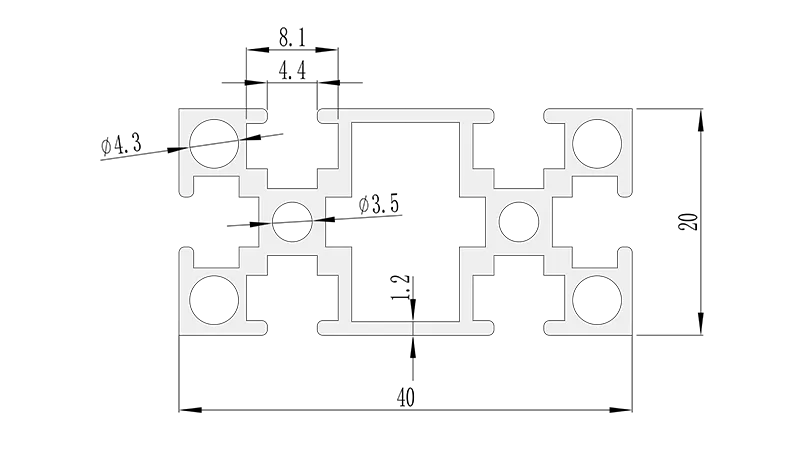
First things first: let's get familiar with the basics. The 2040 national standard profile is a type of aluminum extrusion profile, part of a family of standardized aluminum shapes used in modular industrial systems. The "2040" refers to its cross-sectional dimensions: 20 millimeters in width and 40 millimeters in height. Picture a long, hollow bar with a rectangular shape, but with a twist—along its length, it features T-shaped slots (called T-slots) that run parallel to the edges. These slots are key: they let you attach accessories like brackets, panels, or joints without welding, drilling, or other permanent modifications. That modularity is one reason it's so popular, but today, we're here to talk about its other superpower: how much strength it packs relative to its weight.
To understand why this matters, let's start with how aluminum extrusion profiles are made. Aluminum, in its raw form, is soft and malleable, but when alloyed with elements like magnesium or silicon, it becomes surprisingly strong. The extrusion process involves heating a billet of this aluminum alloy until it's pliable, then forcing it through a die (a metal mold) under high pressure. The result? A long, continuous profile with a consistent cross-section—exactly the 2040 shape we're discussing. This process isn't just efficient; it also allows for intricate designs that optimize strength. The T-slots, for example, aren't just for attachments—they also act as internal ribs, distributing stress evenly along the profile and boosting its structural integrity without adding extra weight.
Why Weight-to-Strength Ratio Matters More Than You Think
Before we dig into the 2040 profile specifically, let's clarify what "weight-to-strength ratio" actually means. In simple terms, it's a measure of how much strength a material offers per unit of weight. Think of it as a efficiency score: a higher ratio means you get more strength without carrying around unnecessary bulk. For manufacturers, this ratio is a game-changer. A structure with a high weight-to-strength ratio is easier to move, cheaper to ship, and uses less energy to operate—whether that's a workbench being repositioned on the factory floor or a material rack being loaded onto a truck.
Let's put this in context. Imagine two workbenches: one made of solid steel, another made of 2040 aluminum profile. The steel bench might be able to hold 500kg, but it weighs 150kg itself—so moving it requires a forklift or multiple people. The aluminum bench, on the other hand, might hold 400kg (still more than enough for most assembly tasks) but weighs only 40kg. Suddenly, a single worker can reposition it with a few caster wheels, or you can add brakes to lock it in place when needed. That flexibility? It's all thanks to the aluminum's superior weight-to-strength ratio.
In industrial settings, where time is money, this efficiency translates directly to productivity. Lighter structures reduce strain on workers, lower the risk of workplace injuries, and make it easier to reconfigure layouts as production needs change. And when you're talking about large-scale operations—think warehouses with hundreds of material racks or factories with dozens of workstations—those small per-unit weight savings add up to big wins in energy use and operational costs.
Breaking Down the 2040 Profile's Winning Ratio
So, what makes the 2040 national standard profile stand out in terms of weight-to-strength? Let's start with the material itself: aluminum. Pure aluminum is lightweight (density of about 2.7 g/cm³) but not particularly strong. But when alloyed with elements like magnesium and silicon (common in industrial aluminum alloys like 6063), it gains impressive strength while retaining its low weight. The 2040 profile, typically made from 6063-T5 aluminum, has a tensile strength of around 120-150 MPa (megapascals) and a yield strength of 100-120 MPa. For reference, that means it can withstand a pulling force of 120 million Pascals before breaking—more than enough for most medium-duty industrial applications.
But the extrusion process itself also plays a role. Unlike solid steel bars, which rely on sheer mass for strength, aluminum extrusions are engineered with hollow cores and reinforced walls. The 2040 profile's T-slots, for example, act as internal gussets, distributing stress along the length of the profile and preventing bending or warping under load. This design means you get more strength per gram of material. A typical 2040 profile with a 1.5mm wall thickness weighs about 0.9 kg per meter—compare that to a steel profile of the same dimensions, which might weigh 3-4 kg per meter. Even if the steel has a higher absolute tensile strength (say, 300 MPa), its weight-to-strength ratio (300 MPa / 3.5 kg/m = 85.7 MPa/(kg/m)) is far lower than the 2040 aluminum's (130 MPa / 0.9 kg/m = 144.4 MPa/(kg/m)). In other words, the aluminum gives you more "bang for your buck" in terms of strength relative to how much it weighs.
Another factor is consistency. Aluminum extrusion is a highly controlled process, so each 2040 profile comes out with uniform dimensions, wall thickness, and material properties. This predictability is crucial for engineers—they can trust that a 2040 profile from one batch will perform the same as another, making it easier to design structures with precise load capacities. No more guessing if a slightly thicker or thinner section will throw off your weight-to-strength calculations; with standardized extrusions, what you see is what you get.
How Does 2040 Stack Up Against Other Aluminum Profiles?
Of course, the 2040 isn't the only aluminum profile on the market. There's the 3030 (30x30mm), 4040 (40x40mm), and even larger profiles like 4080 (40x80mm). Each has its own weight-to-strength ratio, tailored to specific use cases. Let's compare them side by side to see where the 2040 fits in:
| Profile Type | Dimensions (WxH, mm) | Weight per Meter (kg) | Tensile Strength (MPa) | Yield Strength (MPa) | Weight-to-Strength Ratio* (MPa/(kg/m)) |
|---|---|---|---|---|---|
| 2020 National Standard Profile | 20x20 | 0.5 | 120 | 100 | 240.0 |
| 2040 National Standard Profile | 20x40 | 0.9 | 130 | 110 | 144.4 |
| 3030 National Standard Profile | 30x30 | 1.2 | 140 | 120 | 116.7 |
| 4040 National Standard Profile | 40x40 | 1.8 | 150 | 130 | 83.3 |
*Calculated as tensile strength divided by weight per meter. Higher values indicate better weight-to-strength efficiency.
As the table shows, smaller profiles like the 2020 have higher weight-to-strength ratios, but they lack the load-bearing capacity of the 2040. The 2040 strikes a sweet spot: it's narrow enough to fit into tight spaces (unlike the bulkier 4040) but tall enough to resist bending, making it ideal for medium-duty applications. For example, a workbench frame built with 2040 profiles can easily support a wooden or aluminum honeycomb panel top, plus tools, parts, and even a worker leaning on it—all without adding unnecessary weight. On the flip side, if you need to support extremely heavy loads (like 1-ton machinery), you might opt for the 4040, but you'll pay for it in increased weight and reduced flexibility.
Real-World Applications: Where the 2040 Shines
Enough theory—let's talk about how the 2040 national standard profile's weight-to-strength ratio translates to real-world use. One of the most common applications is in workbenches. Take the "Workbench E (single deck-without caster)" from many industrial suppliers: its frame is often built with 2040 profiles. The result? A sturdy surface that can handle assembly tasks, testing, or packaging, but light enough that adding a set of caster wheels lets you move it around the shop floor. Imagine a electronics manufacturer reconfiguring their line to accommodate a new product—instead of hiring a crew to disassemble and rebuild workbenches, they can simply unlock the casters and roll the 2040-framed benches into place. That's efficiency in action.
Another area where the 2040 excels is material racks. Consider "Material Rack B (3 row and 3 floor)"—a common design for storing small to medium-sized parts. Using 2040 profiles for the uprights and crossbars keeps the rack light enough to move with a pallet jack but strong enough to hold hundreds of kilograms of inventory. The T-slots in the 2040 also make it easy to adjust shelf heights as storage needs change; just loosen the brackets, slide them up or down, and retighten. No welding, no drilling—just quick, tool-free adjustments. This adaptability is a huge plus in dynamic environments where product lines or part sizes frequently change.
Turnover trolleys are another perfect fit. These trolleys, used to move parts from storage to assembly lines, need to be both strong (to carry heavy bins) and light (to be pushed by workers). A trolley frame made with 2040 profiles hits that mark. Add a few swivel caster wheels (with brakes, of course) and a plywood or aluminum panel base, and you've got a tool that's easy to maneuver through tight aisles but tough enough to handle daily use. Even better, if the trolley gets damaged (say, a bent crossbar), you can simply replace the 2040 section instead of buying a whole new trolley—thanks to the modular design enabled by those T-slots.
Accessorizing the 2040: Making the Most of Its Ratio
The 2040 profile's performance isn't just about the extrusion itself—it's also about the aluminum profile accessories that complement it. These accessories are designed to work with the T-slots, enhancing the profile's functionality without adding unnecessary weight. Let's take a look at a few key ones:
- Internal Rotary Aluminum Joints: These joints let you connect two 2040 profiles at angles (like 90° or 135°) without welding. They're lightweight, durable, and allow for some rotation, making it easy to adjust the angle of a shelf or a workbench extension. Since they're made of aluminum, they don't add much weight, preserving the profile's weight-to-strength ratio.
- End Caps: Simple but essential, these plastic or aluminum caps fit over the ends of the 2040 profile, preventing dust, debris, or fingers from getting stuck in the hollow core. They add almost no weight but improve safety and cleanliness.
- Aluminum Guide Rails: Used in roller tracks or conveyor systems, guide rails made from 2040 profiles help direct parts along a path. Their low weight means the conveyor motor doesn't have to work as hard, reducing energy use, while their strength ensures they don't bend under the friction of moving parts.
- Caster Accessories: When adding caster wheels to a 2040-framed structure, accessories like caster installation bases or fixed plates ensure a secure connection. These are typically made of lightweight aluminum or steel (but even steel ones are small enough that their weight impact is minimal), letting you turn a stationary workbench into a mobile one without sacrificing stability.
The beauty of these accessories is that they're designed to work with the 2040's T-slots, so you don't need to drill holes or modify the profile itself. This modularity means you can customize your setup—adding a shelf here, a rail there—without compromising the profile's structural integrity or weight efficiency.
Debunking Myths: "Lightweight" Doesn't Mean "Flimsy"
One common misconception about aluminum profiles like the 2040 is that their light weight equates to being flimsy or weak. Let's put that to rest. While it's true that aluminum is less dense than steel, its strength-to-weight ratio means it can often outperform steel in applications where weight is a factor. For example, a 2040 profile workbench might flex slightly under a heavy load, but that's actually a good thing—it's absorbing the stress rather than cracking. Steel, being stiffer, might not flex, but it could warp or snap if overloaded.
Another myth is that aluminum isn't durable enough for industrial use. In reality, the 6063-T5 aluminum used in 2040 profiles is corrosion-resistant (thanks to its natural oxide layer), making it suitable for use in humid or dusty environments. It's also resistant to dents and scratches compared to plastic profiles, which can crack or bend under impact. And because it's non-magnetic and non-sparking, it's safe for use in environments with sensitive electronics or flammable materials—something steel can't always claim.
Finally, some worry that aluminum profiles are too expensive. While it's true that aluminum extrusions have a higher upfront cost than basic steel or plastic, their longevity and low maintenance costs often make them cheaper in the long run. A 2040 profile workbench might cost 30% more than a steel one initially, but it won't rust, it's easier to repair, and it uses less energy to move—savings that add up over years of use.
Choosing the Right Supplier: Why Quality Matters
Not all 2040 national standard profiles are created equal. To get the best weight-to-strength ratio, you need to source from a reputable aluminum profile supplier. Here's what to look for:
- Material Purity: High-quality suppliers use virgin aluminum alloys (like 6063-T5) rather than recycled or low-grade materials, ensuring consistent strength and weight.
- Extrusion Precision: Look for suppliers with advanced extrusion dies and quality control processes. Inconsistent wall thickness or warped profiles can throw off the weight-to-strength ratio, leading to weak spots or unexpected flexibility.
- Accessory Compatibility: A good supplier will offer a full range of aluminum profile accessories (joints, end caps, brackets) designed to work seamlessly with their 2040 profiles. Mismatched accessories can add unnecessary weight or reduce structural integrity.
- Technical Support: The best suppliers don't just sell profiles—they help you design structures that maximize the 2040's weight-to-strength ratio. Whether you need help calculating load capacities or choosing the right wall thickness, their engineers should be able to guide you.
Don't skimp on supplier research. A cheap, low-quality 2040 profile might save you money upfront, but it could fail under load, leading to downtime, repairs, or even safety hazards. Investing in a trusted supplier ensures you get the performance you need from your aluminum extrusion.
Wrapping Up: The 2040's Role in Modern Manufacturing
The 2040 national standard profile is more than just a piece of aluminum—it's a testament to how smart material design can transform industrial efficiency. By prioritizing the weight-to-strength ratio, engineers and designers have created a profile that balances strength, flexibility, and cost in a way that few other materials can match. Whether you're building workbenches, material racks, or trolleys, the 2040 offers the kind of adaptability that modern manufacturing demands: strong enough to handle the job, light enough to keep operations moving, and modular enough to grow with your needs.
As factories and warehouses continue to evolve—leaner, more agile, and focused on sustainability—the 2040 profile will only become more essential. Its low weight reduces carbon footprints by cutting energy use in transportation and operation. Its modularity reduces waste by allowing components to be reused or repurposed. And its durability ensures it will outlast cheaper, less efficient materials, reducing the need for frequent replacements.
So the next time you walk through a factory or warehouse, take a closer look at the workbenches, racks, and trolleys around you. Chances are, many of them are built with 2040 national standard profiles. And now that you understand the science behind their weight-to-strength ratio, you'll appreciate the quiet innovation that's making those operations run smoother, safer, and more efficiently than ever before.