- Company Articles
- Industry articles
- Industry standards
- What is 2040 National Standard Profile? Definition, Specifications & Applications

What is 2040 National Standard Profile? Definition, Specifications & Applications
Related Product
2040 National Standard Profile
45° external bending joint, used for 45° external connection of two aluminum pipes.
Picture this: You walk into a bustling electronics workshop, and your eyes are drawn to the sleek, organized workstations lining the floor. Each bench stands steady, holding tools, components, and half-assembled devices with precision. Nearby, a material rack glides smoothly as workers load and unload parts, while a lightweight trolley zips by carrying supplies. What ties all these elements together? Chances are, it's aluminum profiles—those unassuming yet mighty building blocks that form the backbone of modern industrial and commercial spaces. Among the countless profile types available today, one has earned a reputation for its unique blend of flexibility and strength: the aluminum extrusion profile known as the 20×40 National Standard Profile. If you've ever wondered what makes this profile a favorite among engineers and designers (or if you're simply curious about the "bones" behind those efficient workspaces), let's break it down.
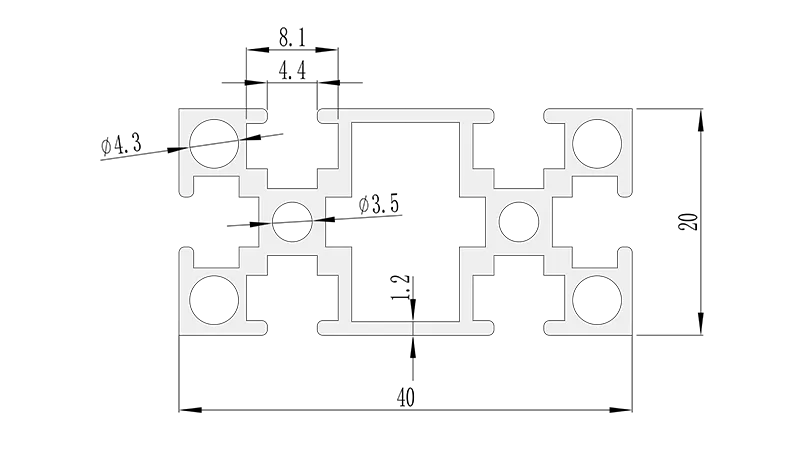
At its core, a 20×X40 national standard profile is a standardized aluminum extrusion designed to meet strict national manufacturing guidelines. The name itself gives a clue to its size: typically, it measures approximately 20mm in width and X40mm in height (though exact dimensions can vary slightly by region, the "national standard" label ensures consistency across suppliers). Unlike generic aluminum pipes, this profile features a hollow cross-section with T-slots —longitudinal grooves running along its length—that allow for easy attachment of accessories like brackets or panels. Think of it as a modular "Lego for grown-ups," but built to withstand industrial-level demands.
What sets it apart from other profiles? Its proportions strike a sweet spot: not too bulky to limit mobility, yet not too slender to sacrifice stability. "It's the Goldilocks of profiles," jokes Mark Chen, a production manager at a mid-sized automotive parts factory. "For tasks that need a balance of strength and space efficiency—like workbenches or light-duty material racks—20×X40 just works."
| Overall Dimensions | Width: 20mm ± 0.3mm; Height: 40mm ± 0.3mm | Outer dimensions; inner hollow space varies by wall thickness |
| Wall Thickness | 1.2mm–1.5mm (common: 1.2mm) | Thicker walls increase load capacity but add weight |
| Standard Length | 6 meters (custom lengths available via cutting) | Easily cut to size with basic tools like a miter saw |
| Material | 6063-T5 aluminum alloy | High strength-to-weight ratio; excellent corrosion resistance |
| Surface Treatment | Anodized (silver/clear), powder-coated (custom colors) | Anodizing adds durability; powder coating offers color options |
| T-Slot Configuration | 1–2 slots per face; slot width: 6mm–8mm | Slots accept T-nuts, bolts, and aluminum profile accessories |
| Weight per Meter | 0.7kg–0.9kg (varies by wall thickness) | Light enough for manual handling; strong enough for heavy loads |
| Max Load Capacity (Horizontal) | 150kg–200kg per linear meter (uniformly distributed) | Higher with additional supports or thicker walls |
These specs might seem technical, but they're the secret to the profile's versatility. For instance, the 1.2mm wall thickness hits a balance: thick enough to support tools and materials on a workbench , but thin enough to keep the profile lightweight for mobile structures like trolleys. And those T-slots? They're what make the profile "modular." With the right aluminum profile accessories —think angle brackets, end caps, or even casters—you can reconfigure a 20×X40 frame in minutes, no welding required.
To appreciate the 20×X40 profile, it helps to peek behind the scenes of its creation. Most start as pure aluminum ingots, which are melted down and mixed with small amounts of silicon and magnesium to form the 6063 alloy—a recipe known for its extrudability and strength. The molten alloy is then cast into cylindrical billets, which are heated to around 500°C (932°F) until they're soft enough to shape.
Next comes the extrusion process: A hydraulic press forces the heated billet through a steel die shaped like the 20×X40 profile's cross-section. As the metal exits the die, it cools rapidly (often with water sprays) and hardens into the desired shape. After extrusion, the profiles are "aged" in ovens at 175°C (347°F) for several hours to strengthen the alloy—a step that gives the profile its "T5" designation (meaning it's artificially aged for optimal hardness).
Finally, the surface is treated. Anodizing is the most common method: the profiles are submerged in an electrolyte bath and charged with electricity, creating a protective oxide layer that resists corrosion and wear. Some suppliers also offer powder coating, where a dry paint powder is electrostatically applied and baked on, adding color and extra durability.
Numbers and specs tell part of the story, but the 20×X40 profile's real appeal lies in how its features translate to real-world benefits. Let's break down why it's a staple in workshops, factories, and beyond:
Aluminum is already 30% lighter than steel, and the 20×X40 profile's hollow design cuts weight further without sacrificing rigidity. This makes it ideal for structures that need to be moved occasionally, like mobile workbenches or temporary assembly stations. "We used to have steel workbenches that took two people to shift," says Lisa Wong, a facility manager at a small appliance manufacturer. "Now, with 20×X40 frames and locking casters, one person can reposition a bench in seconds. It's game-changing for rearranging our production line."
The T-slots are more than just grooves—they're the profile's "superpower." With aluminum profile accessories like T-nuts and bolts, you can attach shelves, panels, or tools anywhere along the slot, no pre-drilling needed. Need to add a tool holder to your workbench? Screw a bracket into the T-slot. Want to adjust a shelf height? Loosen the bolts, slide, and retighten. This modularity reduces waste, too: instead of buying a new bench when your needs change, you can reconfigure the existing one.
Aluminum's natural oxide layer (boosted by anodizing) protects the profile from rust and corrosion, even in humid or dusty environments. This is a huge plus in industries like food processing, where moisture is common, or outdoor settings like loading docks. Unlike steel, which requires regular painting or coating, anodized 20×X40 profiles can last decades with minimal maintenance.
Let's not overlook the "look" factor. The clean, silver finish of anodized aluminum gives workspaces a modern, professional vibe—far more appealing than clunky wooden benches or rusted steel frames. And if you want to match your brand colors? Powder-coated versions come in hues like blue, gray, or even custom shades, making them suitable for everything from industrial facilities to retail displays.
The 20×X40 profile's versatility means it pops up in more places than you might think. Here are some of its most common uses:
Perhaps the most iconic use of the 20×X40 profile is in workbench construction. A typical setup might use 20×X40 rails for the legs and crossbars, with a plywood or aluminum honeycomb top bolted to the frame via T-slots. Add a shelf halfway up for storage, a pegboard on the back for tools, and casters on the bottom for mobility, and you've got a workstation tailored to your needs. "Our electronics assembly team swears by these benches," says Wong. "They're sturdy enough to hold oscilloscopes and soldering stations, but we can still wheel them aside when we need extra floor space for large projects."
In warehouses or workshops, keeping materials organized is half the battle. 20×X40 profiles excel here, too. A simple material rack might use vertical 20×X40 posts connected by horizontal crossbars, with adjustable shelves held in place by T-slot brackets. For smaller parts, add dividers or bins; for heavier items like metal sheets, reinforce the frame with thicker crossbars. "We built a 3-tier rack using 20×X40 profiles to hold our injection molding dies," Chen explains. "The T-slots let us adjust shelf heights as we add new dies, and the aluminum won't rust, even in our humid storage room."
In manufacturing, assembly lines need to be both rigid and adaptable. 20×X40 profiles form the perfect frames for conveyor supports, tool hangers, or even light-duty robots. Since they're easy to cut and join, production teams can modify line layouts quickly to accommodate new products. "When we launched a smaller version of our air conditioner, we reconfigured our line in a day using 20×X40 profiles," Chen adds. "No need to call in welders—just a few brackets and bolts, and we were ready to go."
It's not just industrial spaces that benefit. The 20×X40 profile's clean look has made it popular in retail, where it's used for shelving, product displays, or even cash wrap counters. In offices, it's turned into sleek standing desks or modular cubicle dividers. "We used 20×X40 profiles to build custom display shelves for our store," says Mia Torres, a boutique owner. "They're lightweight enough to mount on the wall, but strong enough to hold heavy pottery. Plus, the silver finish matches our modern aesthetic perfectly."
Aluminum profiles come in all shapes and sizes—20×20, 30×30, 40×40, and beyond. So when should you reach for a 20×X40 instead of these alternatives? Let's compare:
- 20×20 Profile: Smaller and lighter, ideal for tiny structures like model displays or lightweight shelving. But its narrow width limits load capacity—great for holding pens or small tools, not so much for a workbench with a drill press.
- 30×30 Profile: A square profile with more strength than 20×20, often used for heavier racks or machine guards. However, its larger size can feel bulky in tight spaces, and it's heavier than 20×X40, making it less mobile.
- 40×40 Profile: The "workhorse" of industrial profiles, built for heavy loads like CNC machine frames or large storage racks. But it's overkill for smaller projects—using 40×40 where 20×X40 would suffice is like using a sledgehammer to hang a picture.
The 20×X40 profile fills the gap between these extremes. Its rectangular shape (wider than it is tall) offers more stability than a 20×20 when used horizontally, while its compact size keeps it nimble. Think of it as the "everyday driver" of profiles—reliable, adaptable, and ready for most tasks without overcomplicating things.
Ready to start your own project with 20×X40 profiles? Here are a few pro tips to ensure success:
The profile is only as good as the accessories you pair with it. Opt for high-strength T-nuts (preferably with nylon inserts to prevent loosening), and choose brackets rated for your load. Cheap accessories can bend or strip, undoing all the profile's hard work.
Aluminum cuts cleanly with a miter saw or hacksaw, but accuracy matters. Use a square to mark cuts, and clamp the profile securely to avoid bending. If you're new to cutting aluminum, practice on scrap pieces first—you'll get smoother results.
Aluminum is softer than steel, so over-tightening bolts can strip T-slots or crack the profile. Tighten until the connection is snug, but stop if you feel resistance—you can always add a drop of thread locker if needed.
One of the profile's best features is its adaptability, so design with future changes in mind. Leave extra T-slots unused, or add extra crossbars to your frame—you'll thank yourself later when you need to add a shelf or a new tool holder.
With minimal care, a 20×X40 profile can last for decades. Here's how to keep it in top shape:
- Clean Regularly: Wipe down the profile with a soft cloth and mild soap to remove dust or grease. Avoid abrasive cleaners, which can scratch the anodized surface.
- Check Connections: Over time, bolts can loosen from vibration. Tighten them gently every few months to prevent wobbling.
- Protect from Impact: Aluminum dents more easily than steel, so avoid dropping heavy objects on the profile or hitting it with tools.
- Address Scratches: Minor scratches can be touched up with clear nail polish to prevent corrosion; deeper damage may require replacing the affected section.
In a world of one-size-fits-all solutions, the 20×X40 National Standard Profile stands out as a reminder that "good enough" rarely is. Its thoughtful design—balancing size, strength, and flexibility—has made it a quiet hero in workshops, factories, and even retail spaces. Whether you're building a workbench, organizing a warehouse, or designing a custom display, this aluminum extrusion profile offers the kind of adaptability that modern projects demand.
So the next time you walk into that electronics workshop or well-organized garage, take a closer look at those sleek frames. Chances are, you'll spot the 20×X40 profile hard at work—proving that sometimes, the most impressive innovations are the ones that quietly make everything else work better.