- Company Articles
- Industry articles
- Industry standards
- What is 3030 National Standard Profile A? Definition & Core Characteristics for Manufacturers

What is 3030 National Standard Profile A? Definition & Core Characteristics for Manufacturers
Related Product
3030 National Standard Profile A
Workbench, production line, logistic rack, warehouse rack Industry: Manufacturer workshop, Automobile, Electronic, Assembling, logistic
Walk into any bustling manufacturing facility today, and you'll spot a silent hero on the factory floor: aluminum profiles. These unassuming metal bars are the backbone of workbenches, material racks, and assembly lines, quietly solving a critical challenge—how to build structures that are both strong and flexible. But not all profiles are created equal. Among the sea of options, one stands out for its versatility and reliability: the 3030 National Standard Profile A. If you've ever struggled with rigid, one-size-fits-all equipment that slows down your workflow, this profile might just be the game-changer your team needs. Let's dive into what makes it tick, why it matters for your operations, and how it can transform the way you build and adapt.
Let's Start with the Basics: What Exactly Is 3030 National Standard Profile A?
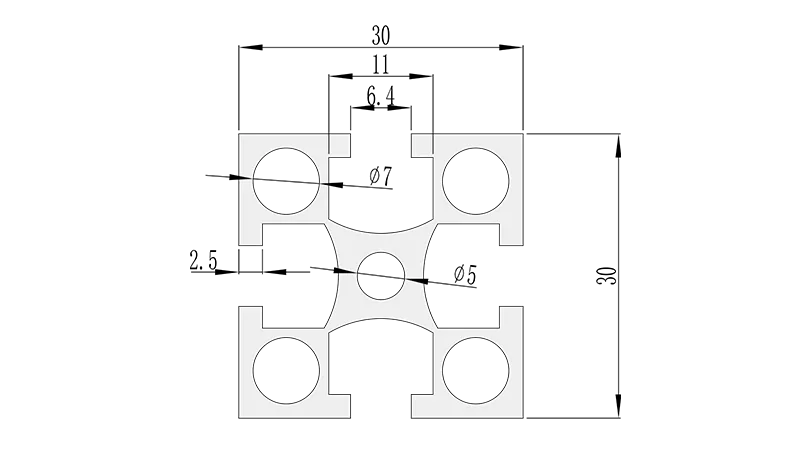
First things first—let's decode the name. The "3030" refers to its cross-sectional dimensions: 30 millimeters wide by 30 millimeters tall. Picture a square tube, but with a clever twist: along each of its four sides, you'll find T-shaped slots (called T-slots) running the length of the profile. These slots are the secret to its adaptability, allowing you to attach accessories, connectors, and components without drilling or welding. But what makes it "National Standard"? That label is your guarantee of consistency. It means this profile meets strict industry regulations for material quality, dimensions, and performance. Whether you order it from a local supplier or a national distributor, you can trust that the 3030 National Standard Profile A will fit seamlessly with other components—no guesswork, no mismatched parts, just reliability you can build your operations around.
Quick Fact: The 3030 National Standard Profile A is typically made from 6063-T5 aluminum alloy, a material prized for its perfect balance of strength, lightweight, and corrosion resistance. This alloy is widely used in manufacturing because it handles daily wear and tear like a champ, even in busy environments where equipment is moved, adjusted, and reconfigured regularly.
Core Characteristics: Why This Profile Stands Out on the Factory Floor
So, what makes the 3030 National Standard Profile A more than just another piece of metal? Let's break down the features that matter most for manufacturers like you.
1. Just the Right Size: The Sweet Spot of Strength and Practicality
At 30x30mm, this profile hits a sweet spot that's hard to beat. It's sturdy enough to support heavy loads—think stacks of components, tools, or even small machinery—without being overkill. For example, a workbench built with 3030 profiles can easily handle 150-200 kg of weight on its surface, which is more than enough for most assembly tasks. But it's also lightweight enough to move around when you need to reconfigure your workspace. Compare that to bulkier 40x40mm profiles, which might be too heavy for frequent adjustments, or smaller 20x20mm profiles, which can feel flimsy for anything beyond light-duty use. The 3030 profile? It's the Goldilocks of aluminum profiles—just right for most factory needs.
2. T-Slots: Your Ticket to Endless Configurations
Remember those T-slots we mentioned earlier? They're not just a design quirk—they're the reason this profile is so versatile. Imagine being able to attach a shelf, a tool holder, or a conveyor track to your structure in minutes, not hours. With the T-slots, you can slide in bolts, brackets, or aluminum profile accessories like end caps and gusset plates, then tighten them down with a wrench. No welding, no cutting, no messy modifications. Need to raise a shelf by a few inches? Loosen the bolts, adjust, and retighten. Want to add a second level to your material rack? Grab a few extra profiles and connectors, and you're done. This flexibility is a lifesaver for teams that need to pivot quickly—whether you're launching a new product line or rearranging your assembly area for efficiency.
3. Built to Last: Durability That Saves You Money Long-Term
Let's talk about the long game. The 3030 National Standard Profile A is built to withstand the chaos of a manufacturing environment. Its aluminum alloy resists rust and corrosion, so even if you're working in a humid or dusty space, you won't see it degrade over time. The anodized surface (a common finish for these profiles) adds an extra layer of protection, preventing scratches and dents from daily use. And because it's modular, you won't have to replace the entire structure if one part gets damaged—just swap out the affected profile. Compare that to traditional wooden workbenches or welded steel racks, which can rot, rust, or require complete replacement if they break. Over time, this durability translates to lower costs and less downtime for your team.
4. Lightweight but Mighty: Easy to Handle, Strong Enough to Trust
Aluminum is naturally lightweight, and the 3030 profile is no exception. A 1-meter length weighs in at around 0.8-1 kg, which means even your smaller team members can carry and install it without strain. This is a big deal for factories that frequently reconfigure their layouts—no need for heavy machinery or extra to move a workbench or material rack. But don't let the light weight fool you: this profile is surprisingly strong. Thanks to its square shape and solid construction, it can support vertical loads of up to 500 kg per meter when properly braced. That means you can build tall material racks or overhead storage without worrying about stability.
Real-World Applications: How Factories Are Using 3030 National Standard Profile A Today
Enough theory—let's look at how this profile is making a difference on actual factory floors. Here are a few common use cases that might sound familiar to your team:
Custom Workbenches: Built for Your Team's Exact Needs
Every team has unique needs when it comes to workbenches. The electronics manufacturer might need a surface with ESD protection to prevent static damage, while the automotive shop could use a bench with built-in tool hooks and storage. With 3030 National Standard Profile A, you can build a workbench that fits your team like a glove. Start with a frame of 3030 profiles, add a plywood or aluminum top, then use T-slots to attach accessories: LED lights for better visibility, power strips for tools, or even monitor mounts for digital work instructions. And if your needs change next quarter? Disassemble the bench and rebuild it—no waste, no hassle.
Material Racks: Organized Storage That Grows with You
Material Rack B, a popular setup with 3 rows and 3 floors, is a perfect example of how 3030 profiles shine. Instead of buying a pre-built rack that's too tall, too short, or has shelves spaced awkwardly, you can design one that fits your exact inventory. Need taller shelves for bulky boxes? Adjust the vertical profiles. Smaller compartments for tiny components? Add dividers using T-slots. And when your inventory expands, simply add more sections to the rack. It's storage that adapts to your needs, not the other way around.
Conveyor Systems: Smooth Material Flow, No Welding Required
Moving parts from one station to the next is a critical part of any assembly line. With 3030 profiles, you can build custom conveyor tracks that fit your space perfectly. Attach roller track guide rails (like the plastic roller track guide rail yellow or grey) to the T-slots, add swivel roller balls for easy sliding, and you've got a system that moves materials smoothly without the cost of a pre-built conveyor. Best of all, if you need to adjust the track's angle or length, you can do it in minutes—no need to call in a contractor.
How Does It Stack Up? Comparing 3030 to Other Common Profiles
Still not sure if 3030 is right for you? Let's compare it to two other popular options: the smaller 2020 National Standard Profile and the larger 4040 National Standard Profile. This quick table will help you see where 3030 fits best.
| Feature | 2020 National Standard Profile | 3030 National Standard Profile A | 4040 National Standard Profile |
|---|---|---|---|
| Dimensions | 20x20mm | 30x30mm | 40x40mm |
| Weight (per meter) | 0.3-0.4 kg | 0.8-1 kg | 1.5-2 kg |
| Max Load (per linear meter) | 50-80 kg | 150-200 kg | 300-400 kg |
| Best For | Light-duty tasks: small shelves, display racks, prototyping | Medium-duty tasks: workbenches, material racks, conveyor tracks | Heavy-duty tasks: industrial machinery frames, large storage systems |
| Cost (Relative) | Lowest | Moderate | Highest |
As you can see, 3030 hits the sweet spot for most manufacturers. It's not the cheapest, but it offers the best balance of strength, flexibility, and cost-effectiveness for everyday tasks. Unless you're building something extremely heavy (like a machine frame) or extremely light (like a small display), 3030 is likely the profile that will serve you best.
The Importance of Quality Accessories: Making the Most of Your 3030 Profiles
A profile is only as good as the accessories that go with it, and the 3030 National Standard Profile A pairs perfectly with a wide range of aluminum profile accessories. Here are a few must-haves to keep in mind:
- Connectors: 90° aluminum profile connectors, 45° connectors, and three-way connectors let you join profiles at any angle.
- End Caps: These plastic or metal caps snap into the ends of the profile, protecting workers from sharp edges and keeping dust out of the T-slots.
- Gusset Plates: For extra stability in corners or high-load areas, these metal plates reinforce joints and prevent bending.
- Casters: Add wheels to the bottom of your workbench or material rack for easy mobility—perfect for teams that reconfigure often.
Investing in high-quality accessories might seem like a small detail, but it makes a big difference in how well your structure performs. Cheap connectors can loosen over time, while flimsy casters might get stuck, slowing down your team. When you pair 3030 National Standard Profile A with reliable accessories, you're building a system that will last for years.
Final Thoughts: Why 3030 National Standard Profile A Deserves a Spot in Your Factory
In a world where manufacturing is all about speed, adaptability, and efficiency, the 3030 National Standard Profile A is more than just a tool—it's a partner in your success. It lets you build exactly what you need, when you need it, without being locked into rigid, one-size-fits-all equipment. Whether you're setting up a new assembly line, upgrading your existing workbenches, or organizing your material storage, this profile offers the flexibility to grow with your business and the durability to keep up with your team's demands.
So, the next time you're struggling with a workstation that doesn't quite fit, a material rack that's too rigid, or a conveyor system that's slowing you down, remember: the solution might be as simple as a 30x30mm aluminum profile. It's not flashy, but it's reliable, adaptable, and ready to work as hard as your team does. Give it a try—we think you'll wonder how you ever managed without it.