- Company Articles
- Industry articles
- Industry standards
- What Is 3030b EU Standard Aluminum Profile? Definition & Core Features

What Is 3030b EU Standard Aluminum Profile? Definition & Core Features
Related Product
3030B EU Standard Aluminum Profile
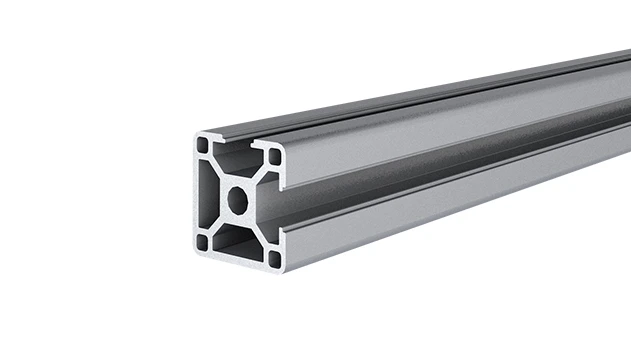
3030 is a 3.00 x 3.00CM fractional 30 series square extrusion T-slot profile with two side open T-slots, each side with 3.00cm face, 2 side with open slot, 2 side with closed face. The profile has align-a-grooves to assist in aligning connecting profiles.
The Backbone of Modern Workspaces: Why Aluminum Profiles Matter
Walk into any modern factory, workshop, or even a small-scale production line, and you'll likely spot a common element holding everything together: aluminum profiles. These unassuming metal beams are the unsung heroes of efficient workspace design, quietly supporting workbenches, material racks, conveyor systems, and more. But not all aluminum profiles are created equal. Today, we're zeroing in on one that's become a staple in lean manufacturing and modular setups: the 3030b EU Standard Aluminum Profile. Whether you're a small business owner setting up your first workshop or a production manager looking to optimize your factory floor, understanding what makes this profile unique can transform how you build, adapt, and grow your workspace.
Defining 3030b EU Standard Aluminum Profile: What Sets It Apart?
Let's start with the basics. The term "3030b EU Standard Aluminum Profile" might sound technical, but break it down, and it's surprisingly straightforward. The "3030" refers to its dimensions: 30 millimeters in width and 30 millimeters in height, making it a square profile. The "b" denotes a specific variant within the 3030 family—think of it as a model number that differentiates it from other 3030 sub-types (like 3030a or 3030r). Then there's "EU Standard," which is key: this profile adheres to strict European manufacturing norms, ensuring consistency in dimensions, material quality, and safety across suppliers. That means whether you source it from Germany, Italy, or a trusted lean system supplier in Asia, you can count on it fitting with EU-standard accessories and components.
But why does this matter? Imagine ordering a batch of profiles and finding out the slots are slightly off, or the connectors don't fit—suddenly, your "modular" setup becomes a frustrating puzzle. EU standards eliminate that headache, making 3030b a reliable choice for businesses that value interoperability and quality.

Core Features: Why 3030b Stands Out in the Crowd
Material: The Power of 6063-T5 Aluminum Alloy
At its core, the 3030b profile is made from 6063-T5 aluminum alloy—and that's no accident. This alloy is a favorite in industrial design for good reason: it strikes a near-perfect balance between strength, weight, and workability. Unlike heavier steel profiles, 6063-T5 aluminum is lightweight enough to reposition without heavy machinery, yet sturdy enough to support tools, materials, and even small equipment. "T5" refers to the heat treatment process it undergoes, which (strengthens) the metal while keeping it malleable. This means you can drill, cut, or shape the profile on-site if needed, without compromising its integrity—a huge plus for custom setups.
Surface Treatment: More Than Just Looks
Run your hand along a 3030b profile, and you'll notice it's smooth, often with a subtle matte finish. That's thanks to anodizing—a surface treatment that forms a protective oxide layer on the aluminum. Anodizing does more than make the profile look professional; it shields it from corrosion, scratches, and daily wear and tear. In humid workshops or factories handling liquids, this is a game-changer. Some suppliers also offer powder coating for extra durability or color customization (think blue, yellow, or gray to match your brand), but the standard anodized finish is usually all you need for long-lasting performance.
T-Slot Design: The Secret to Modularity
Here's where the 3030b really shines: its T-slot design. Look closely, and you'll see long, narrow grooves (slots) running along each side of the profile. These slots aren't just for show—they're the reason this profile is so versatile. Using T-slot nuts, bolts, and brackets, you can attach accessories like shelves, tool holders, or even small machines directly to the profile, no welding required. Need to move a shelf up by 10cm? Loosen the bolts, slide the bracket, and tighten—done. It's this flexibility that makes 3030b a favorite for lean manufacturing, where workflows evolve and adapt over time.
Load Capacity: Sturdy Without the Bulk
Don't let its lightweight fool you—3030b can handle serious weight. Depending on the length and how it's supported, a single 3030b profile can typically carry 50-100kg evenly distributed. That's enough for a workbench loaded with tools, a material rack stacked with parts, or even a small conveyor section. For heavier loads, you can reinforce it with gussets (like the gusset alp 3030 from the keyword list) or pair it with thicker profiles, but for most small to medium applications, 3030b holds its own.
Accessories: The Building Blocks of Customization
A profile is only as good as the accessories that bring it to life, and 3030b works with a range of EU-standard components that make assembly a breeze. Let's break down the essentials:
Connectors and Joints: Bringing Profiles Together
Need to join two profiles at a right angle? Grab a 90° aluminum profile connector. Working on a corner that's not 90°? There's a 45° or 135° connector for that. These small but mighty parts slide into the T-slots and lock in place with bolts, creating strong, stable joints without welding. Even better, most connectors are reusable—so if you reconfigure your setup later, you can just unscrew them and start fresh.
End Caps and Finishing Touches
Ever had a sharp metal edge catch your sleeve? Not with 3030b. 3030 aluminum profile end caps snap onto the ends of the profile, covering rough edges and adding a polished look. They're cheap, easy to install, and a small detail that makes a big difference in workplace safety.
Brackets and Supports: Adding Strength Where It Counts
For shelves, workbench tops, or anything that needs extra support, brackets like the roller track placon mount (from the keyword list) or aluminum pipe clamp are indispensable. These accessories attach to the T-slots and provide a stable base for adding surfaces or connecting to other systems, like roller tracks for material flow.
Applications: Where 3030b Shines in Real-World Use
Now that we've covered the "what" and "why," let's talk about the "where." 3030b isn't just a profile—it's a building block for countless setups. Here are some of the most common ways businesses put it to work:
Aluminum Workbenches: Your Workshop's Best Friend
Walk into a electronics repair shop, a small-scale assembly line, or even a makerspace, and you'll likely find an aluminum workbench built with 3030b profiles. These workbenches are customizable: add a plywood or aluminum honeycomb panel top, attach a vice on one end, hang tool holders from the sides, and you've got a workstation tailored to your tasks. Best of all, if you need to add a shelf later or raise the height, you can do it in an afternoon with basic tools—no need to buy a whole new bench.
Material Racks and Flow Racks: Streamlining Storage
In warehouses and factories, keeping materials organized is half the battle. 3030b profiles make it easy to build material racks (like material rack b from the keywords) with adjustable shelves, so you can store parts of different sizes without wasting space. For faster access, pair 3030b with roller track (another keyword!) to create flow racks—these let materials glide forward as items are removed, reducing the need to reach or bend. It's a small change that cuts down on manual labor and speeds up production.
Lean Systems: Building Efficient Production Cells
Lean manufacturing is all about eliminating waste, and 3030b fits right in. Whether you're setting up a U-shaped production cell or a kanban system, modular 3030b structures adapt to your workflow. For example, you can build a mini assembly line with a conveyor (using roller track and 3030b supports), a workbench in the middle, and a material rack nearby—all connected and reconfigurable as your processes improve. As a lean system supplier might tell you, this flexibility is key to staying competitive in fast-changing industries.
How 3030b Compares to Other Aluminum Profiles: A Quick Guide
With so many aluminum profiles out there, how do you know 3030b is right for you? Let's compare it to two common alternatives:
| Profile Type | Dimensions (WxH) | Typical Load Capacity | Best For |
|---|---|---|---|
| 3030b EU Standard | 30x30mm | 50-100kg | Workbenches, small material racks, lean cells |
| 2020 EU Standard | 20x20mm | 20-50kg | Light-duty shelves, display racks, small tools |
| 4040 EU Standard | 40x40mm | 100-200kg | Heavy workbenches, large material racks, machinery supports |
As you can see, 3030b hits the sweet spot for most mid-sized applications. It's not too big to be unwieldy, not too small to be limited—and its EU standard compliance means you won't struggle to find compatible accessories.
Why Choose 3030b for Your Next Project?
At the end of the day, the 3030b EU Standard Aluminum Profile isn't just a piece of metal—it's a tool for problem-solving. It's for the mechanic who needs a workbench that grows with their shop, the warehouse manager tired of one-size-fits-all racks, and the startup founder building a production line on a budget. Its modularity means you can start small and expand later; its durability ensures it will last for years; and its compatibility with EU-standard accessories takes the guesswork out of sourcing parts.
So whether you're a seasoned manufacturer or just starting out, consider this: the right workspace design can boost productivity, reduce stress, and even save you money in the long run. And with 3030b, you're not just buying a profile—you're investing in a workspace that works for you .
Conclusion: The Versatile Workhorse of Industrial Design
The 3030b EU Standard Aluminum Profile may not grab headlines, but in workshops, factories, and production lines around the world, it's quietly revolutionizing how we build and adapt our workspaces. From its 6063-T5 aluminum core to its clever T-slot design and range of accessories, it's a profile built for the real world—where flexibility, durability, and affordability matter most. So the next time you're planning a workspace upgrade, ask yourself: Could 3030b be the missing piece in your setup? Chances are, the answer is yes.