- Company Articles
- Industry articles
- Industry standards
- What is 3030r EU Standard Aluminum Profile? Key Definitions & Core Features

What is 3030r EU Standard Aluminum Profile? Key Definitions & Core Features
Related Product
3030R EU Standard Aluminum Profile
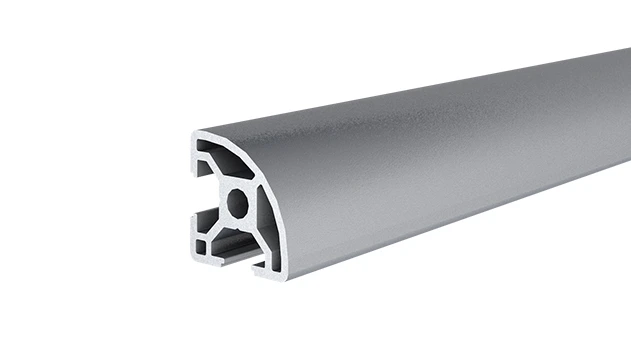
3030R is a 3.00 x 3.00CM fractional 30 series square extrusion T-slot profile with four open T-slots, two side with 3.00cm face, the other side with round face. The profile has align-a-grooves to assist in aligning connecting profiles.
Walk into any modern manufacturing facility, warehouse, or workshop, and you'll likely spot a common building block holding everything together: aluminum profiles. These unassuming metal structures are the backbone of workbenches, material racks, assembly lines, and even lean system setups. But not all aluminum profiles are created equal. Today, we're zeroing in on one that's become a favorite for businesses prioritizing durability, flexibility, and compliance: the 3030r EU Standard Aluminum Profile. Whether you're a small business owner upgrading your production floor or a procurement manager sourcing components for a large-scale operation, understanding what 3030r is and why it matters can save you time, money, and headaches down the line.
Defining the Basics: What Are EU Standard Aluminum Profiles?
Before diving into the specifics of 3030r, let's start with the fundamentals. Aluminum profiles are extruded pieces of aluminum alloy shaped into consistent cross-sections, designed to be lightweight yet strong. They're used to build everything from simple shelving to complex automated systems. But when we add "EU Standard" to the mix, we're talking about profiles manufactured to meet strict European union guidelines for quality, safety, and dimensional consistency.
EU standards—developed by organizations like CEN (European Committee for Standardization)—ensure that aluminum profiles across Europe (and beyond) adhere to uniform specifications. This means if you buy a 3030r profile from a supplier in Germany, Poland, or even China (as long as they're EU-certified), it will fit seamlessly with accessories and components from another EU-standard supplier. No more guesswork about whether a connector will fit or if a bracket will align—standardization takes the hassle out of assembly.
Breaking Down 3030r: What the Numbers and Letter Mean
Now, let's decode "3030r." The name itself gives us clues about its design. The first two numbers, "30," refer to the profile's width: 30 millimeters. The next two numbers, another "30," indicate its height: also 30 millimeters. So, in simple terms, the 3030r has a square cross-section measuring 30mm x 30mm. That symmetry makes it incredibly versatile—you can orient it vertically, horizontally, or at angles without worrying about uneven weight distribution.
Then there's the "r." This little letter stands for "rounded," and it's a key detail that sets the 3030r apart from other 3030 profiles (like the 3030a or 3030b). Unlike profiles with sharp, angular edges, the 3030r features gently rounded corners. Why does this matter? For starters, safety. In busy work environments, sharp edges can lead to cuts or scrapes—especially when employees are moving materials or leaning against workbenches. Rounded edges reduce that risk. They also make the profile more ergonomic; if you're using it to build a workstation where operators stand for hours, a smooth edge is more comfortable to rest against than a sharp one.

Core Features of 3030r EU Standard Aluminum Profile
What makes the 3030r such a standout choice for businesses? Let's break down its most important features, from material to design, and how they translate to real-world benefits.
1. Premium Aluminum Alloy: Strength Meets Lightweight
The 3030r is typically made from 6063-T5 aluminum alloy, a material beloved in the industry for its perfect balance of strength, flexibility, and corrosion resistance. 6063 aluminum is known as an "architectural alloy" because it extrudes easily into complex shapes (like the t-slots we'll discuss next) and responds well to surface treatments. The "T5" designation refers to its heat treatment process—artificially aged to enhance hardness without sacrificing ductility. This means the 3030r can support significant weight (we're talking hundreds of kilograms per meter, depending on the setup) without bending or warping, yet it's light enough to be maneuvered by a single person during assembly. For small businesses without heavy lifting equipment, that's a game-changer.
2. T-Slot Design: The Secret to Versatility
If there's one feature that makes aluminum extrusion profiles indispensable, it's the t-slot. Look at the cross-section of a 3030r, and you'll notice one or more longitudinal slots (usually on all four sides) shaped like a "T." These slots are standardized in size (often 6mm or 8mm wide) to accept t-slot nuts, bolts, and accessories. Why is this so important? Because it turns the 3030r into a modular building block. Need to attach a shelf to your workbench? Slide a t-slot nut into the slot, bolt on the bracket, and you're done. Want to add a tool holder or a light fixture? No drilling or welding required—just clamp it into the slot. This modularity means you can reconfigure your setup as your needs change. A workbench today can become a material rack tomorrow, or a conveyor side rail next month. For lean system setups, where adaptability is key, this flexibility is priceless.
3. Surface Treatments: Durable and Aesthetically Pleasing
EU standard 3030r profiles don't just perform well—they look good too. Most come with a surface treatment to enhance durability and appearance. The most common is anodizing: an electrochemical process that forms a protective oxide layer on the aluminum's surface. Anodized 3030r profiles have a smooth, matte finish (often silver or black) that resists scratches, fingerprints, and corrosion. This is especially important in environments with moisture, like food processing plants, or where chemicals are used, such as electronics manufacturing.
For businesses that want to match their brand colors or improve visibility, powder coating is another option. Powder-coated 3030r profiles can be finished in any color (yellow, blue, grey—you name it) and have a durable, textured surface that's even more resistant to chipping than anodizing. Whether you prioritize function or style, the 3030r's surface treatments ensure it holds up in tough industrial settings.
4. Dimensional Accuracy: Precision You Can Count On
EU standards aren't just about safety—they're about precision. 3030r profiles are extruded using high-precision dies, ensuring that every piece has consistent dimensions. The width, height, wall thickness, and slot size vary by no more than a few thousandths of a millimeter from piece to piece. Why does this matter? Imagine building a workbench with profiles that are slightly warped or have mismatched slot sizes. The shelves might wobble, the doors might not close, and the whole structure could feel flimsy. With 3030r, you get a tight, stable fit every time. This precision also extends to accessories; EU-standard brackets, connectors, and end caps are designed to pair perfectly with 3030r, so assembly is quick and frustration-free.
Applications: Where 3030r Shines in the Real World
Now that we understand its features, let's talk about how businesses actually use the 3030r. Its 30mm x 30mm size, rounded edges, and t-slot design make it a jack-of-all-trades, but here are some of its most common applications:
Workbenches: The Backbone of Assembly Lines
Walk into any manufacturing plant, and you'll find workbenches everywhere—for assembly, testing, packaging, and more. 3030r is a top choice for building these workbenches because it strikes the perfect balance between strength and weight. A typical workbench frame made with 3030r can support heavy tools, equipment, and materials (think laptops, soldering irons, bins of components) without sagging. Add a plywood or aluminum honeycomb panel top, and you've got a sturdy, customizable workspace. And because of those rounded edges, operators can lean against the bench comfortably during long shifts—no more bruising elbows!
Take the "workbench E (single deck-without caster)" from many suppliers' catalogs—it's often built with 3030r profiles. Simple, functional, and easy to assemble, it's a staple in small to medium-sized workshops.
Material Racks: Organizing Inventory Efficiently
Keeping inventory organized is critical for lean manufacturing, and 3030r excels here too. Material racks built with 3030r are lightweight enough to move (with casters) but strong enough to hold boxes, bins, or even heavy parts. A "material rack B (3 row and 3 floor)" setup, for example, uses 3030r uprights and crossbars to create a stable structure that maximizes vertical space. The t-slots make it easy to adjust shelf heights as inventory needs change—no tools required. Plus, the rounded edges mean you don't have to worry about damaging delicate components when sliding bins in and out.
Lean Systems: Streamlining Production with Modularity
Lean manufacturing is all about eliminating waste—whether it's time, space, or materials. 3030r fits right into this philosophy because it's modular and adaptable. Need a temporary assembly line for a new product? Build it with 3030r and disassemble it when the project ends. Want to reconfigure your workflow to reduce bottlenecks? Just unbolt the profiles and rearrange them. This flexibility reduces the need for custom-built, one-off structures that gather dust when production needs change. 3030r also pairs well with other lean tools like flow racks and roller tracks—its t-slots make it easy to attach roller track placon mounts or swivel roller balls for smooth material flow.
Turnover Trolleys and Carts: Moving Materials Safely
Trolleys and carts are essential for moving materials around a facility, and 3030r is ideal for building these too. Its lightweight nature means the carts are easy to push, even when loaded, while its strength ensures they can handle heavy loads. Add casters (like the 360° swivel expanding stem casters with brake from the keyword list), and you've got a mobile solution that's both agile and stable. Rounded edges are a bonus here too—no more catching corners on doorframes or walls as you maneuver through tight spaces.
Accessories: Making 3030r Even More Versatile
A profile is only as good as the accessories that go with it, and 3030r has a wide range of EU-standard aluminum profile accessories to extend its functionality. Let's take a look at some of the most common ones:
- End Caps: These plastic or aluminum caps snap onto the ends of the profile to cover sharp edges (though 3030r's rounded edges are already safe, end caps add a finished look) and prevent dust, debris, or small parts from falling into the t-slots. The 3030 aluminum profile end cap is a must-have for any project.
- Connectors: From 90° aluminum profile connectors to 45° brackets and 135° angle codes, these accessories let you join profiles at any angle without welding. Many connectors use set screws or bolts that tighten into the t-slots, creating a secure, tool-free connection.
- Gusset Plates: For extra stability in corners, gusset plates (like the gusset alp 3030) reinforce joints, distributing weight evenly and preventing flexing under heavy loads.
- T-Slot Nuts and Bolts: These small but mighty accessories are the key to attaching anything to the t-slots. T-slot nuts slide into the slot and rotate to lock in place, while bolts pass through the accessory and into the nut, creating a strong hold.
- Wheels and Casters: Adding casters (like the flat swivel castor wheel with brake) turns a static structure into a mobile one. 3030r's strength means it can support casters even when loaded, making carts and trolleys easy to move.
Comparing 3030r to Other EU Standard Profiles
With so many aluminum profiles available, why choose 3030r? Let's compare it to a few other popular EU standard profiles to see where it fits best:
| Profile Type | Dimensions (W x H) | Weight (kg/m) | Typical Load Capacity (kg/m) | Best For |
|---|---|---|---|---|
| 2020 EU Standard | 20mm x 20mm | 0.4–0.6 | 50–100 | Light-duty applications: small shelves, display racks, 3D printer frames |
| 3030r EU Standard | 30mm x 30mm | 0.8–1.2 | 150–300 | Medium-duty applications: workbenches, material racks, lean system frames, trolleys |
| 4040 EU Standard | 40mm x 40mm | 1.5–2.0 | 300–500+ | Heavy-duty applications: industrial machinery frames, large storage systems, automated conveyor supports |
As you can see, 3030r sits in the sweet spot between lightweight 2020 profiles and heavy-duty 4040s. If you need something stronger than 2020 but don't want the extra weight (or cost) of 4040, 3030r is the way to go. Its rounded edges also make it safer than sharp-edged 3030 variants, which is a big plus in environments with lots of foot traffic.
Why Choose 3030r EU Standard for Your Business?
Still on the fence? Here are a few reasons businesses keep coming back to 3030r:
Cost-Effective: Compared to custom metal fabrication or heavier profiles like 4040, 3030r offers great value. Its modular design reduces labor costs (no welding or specialized tools needed), and its durability means it lasts for years—no need for frequent replacements.
Time-Saving: Assembly is quick and easy, thanks to t-slots and standardized accessories. A team of two can build a basic workbench or material rack in under an hour, so you can get back to focusing on your core operations.
Sustainable: Aluminum is 100% recyclable, and 3030r's long lifespan means less waste. When you're done with a structure, you can disassemble it and reuse the profiles or recycle them—no scrap metal going to landfills.
Future-Proof: As your business grows, your needs change. 3030r's modularity lets you expand or reconfigure existing structures instead of starting from scratch. Need a longer workbench? Add more profiles. Want to turn a shelf into a cart? Just add casters.
Conclusion: 3030r—More Than Just a Profile, It's a Solution
At the end of the day, the 3030r EU Standard Aluminum Profile is more than just a piece of metal. It's a tool that helps businesses work smarter, safer, and more efficiently. Whether you're building workbenches, organizing inventory with material racks, or streamlining production with lean systems, its strength, versatility, and EU-standard reliability make it a top choice.
So, if you're tired of flimsy, one-size-fits-none structures that slow down your workflow, consider 3030r. With its rounded edges, t-slot design, and endless accessory options, it's not just a profile—it's a foundation for growth. And in today's fast-paced business world, that's a foundation worth investing in.