- Company Articles
- Industry articles
- Industry standards
- What is 3060 National Standard Profile A? Definition, Specifications & Key Features

What is 3060 National Standard Profile A? Definition, Specifications & Key Features
Related Product
3060 National Standard Profile A
Workbench, production line, logistic rack, warehouse rack Industry: Manufacturer workshop, Automobile, Electronic, Assembling, logistic
Walk through any modern manufacturing facility, busy warehouse, or even a DIY workshop, and you'll likely spot a silent workhorse holding everything together: aluminum profiles. These sleek, versatile structures form the backbone of assembly lines, workbenches, material racks, and countless other industrial setups. Among the many types of aluminum profiles available, the 3060 National Standard Profile A has earned a reputation as a reliable, adaptable choice for medium-duty applications. But what exactly is it? Why do engineers, factory managers, and even hobbyists reach for it time and again? In this guide, we'll break down its definition, dive into its specifications, explore its key features, and uncover why it's become a staple in industries ranging from automotive production to electronics assembly.
Defining 3060 National Standard Profile A: More Than Just a "Metal Stick"
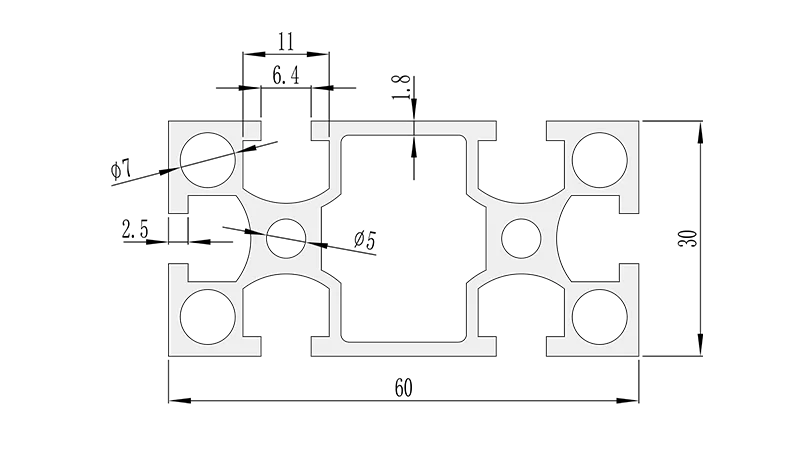
At its core, the 3060 National Standard Profile A is a type of aluminum extrusion profile —a product created by forcing heated aluminum alloy through a die to form a specific cross-sectional shape. The "3060" in its name isn't arbitrary: it refers to the profile's cross-sectional dimensions, with a width of 30 millimeters and a height of 60 millimeters. The "National Standard" label means it adheres to strict manufacturing guidelines set by national regulatory bodies, ensuring consistency in size, material quality, and performance across suppliers. The "A" designation differentiates it from other variations in the 3060 series (such as "B" or "C"), which may have slight differences in slot design, wall thickness, or weight distribution.
But to truly understand it, let's move beyond the numbers. Imagine a long, rectangular tube with a hollow interior and a series of T-shaped slots running along its length. These slots are the profile's secret weapon: they allow for quick, tool-free connection to aluminum profile accessories like brackets, connectors, and panels. Unlike welded steel structures, which require specialized skills and equipment to modify, 3060 profiles let you assemble, disassemble, and reconfigure setups in minutes—making it a favorite for lean manufacturing systems that prioritize flexibility and adaptability.
Specifications: The Nitty-Gritty Details That Matter
To appreciate why the 3060 National Standard Profile A works so well in real-world applications, we need to look at its technical specifications. These details determine everything from how much weight it can support to how easily it integrates with other components. Below is a breakdown of its key specs, organized for clarity:
| Specification | Details | Why It Matters |
|---|---|---|
| Cross-Sectional Dimensions | 30mm (width) x 60mm (height) | Balances space efficiency with load capacity; fits well in medium-duty setups without taking up excess space. |
| Material Composition | Typically 6063 or 6061 aluminum alloy | 6063 offers excellent extrudability (for complex shapes) and corrosion resistance; 6061 adds higher tensile strength for heavier loads. |
| Wall Thickness | 1.5mm – 3.0mm (varies by supplier, but 2.0mm is standard) | Thicker walls boost strength but add weight; 2.0mm strikes a balance for most medium-duty uses (e.g., workbenches, light material racks). |
| Surface Treatment | Anodized (silver, black, or custom colors) or powder-coated | Anodizing creates a hard, corrosion-resistant oxide layer; powder coating adds durability and color options for aesthetic or safety purposes (e.g., yellow for hazard zones). |
| T-Slot Design | 2-4 T-slots (typically 2 on the 60mm sides, 1 on each 30mm side) | Slots accept bolts, nuts, and aluminum profile accessories (e.g., angle brackets, sliding nuts) for tool-free assembly. |
| Weight per Meter | Approx. 0.6kg – 1.2kg (varies with wall thickness) | Lightweight enough for manual handling but sturdy enough to support tools, materials, or equipment. |
| Tolerance | ±0.1mm for dimensions, ±0.5° for straightness | National standard ensures parts from different suppliers fit together seamlessly—critical for modular setups. |
These specs might seem technical, but they translate to real-world performance. For example, the 2.0mm wall thickness and 6063 alloy composition mean a 1-meter length of 3060 Profile A can typically support 50-80kg of evenly distributed weight—enough for a workbench holding power tools, or a material rack storing boxes of electronic components. The T-slot design, meanwhile, turns a simple aluminum bar into a building block: with the right accessories, you can attach shelves, wheels, or even conveyor tracks in minutes.
Key Features: Why 3060 National Standard Profile A Stands Out
Numbers and specs tell part of the story, but the 3060 National Standard Profile A's popularity stems from its features —the qualities that make it practical, reliable, and cost-effective. Let's explore the most notable ones:
1. Strength Without the Bulk: The "Goldilocks" of Load Capacity
Aluminum is already known for its impressive strength-to-weight ratio, and 3060 Profile A takes this to the next level. Its 30x60mm cross-section provides more structural rigidity than smaller profiles like 2020 or 3030, making it suitable for heavier tasks—think supporting a workbench with a soldering iron, oscilloscope, and bins of parts. Yet it's lighter and more compact than larger profiles like 4080 or 50100, which is a boon in tight spaces. A factory manager in charge of a cramped electronics assembly line, for instance, might choose 3060 over 4080 to free up floor space without sacrificing stability.
2. T-Slot Versatility: Build, Modify, Repeat
The T-slots running along the profile's length are its most defining feature. These grooves act like built-in "tracks" that accept specialized nuts (called "T-nuts" or "slider nuts") and bolts, allowing you to attach accessories without drilling holes or welding. Need to add a shelf to your workbench? Slide a bracket into the slot, tighten a bolt, and you're done. Want to reposition a tool holder? Loosen the bolt, slide it to the new spot, and retighten. This flexibility is a game-changer for lean manufacturing, where production lines often need to adapt to new products or processes. Unlike fixed steel frames, which require cutting and rewelding to modify, 3060 setups can be reconfigured in hours—saving time and money.
3. Compatibility with Standard Accessories: No More "Special Order" Headaches
One of the biggest frustrations in industrial design is buying a component only to find its accessories are rare or overpriced. Not so with 3060 National Standard Profile A. Because it adheres to national standards, it works seamlessly with a vast array of aluminum profile accessories available from most suppliers. This includes angle brackets, corner connectors, end caps, panel mounts, and even casters for mobile setups. Whether you need a 90° connector to join two profiles at a right angle or a plastic end cap to cover sharp edges (critical for safety in busy workshops), you won't have to hunt for "custom" parts—they're likely in stock at your local hardware store or industrial supplier.
4. Corrosion Resistance: Built to Last in Harsh Environments
Aluminum naturally forms a thin oxide layer that resists rust, but 3060 Profile A takes this further with surface treatments like anodizing. Anodizing involves submerging the profile in an electrolytic solution and passing an electric current through it, thickening the oxide layer and making it even more durable. This makes the profile ideal for use in damp warehouses, factories with chemical exposure, or outdoor settings (like covered loading docks). A food packaging plant, for example, might use anodized 3060 profiles for material racks near washdown areas, where stainless steel would be overkill and uncoated steel would rust.
5. Cost-Effective: Quality Without Breaking the Bank
While premium materials like stainless steel or carbon fiber offer superior strength, they come with a premium price tag. 3060 National Standard Profile A hits a sweet spot: it's affordable enough for small businesses and hobbyists but durable enough for industrial use. Aluminum extrusion is also a mass-production process, driving down costs further. For a startup building its first assembly line, or a maker building a home workshop, this balance of quality and cost is often the deciding factor.
Real-World Applications: Where 3060 National Standard Profile A Shines
Theory is one thing, but seeing how 3060 Profile A performs in real life helps illustrate its value. Let's look at some common applications:
Workbenches and Assembly Stations
Perhaps the most common use is in workbench construction. A typical setup might use 3060 profiles for the frame, with a plywood or aluminum honeycomb panel for the top. T-slots along the sides let workers attach tool holders, bins, or even small conveyors for parts. In an electronics factory, for example, an assembly station built with 3060 might have slots for electrostatic discharge (ESD) mats (to protect sensitive components), adjustable shelves for manuals, and caster wheels (attached via slot-compatible brackets) for mobility.
Material Racks and Storage Systems
Warehouses and factories rely on 3060 profiles for lightweight yet sturdy material racks. A "3-row, 3-floor" material rack (similar to the "material rack B" mentioned in industrial catalogs) might use 3060 uprights and crossbars, with wire shelves or plywood platforms held in place by slot brackets. The profile's load capacity ensures it can handle boxes of parts, while its light weight makes the rack easy to move during warehouse reorganizations.
Conveyor and Production Line Frames
In production lines, 3060 profiles often form the frame for small conveyors or "flow racks"—systems that use gravity to move parts from one workstation to the next. For example, a plastic roller track (like the "plastic roller track guide rail yellow" or "grey" models) can be mounted to 3060 profiles using specialized brackets, creating a smooth path for bins of circuit boards or automotive components. The T-slots make it easy to adjust the conveyor's height or angle to match worker ergonomics.
Machine Guards and Safety Barriers
Factories use 3060 profiles to build machine guards, protecting workers from moving parts. The profile's strength ensures the guard can withstand accidental impacts, while its transparency (when paired with polycarbonate panels inserted into T-slots) lets operators monitor machinery without removing the guard. In automotive plants, for instance, robot welding cells often have barriers made from 3060 profiles and clear panels—lightweight enough to move for maintenance but strong enough to contain sparks.
3060 vs. Other Profiles: When to Choose "A" Over the Rest
With so many aluminum profiles on the market, how do you know when 3060 National Standard Profile A is the right pick? Let's compare it to a few common alternatives:
- 2020/3030 Profiles: Smaller and lighter, ideal for lightweight tasks like 3D printer frames or hobby projects. 3060 is better for heavier loads (e.g., a workbench with tools vs. a small shelf for a drone kit).
- 4040/4080 Profiles: Larger and stronger, suited for heavy-duty applications like industrial machine bases. 3060 is more space-efficient and affordable for medium loads.
- Stainless Steel Profiles: More corrosion-resistant but heavier and pricier. 3060 is a better fit for dry or moderately damp environments where cost and weight matter.
- Wooden Frames: Cheaper upfront but less durable and harder to modify. 3060 lasts longer and adapts better to changing needs.
In short, 3060 National Standard Profile A is the "middle child" of aluminum profiles—versatile enough to handle most medium-duty tasks, but not overkill for lighter ones. It's the profile you reach for when you need strength, flexibility, and affordability in one package.
Choosing a Supplier: What to Look For
Not all 3060 National Standard Profile A products are created equal. To ensure you get a quality profile, keep these tips in mind when choosing a supplier:
- Check for National Standard Compliance: Ask for certificates or test reports confirming the profile meets national standards for dimensions, material, and tolerance. This ensures compatibility with accessories from other suppliers.
- Surface Treatment Quality: Anodized surfaces should be uniform (no discoloration or scratches), and powder coating should be smooth and chip-resistant. Request samples if possible.
- Accessory Availability: A good supplier will also stock aluminum profile accessories (connectors, brackets, T-nuts) that fit the 3060 profile. Mixing and matching from different suppliers can lead to compatibility issues.
- Custom Cutting Services: Many suppliers offer to cut profiles to your desired length (e.g., 1.2m, 2.4m). This saves you time and reduces waste, especially for large projects.
Conclusion: Why 3060 National Standard Profile A Deserves Its Reputation
The 3060 National Standard Profile A isn't just another aluminum extrusion—it's a testament to the power of thoughtful design. By balancing strength, versatility, and affordability, it bridges the gap between lightweight hobby profiles and heavy-duty industrial beams. Its T-slot system turns rigid metal into a flexible building block, empowering users to create, modify, and adapt without limits. Whether you're building a workbench for your garage, a material rack for a warehouse, or an assembly line for a factory, this profile delivers the reliability and flexibility modern industries demand.
So the next time you walk through a factory or workshop and spot those sleek, silver frames holding everything together, take a closer look—chances are, you're looking at 3060 National Standard Profile A, quietly doing what it does best: making complex setups simple, and simple setups last.