- Company Articles
- Industry articles
- Industry standards
- What is 4040r EU Standard Aluminum Profile? Definition & Core Characteristics

What is 4040r EU Standard Aluminum Profile? Definition & Core Characteristics
Related Product
4040R EU Standard Aluminum Profile
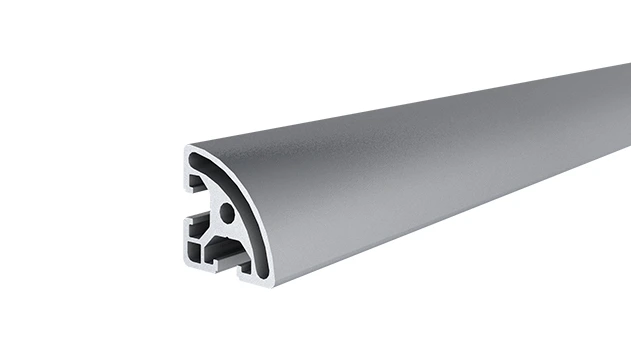
4040R is a 4.00x4.00 CM fractional 40 series square extrusion T-slot profile with two side open T-slots, each side with 4.00cm face,the other side is round face. The profile has align-a-grooves to assist in aligning connecting profiles.
In the world of industrial manufacturing, warehouse management, and lean production, the right tools and components can make all the difference between a chaotic workflow and a seamless, efficient operation. Among the unsung heroes of this space are aluminum profiles—versatile, durable, and endlessly adaptable structures that form the backbone of everything from workbenches to complex material handling systems. Today, we're diving deep into one specific profile that's become a staple in European and global industries alike: the 4040r EU Standard Aluminum Profile. Whether you're a seasoned plant manager, a small business owner setting up a workshop, or simply curious about the building blocks of modern industrial design, this guide will break down what makes the 4040r profile unique, why it matters, and how it can transform your operations.
Defining the 4040r EU Standard Aluminum Profile
Let's start with the basics: What exactly is the 4040r EU Standard Aluminum Profile? At first glance, it might seem like a jumble of numbers and letters, but each part of its name tells a story. Let's unpack it step by step.
The "4040" refers to its cross-sectional dimensions: this profile measures 40 millimeters in width and 40 millimeters in height, making it a square-shaped extrusion. The "r" stands for "rounded," a key design feature that sets it apart from other 40x40 profiles. Unlike angular profiles with sharp edges, the 4040r has gently curved edges, a detail that enhances safety, aesthetics, and functionality. Finally, "EU Standard" is more than just a label—it's a guarantee that the profile meets rigorous European union regulations for quality, safety, and environmental sustainability. This means it's been tested for factors like load-bearing capacity, corrosion resistance, and compliance with RoHS (Restriction of Hazardous Substances) directives, ensuring it's both safe for workers and kind to the planet.
But the 4040r is more than just a well-labeled piece of aluminum. It's a precision-engineered aluminum extrusion profile, crafted through a process where heated aluminum alloy is forced through a die to create its distinct shape—including the signature T-slots that run along its length. These T-slots are what make aluminum profiles so versatile: they allow for easy attachment of accessories, connectors, and panels without the need for welding or drilling, turning a simple length of metal into a customizable building block.
Core Characteristics: What Makes the 4040r Profile Stand Out?
To truly understand the 4040r's appeal, we need to look at its core characteristics—the features that make it a top choice for engineers, designers, and operators across industries. Let's break these down into five key areas: structural design, material composition, EU standard compliance, versatility, and compatibility with lean systems.
1. Structural Design: T-Slots and Rounded Edges
The most defining feature of the 4040r profile is its structural design, starting with the T-slots. These are long, narrow channels that run the entire length of the profile, shaped like a "T" when viewed cross-sectionally. Why T-slots? They're a game-changer for customization. Instead of being stuck with a fixed structure, you can slide bolts, nuts, brackets, or specialized connectors into these slots and tighten them in place—no welding, no permanent modifications. Need to reposition a shelf? Loosen the bolts, adjust, and retighten. Want to add a tool holder or a light fixture? Just clamp an accessory into the T-slot. This flexibility is why aluminum extrusion profiles like the 4040r have replaced rigid, welded steel structures in so many modern workplaces.
Then there are the rounded edges, the "r" in 4040r. In industrial settings, sharp edges are a hazard—they can catch on clothing, cause cuts, or damage delicate materials. The 4040r's curved edges eliminate this risk, making workspaces safer for employees. But safety isn't the only benefit: rounded edges also make the profile easier to clean (no crevices for dust and debris to hide in), and they give the finished structure a sleek, professional look that's hard to achieve with angular profiles. It's a small detail, but it's one that speaks to the thoughtful engineering behind EU standard profiles.
2. Material Composition: Strength Meets Lightweight Efficiency
At its core, the 4040r profile is made from high-grade aluminum alloy, specifically the 6063 T5 grade. If you're not familiar with aluminum alloys, 6063 is a favorite in extrusion applications because it's highly malleable when heated, allowing for the precise formation of complex shapes like T-slots. Once extruded, the profile undergoes T5 heat treatment—a process that involves cooling the aluminum rapidly and then artificially aging it to enhance its mechanical properties. The result? A material that's surprisingly strong for its weight. The 4040r can support heavy loads (we're talking hundreds of kilograms, depending on the setup) while remaining lightweight enough to be moved or reconfigured by a small team.
This strength-to-weight ratio is a big deal. Steel might be stronger in absolute terms, but it's also much heavier, making it harder to transport, install, or reposition. Aluminum, on the other hand, cuts down on labor costs and energy use—whether you're shipping profiles to a new location or rearranging a workbench on the factory floor. Plus, aluminum is naturally corrosion-resistant, thanks to a thin oxide layer that forms on its surface. This means the 4040r can stand up to humidity, spills, and even mild chemicals without rusting, making it ideal for both indoor and covered outdoor use.
3. EU Standard Compliance: Quality You Can Trust
The "EU Standard" label isn't just marketing fluff—it's a rigorous certification that ensures the 4040r profile meets strict European guidelines. These standards cover everything from material purity to manufacturing processes to environmental impact. For example, EU regulations limit the use of hazardous substances like lead and cadmium, so you can be sure the 4040r is safe for workers and compliant with global green initiatives. They also set benchmarks for dimensional accuracy: a 40x40mm profile must measure exactly that, with minimal tolerance for variation, ensuring compatibility with accessories and other components across brands.
Sustainability is another key focus of EU standards. Aluminum is 100% recyclable, and the energy required to recycle it is just 5% of what's needed to produce new aluminum from raw ore. Many EU-certified manufacturers prioritize using recycled aluminum in their profiles, reducing the carbon footprint of each 4040r extrusion. For businesses aiming to meet ESG (Environmental, Social, Governance) goals, this makes the 4040r a responsible choice that aligns with both regulatory requirements and ethical values.
4. Versatility: Adaptable to Any Workflow
If there's one word that sums up the 4040r profile, it's "versatile." Thanks to its standardized size, T-slot design, and compatibility with a wide range of aluminum profile accessories, it can be adapted to almost any task. Need a sturdy workbench for electronics assembly? Combine 4040r rails with a plywood or aluminum honeycomb top, add a few shelves, and you're good to go. Building a flow rack for warehouse order picking? Mount roller tracks (like the 40 steel roller track or 38 aluminum roller track) into the T-slots, and gravity will do the rest, moving materials from the loading end to the picking end with minimal effort.
Even more complex systems are within reach. Think of automated conveyor supports, machine guards, or custom storage solutions—all can be built using 4040r profiles as the base. And because it's modular, you're not locked into a single design. As your business grows or your needs change, you can easily add sections, reconfigure components, or repurpose the profile for a new project. This adaptability is why the 4040r is a favorite in lean manufacturing environments, where flexibility and continuous improvement are core principles.
5. Compatibility with Lean Systems
Speaking of lean systems, the 4040r profile is practically tailor-made for lean manufacturing and warehouse management. Lean principles focus on eliminating waste, optimizing workflows, and empowering teams to work smarter—not harder. The 4040r supports all of these goals. Its lightweight design reduces the energy needed to move equipment, while its modularity means you can build exactly what you need, avoiding the waste of over-engineering. For example, a lean workbench built with 4040r can be customized to include tool holders, cable management, and storage bins, keeping everything within arm's reach and reducing unnecessary movement (a common form of waste in lean terminology).
Material racks, another staple of lean systems, benefit greatly from the 4040r's strength and adjustability. A material rack B with 3 rows and 3 floors, for instance, can be built using 4040r uprights and crossbars, with shelves positioned at heights that minimize bending or stretching for workers. And because the T-slots allow for quick adjustments, you can reconfigure the rack to hold larger or smaller items as inventory changes—no need to buy a whole new rack.

How the 4040r Compares to Other Aluminum Profiles
You might be wondering: With so many aluminum profiles on the market (4040a, 4040b, 3030, 2020, etc.), what makes the 4040r stand out? Let's take a closer look at how it compares to similar profiles, using the 4040a and 4040b—two common EU standard 40x40mm profiles—as benchmarks.
| Feature | 4040r EU Standard | 4040a EU Standard | 4040b EU Standard |
|---|---|---|---|
| Edge Design | Rounded edges (safety-focused) | Sharp, angular edges | Chamfered edges (slightly rounded but less so than 4040r) |
| T-Slot Configuration | 2-4 T-slots (varies by manufacturer, typically 4 slots for maximum versatility) | 2-4 T-slots (similar to 4040r) | 2-4 T-slots (similar to 4040r) |
| Primary Use Case | Safety-sensitive environments (e.g., electronics assembly, food processing), workbenches, material racks | Heavy-duty structural applications (e.g., machine frames, conveyor supports) | General-purpose industrial use (balances strength and cost) |
| Weight (per meter) | ~1.8-2.2 kg/m (varies by wall thickness) | ~2.0-2.5 kg/m (thicker walls for added strength) | ~1.7-2.0 kg/m (lighter than 4040a, more cost-effective) |
| Cost | Mid-range (slightly higher than 4040b due to rounded edge manufacturing) | Higher (due to thicker walls and heavier material) | Budget-friendly (most economical 40x40 EU profile) |
As the table shows, the 4040r's biggest differentiator is its rounded edges, which make it the go-to choice for environments where worker safety is a top priority—think electronics manufacturing, pharmaceutical labs, or any setting where employees interact closely with the profile. It also strikes a balance between strength and weight, making it versatile enough for both light and medium-duty applications. While the 4040a might be better for heavy machinery frames and the 4040b for cost-sensitive projects, the 4040r shines in scenarios where adaptability, safety, and durability are equally important.
Practical Applications: Where the 4040r Profile Excels
Theory is one thing, but seeing the 4040r in action is where its value really comes to life. Let's explore some of the most common applications where this profile proves its worth, from workbenches to flow racks to lean system setups.
Workbenches: The Heart of the Workshop
A workbench is more than just a table—it's where ideas become products, where precision matters, and where comfort directly impacts productivity. The 4040r profile is ideal for building workbenches that check all these boxes. For example, the "Workbench E (Single Deck—Without Caster)" is a popular configuration that uses 4040r rails for the frame, paired with a solid top (often plywood, MDF, or aluminum honeycomb) and optional shelves or drawers. The rounded edges mean workers can lean against the bench or reach across it without worrying about cuts, while the T-slots make it easy to add accessories like tool hooks, monitor mounts, or ESD (Electrostatic Discharge) mats for electronics work.
What if you need a mobile workbench? Simply add casters (another common aluminum profile accessory) to the base, and you've got a bench that can follow the flow of production. This is a game-changer for lean environments, where reducing movement waste is key. Whether you're assembling small parts, testing equipment, or packing orders, a 4040r workbench adapts to your needs—no need to invest in multiple specialized tables.
Flow Racks: Streamlining Material Handling
In warehouses and distribution centers, moving materials efficiently can make or break order fulfillment times. That's where flow racks come in—and the 4040r profile is a star here. Flow racks use gravity to slide materials from the loading end (typically at a slight incline) to the picking end, eliminating the need for manual lifting and reducing the risk of errors. The 4040r provides the rigid framework needed to support heavy bins, cartons, or even pallets, while its T-slots make installing roller tracks a breeze.
Take the "Material Rack B (3 Row and 3 Floor)" as an example. This setup uses 4040r uprights and crossbars to create three levels of storage, each fitted with roller tracks (like the plastic roller track guide rail in yellow or grey) to move materials smoothly. Workers load products onto the top shelf from the back, and they gravity-feed down to the front picking shelf, ensuring first-in, first-out (FIFO) inventory rotation—a critical feature for perishable goods or time-sensitive orders. The 4040r's strength ensures the rack remains stable even when fully loaded, while its modular design allows for easy expansion if storage needs grow.
Lean System Setups: Building for Efficiency
Lean manufacturing isn't just a buzzword—it's a philosophy that relies on tools and systems that eliminate waste and empower teams. The 4040r profile aligns perfectly with this mindset, serving as the foundation for everything from 5S workstations to kanban systems. For example, a 5S workstation built with 4040r might include labeled shelves for tools (Sort), shadow boards for visual organization (Set in Order), and easy-to-clean surfaces (Shine). The T-slots allow for quick adjustments as workflows change, ensuring the workstation evolves with the team's needs.
Another lean application is the turnover trolley—a mobile cart used to transport materials between workstations. A 4040r turnover trolley can be customized with shelves, dividers, or even roller tracks, making it easy to load and unload goods. Its lightweight design means one person can move it, reducing labor costs, while its durability ensures it holds up to daily use in busy factories. For businesses transitioning to lean, the 4040r profile is often the first step toward building a more agile, efficient operation.
Aluminum Profile Accessories: Unlocking the 4040r's Full Potential
A profile is only as good as the accessories that complement it, and the 4040r is no exception. Aluminum profile accessories are the "glue" that turns a simple length of extrusion into a functional system. Let's explore some of the most essential accessories and how they enhance the 4040r's capabilities.
Connectors: Joining Profiles with Precision
Connectors are the backbone of any aluminum profile structure, and the 4040r works with a wide range to suit different angles and load requirements. The "90° aluminum profile connector" is the most common, used to join two profiles at a right angle (e.g., the corner of a workbench). For diagonal supports or angled frames, the "45° aluminum profile connector" is ideal. There are also specialized connectors like the "three-way aluminum profile connector" for T-junctions or the "135° aluminum profile connector" for obtuse angles. Most connectors use bolts that fit into the T-slots, ensuring a secure, tool-free connection that can be adjusted or disassembled later.
End Caps: Finishing Touches with Purpose
Ever noticed the plastic or rubber caps on the ends of aluminum profiles? Those are end caps, and they're more important than you might think. The "4040 aluminum profile end cap" is designed to fit snugly into the open ends of the 4040r, preventing dust, debris, and moisture from entering the T-slots. They also add a clean, professional look to the finished structure and eliminate any sharp edges (though the 4040r's rounded edges already minimize this risk). End caps come in various colors, so you can even match them to your brand or workspace aesthetic.
Panels and Shelves: Adding Functionality
To turn a 4040r frame into a storage system or workbench, you'll need panels or shelves. Aluminum honeycomb panels are a popular choice—lightweight, strong, and resistant to warping. They can be attached directly to the T-slots using brackets or shelf supports, creating sturdy surfaces for tools, materials, or equipment. For heavier loads, plywood or steel panels work well, though they add a bit more weight. The key is that the 4040r's T-slots make mounting these panels a breeze, with no drilling required.
Casters and Leveling Feet: Mobility and Stability
Whether you need your structure to stay put or move freely, the 4040r has you covered. Leveling feet (like the "anti-slip adjustable leveling feet") screw into the base of the profile, allowing you to stabilize the structure on uneven floors and prevent wobbling. For mobile setups, casters (such as "flat swivel castor wheel with brake") attach to the base, making it easy to roll workbenches, trolleys, or racks across the factory floor. Many casters come with brakes, so you can lock the structure in place when needed—perfect for situations where you want mobility without sacrificing stability.
Why Choose the 4040r Profile for Your Business?
By now, you might be thinking, "This all sounds great, but why should I choose the 4040r over other materials or profiles?" Let's boil it down to three key reasons that matter for businesses of all sizes.
1. Long-Term Cost Savings: While the upfront cost of aluminum profiles might be higher than, say, wood or basic steel, the 4040r's durability and adaptability mean it pays for itself over time. Unlike wood, it won't warp or rot; unlike basic steel, it won't rust. And because it's modular, you won't need to replace the entire structure when your needs change—just reconfigure it with new accessories. This reduces waste and cuts down on replacement costs in the long run.
2. Safety First: The rounded edges, corrosion resistance, and compliance with EU safety standards make the 4040r a smart choice for businesses prioritizing worker well-being. Fewer workplace injuries mean lower insurance costs, less downtime, and a happier, more productive team—all of which impact your bottom line.
3. Future-Proofing Your Workspace: Industries evolve, and your workspace should too. The 4040r's versatility ensures it can grow with your business, whether you're expanding into new product lines, scaling up production, or shifting to a more lean-focused model. It's not just a purchase—it's an investment in your ability to adapt and thrive.
Conclusion: The 4040r Profile—A Foundation for Efficiency
The 4040r EU Standard Aluminum Profile might not be the most glamorous component in your workshop or warehouse, but it's undoubtedly one of the most important. Its combination of strength, versatility, safety, and compliance with EU standards makes it a go-to choice for engineers, designers, and business owners who refuse to compromise on efficiency or quality. From workbenches that adapt to your team's needs to flow racks that streamline material handling, the 4040r is more than just a piece of aluminum—it's a tool that empowers you to build better, work smarter, and grow faster.
So, whether you're setting up a new facility, upgrading an existing workspace, or simply curious about the building blocks of modern industry, remember this: the right profile can transform chaos into order, waste into efficiency, and ideas into reality. And in that transformation, the 4040r EU Standard Aluminum Profile is a partner you can count on.