- Company Articles
- Industry articles
- Industry standards
- What is 4080A EU Standard Aluminum Profile? Definition & Key Features

What is 4080A EU Standard Aluminum Profile? Definition & Key Features
Related Product
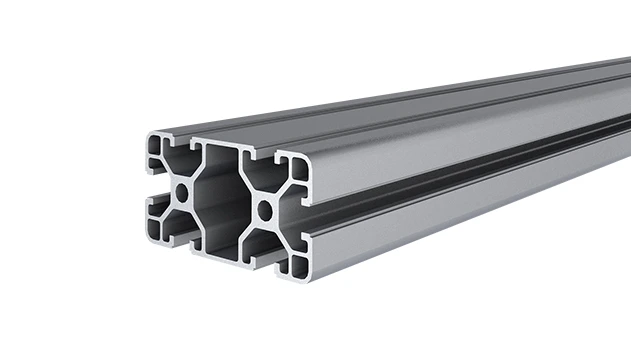
4080A EU Standard Aluminum Profile
4080A is a 4.00x8.00 CM fractional 40 series square extrusion T-slot profile with two side open T-slots, each side with 4.00cm face, two side with 8.00cm face. The profile has align-a-grooves to assist in aligning connecting profiles.
Walk into any modern factory, workshop, or even a high-tech lab, and you'll likely spot a silent workhorse holding everything together: aluminum profiles. These unassuming metal structures are the backbone of industrial design, enabling everything from custom workbenches to complex material handling systems. Among the vast array of aluminum profiles available, one stands out for its versatility and reliability in medium to heavy-duty applications: the 4080A EU Standard Aluminum Profile. But what exactly is it, and why has it become a staple in manufacturing and industrial setups worldwide? Let's dive in.
Defining the 4080A EU Standard Aluminum Profile
At its core, the 4080A EU Standard Aluminum Profile is a precision-engineered extrusion designed to meet strict European union standards for quality, dimensions, and performance. The name itself gives away its most basic attribute: "4080" refers to its cross-sectional dimensions—40 millimeters in width and 80 millimeters in height—while the "A" denotes a specific configuration of T-slots (the grooves running along its length) that sets it apart from other 4080 variants. As an "EU Standard" profile, it adheres to regulations governing material composition, tolerances, and safety, ensuring consistency and compatibility across European and global markets.
Think of it as a building block, but for industrial applications. Unlike generic aluminum tubes, this profile isn't just a hollow rectangle; it's a meticulously designed tool with built-in functionality. Its extrusion process involves forcing heated aluminum alloy through a die to create its unique shape, resulting in a product with uniform strength, precise dimensions, and a smooth surface finish. This attention to detail makes it ideal for everything from supporting heavy machinery on a factory floor to forming the frame of a custom workbench in a electronics assembly line.
Key Features of the 4080A EU Standard Aluminum Profile
What makes the 4080A profile so indispensable? Let's break down its standout features, each contributing to its popularity in industrial settings.
1. Precise, Consistent Dimensions
In manufacturing, precision is non-negotiable. A profile that's even a millimeter off can throw off an entire assembly, leading to wobbly structures or misaligned tools. The 4080A profile excels here: its 40x80mm cross-section is held to tight tolerances (typically ±0.2mm for width and height), ensuring that every piece fits perfectly with the next. This consistency is a result of advanced extrusion dies and quality control measures during production, making it easy to plan and build complex setups without worrying about mismatched parts.
For example, imagine constructing a material rack where each shelf must align perfectly to support boxes or components. With 4080A profiles, you can trust that the vertical supports will stand straight, and the horizontal beams will slot into place without gaps—critical for stability and safety.
2. High-Grade Aluminum Alloy for Strength and Durability
Not all aluminum is created equal, and the 4080A profile leans into this fact by using premium aluminum alloys. Most manufacturers opt for 6063-T5 aluminum, a heat-treated alloy known for its excellent balance of strength, corrosion resistance, and machinability. The "T5" designation means it's been artificially aged to enhance hardness, giving the profile a tensile strength of around 180 MPa—strong enough to support heavy loads without bending or warping over time.
This durability is especially important in industrial environments where equipment is subject to constant use, vibrations, and even occasional impacts. Unlike cheaper steel alternatives, aluminum is also lightweight (about 1/3 the weight of steel), making installation and reconfiguration easier. A 1-meter length of 4080A profile weighs roughly 1.8 kg, so even a team of two can handle assembly without heavy lifting equipment—a small detail that saves time and labor costs.
3. T-Slot Design: The Secret to Customization
If the 4080A profile had a "superpower," it would be its T-slot design. These are the longitudinal grooves (or "slots") that run along the profile's length, shaped like the letter "T" to allow easy attachment of accessories. The 4080A typically features 4 T-slots: two on the 80mm face (spaced 40mm apart) and one on each of the 40mm sides. This configuration strikes a balance between flexibility and strength—offering enough slots to mount accessories without compromising the profile's structural integrity.
Why does this matter? T-slots turn a static piece of aluminum into a dynamic, customizable tool. With the right aluminum profile accessories—like brackets, clamps, or aluminum guide rail A—you can attach everything from shelves and tool holders to conveyor tracks and lighting. Need to add a monitor arm to a workbench? Slide a T-slot nut into the groove, bolt on the arm, and you're done. Want to reconfigure a material rack to hold taller boxes? Loosen the brackets, adjust the height, and retighten. This adaptability is why the 4080A is a favorite for lean system setups, where workflows evolve and flexibility is key.
4. Protective Surface Finishes
Aluminum naturally forms a thin oxide layer that resists corrosion, but the 4080A profile takes this a step further with specialized surface treatments. The most common finish is anodizing—a process where the profile is submerged in an electrolyte bath and exposed to an electric current, thickening the oxide layer. This results in a hard, scratch-resistant surface that's also aesthetically pleasing (often a matte silver or black). Anodized finishes are ideal for environments where the profile might come into contact with oils, chemicals, or moisture, such as automotive or food processing plants.
For applications where conductivity is a concern (e.g., electronics manufacturing), some 4080A profiles also come with a conductive anodized finish or are left in their "mill" state (unfinished, with a natural aluminum look). Regardless of the finish, the goal is the same: to extend the profile's lifespan and maintain its appearance even in harsh conditions.
5. Compatibility with a Vast Range of Accessories
A profile is only as useful as the accessories it works with, and the 4080A shines here thanks to its EU standard design. Manufacturers worldwide produce aluminum profile accessories specifically tailored to fit its T-slots, from simple end caps (to cover sharp edges and prevent dust buildup) to complex corner brackets and hinges. Some of the most common accessories include:
- Aluminum Guide Rail A: A linear rail that mounts to the T-slots, used to guide rollers, slides, or conveyor belts in material handling systems.
- End Caps: Plastic or aluminum caps that snap or bolt onto the ends of the profile, improving safety and aesthetics.
- Connectors: 90° brackets, corner joints, or T-connectors that link profiles together at various angles.
- Workbench Tops: Plywood, MDF, or aluminum panels that attach to 4080A frames to create sturdy work surfaces.
- Casters: Wheel attachments that turn static structures (like racks or workbenches) into mobile units for easy repositioning.
This compatibility means you're never locked into a single supplier—whether you're sourcing from Germany, China, or the U.S., you can find accessories that fit your 4080A profile seamlessly. It also reduces lead times: if a bracket breaks, you can replace it quickly without waiting for custom parts.

How Does the 4080A Compare to Other Aluminum Profiles?
To truly appreciate the 4080A, it helps to see how it stacks up against other common profiles. Let's compare it to two popular alternatives: the 4040A (40x40mm) and the 3060 (30x60mm) profiles. The table below highlights key differences in dimensions, load capacity, and typical uses.
| Feature | 4080A EU Standard | 4040A EU Standard | 3060 EU Standard |
|---|---|---|---|
| Dimensions (WxH) | 40mm x 80mm | 40mm x 40mm | 30mm x 60mm |
| Typical Load Capacity (per meter) | 150-200 kg (vertical) | 80-120 kg (vertical) | 100-150 kg (vertical) |
| Number of T-Slots | 4 (2 on 80mm face, 1 on each 40mm side) | 4 (1 on each face) | 4 (2 on 60mm face, 1 on each 30mm side) |
| Best For | Medium to heavy-duty workbenches, material racks, machine frames | Light to medium-duty structures, shelving, small workbenches | Lightweight frames, guardrails, small conveyor systems |
| Weight (per meter) | ~1.8 kg | ~1.2 kg | ~1.0 kg |
The 4080A's larger size and higher load capacity make it the go-to choice for applications where stability and strength are priorities. For example, a workbench used to assemble heavy machinery parts would benefit from a 4080A frame, as it can support the weight of tools, components, and the operator without sagging. In contrast, a 4040A profile might be better suited for a lightweight shelving unit in a lab, where load requirements are lower.
Practical Applications: Where the 4080A Shines
The 4080A's versatility means it's used across industries, but there are a few applications where it truly excels. Let's explore some real-world scenarios where this profile is the star of the show.
Workbenches: The Heart of the Workshop
A workbench is more than just a table—it's where ideas become products. Whether it's assembling circuit boards, repairing engines, or packaging goods, the workbench needs to be sturdy, customizable, and adaptable. The 4080A profile is perfect for this role. Its 40x80mm frame provides ample stability, even when supporting heavy tools like drills or vises, while its T-slots allow for easy attachment of accessories: tool hooks, monitor arms, LED lights, or even ESD (electrostatic discharge) mats for electronics work.
Consider a scenario in a small electronics manufacturing startup. The team needs a workbench that can hold a soldering iron, a magnifying lamp, and bins for components. Using 4080A profiles, they build a frame with a plywood top, then add aluminum guide rail A along the back to mount the lamp and tool hooks. A few months later, when they expand to assembly line work, they simply add casters to the base and reconfigure the accessories—no need to buy a new bench.
Lean Systems: Streamlining Production
Lean manufacturing is all about eliminating waste and optimizing workflows, and the 4080A profile is a natural fit for lean system setups. Its modular design allows teams to build, modify, and repurpose structures as needs change, reducing downtime and costs. For example, a car parts manufacturer might use 4080A profiles to build a material rack B (3 row and 3 floor) that feeds components directly to the assembly line. The rack's height and shelf spacing can be adjusted as production volumes change, ensuring parts are always within easy reach of workers.
Another common lean application is in kanban systems, where 4080A frames support roller tracks (using roller track placon mount brackets) to move bins of parts between workstations. The profile's strength ensures the track stays level, preventing jams, while its T-slots make it easy to add stops or guides to control the flow of materials.
Material Handling and Storage
From warehouses to factories, efficient material storage is critical. The 4080A profile's load capacity (150-200 kg per vertical meter) makes it ideal for building heavy-duty racks, shelving units, and even turnover trolleys. Unlike traditional steel racks, which are fixed in place, aluminum profiles allow for adjustable shelving—so you can store everything from small boxes to large, bulky parts without needing multiple rack systems.
For example, a distribution center handling automotive parts might use 4080A profiles to build a rack with adjustable shelves spaced 30cm apart for small components and 60cm apart for larger assemblies. When a new part size is introduced, they simply move the shelf brackets—no cutting or welding required. This flexibility reduces the need for excess storage space and keeps operations running smoothly.
Why Choose the 4080A EU Standard Profile?
With so many aluminum profiles on the market, why should you opt for the 4080A? Here's a quick recap of its biggest advantages:
- Balance of size and strength: Its 40x80mm dimensions offer more load capacity than smaller profiles (like 4040) without being as bulky as larger ones (like 8080), making it ideal for medium-duty tasks.
- EU standard reliability: Adherence to EU standards ensures quality, consistency, and compatibility with global accessories.
- Easy customization: T-slots and a wide range of accessories mean you can build exactly what you need, when you need it.
- Durability and sustainability: High-grade aluminum and anodized finishes ensure longevity, while aluminum's recyclability aligns with eco-friendly manufacturing goals.
Final Thoughts: The 4080A Profile as a Foundation for Innovation
In the world of industrial design, the 4080A EU Standard Aluminum Profile is more than just a piece of metal—it's a catalyst for innovation. Its ability to adapt to changing needs, support heavy loads, and work with countless accessories makes it a favorite among engineers, manufacturers, and workshop owners alike. Whether you're building a simple workbench or a complex lean system, this profile provides the strength, precision, and flexibility to turn ideas into reality.
So the next time you walk through a factory or workshop, take a closer look at the structures around you. Chances are, you'll spot the 4080A profile hard at work—quietly supporting the tools, machines, and workflows that power modern industry. It may not be the flashiest component in the room, but in the world of industrial design, reliability and versatility are the true marks of excellence. And the 4080A has both in spades.