- Company Articles
- Industry articles
- Industry standards
- Why 2020 National Standard Profile Is Critical for Lean Management in Warehousing

Why 2020 National Standard Profile Is Critical for Lean Management in Warehousing
Related Product
2020 National Standard Profile
45° external bending joint, used for 45° external connection of two aluminum pipes.
Walk into any modern warehouse, and you'll feel the buzz of activity: pallets gliding on conveyors, workers retrieving items from racks, and teams racing to meet tight delivery deadlines. But behind that chaos lies a hidden challenge: how to do more with less. In an era where profit margins shrink and customer expectations rise, warehouses can't afford waste—whether it's time lost searching for tools, space wasted on disorganized storage, or money spent on rigid, one-size-fits-all equipment. This is where lean management steps in, and at the heart of effective lean warehousing? The 2020 National Standard Profile.
Lean management isn't just a buzzword; it's a philosophy built on continuous improvement, waste reduction, and maximizing value for customers. From Toyota's legendary 5S system (Sort, Set in Order, Shine, Standardize, Sustain) to eliminating the "7 Wastes" (overproduction, waiting, transportation, overprocessing, inventory, motion, defects), lean thrives on flexibility, standardization, and adaptability. And when it comes to building the physical infrastructure that makes lean possible—workbenches, material racks, flow racks, and more—nothing delivers quite like the 2020 National Standard Profile.
In this article, we'll explore why this unassuming 20x20mm aluminum profile has become a cornerstone of lean warehouse operations. We'll break down its design, its benefits, and how it integrates seamlessly with lean principles to transform chaotic spaces into (efficient) hubs of productivity. Whether you're a warehouse manager looking to revamp your layout or a lean enthusiast curious about the tools that drive success, this is your guide to understanding the critical role of the 2020 National Standard Profile in lean management.
What Is Lean Management, and Why Does Infrastructure Matter?
Before diving into the specifics of the 2020 profile, let's ground ourselves in what lean management really means for warehouses. At its core, lean is about creating more value with fewer resources. For warehouses, that translates to faster order fulfillment, lower operational costs, and happier teams—all while minimizing waste.
Consider the "7 Wastes" identified in lean methodology. Transportation waste happens when items are moved unnecessarily; motion waste occurs when workers walk extra steps to retrieve tools; inventory waste piles up when storage spaces are disorganized and overstocked. To tackle these, warehouses need infrastructure that's designed for efficiency: workbenches at the right height, material racks that keep items visible and accessible, and flow racks that let products glide to pickers instead of the other way around.
This is where infrastructure becomes a make-or-break factor. Traditional warehouse setups—think welded steel racks or fixed wooden workbenches—are rigid. If your workflow changes (e.g., a new product line, higher order volumes), you're stuck: modifying them requires cutting, welding, or even replacing entire systems, which is time-consuming and expensive. Lean, however, demands adaptability. Your infrastructure should evolve as your processes do. And that's exactly what the 2020 National Standard Profile delivers.
Meet the 2020 National Standard Profile: Small Size, Big Impact
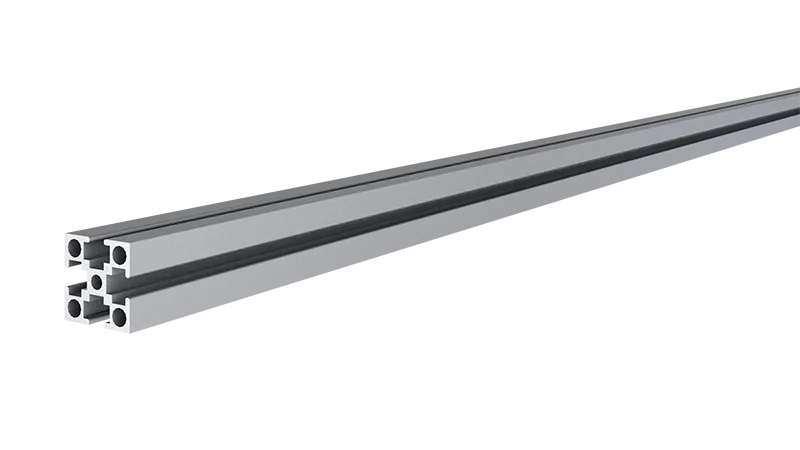
At first glance, the 2020 National Standard Profile might seem unremarkable. It's a simple aluminum extrusion, measuring 20mm by 20mm, with a T-slot running along each side. But that simplicity is its superpower. Let's break down what makes it unique:
Key Features of the 2020 National Standard Profile
- Standardized Dimensions: 20x20mm is a globally recognized size, ensuring compatibility with a wide range of accessories and components—no more custom-made parts or mismatched pieces.
- T-Slot Design: The T-shaped grooves along each edge allow for quick attachment of brackets, connectors, casters, and workbench tops using simple bolts or sliding nuts. No welding, no drilling—just tool-free (or minimal-tool) assembly.
- Lightweight but Strong: Made from high-grade aluminum alloy (typically 6063-T5), it's lightweight enough for easy handling but strong enough to support heavy loads (up to 50kg per linear meter, depending on configuration).
- Corrosion Resistance: Aluminum's natural oxide layer resists rust and corrosion, making it ideal for warehouses with varying humidity levels or even light exposure to liquids.
- Modular by Design: It's engineered to work with a vast ecosystem of accessories—from aluminum profile accessories like 90° connectors and parallel brackets to specialized parts like ESD workbench tops or roller track guides.
But why "national standard"? In manufacturing and warehousing, standardization is a cornerstone of lean. When everyone uses the same profile size and (accessories), teams can assemble, disassemble, and reconfigure systems without guesswork. A worker in Shanghai can follow the same assembly instructions as a worker in Shenzhen, and spare parts are readily available from any lean system supplier . This reduces lead times, cuts down on training costs, and eliminates the waste of "reinventing the wheel" for each new project.

How the 2020 Profile Powers Lean Warehousing: 4 Key Benefits
Now, let's connect the dots: how does this 20x20mm profile directly support lean management in warehouses? Let's explore four critical benefits.
1. Flexibility to Adapt (No Waste of Rigidity)
Lean isn't a one-time project—it's a continuous process of improvement. Your warehouse layout today might not work tomorrow. Maybe you're adding a new product line that requires taller storage, or you're implementing a "goods-to-person" system that needs mobile workstations. With traditional fixed infrastructure, adapting means downtime and expense. With the 2020 profile? It's as simple as loosening a few bolts.
Take workbenches , for example. A workbench E (single deck-without caster) built with 2020 profiles can be reconfigured in hours: add casters to make it mobile, adjust the height by swapping out leg brackets, or attach a side shelf for tools. If your team shifts to standing workstations, you don't need to buy new benches—just adjust the existing ones. This flexibility eliminates the waste of "abandoned infrastructure" and keeps your warehouse agile.
2. Reduced Setup and Changeover Time (Waste of Waiting)
In lean, "waiting waste" occurs when processes are delayed due to setup time. Traditional steel racks might take days to assemble, requiring skilled welders or heavy machinery. The 2020 profile, by contrast, can be assembled by a single worker with basic tools.
Consider building a material rack B (3 row and 3 floor) —a common setup for organizing small parts or components. With 2020 profiles and pre-engineered brackets, assembly involves: cutting the profiles to length (or using pre-cut standard lengths), attaching vertical supports to a base, then adding horizontal shelves using 90° connectors. Total time? A few hours, not days. And if you need to adjust shelf heights later? Just slide the brackets to the desired T-slot position and tighten. No waiting for contractors, no production downtime.
3. Optimized Space and Storage (Waste of Inventory and Transportation)
A disorganized warehouse is a breeding ground for waste. Items get lost, workers spend time searching, and overstocking becomes the norm. The 2020 profile's modularity lets you design storage systems that fit your exact needs—no more wasted space.
For example, flow racks built with 2020 profiles and plastic roller track guides (yellow or grey, as in the keyword list) allow products to slide forward as items are picked, ensuring first-in-first-out (FIFO) inventory management. This reduces inventory waste by keeping stock levels visible and preventing obsolescence. Similarly, turnover trolleys built with 2020 profiles and casters can be customized to fit specific container sizes, eliminating the transportation waste of moving items in oversized carts.
4. Cost-Effectiveness Over Time (No Waste of Overproduction)
At first glance, aluminum profiles might seem pricier than basic steel or wood. But lean thinking demands looking at the total cost of ownership (TCO), not just upfront cost. The 2020 profile's durability means it lasts decades, not years. Its reusability means you can disassemble a workbench and rebuild it as a material rack when needs change. And its compatibility with standard accessories eliminates the need for custom parts, which are often expensive and slow to deliver.
In short, it's an investment that prevents the waste of "overproducing" infrastructure—buying new systems every time your needs shift.
2020 vs. Other Profiles: Why Size Matters for Lean
You might be wondering: why 20x20mm? Why not larger profiles like 3030 or 4040? While larger profiles have their place (e.g., heavy-duty storage), the 2020 profile excels in lean environments for one key reason: right-sizing . Lean teaches us to avoid over-engineering—using the smallest, simplest tool for the job. For most warehouse applications (workbenches, small parts racks, mobile trolleys), 20x20mm is more than sufficient, and its smaller size offers unique advantages:
| Feature | 2020 National Standard Profile | 3030 National Standard Profile |
|---|---|---|
| Size | 20x20mm | 30x30mm |
| Weight (per meter) | ~0.4kg | ~0.9kg |
| Typical Use Case | Workbenches, small parts racks, mobile trolleys, flow racks for light items | Heavy-duty storage, large material racks, industrial workstations |
| Lean Advantage | Lightweight, easy to reconfigure, lower material cost, ideal for agile, low-to-medium load applications | Higher load capacity but bulkier; better for static, heavy-load setups |
For lean warehouses focused on agility and continuous improvement, the 2020 profile strikes the perfect balance between strength and flexibility. It's small enough to keep systems lightweight and easy to move but robust enough to handle daily warehouse demands.
Real-World Impact: How 2020 Profile Transforms Lean Systems
To truly understand the value of the 2020 National Standard Profile, let's look at how it integrates into real lean warehouse systems.
Case 1: Electronics Manufacturing Workbench (ESD Protection)
In electronics warehouses, static electricity can damage sensitive components. A lean ESD workstation needs to be both static-safe and adaptable. Using 2020 profiles, teams can build a workstation with:
- An ESD-safe honeycomb worktop (attached via T-slot brackets)
- Adjustable height legs (using telescoping 2020 extensions)
- Overhead shelving for tools (supported by parallel aluminum joints)
- ESD wristband grounding points (integrated via T-slot conductive bolts)
If production shifts to larger components, the same frame can be extended with additional 2020 sections, or the top can be swapped for a larger ESD panel. No new workstation needed—just reconfiguration.
Case 2: Material Rack B (3 Row, 3 Floor) for Small Parts
A material rack B (3 row and 3 floor) is a staple for organizing screws, washers, and other small components. Built with 2020 profiles:
- Vertical posts are 2020 profiles anchored to the floor with aluminum foot bases.
- Horizontal shelves are made from 2020 profiles with plastic dividers (slotted into T-slots) to separate SKUs.
- Each shelf height is adjustable in 20mm increments (matching the profile's slot spacing), so you can fit taller bins or stack shorter ones without wasted space.
- Add swivel roller balls 1 inch to the shelf edges to let bins glide forward, reducing motion waste when restocking.
The result? A rack that's dense but organized, with every part visible and accessible—exactly what lean's "Set in Order" (Seiton) principle demands.
Case 3: Mobile Turnover Trolley for Line-Side Delivery
In lean manufacturing, "milk-run" delivery systems ensure production lines get exactly the parts they need, when they need them. A mobile trolley built with 2020 profiles:
- Has a lightweight frame (easy for one worker to push) but strong enough to carry 50kg of parts.
- Uses caster wheels (attached via T-slot caster mounts) with brakes for stability when loading/unloading.
- Includes fold-down sides (using aluminum hinges) to save space when not in use.
- Can be customized with dividers, labels, or even small flow racks (using mini aluminum roller tracks) to keep parts sorted during transport.
Choosing the Right Supplier: Why Partnership Matters
To fully leverage the 2020 National Standard Profile, partnering with a reliable lean system supplier is critical. A good supplier won't just sell you profiles—they'll provide:
- Technical Support: Help with design (e.g., calculating load capacities for a workbench or material rack).
- Complete Kits: Pre-packaged sets for common setups (like the workbench E or material rack B) with all necessary profiles, connectors, and hardware.
- Fast Delivery: Stocked inventory of standard profiles and accessories to minimize lead times.
- Customization Options: Cutting profiles to length, anodizing for color-coding (e.g., red for ESD zones), or sourcing specialized accessories.
When evaluating suppliers, ask about their experience with lean systems. Do they understand 5S? Can they help you optimize your layout using 2020 profiles? The best partners become extensions of your lean team.
The Bottom Line: 2020 Profile as a Lean Enabler
In the fast-paced world of warehousing, lean management isn't optional—it's essential. And lean management, in turn, isn't possible without the right tools. The 2020 National Standard Profile isn't just a piece of aluminum; it's a enabler of flexibility, standardization, and continuous improvement.
Its small size, modular design, and compatibility with aluminum profile accessories make it the perfect building block for lean systems—whether you're assembling a simple workbench or a complex network of flow racks and mobile trolleys. It reduces waste, cuts costs, and empowers your team to adapt and improve.
So, if you're ready to take your warehouse's lean management to the next level, start with the basics: invest in infrastructure that works with your processes, not against them. Start with the 2020 National Standard Profile.