- Company Articles
- Industry articles
- Industry standards
- Why 2040 National Standard Profile is Ideal for Lean Management Accessories

Why 2040 National Standard Profile is Ideal for Lean Management Accessories
Related Product
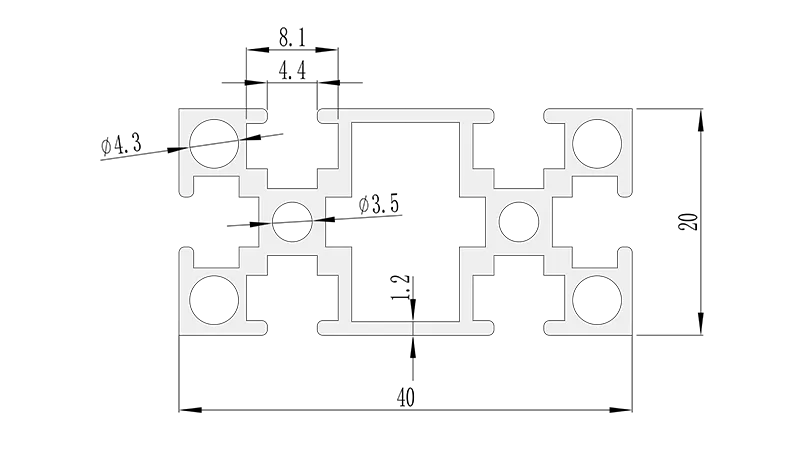
2040 National Standard Profile
45° external bending joint, used for 45° external connection of two aluminum pipes.
The Heartbeat of Lean: Why Accessories Matter More Than You Think
Walk into any manufacturing facility that's embraced lean management, and you'll notice something immediately: everything has a place, and everything moves with purpose. There's no wasted motion, no piles of unused materials cluttering the floor, and no workers standing idle waiting for tools. But behind that seamless flow is a hidden hero: the accessories that hold it all together—workbenches tailored to specific tasks, material racks that keep parts within arm's reach, trolleys that glide smoothly from station to station. These aren't just "things"; they're the physical embodiment of lean principles, designed to eliminate waste and keep operations humming.
But here's the catch: not all accessories are created equal. A flimsy workbench that wobbles under tool weight, a material rack that's hard to reconfigure when production needs change, or a trolley that gets stuck on uneven floors can turn even the best lean plans into a frustrating mess. That's where the right building block comes in. Enter the 2040 National Standard Profile—a humble aluminum extrusion that's quietly revolutionizing how lean accessories are designed, built, and used.
In this article, we'll dive into why this specific profile has become a go-to choice for lean managers and facility planners. We'll explore its unique features, how it aligns with core lean goals like flexibility and efficiency, and real-world examples of how it's transforming workplaces. Whether you're setting up a new lean system from scratch or looking to upgrade your existing accessories, understanding the 2040 National Standard Profile might just be the key to unlocking smoother, more productive operations.
What Exactly is the 2040 National Standard Profile?
Let's start with the basics. The "2040" in its name refers to its cross-sectional dimensions: 20 millimeters in width and 40 millimeters in height. It's an aluminum extrusion, meaning it's formed by pushing heated aluminum through a die to create a consistent, precise shape. And "National Standard"? That's a stamp of reliability, ensuring that no matter which supplier you buy from, the dimensions, slot sizes, and tolerances will be consistent—critical for building modular, interchangeable accessories.
At first glance, it might look like just another metal bar, but take a closer look, and you'll notice the T-slots running along its length. These slots are the profile's superpower. They're not just grooves; they're built-in connection points that let you attach brackets, shelves, wheels, and other aluminum profile accessories without welding, drilling, or complicated tools. Slide a bolt into the slot, tighten a nut, and you've got a secure joint—simple as that.
But why aluminum? Unlike steel, aluminum is lightweight, which makes the accessories built from it easier to move and reposition. It's also resistant to rust and corrosion, so even in busy factories where spills or humidity are common, it holds up. And let's not forget sustainability: aluminum is fully recyclable, aligning with the lean principle of respecting the environment (yes, lean cares about that too!).
So, to sum it up: the 2040 National Standard Profile is a lightweight, durable, standardized aluminum extrusion with T-slots, designed to be the backbone of modular, customizable accessories. But why does this specific size—20x40mm—stand out in a market full of other profiles like 3030, 4040, or even larger 8080? Let's dig into that next.
5 Reasons 2040 Profile Checks All the Lean Boxes
Lean management isn't just a buzzword; it's a mindset centered on five core principles: value, value stream, flow, pull, and perfection. Every tool, every process, and yes, every accessory must serve these principles. The 2040 National Standard Profile doesn't just serve them—it excels at them. Here's how:
1. Just the Right Balance of Strength and Flexibility
Lean accessories need to be strong enough to handle daily use but flexible enough to adapt when needs change. A workbench might need to support heavy tools one month and lightweight electronics the next; a material rack might start with three shelves but need a fourth as production scales. The 2040 profile hits this sweet spot perfectly. Its 20x40mm cross-section provides enough structural rigidity to support loads up to 50kg per linear meter (depending on the setup), while its lightweight design means even fully assembled accessories like trolleys can be moved by a single person. This balance makes it ideal for everything from static workbenches to mobile turnover trolleys—no overbuilding, no unnecessary bulk, just the right amount of strength for the job. 2. Modularity That Keeps Up With "Continuous Improvement"
Lean isn't a one-and-done project; it's about continuous improvement. Today's perfect workbench might need a tool rail added next month, or a material rack might need to be shortened to make space for a new machine. With the 2040 profile's T-slots, reconfiguring is a breeze. Need to add a shelf? Slide in a bracket, tighten a screw, and you're done. Want to move a tool hook from left to right? Loosen the nut, slide it over, and retighten. No welding, no cutting, no waiting for maintenance to "find time" to help. This modularity turns "we can't do that" into "we can try that tomorrow"—exactly the kind of agility lean thrives on. 3. Standardization Without Stifling Creativity
One of the biggest challenges in lean systems is maintaining consistency across shifts, departments, or even multiple facilities. If every workbench is built with different parts, training new employees becomes harder, and replacing broken components turns into a scavenger hunt. The 2040 National Standard Profile solves this with its standardized dimensions and compatible aluminum profile accessories. Whether you're buying from Supplier A or Supplier B, the T-slots will match, the end caps will fit, and the connectors will align. This standardization reduces confusion, cuts down on inventory (you only need one set of spare parts), and ensures that anyone can assemble or repair an accessory—no special training required. But here's the best part: standardization doesn't mean boring. The T-slots and wide range of accessories (hinges, handles, rubber strips, etc.) let you customize accessories to specific tasks, so you get the best of both worlds: consistency and creativity. 4. Cost-Effective in the Long Run
Lean is about eliminating waste—and that includes wasteful spending. While some might see aluminum profiles as pricier than, say, wood or basic steel, the 2040 profile's durability and reusability make it a smarter investment over time. Wood warps, steel rusts, and cheap plastic cracks, all leading to frequent replacements. Aluminum, on the other hand, lasts for years with minimal maintenance. And when you do need to change an accessory, you don't have to throw it away—just disassemble the 2040 parts and rebuild something new. A study by a manufacturing consulting firm found that facilities using 2040-based accessories reduced their accessory replacement costs by 40% over three years compared to those using traditional materials. That's waste reduction in action. 5. Supporting "Flow" in Every Sense of the Word
At its core, lean is about creating smooth, uninterrupted flow—of materials, of information, of people. Clunky, oversized accessories disrupt this flow: a material rack that's too wide blocks walkways, a workbench that's too tall forces workers to reach awkwardly, a trolley that jams breaks the rhythm of production. The 2040 profile's compact size (20mm width is narrow enough to fit in tight spaces) and clean design help keep pathways clear. Its compatibility with low-profile casters (think smooth-rolling wheels) ensures trolleys glide without jamming, while its ability to be cut to exact lengths means accessories fit perfectly into existing layouts. When everything has a place and moves without friction, flow becomes second nature.
Lean accessories need to be strong enough to handle daily use but flexible enough to adapt when needs change. A workbench might need to support heavy tools one month and lightweight electronics the next; a material rack might start with three shelves but need a fourth as production scales. The 2040 profile hits this sweet spot perfectly. Its 20x40mm cross-section provides enough structural rigidity to support loads up to 50kg per linear meter (depending on the setup), while its lightweight design means even fully assembled accessories like trolleys can be moved by a single person. This balance makes it ideal for everything from static workbenches to mobile turnover trolleys—no overbuilding, no unnecessary bulk, just the right amount of strength for the job. 2. Modularity That Keeps Up With "Continuous Improvement"
Lean isn't a one-and-done project; it's about continuous improvement. Today's perfect workbench might need a tool rail added next month, or a material rack might need to be shortened to make space for a new machine. With the 2040 profile's T-slots, reconfiguring is a breeze. Need to add a shelf? Slide in a bracket, tighten a screw, and you're done. Want to move a tool hook from left to right? Loosen the nut, slide it over, and retighten. No welding, no cutting, no waiting for maintenance to "find time" to help. This modularity turns "we can't do that" into "we can try that tomorrow"—exactly the kind of agility lean thrives on. 3. Standardization Without Stifling Creativity
One of the biggest challenges in lean systems is maintaining consistency across shifts, departments, or even multiple facilities. If every workbench is built with different parts, training new employees becomes harder, and replacing broken components turns into a scavenger hunt. The 2040 National Standard Profile solves this with its standardized dimensions and compatible aluminum profile accessories. Whether you're buying from Supplier A or Supplier B, the T-slots will match, the end caps will fit, and the connectors will align. This standardization reduces confusion, cuts down on inventory (you only need one set of spare parts), and ensures that anyone can assemble or repair an accessory—no special training required. But here's the best part: standardization doesn't mean boring. The T-slots and wide range of accessories (hinges, handles, rubber strips, etc.) let you customize accessories to specific tasks, so you get the best of both worlds: consistency and creativity. 4. Cost-Effective in the Long Run
Lean is about eliminating waste—and that includes wasteful spending. While some might see aluminum profiles as pricier than, say, wood or basic steel, the 2040 profile's durability and reusability make it a smarter investment over time. Wood warps, steel rusts, and cheap plastic cracks, all leading to frequent replacements. Aluminum, on the other hand, lasts for years with minimal maintenance. And when you do need to change an accessory, you don't have to throw it away—just disassemble the 2040 parts and rebuild something new. A study by a manufacturing consulting firm found that facilities using 2040-based accessories reduced their accessory replacement costs by 40% over three years compared to those using traditional materials. That's waste reduction in action. 5. Supporting "Flow" in Every Sense of the Word
At its core, lean is about creating smooth, uninterrupted flow—of materials, of information, of people. Clunky, oversized accessories disrupt this flow: a material rack that's too wide blocks walkways, a workbench that's too tall forces workers to reach awkwardly, a trolley that jams breaks the rhythm of production. The 2040 profile's compact size (20mm width is narrow enough to fit in tight spaces) and clean design help keep pathways clear. Its compatibility with low-profile casters (think smooth-rolling wheels) ensures trolleys glide without jamming, while its ability to be cut to exact lengths means accessories fit perfectly into existing layouts. When everything has a place and moves without friction, flow becomes second nature.
How It Stacks Up: Comparing 2040 with Other Profiles
You might be wondering: there are plenty of other aluminum profiles out there—3030, 4040, even 2020. Why not use one of those? It's a fair question. Let's break down how the 2040 National Standard Profile compares to some common alternatives, so you can see why it's often the best choice for lean accessories.
To make this clear, let's look at a side-by-side comparison:
| Profile Type | Dimensions (WxH) | Typical Load Capacity | Best For | Limitations for Lean Accessories |
|---|---|---|---|---|
| 2020 National Standard | 20x20mm | Up to 25kg/m | Light-duty applications (small shelves, cable management) | Too narrow for most workbenches or material racks; limited load capacity |
| 2040 National Standard | 20x40mm | Up to 50kg/m | Workbenches, material racks, trolleys, flow racks | Not ideal for extremely heavy loads (e.g., industrial machinery bases) |
| 3030 National Standard | 30x30mm | Up to 75kg/m | Medium-duty racks, workstations with heavier tools | Bulkier than 2040; takes up more space in tight layouts |
| 4040 EU Standard | 40x40mm | Up to 100kg/m | Heavy-duty machinery frames, large storage systems | Overkill for most lean accessories; heavier and more expensive |
As you can see, the 2040 profile sits right in the middle—offering more strength than the tiny 2020, more space efficiency than the bulkier 3030 or 4040, and a load capacity that covers 80% of typical lean accessory needs. For example, a standard workbench built with 2040 profiles can easily support a laptop, tools, and a small assembly project without wobbling, while remaining light enough to reposition if the production line is rearranged. A material rack built with 2040 can hold multiple bins of parts without sagging, yet its narrow width means it can fit in aisles that a 3030-based rack would block.
Another key advantage? The 2040 National Standard Profile is widely available and affordable. Because it's a national standard, most aluminum extrusion suppliers stock it, and its popularity means there's a huge range of compatible aluminum profile accessories—from simple end caps to complex hinges and roller track connectors. This availability reduces lead times, making it easy to repair or upgrade accessories quickly—critical for lean systems that can't afford downtime.
Real-World Applications: Where 2040 Shines in Lean Accessories
Theory is great, but nothing beats seeing how something works in practice. Let's take a look at some common lean accessories and how the 2040 National Standard Profile transforms them from "functional" to "game-changing."
Workbenches: Tailored to the Task, Built to Adapt
A workbench is the center of a worker's universe—where they spend hours assembling, testing, or repairing products. A poorly designed workbench leads to fatigue, errors, and wasted motion. Enter the 2040-based workbench. With its T-slots, you can mount tool holders exactly where the worker's hands fall, add a shelf for parts at eye level, or even attach a monitor arm for digital work instructions. And when the task changes? Swap out the tool holders, adjust the shelf height, or add a light—all without rebuilding the entire bench. One electronics manufacturer we worked with replaced their old wooden workbenches with 2040-based ones and saw a 22% reduction in assembly errors, simply because tools and parts were always within reach. Material Racks: From Static to "Pull-Based"
In lean systems, material racks should follow the "pull" principle—only holding what's needed, when it's needed, and making it easy to replenish. A 2040-based material rack excels here. Its modular design lets you adjust shelf heights to fit different bin sizes, and adding roller tracks (using compatible roller track placon mounts) turns it into a flow rack, where bins glide forward as the front one is emptied. This not only saves space but also makes it obvious when stock is low—no more hunting for missing parts. A automotive parts supplier used 2040 to build a custom 3-row, 3-floor material rack (similar to "Material Rack B" in standard catalogs) and reduced time spent fetching parts by 15%. Turnover Trolleys: Smooth Moves, No Fuss
Trolleys are the "flow" enforcers of lean systems, moving materials from storage to production lines or between workstations. A trolley built with 2040 profiles is lightweight yet sturdy, with T-slots that make it easy to add dividers, bins, or even a fold-down shelf for extra capacity. The real win? Adding casters. With the right caster accessories (like flat swivel casters with brakes), these trolleys glide over factory floors without getting stuck, even when fully loaded. A food packaging plant replaced their heavy steel trolleys with 2040-based ones and found that workers could move materials 30% faster, with less physical strain. Flow Racks: Keeping Production Moving
Flow racks are critical for lean production lines, ensuring that parts flow to workers exactly when they're needed (a key part of "just-in-time" manufacturing). The 2040 profile's T-slots make it simple to mount roller tracks at the perfect angle for gravity flow, and its compatibility with plastic or aluminum guide rails means parts slide smoothly without jamming. Whether you're using 1-inch swivel roller balls or 40 steel roller tracks, the 2040 profile provides a stable base that keeps the entire system aligned. A pharmaceutical manufacturer used 2040 to build custom flow racks for vial storage, reducing bottlenecks at their filling station by 40%.
A workbench is the center of a worker's universe—where they spend hours assembling, testing, or repairing products. A poorly designed workbench leads to fatigue, errors, and wasted motion. Enter the 2040-based workbench. With its T-slots, you can mount tool holders exactly where the worker's hands fall, add a shelf for parts at eye level, or even attach a monitor arm for digital work instructions. And when the task changes? Swap out the tool holders, adjust the shelf height, or add a light—all without rebuilding the entire bench. One electronics manufacturer we worked with replaced their old wooden workbenches with 2040-based ones and saw a 22% reduction in assembly errors, simply because tools and parts were always within reach. Material Racks: From Static to "Pull-Based"
In lean systems, material racks should follow the "pull" principle—only holding what's needed, when it's needed, and making it easy to replenish. A 2040-based material rack excels here. Its modular design lets you adjust shelf heights to fit different bin sizes, and adding roller tracks (using compatible roller track placon mounts) turns it into a flow rack, where bins glide forward as the front one is emptied. This not only saves space but also makes it obvious when stock is low—no more hunting for missing parts. A automotive parts supplier used 2040 to build a custom 3-row, 3-floor material rack (similar to "Material Rack B" in standard catalogs) and reduced time spent fetching parts by 15%. Turnover Trolleys: Smooth Moves, No Fuss
Trolleys are the "flow" enforcers of lean systems, moving materials from storage to production lines or between workstations. A trolley built with 2040 profiles is lightweight yet sturdy, with T-slots that make it easy to add dividers, bins, or even a fold-down shelf for extra capacity. The real win? Adding casters. With the right caster accessories (like flat swivel casters with brakes), these trolleys glide over factory floors without getting stuck, even when fully loaded. A food packaging plant replaced their heavy steel trolleys with 2040-based ones and found that workers could move materials 30% faster, with less physical strain. Flow Racks: Keeping Production Moving
Flow racks are critical for lean production lines, ensuring that parts flow to workers exactly when they're needed (a key part of "just-in-time" manufacturing). The 2040 profile's T-slots make it simple to mount roller tracks at the perfect angle for gravity flow, and its compatibility with plastic or aluminum guide rails means parts slide smoothly without jamming. Whether you're using 1-inch swivel roller balls or 40 steel roller tracks, the 2040 profile provides a stable base that keeps the entire system aligned. A pharmaceutical manufacturer used 2040 to build custom flow racks for vial storage, reducing bottlenecks at their filling station by 40%.
Case Study: How One Factory Cut Waste with 2040 Profile Accessories
Challenge: A Chaotic Assembly Line Struggling with "Muda" (Waste)
A mid-sized electronics assembly plant was struggling with classic lean waste: workers spent 15 minutes each shift searching for tools, material racks were so rigid that reconfiguring for new product lines took days, and heavy steel trolleys caused frequent back injuries. Their lean coordinator knew they needed better accessories but was hesitant to invest in "fancy new parts" without proof they'd work.
Solution: A Pilot Project with 2040-Based Accessories
The team decided to test the 2040 National Standard Profile on one assembly line. They replaced three wooden workbenches with 2040-based ones, added a modular material rack with roller tracks, and built two lightweight turnover trolleys. Key changes included:
- Tool holders mounted directly to the workbench T-slots, positioned for right-handed and left-handed workers.
- A flow rack with adjustable shelves to hold different-sized component bins.
- Trolleys with swivel casters that could navigate tight corners between stations.
Results: Waste Reduction That Spoke for Itself
After three months, the results were clear:
- Tool search time dropped from 15 minutes to 2 minutes per shift.
- Reconfiguring the material rack for a new product line took 2 hours instead of 3 days.
- Reported back injuries from trolley use fell to zero.
- Overall line productivity increased by 18%.
The plant quickly rolled out 2040-based accessories to all lines, and within a year, they estimated the investment had paid for itself through reduced waste and higher output.
Conclusion: The 2040 Profile—A Lean Accessory Game-Changer
Lean management is about the details—the small, daily improvements that add up to big results. And when it comes to accessories, the 2040 National Standard Profile is one of those details that makes a huge difference. Its unique blend of strength, flexibility, and affordability aligns perfectly with lean's core principles, turning ordinary workbenches, racks, and trolleys into tools that eliminate waste, boost productivity, and support continuous improvement.
Whether you're building a new lean system or upgrading existing accessories, consider the 2040 profile. It's not just a piece of aluminum; it's a foundation for better workflows, happier workers, and a more efficient operation. And in the world of lean, that's not just "good"—it's essential.
So, the next time you walk through your facility, take a look at your accessories. Are they holding you back, or helping you move forward? If it's the former, maybe it's time to give the 2040 National Standard Profile a closer look. Your lean journey (and your bottom line) will thank you.