- Company Articles
- Industry articles
- Industry standards
- Why 3060 National Standard Profile A Replaces Traditional Steel in Modern Factories

Why 3060 National Standard Profile A Replaces Traditional Steel in Modern Factories
Related Product
3060 National Standard Profile A
Workbench, production line, logistic rack, warehouse rack Industry: Manufacturer workshop, Automobile, Electronic, Assembling, logistic
Walk into any modern factory today, and you'll notice a quiet revolution unfolding on the shop floor. Gone are the days of clunky, immovable steel structures dominating the space—instead, sleek, modular setups hum with efficiency, adapting to changing production needs in real time. At the heart of this transformation? The 3060 National Standard Profile A , a star player in the world of aluminum extrusion profile that's rapidly making traditional steel obsolete. Let's dive into why factories are swapping steel for this lightweight, versatile aluminum solution, and how it's reshaping the future of manufacturing.
The Weight of Tradition: Why Steel Is No Longer Cutting It
For decades, steel was the backbone of factory infrastructure. Its strength made it a go-to for workbenches, material racks, and conveyor systems. But as manufacturing evolved—demanding faster production cycles, greater flexibility, and lower costs—steel's limitations became impossible to ignore.
First, there's the weight. A single steel beam can weigh hundreds of pounds, making installation a labor-intensive ordeal that requires heavy machinery. Once in place, reconfiguring that beam? Almost unheard of. Factories stuck with steel often found themselves locked into rigid layouts, unable to adapt when product lines changed or new efficiency protocols (like lean system principles) were introduced.
Then there's corrosion. Even with coatings, steel exposed to moisture, chemicals, or high humidity eventually rusts, weakening structures and requiring frequent replacements. Maintenance crews spent hours sanding, painting, and repairing—time and money that could have been invested in innovation.
Finally, cost. Steel isn't just heavy; it's expensive to transport, install, and maintain. When you factor in the hidden costs—like downtime during installations or lost productivity from inflexible layouts—it becomes clear: steel was holding factories back.
Enter 3060 National Standard Profile A: The Aluminum Extrusion Revolution
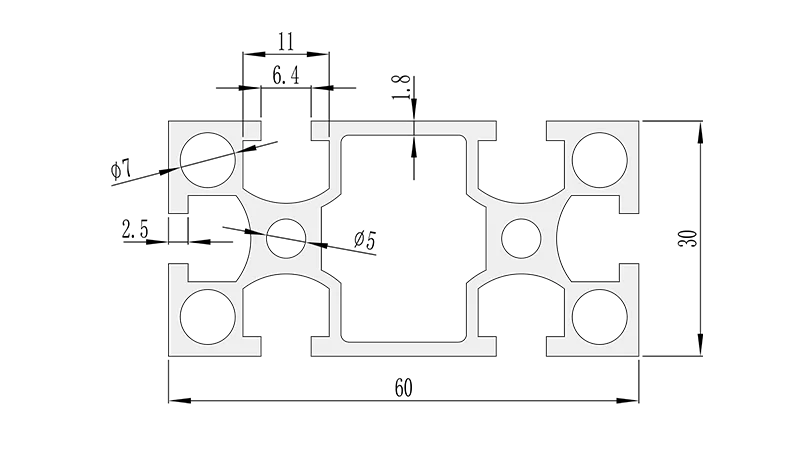
If steel is the factory's old, stubborn workhorse, 3060 National Standard Profile A is the agile, tech-savvy newcomer. Part of the aluminum extrusion family, this profile is created by forcing molten aluminum through a die, resulting in a lightweight, high-strength structure with precise, consistent dimensions. The "3060" refers to its cross-section (30mm wide, 60mm tall), making it perfect for medium-to-heavy-duty applications—without the bulk of steel.
But what really sets it apart is its modularity. Unlike steel, which requires welding or drilling to modify, 3060 profiles use aluminum profile accessories like T-slot nuts, brackets, and connectors. These simple, tool-free components let workers assemble, disassemble, and reconfigure structures in minutes. Need to adjust a workbench height for a new assembly line? Swap out a few brackets. Want to add shelves to a material rack? Slide in some new crossbars. It's manufacturing on demand—and it's a game-changer.
The Advantages That Make the Switch Irresistible
Why are factory managers raving about 3060 profiles? Let's break down the benefits that make them impossible to ignore:
1. Lightweight Strength That Slashes Costs
Aluminum is about 1/3 the weight of steel, but don't let that fool you—it's surprisingly strong. 3060 profiles can handle heavy loads (think: stacks of materials, industrial equipment, or even automated machinery) without bending or warping. This lightweight nature cuts transportation costs (fewer trucks needed to ship materials), reduces installation time (no cranes required for assembly), and lowers energy use (lighter structures are easier to move, even for automated systems).
2. Flexibility to Keep Up With Lean Systems
Modern manufacturing thrives on lean system principles—eliminating waste, streamlining workflows, and adapting to customer demands. 3060 profiles are lean by design. With aluminum profile accessories like hinges, casters, and adjustable brackets, factories can create everything from mobile workstations to flow racks that adapt as production needs change. For example, a electronics plant might reconfigure a workbench from assembling smartphones to tablets in an afternoon—no welding, no downtime, just quick, tool-free adjustments.
3. Corrosion Resistance That Boosts Lifespan
Aluminum naturally forms a protective oxide layer, making it resistant to rust, corrosion, and chemical damage. In humid environments (like food processing plants) or areas with frequent cleaning (medical device factories), this is a lifesaver. Unlike steel, 3060 profiles don't need repainting or rust treatments, reducing maintenance costs and extending their lifespan by years—even decades.
4. Sustainability That Aligns With Green Goals
Today's factories aren't just focused on profit—they're prioritizing sustainability. Aluminum is 100% recyclable, and recycling it uses just 5% of the energy needed to produce new aluminum. When a 3060 structure reaches the end of its life, it can be melted down and repurposed, cutting waste and lowering a factory's carbon footprint. Steel, by contrast, is energy-intensive to produce and often ends up in landfills once it's corroded.
Steel vs. 3060 Aluminum: A Side-by-Side Comparison
| Feature | Traditional Steel | 3060 National Standard Profile A |
|---|---|---|
| Weight | Heavy (high transport/installation costs) | 1/3 the weight of steel (lower costs, easier handling) |
| Flexibility | Rigid (requires welding/drilling to modify) | Modular (tool-free adjustments with accessories) |
| Corrosion Resistance | Prone to rust (needs frequent maintenance) | Natural oxide layer (no rust, low maintenance) |
| Sustainability | Energy-heavy to produce, hard to recycle | 100% recyclable, low-energy production |
| Cost Over Time | High (transport, installation, maintenance) | Lower (reduced labor, energy, and upkeep costs) |
Real-World Impact: Factories Thriving With 3060 Profiles
Don't just take our word for it—factories across industries are already reaping the rewards. Take a leading automotive parts manufacturer in Guangzhou: after switching to 3060 profiles for their assembly line workbenches and material racks, they reduced installation time by 60% and cut annual maintenance costs by $45,000. Workers now adjust workstations on the fly to accommodate new part designs, and the plant's carbon footprint dropped by 15% thanks to lighter transportation and recycling programs.
Or consider a electronics factory in Shenzhen that adopted 3060 profiles for their lean system. By replacing steel conveyor frames with aluminum ones, they reduced the system's weight by 40%, allowing it to run on smaller motors—slashing energy bills by $30,000 a year. When they launched a new product line, they reconfigured the entire conveyor system in a weekend, avoiding weeks of downtime.
The Future of Manufacturing Is Aluminum
Traditional steel had a good run, but modern factories demand more—more flexibility, more efficiency, more sustainability. 3060 National Standard Profile A delivers on all fronts, proving that lightweight, modular, and eco-friendly materials can outperform the old guard. With aluminum extrusion profile technology advancing every year, we're only seeing the beginning of this revolution.
So the next time you walk through a factory, take a closer look at those sleek, silver structures. Chances are, they're 3060 profiles—quietly transforming manufacturing, one T-slot connector at a time. And for factory managers, the message is clear: to stay competitive in the 21st century, it's time to go aluminum.