- Company Articles
- Industry articles
- Industry News
- Why Medical Industry Relies on Aluminum Profile 3 Way Connectors

Why Medical Industry Relies on Aluminum Profile 3 Way Connectors
Related Product
Aluminum Profile 3 Way Connector
The 3 way - squared corner connector is an external fastening method that is typically used to create a corner connection between three profiles. It is a heavy-duty connection that is simple to use and provides a polished look.
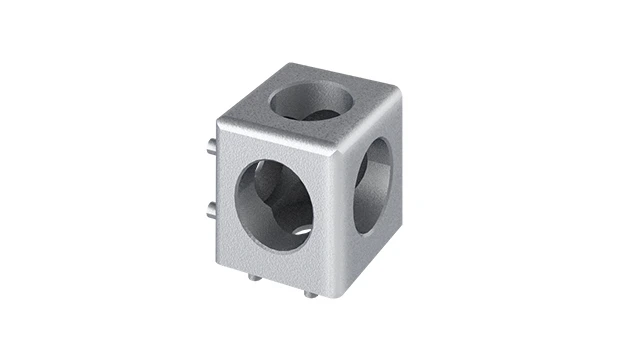
Walk into any medical device manufacturing facility, and you'll be struck by the precision in every corner. From the sterile white walls to the humming assembly lines where life-saving equipment takes shape, every detail matters. Amidst the high-tech machinery and specialized tools, there's an unsung hero quietly holding it all together: the aluminum profile 3 way connector. These small, unassuming components are the backbone of the medical industry's most critical systems—from workbenches where surgeons' tools are assembled to material racks that store sensitive components. In an industry where compliance, adaptability, and safety are non-negotiable, aluminum profile 3 way connectors have become indispensable. Let's dive into why they're so vital, and how they support the medical sector's unique demands.
The Medical Industry's Unique Demands: More Than Just "Making Stuff"
Manufacturing medical devices isn't like building consumer electronics or automotive parts. The stakes are exponentially higher. A single error in production could compromise a device that's used in surgeries, monitors a patient's heart rate, or administers life-sustaining medication. That's why the industry is governed by some of the strictest regulations in the world—think FDA guidelines, ISO 13485 standards, and CE marking requirements. These rules don't just apply to the final product; they extend to every step of the manufacturing process, including the equipment and workspaces used to build them.
So, what do these regulations translate to for facility managers and production teams? First, cleanliness is non-negotiable. Surfaces must be easy to sanitize, with no crevices where bacteria or contaminants can hide. Second, adaptability is key. Medical device trends evolve rapidly—new technologies, smaller components, and shifting patient needs mean production lines can't stay static for years. A workspace that assembles insulin pumps today might need to retool for wearable health monitors tomorrow. Third, static control is critical. Many medical devices, like pacemakers or MRI machine components, contain sensitive electronics that can be damaged by electrostatic discharge (ESD). That's where ESD workstations come into play, but their effectiveness depends on the materials they're built with.
Traditional materials like steel or wood struggle to meet these demands. Steel is heavy, making it hard to reconfigure workspaces quickly. It's also prone to rust if not properly coated, which is a red flag in sterile environments. Wood, meanwhile, is porous—even with sealants, it can trap moisture and bacteria, violating cleanliness standards. And neither steel nor wood offers the modular flexibility needed to adapt to changing production needs without expensive overhauls. This is where aluminum profiles and their connectors step in.
Aluminum Extrusion Profiles: The Foundation of Medical-Grade Systems
Aluminum extrusion profile has become the gold standard for medical manufacturing setups, and for good reason. Unlike steel, aluminum is naturally corrosion-resistant, thanks to its oxide layer that forms when exposed to air. This means it can withstand frequent cleaning with harsh disinfectants—think bleach or alcohol-based solutions—without deteriorating. Its smooth, non-porous surface leaves nowhere for bacteria to hide, making it ideal for environments where sterility is paramount.
But it's not just about cleanliness. Aluminum's strength-to-weight ratio is a game-changer. It's lightweight enough to be moved or reconfigured by a small team, yet strong enough to support heavy equipment, like microscopes or automated assembly arms, on workbenches. This combination of strength and portability is a boon for facilities that need to adapt quickly. For example, during the height of the COVID-19 pandemic, many medical manufacturers had to pivot from producing regular devices to ventilators. Facilities using aluminum extrusion profiles could reconfigure their workspaces in days, not weeks, by adjusting frames and adding new components—something that would have been nearly impossible with steel or wood.
Sustainability is another factor driving the shift to aluminum. The medical industry, like many others, is under increasing pressure to reduce its environmental footprint. Aluminum is 100% recyclable, and recycling it requires just 5% of the energy needed to produce new aluminum. This aligns with the industry's goals of reducing waste and operating more sustainably. Plus, aluminum profiles are designed to be reused—unlike custom-welded steel structures, which often end up in landfills when production lines change.
Perhaps most importantly, aluminum extrusion profiles are compatible with a wide range of accessories, from ESD-safe work surfaces to LED lighting strips and cable management systems. This versatility means they can be tailored to almost any task, whether it's a cleanroom assembly station or a material storage rack. And at the heart of this versatility? Connectors—specifically, aluminum profile 3 way connectors.

Aluminum Profile 3 Way Connectors: The Glue That Holds It All Together
If aluminum extrusion profiles are the building blocks of medical manufacturing systems, then 3 way connectors are the glue that turns those blocks into functional structures. These small, often T-shaped or L-shaped components are designed to join three aluminum profiles at various angles—90 degrees, 45 degrees, or even custom angles—enabling the creation of complex, three-dimensional structures. But their value goes far beyond just "connecting pieces."
Let's start with modularity. Medical device production lines rarely stay the same for long. A facility might need to add a new shelf to a workbench to accommodate a larger component, or extend a material rack to store more parts during a production surge. With aluminum profile 3 way connectors, these changes are simple. Unlike welded steel joints, which are permanent, 3 way connectors use set screws or bolts to secure profiles. This means you can loosen a connector, adjust the angle or length of a profile, and retighten it—no welding, no cutting, no specialized tools required. This tool-less assembly saves hours of downtime and reduces the need for skilled labor, which is a huge cost-saver for manufacturers.
Take, for example, a workbench used to assemble neurostimulation devices—tiny, intricate tools used to treat chronic pain. The workbench needs multiple levels: a lower shelf for storing tools, a main surface for assembly (which must be ESD-safe), and an upper shelf for a microscope and monitor. Using aluminum profiles and 3 way connectors, the workbench can be built with vertical supports connected to horizontal beams via 3 way connectors. If the team later needs to add a side extension for a parts bin, they can simply attach another profile to one of the existing 3 way connectors, no rebuild required. This level of flexibility is impossible with fixed materials like wood or welded steel.
Durability is another key advantage. Aluminum profile 3 way connectors are typically made from high-strength aluminum alloys or reinforced plastic, designed to withstand the rigors of daily use. They don't loosen over time, even with vibrations from nearby machinery, ensuring that workbenches and racks remain stable—critical when assembling precision medical devices. And because they're made from the same material as the profiles (aluminum), they're corrosion-resistant and easy to clean, maintaining the sterile environment required by regulations.

ESD Workstations and Aluminum Profile Systems: A Match Made in Safety
Earlier, we touched on the importance of ESD protection in medical manufacturing. Static electricity can damage sensitive electronic components in devices like defibrillators or glucose monitors, rendering them useless (or worse, dangerous) for patients. ESD workstations are designed to dissipate static charges, protecting these components during assembly. But their effectiveness depends on the materials used in their construction—and aluminum profiles play a starring role here.
Aluminum is a conductive material, which means it can be grounded to dissipate static charges. When used in ESD workstations, the aluminum frame (built with profiles and 3 way connectors) acts as a pathway for static electricity to flow safely to the ground, rather than building up and discharging onto components. This is far more reliable than ESD mats alone, which can wear out or lose their conductivity over time. The 3 way connectors ensure the frame is electrically continuous—no gaps or breaks in the path—so static is always redirected away from sensitive parts.
But ESD protection isn't just about the frame. Many aluminum profile accessories, like ESD-safe work surfaces or conductive casters, can be integrated seamlessly with the profiles and connectors. For example, a lean system supplier might offer ESD workbench packages that include aluminum profiles, 3 way connectors, a conductive top surface, and grounding cables—all pre-configured to meet ESD standards. This turnkey solution saves manufacturers time and ensures compliance with regulations, which is critical in an industry where non-compliance can lead to fines or production shutdowns.
Real-World Applications: How 3 Way Connectors Power Medical Manufacturing
To understand the impact of aluminum profile 3 way connectors, let's look at some real-world applications. Consider a medical device company that produces surgical robots. These robots have hundreds of tiny, precise components, so their assembly requires specialized workbenches with multiple stations: one for electronics, one for mechanical parts, and one for final testing. Using aluminum profiles and 3 way connectors, the company can build a custom workbench system where each station is connected but modular. If they need to add a new testing station, they can simply extend the frame with additional profiles and 3 way connectors, without disrupting the existing workflow.
Material racks are another area where 3 way connectors shine. Medical facilities need to store everything from raw materials (like titanium screws for orthopedic implants) to finished devices, and these storage systems must be organized, accessible, and compliant. A material rack built with aluminum profiles and 3 way connectors can be customized with adjustable shelves to fit different-sized components. For example, a rack for storing catheters might have narrow shelves, while one for surgical tools has wider ones. If storage needs change, the shelves can be moved up or down by adjusting the 3 way connectors—no need to buy a new rack.
Turnover trolleys are yet another application. These trolleys transport components between assembly stations, and they need to be lightweight, easy to maneuver, and sterile. Aluminum profiles make the trolley frames light enough for a single worker to push, while 3 way connectors ensure the structure is sturdy enough to hold heavy loads without wobbling. Many trolleys also include ESD-safe surfaces, grounded via the aluminum frame, to protect components during transport. And if a trolley gets damaged—say, a wheel breaks—the frame can be repaired by replacing the affected profile and connector, rather than replacing the entire trolley.
Why Lean System Suppliers Choose Aluminum Profile 3 Way Connectors
Lean manufacturing principles—focused on eliminating waste, optimizing flow, and continuous improvement—are deeply ingrained in the medical industry. Every minute of downtime, every unnecessary step in production, adds cost and delays life-saving devices from reaching patients. Lean system suppliers specialize in providing solutions that align with these principles, and aluminum profile 3 way connectors are a cornerstone of their offerings.
For starters, modularity reduces waste. Instead of building custom steel structures for each client, lean system suppliers can stock standard aluminum profiles and connectors, then assemble them on-site to meet specific needs. This cuts down on inventory costs and reduces lead times—critical for medical manufacturers facing tight deadlines. For example, a supplier might have a base set of 20mm and 40mm aluminum profiles, along with 3 way connectors, end caps, and ESD surfaces. When a client needs a new workbench, the supplier can design it using these standard parts, assemble it quickly, and deliver it within days, not weeks.
Reconfigurability also supports lean goals. In lean manufacturing, "muda" (waste) includes unused space or inefficient workflows. With aluminum profiles and 3 way connectors, workspaces can be adjusted to eliminate these inefficiencies. A production line that's too spread out can be condensed by repositioning racks and workbenches. A bottleneck at an assembly station can be relieved by adding a parallel workstation using existing profiles and connectors. This ability to adapt on the fly keeps production flowing smoothly, reducing waste and increasing output.
Finally, sustainability aligns with lean's focus on long-term efficiency. Aluminum's recyclability and reusability mean that when a facility upgrades its systems, the old profiles and connectors can be repurposed or recycled, rather than sent to landfills. This reduces the environmental impact and lowers disposal costs—a win-win for both the manufacturer and the planet.
Comparing Traditional vs. Aluminum-Based Systems: A Clear Advantage
| Feature | Traditional Steel | Wood | Aluminum Profile with 3 Way Connectors |
|---|---|---|---|
| Cleanliness & Sterility | Prone to rust; requires frequent coating to prevent corrosion. | Porous; traps moisture and bacteria even with sealants. | Non-porous, corrosion-resistant surface; easy to sanitize with harsh disinfectants. |
| Adaptability | Permanent welded joints; reconfiguration requires cutting/welding. | Fixed structure; modifications damage the material. | Tool-less assembly with connectors; reconfigurable in hours with no damage. |
| ESD Compatibility | Conductive but heavy; hard to integrate with ESD surfaces. | Non-conductive; cannot dissipate static charges. | Conductive frame; easily grounded for ESD protection; compatible with ESD accessories. |
| Cost Over Time | High initial cost; expensive to modify or replace. | Low initial cost; short lifespan due to wear and tear. | Moderate initial cost; reusable, repairable, and long-lasting—lower total cost of ownership. |
| Sustainability | Recyclable but energy-intensive to produce; often ends up in landfills when obsolete. | Renewable but not fully recyclable; limited lifespan. | 100% recyclable; reusable components; low energy footprint for production/recycling. |
Looking Ahead: The Future of Aluminum Profile Systems in Medicine
As medical technology advances, so too will the demands on manufacturing systems. We're already seeing trends toward smaller, more complex devices—think nanoscale drug delivery systems or AI-powered diagnostic tools. These will require even more precise, adaptable workspaces, and aluminum profile 3 way connectors are poised to meet these needs.
Innovations in connector design are making systems even more flexible. New internal rotatary aluminum joints, for example, allow profiles to rotate 360 degrees, enabling dynamic workspaces that can adjust in real time. Smart connectors with built-in sensors are also on the horizon—these could monitor temperature, humidity, or vibration in critical areas, alerting teams to issues before they affect production. And as additive manufacturing (3D printing) becomes more widespread, we may see custom 3 way connectors printed on-site to meet unique design needs, further reducing lead times.
Sustainability will continue to drive adoption, too. As medical companies set more aggressive carbon neutrality goals, aluminum's recyclability and energy efficiency will make it an even more attractive choice. We may also see growth in "circular" supply chains, where lean system suppliers take back old aluminum profiles and connectors, refurbish them, and resell them—reducing waste and lowering costs for manufacturers.
Conclusion: The Unsung Heroes of Medical Manufacturing
Aluminum profile 3 way connectors may not be the most glamorous components in a medical device manufacturing facility, but they're undoubtedly some of the most important. They enable the clean, adaptable, and safe workspaces that are critical to producing life-saving devices. From ESD workstations that protect sensitive electronics to reconfigurable material racks that optimize storage, these connectors make it possible for the medical industry to meet strict regulations, adapt to changing needs, and operate sustainably.
As technology advances and the industry faces new challenges—from pandemics to evolving patient needs—aluminum profile systems will only grow in importance. They're not just tools for building workbenches or racks; they're enablers of innovation, ensuring that medical manufacturers can focus on what matters most: creating devices that improve and save lives. So the next time you walk into a medical manufacturing facility, take a moment to appreciate the aluminum frames and connectors holding it all together. They may be small, but their impact is enormous.