- Company Articles
- Products and Technology
- Product knowledge
- Adjustable Leveling Feet for 3C Assembly Lines: Stability in High-Precision Work

Adjustable Leveling Feet for 3C Assembly Lines: Stability in High-Precision Work
Related Product
Adjustable Leveling Feet
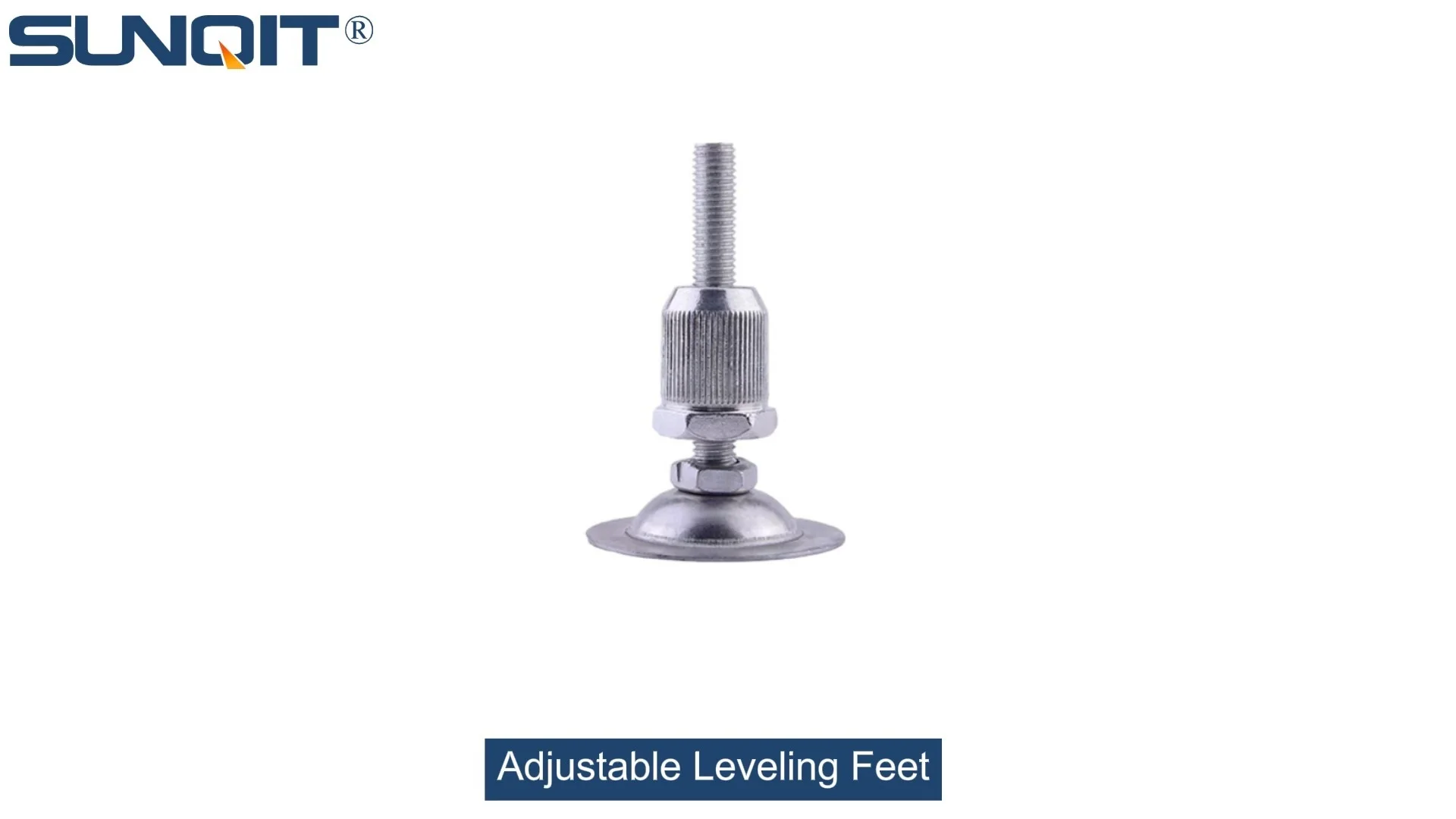
Adjustable leveling feet are designed to keep machines level when placed on uneven or sloped ground. Otherwise known as adjustable equipment feet, they are available to order in a wide variety of size and load capacity combinations.
In the world of 3C manufacturing—where "3C" stands for computers, communication devices, and consumer electronics—precision isn't just a buzzword; it's the difference between a flawless smartphone motherboard and a defective unit that never makes it to store shelves. Imagine assembling a microchip smaller than a fingernail, where a misalignment of just 0.1 millimeters can render the entire component useless. Now, picture doing this on a workstation that wobbles slightly every time an operator reaches for a tool. Sounds like a recipe for disaster, right? This is where the unsung heroes of assembly line stability come into play: adjustable leveling feet. These small but mighty components might not grab headlines, but they're the foundation upon which high-precision 3C assembly lines rely. In this article, we'll dive into why adjustable leveling feet matter, how they integrate with lean systems, and their critical role in supporting workbenches, ESD workstations, and aluminum profile structures—all while ensuring the stability that keeps production running smoothly and defect rates in check.
Understanding Adjustable Leveling Feet: More Than Just "Feet"
At first glance, adjustable leveling feet might seem like simple hardware—just a metal stem with a base, right? But anyone who's worked on a 3C assembly line knows better. These components are engineered to solve a common but critical problem: floors in manufacturing facilities are rarely perfectly flat. Over time, concrete shifts, heavy machinery causes indentations, and even minor unevenness can throw off the alignment of workbenches, conveyor belts, and ESD workstations. Adjustable leveling feet compensate for these imperfections, ensuring that every surface stays stable, level, and ready for the precision tasks at hand.
Let's break down the anatomy of a typical adjustable leveling foot. Most designs feature a threaded stem (often made of steel or stainless steel for durability) that screws into a mounting plate or directly into the bottom of a workbench leg. At the base of the stem is a larger, flat base plate—usually with a rubber or plastic pad—to distribute weight evenly and prevent slipping. A locking nut allows operators to adjust the height of the foot by turning the stem; once the desired height is set, the nut is tightened to keep it in place. Some models also include anti-vibration features, like spring-loaded mechanisms or soft rubber pads, to absorb shocks from nearby machinery—critical in 3C plants where even small vibrations can disrupt delicate assembly work.
But not all adjustable leveling feet are created equal. In 3C manufacturing, where environments can vary from cleanrooms to busy production floors, different applications call for specialized designs. For example, ESD workstations—used to assemble sensitive electronics like circuit boards—require leveling feet that don't conduct static electricity, so manufacturers might opt for feet with non-conductive rubber pads or coated stems. Heavy-duty models, with thicker stems and reinforced bases, are used for workbenches loaded with automated assembly tools, while anti-slip versions are a must in areas where oil or coolant might make floors slippery. The key is choosing the right foot for the job—and that starts with understanding the unique demands of the 3C assembly line.
The Lean System Connection: Stability as a Foundation for Efficiency
Lean manufacturing has revolutionized how 3C companies operate, with its focus on eliminating waste, streamlining processes, and continuous improvement. But here's the thing: lean systems rely on consistency. If your workbenches aren't stable, your processes can't be consistent—and waste creeps in. Think about it: an operator struggling to keep a circuit board steady on a wobbly workstation is more likely to make mistakes, leading to rework (a classic form of waste in lean terms). A conveyor belt that's slightly tilted because its feet aren't level might cause parts to jam, bringing the entire line to a halt (another waste: downtime). In short, instability is the enemy of lean—and adjustable leveling feet are the first line of defense.
Consider a real-world example: a mid-sized 3C manufacturer producing smartwatch components. Before upgrading to adjustable leveling feet, their assembly line had a recurring problem: the ESD workstations used for soldering tiny components would wobble slightly, especially when operators leaned on the bench. This led to inconsistent solder joints, with roughly 8% of units requiring rework—a significant drain on time and resources. After installing adjustable anti-slip leveling feet, the workstations stayed stable even under operator pressure. Within three months, rework rates dropped to 2%, and the line saw a 10% increase in daily output. The reason? By eliminating the waste caused by instability, the lean system could finally operate at its full potential—proving that even the smallest components (like leveling feet) play a big role in lean success.
But lean isn't just about reducing defects; it's also about empowering operators. When workbenches are level and stable, operators can focus on their tasks instead of compensating for wobbles. This reduces fatigue, improves morale, and even cuts down on workplace injuries—all of which contribute to a more efficient, leaner operation. As one plant manager put it: "We used to spend hours troubleshooting why our defect rates were high, only to realize the problem was under our feet. Adjustable leveling feet didn't just fix the workbenches—they fixed our entire approach to process stability."

Workbenches and ESD Workstations: Where Precision Meets Stability
In 3C assembly, workbenches and ESD workstations are the command centers of production. This is where operators spend hours soldering, testing, and assembling components that often measure in millimeters. For these tasks, stability isn't just a luxury—it's a requirement. A workbench that tilts by even 1 degree can cause a component to slide out of place, or a test probe to misalign with a circuit board contact. ESD workstations, which protect sensitive electronics from static discharge, face an added challenge: their grounding systems rely on consistent contact with the floor. If a workstation's feet are uneven, the grounding path can be broken, exposing components to static damage.
Let's take the example of smartphone camera module assembly. The lens and sensor in a modern smartphone camera are aligned with tolerances as tight as 2 micrometers—about 1/50th the width of a human hair. To achieve this, the assembly workbench must be so stable that even the vibration from an operator's hand movements doesn't disrupt the alignment. Adjustable leveling feet ensure that the workbench remains perfectly level, even if the floor beneath it has minor dips or bumps. Without them, the camera modules would suffer from blurry images or misaligned sensors, leading to costly rejections.
ESD workstations face similar demands. When assembling a laptop motherboard, static electricity can fry delicate microchips in an instant. ESD workstations are designed to dissipate static through grounding straps, conductive mats, and yes—their feet. If a workstation's foot isn't making solid contact with the floor, the grounding system fails, putting the motherboard at risk. Adjustable leveling feet solve this by allowing operators to ensure each foot is firmly planted, maintaining a continuous grounding path. In fact, many ESD workstation manufacturers now include adjustable leveling feet as standard equipment, recognizing their role in protecting both products and profits.

Aluminum Profile: The Backbone of Modern Workstation Stability
While adjustable leveling feet provide the "adjustment," the structures they support—like workbenches and ESD workstations—need to be strong and lightweight to maximize efficiency. This is where aluminum profile comes into play. Aluminum profile (also called aluminum extrusion profile) has become the material of choice for 3C assembly line structures, thanks to its unique combination of strength, flexibility, and light weight. Unlike traditional steel, aluminum profile is easy to cut, drill, and assemble, making it ideal for building custom workbenches and frames that can be reconfigured as production needs change. And when paired with adjustable leveling feet, aluminum profile structures become even more versatile.
Aluminum profile's modular design is a perfect match for adjustable leveling feet. Most aluminum profiles feature T-slots—longitudinal grooves that allow accessories like leveling feet, brackets, and shelves to be attached without welding. This means operators can install leveling feet quickly, adjust them as needed, and even swap them out for different models (e.g., switching from standard feet to heavy-duty ones) without disassembling the entire workbench. For 3C manufacturers that frequently retool lines for new product launches, this flexibility is a game-changer. Imagine needing to adjust a workbench height by 2 inches to accommodate a new assembly tool—with aluminum profile and adjustable leveling feet, it's as simple as loosening the locking nuts, turning the stems, and retightening. No cutting, no welding, no downtime.
Another advantage of aluminum profile is its compatibility with other lean system components, like conveyor systems and material racks. Many 3C assembly lines use aluminum profile to build modular conveyor supports, and adjustable leveling feet ensure these supports stay level, preventing jams and ensuring smooth part flow. This integration of aluminum profile, leveling feet, and lean systems creates a cohesive, efficient production environment where every component works together to minimize waste and maximize output.

Comparing Adjustable Leveling Feet: Which Is Right for Your Line?
With so many adjustable leveling feet on the market, choosing the right one for your 3C assembly line can feel overwhelming. To simplify the process, we've put together a comparison of four common types, highlighting their features, materials, and ideal applications. Whether you're outfitting a new ESD workstation or upgrading an existing workbench, this table will help you find the perfect fit.
| Type of Adjustable Leveling Foot | Key Materials | Load Capacity (per foot) | Adjustment Range | Standout Feature | Ideal 3C Application |
|---|---|---|---|---|---|
| Standard Anti-Slip Adjustable Leveling Feet | Steel stem, rubber pad, zinc-plated finish | Up to 500 kg | 10-50 mm | Non-slip rubber pad prevents workstation movement | General assembly workbenches, lightweight material racks |
| Heavy-Duty Aluminum Profile-Compatible Feet | Stainless steel stem, aluminum base, reinforced plastic pad | Up to 1,500 kg | 20-80 mm | Designed to fit T-slots in aluminum extrusion profiles | Workbenches with automated tools, heavy conveyor supports |
| ESD-Safe Threaded Leveling Feet | Brass stem, conductive rubber pad, nickel coating | Up to 800 kg | 15-60 mm | Conductive materials prevent static buildup | ESD workstations for circuit board assembly, semiconductor testing |
| Vibration-Dampening Leveling Feet | Steel stem, spring-loaded core, neoprene pad | Up to 1,000 kg | 10-40 mm | Absorbs shocks from nearby machinery | Workstations near robotic arms or high-speed conveyors |
Case Study: How One Manufacturer Solved a Costly Stability Problem
To truly understand the impact of adjustable leveling feet, let's look at a case study from a leading 3C manufacturer: XYZ Electronics, which produces wireless earbuds for a major global brand. In 2023, XYZ was struggling with a frustrating issue: their final assembly line for earbud charging cases had a defect rate of 9%, well above their target of 3%. The problem? The plastic housing of the charging case was cracking during the final screw-fastening step. Engineers suspected the automated screwdriver was applying too much torque, but tests showed torque levels were within specs. It wasn't until a floor supervisor noticed that the workbench holding the screwdriver would rock slightly when the machine cycled that the team realized the real culprit: instability.
The workbench in question was an older model with fixed wooden feet. Over time, the concrete floor beneath it had developed a small dip, causing the bench to tilt by about 2 degrees. When the automated screwdriver lowered to fasten the screws, the bench would rock backward, misaligning the screwdriver with the screw hole. This misalignment caused uneven pressure on the plastic housing, leading to cracks. The solution? The team replaced the fixed feet with heavy-duty aluminum profile-compatible adjustable leveling feet. Within a week, they adjusted the feet to level the bench, and the defect rate plummeted to 2.5%—below the target. By the end of the quarter, XYZ had saved over $200,000 in rework costs and reduced production delays by 15 hours per week.
But the benefits didn't stop there. The new leveling feet made the workbench easier to reconfigure when XYZ launched a new earbud model three months later. Instead of building a new bench, the team simply adjusted the height of the feet to accommodate the larger charging case design, saving $10,000 in new equipment costs. As the plant engineer noted: "We always thought of leveling feet as a 'set it and forget it' part, but they've become a tool for continuous improvement. Now, whenever we launch a new product, checking and adjusting the leveling feet is one of the first steps in our setup process."
Future Trends: Smart Leveling Feet and the Next Frontier of 3C Assembly
As 3C manufacturing becomes more automated and data-driven, even humble components like adjustable leveling feet are getting a high-tech upgrade. The next generation of leveling feet will likely integrate with IoT (Internet of Things) systems, allowing real-time monitoring of stability and performance. Imagine a smart leveling foot equipped with a tiny sensor that measures tilt, vibration, and load distribution. If the foot detects that a workbench is becoming unlevel—maybe due to a loose locking nut or a shifting floor—it could send an alert to the plant's maintenance team, who can address the issue before it causes defects. This predictive maintenance approach would reduce downtime and ensure that stability is maintained 24/7.
Another trend is the development of lightweight, high-strength materials for leveling feet. Manufacturers are experimenting with carbon fiber-reinforced plastics and titanium alloys to create feet that are stronger than steel but lighter than aluminum—perfect for mobile workstations or automated guided vehicles (AGVs) that need to move quickly while maintaining stability. For 3C plants with limited floor space, these lightweight feet could allow for more flexible, agile layouts without sacrificing precision.
Finally, sustainability is playing a bigger role in component design. Many manufacturers are now producing adjustable leveling feet from recycled steel or aluminum, with modular designs that make them easy to repair or recycle at the end of their lifespan. In an industry where environmental responsibility is becoming a key customer demand, even small changes like eco-friendly leveling feet can help 3C companies reduce their carbon footprint.
Conclusion: Stability Starts from the Ground Up
In the fast-paced world of 3C manufacturing, where innovation and precision are everything, it's easy to focus on the latest robots, AI-powered inspection tools, or cutting-edge materials. But as we've explored, the foundation of any successful assembly line is stability—and that foundation starts with adjustable leveling feet. These unassuming components are the silent partners in lean systems, ensuring workbenches and ESD workstations stay level, aluminum profile structures remain stable, and every microchip, sensor, and circuit board is assembled with the precision that 3C customers demand.
Whether you're a plant manager looking to reduce defects, an engineer designing a new assembly line, or an operator striving for better productivity, never underestimate the power of a well-adjusted leveling foot. In an industry where the difference between success and failure can be measured in micrometers, stability isn't just a technical requirement—it's a competitive advantage. So the next time you walk through a 3C factory, take a moment to look down. Those small, unassuming feet beneath the workbenches? They're the reason the devices in your pocket work as flawlessly as they do.