- Company Articles
- Products and Technology
- Product knowledge
- Advantages of 3030b EU Standard Aluminum Profile for Reusable Industrial Systems

Advantages of 3030b EU Standard Aluminum Profile for Reusable Industrial Systems
Related Product
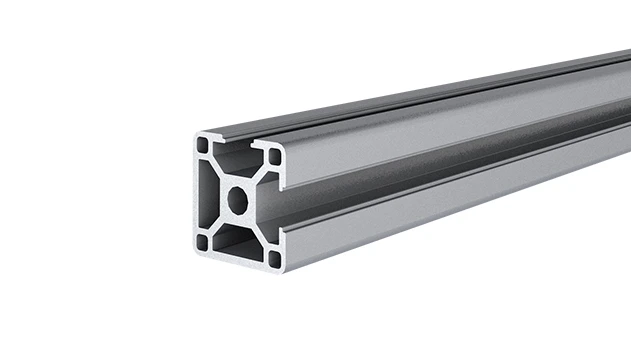
3030B EU Standard Aluminum Profile
3030 is a 3.00 x 3.00CM fractional 30 series square extrusion T-slot profile with two side open T-slots, each side with 3.00cm face, 2 side with open slot, 2 side with closed face. The profile has align-a-grooves to assist in aligning connecting profiles.
Introduction: The Need for Adaptable Industrial Systems
Walk into any modern manufacturing facility, warehouse, or assembly plant, and you'll notice a silent but powerful trend: the death of the "permanent" setup. Gone are the days when production lines, workstations, and material racks were welded into place, destined to stay unchanged for decades. Today, industries from automotive to electronics are racing to keep up with shifting consumer demands, shorter product lifecycles, and the need to pivot quickly—whether that means scaling up a new product line, downsizing an underperforming one, or reconfiguring a workspace to accommodate new technology.
In this landscape, flexibility isn't just a buzzword; it's the backbone of operational resilience. And at the heart of this flexibility lies a material that's quietly revolutionizing how industrial systems are built: aluminum profiles. Specifically, the 3030b EU Standard Aluminum Profile has emerged as a standout choice for engineers, plant managers, and operations teams who refuse to be tied down by rigid infrastructure. But what makes this unassuming 30x30mm extrusion so special? Why is it becoming the go-to for reusable industrial systems? Let's dive in.
What is 3030b EU Standard Aluminum Profile?
First things first: let's demystify the name. The "3030b" refers to its dimensions—30mm in width and 30mm in height—with "b" denoting a specific variation in its T-slot design (more on that later). The "EU Standard" tag isn't just a label; it's a promise of precision, quality, and compliance with strict European manufacturing norms, ensuring consistency in everything from wall thickness to slot dimensions across batches. Unlike generic aluminum extrusions, which might cut corners on material purity or dimensional accuracy, 3030b profiles are engineered for industrial-grade performance.
At its core, 3030b is a product of the aluminum extrusion process: heated aluminum alloy is forced through a die to create a uniform cross-section, resulting in a lightweight yet surprisingly strong structure. The magic, however, lies in its T-slots—the longitudinal grooves running along its length. These slots are the profile's "secret sauce," allowing it to connect seamlessly with a vast array of aluminum profile accessories: brackets, hinges, handles, panels, and more. No welding, no drilling, no permanent modifications—just simple, tool-free (or minimal-tool) assembly that turns a basic extrusion into a fully functional system.

Key Features of 3030b Aluminum Profile
Before we jump into its advantages, let's break down the features that make 3030b a workhorse in industrial settings:
- Precision T-Slots: The T-shaped grooves (typically 8mm or 10mm wide) are machined to tight tolerances, ensuring that aluminum profile accessories—like bolts, nuts, and brackets—fit snugly without play. This precision is critical for stability in high-vibration environments, such as near conveyor belts or heavy machinery.
- Alloy Composition: Most 3030b profiles are made from 6063-T5 aluminum alloy, a blend prized for its balance of strength, corrosion resistance, and machinability. It's lightweight (about 2.7g/cm³, compared to steel's 7.8g/cm³) but can handle loads of up to 500kg per linear meter when properly supported—more than enough for most workbench or rack applications.
- Surface Finish: EU standards mandate a smooth, anodized finish (often clear or silver) that not only resists scratches and corrosion but also reduces friction when sliding accessories into T-slots. This finish is far more durable than paint, which can chip or fade in industrial settings.
- Modular Design: Unlike custom-fabricated steel structures, 3030b profiles are designed to work with a universal set of components. A single length of 3030b can be cut to size, connected to another profile at 90°, 45°, or 135° angles using corner brackets, and fitted with shelves, panels, or roller tracks—all without specialized tools.
Advantage 1: Reusability & Modularity—The "Zero Waste" Setup
Let's start with the most obvious (and most celebrated) advantage: reusability. In traditional industrial setups, changing a production line often meant cutting, welding, or even scrapping old steel structures. A workbench that once held assembly tools might end up in a landfill when the line shifts to a new product. With 3030b, that's a thing of the past.
Imagine you run a small electronics plant, and your current workbench—built with 3030b profiles and aluminum profile accessories—has served as a testing station for smartphones for the past two years. Now, you're pivoting to smartwatches, which require a narrower workspace and additional storage for smaller components. Instead of ordering a new workbench, you can:
- Loosen the T-slot bolts holding the tabletop in place and trim the 3030b frame to the new width.
- Add a second shelf using angle brackets (snapped into the T-slots) for tool storage.
- Swap out the fixed feet for casters (another aluminum profile accessory) to make the bench mobile, allowing it to be moved between stations as needed.
When you're done, the original components—cut pieces, brackets, even the casters—aren't wasted. They can be stored, repurposed for another project, or even resold. This isn't just about saving money (though we'll get to that); it's about aligning with lean system principles, where waste reduction is paramount. In lean manufacturing, "muda" (waste) includes unnecessary inventory, overproduction, and unused resources. By designing systems that adapt instead of replace, 3030b helps eliminate that waste at the source.
Advantage 2: Durability That Outlasts Trends
You might be thinking: "If it's so easy to take apart, does it hold up in tough industrial environments?" The answer is a resounding yes. Aluminum's natural resistance to corrosion (thanks to its oxide layer) makes 3030b ideal for settings where moisture, chemicals, or humidity are present—think food processing plants, automotive workshops, or even outdoor warehouses. Unlike mild steel, which rusts without constant painting, 3030b profiles require almost no maintenance to stay in top shape.
But it's not just corrosion resistance. The 6063-T5 alloy used in 3030b is heat-treated to enhance its strength, making it surprisingly rigid for its weight. A properly assembled 3030b frame can support heavy machinery, stack pallets, or withstand the daily wear of workers leaning, pushing, or even accidentally bumping into it. I've visited factories where 3030b racks have been in use for over a decade, reconfigured half a dozen times, and still look as sturdy as the day they were built.
Compare this to plastic extrusions, which warp under heat or heavy loads, or wood, which splinters and absorbs moisture. Even other aluminum profiles (like non-EU standard versions) often skimp on wall thickness or use lower-grade alloys, leading to bending or slot deformation over time. With 3030b, you're investing in a material that can keep up with your operation's demands—today, tomorrow, and for years to come.
Advantage 3: Lightweight Strength—Ease of Handling, Lower Costs
Here's a paradox of industrial design: the stronger a material is, the heavier it tends to be. Steel is strong, but moving a steel workbench or rack requires forklifts, multiple workers, and careful planning. 3030b flips this script. Aluminum is about one-third the weight of steel, which means a single worker can carry a 2-meter length of 3030b with ease. Installing a rack? No need for heavy machinery—just a few people and a basic toolkit.
This lightness translates to real-world benefits. For starters, it reduces the risk of workplace injuries. Lifting heavy steel beams is a common cause of back strain; with 3030b, assembly becomes a one-person job, minimizing physical stress. It also cuts down on installation time: a team can build a 10-meter-long roller track system (using 3030b frames and roller track accessories) in a day, compared to a week for a welded steel equivalent.
Then there's shipping. If you're a manufacturer ordering pre-cut 3030b profiles from a supplier, the lower weight slashes transportation costs. Even better, if you need to move a workstation from one facility to another, you can disassemble it into lightweight components, pack them into a standard van, and reassemble on-site—no need for expensive flatbed trucks.
But don't mistake "lightweight" for "weak." As mentioned earlier, 3030b can handle significant loads when properly braced. A 3030b workbench with a plywood top can easily support 200kg of tools and equipment. For heavier applications (like automotive assembly), you can reinforce the frame with cross-braces or pair 3030b with thicker profiles (like 4040) at stress points. It's the best of both worlds: strength where you need it, lightness where you don't.
Advantage 4: Compatibility with Lean Systems—Streamlining Workflows
Lean manufacturing isn't just about cutting waste; it's about optimizing workflows to make them smoother, faster, and more efficient. 3030b profiles are practically tailor-made for lean system principles, thanks to their ability to adapt to the "flow" of work.
Take material handling, for example. In a lean setup, materials should move seamlessly from storage to the assembly line, with minimal manual lifting or delays. A roller track system built with 3030b frames and roller track accessories (like plastic guide rails or swivel roller balls) can do just that. Imagine a production line where components slide down a 3030b-framed roller track directly to the worker, eliminating the need for a forklift or hand trolley. If the line speeds up, you can extend the track by adding more 3030b sections and roller track connectors. If bottlenecks form, you can reangle the track to redirect materials to a less busy station.
Workstations, too, become leaner with 3030b. The T-slots allow for custom tool placement: a screwdriver holder can be mounted exactly where the worker's hand falls, reducing reach time. Cable management becomes a breeze—run wires through the slots to keep them off the floor and out of the way. Even 5S practices (sort, set in order, shine, standardize, sustain) are easier to implement: since the setup is modular, you can "set in order" tools and materials once, then replicate that setup across identical 3030b workstations, ensuring consistency.
Perhaps the biggest lean win? Reduced downtime during changes. In a traditional steel setup, reconfiguring a line might take days (or weeks) of shutdown. With 3030b, you can make changes during off-hours or even incrementally during shifts, keeping production running while you adapt. For a plant operating on tight deadlines, that's not just efficient—it's competitive.
Advantage 5: Cost-Effectiveness—Investing in the Long Term
Let's talk numbers. At first glance, 3030b profiles might seem pricier than, say, welded steel or even plastic extrusions. A meter of 3030b can cost 2-3 times more than a comparable length of mild steel. But that's only the upfront cost. When you factor in reusability, maintenance, and operational efficiency, 3030b often comes out ahead—by a lot.
Consider a hypothetical scenario: A manufacturer needs a workbench and a material rack. Option A: Build both with welded steel for $500 total. Option B: Build both with 3030b and aluminum profile accessories for $800 total. Year 1: Option A is cheaper. Year 2: The manufacturer needs to resize the workbench and add a second shelf to the rack. For Option A, this means hiring a welder ($300), buying new steel ($200), and losing a day of production ($1,000 in downtime). Total cost now: $500 + $300 + $200 + $1,000 = $2,000. For Option B, the manufacturer spends $0 on new materials (reusing existing profiles and accessories), $0 on labor (a maintenance worker does the reconfiguring), and $0 on downtime (changes made overnight). Total cost: $800. By Year 3, the gap only widens as more changes are needed.
Maintenance costs also tilt in 3030b's favor. Steel racks need periodic painting to prevent rust; 3030b's anodized finish requires nothing more than a wipe-down with a damp cloth. If a steel bracket bends, it's often irreparable; a bent aluminum bracket can be swapped out for $10 and 5 minutes of work. Even shipping, as mentioned earlier, is cheaper for 3030b components, adding up over time for companies that frequently reconfigure or expand.
For small to medium-sized businesses, this cost-effectiveness is a game-changer. It allows them to compete with larger firms that have bigger budgets for custom infrastructure, by investing in a system that grows with them—without breaking the bank.
How 3030b Compares to Other Profiles: A Quick Comparison
To truly appreciate 3030b's advantages, it helps to see how it stacks up against other common industrial materials. Here's a snapshot:
| Feature | 3030b Aluminum Profile | 4040 Aluminum Profile | Mild Steel | Plastic Extrusions |
|---|---|---|---|---|
| Weight (per meter) | ~0.8kg | ~1.2kg | ~2.4kg | ~0.5kg |
| Max Load Capacity | Up to 500kg (braced) | Up to 800kg (braced) | Up to 1,000kg (welded) | Up to 100kg |
| Reusability | Excellent (100% reusable) | Excellent (100% reusable) | Poor (welded joints break when disassembled) | Fair (prone to cracking when reconfigured) |
| Corrosion Resistance | High (anodized finish) | High (anodized finish) | Low (requires painting) | High (but prone to UV damage) |
| Cost (Relative) | Medium | High | Low (upfront) | Low |
| Best For | Workbenches, racks, roller tracks, small to medium loads | Heavy-duty assembly lines, large racks | Permanent, high-load structures (rarely reused) | Light-duty, temporary setups |
As the table shows, 3030b hits the sweet spot for most reusable industrial systems: it's strong enough for common loads, lightweight for easy handling, and infinitely reusable. While 4040 profiles are better for heavy loads, they're overkill for many applications—and more expensive. Steel is cheaper upfront but costly in the long run. 3030b? It's the Goldilocks of industrial profiles: just right.
Real-World Applications: Where 3030b Shines
3030b isn't just a theoretical solution; it's already transforming workplaces across industries. Here are a few examples of how it's being used today:
Electronics Manufacturing: Custom Workstations
A major smartphone manufacturer in Hungary uses 3030b profiles to build modular workstations for its assembly line. Each workstation is tailored to a specific task—screen installation, battery insertion, quality control—and can be reconfigured in under an hour when new phone models are introduced. Workers love that the T-slots let them mount tools (like torque screwdrivers) at eye level, reducing neck strain, while managers appreciate that downtime during model transitions has dropped from 2 days to 4 hours.
Warehousing: Flexible Material Racks
A logistics company in Germany needed racks that could adapt to varying package sizes—from small envelopes to large boxes. They chose 3030b frames with adjustable shelves (using aluminum profile accessories like shelf brackets and height-adjustable pins). When peak season hits, they add more 3030b sections to extend the racks; during slow periods, they disassemble the extra sections and store them, freeing up floor space. The result? A 30% increase in storage density during peaks, with no wasted space during lulls.
Automotive: Lean Assembly Lines
A Tier 1 automotive supplier in Spain uses 3030b to build roller track systems that move car parts (like door panels) from storage to the assembly line. The tracks are paired with swivel roller balls (another roller track accessory) to allow parts to be rotated or redirected with minimal effort. When the supplier landed a contract for a new car model with larger door panels, they simply added wider 3030b side rails and longer roller tracks—no need for a complete overhaul.
Conclusion: 3030b—The Future of Reusable Industrial Systems
In a world where change is the only constant, the 3030b EU Standard Aluminum Profile stands out as more than just a building material. It's a tool for resilience, a catalyst for innovation, and a partner in lean system success. Its reusability, durability, lightweight strength, and compatibility with aluminum profile accessories make it the ideal choice for industrial systems that need to adapt, grow, and evolve—without costing the earth (or your budget).
Whether you're a small startup looking to build your first workbench or a multinational corporation rethinking your entire production line, 3030b offers something that rigid materials never can: the freedom to change. And in today's industrial landscape, that freedom isn't just an advantage—it's essential.
So the next time you're planning a new setup, ask yourself: Do I want a system that's stuck in the past, or one that can keep up with the future? If it's the latter, 3030b is waiting.