- Company Articles
- Products and Technology
- Product knowledge
- Advantages of 4040F EU Standard Aluminum Profile for Lean Pipe Systems

Advantages of 4040F EU Standard Aluminum Profile for Lean Pipe Systems
Related Product
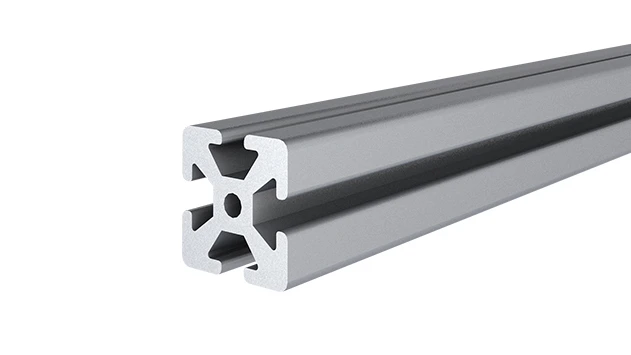
4040F EU Standard Aluminum Profile
4040F is a 4.00x4.00 CM fractional 40 series square extrusion T-slot profile with four side open T-slots, each side with 4.00cm face. The profile has align-a-grooves to assist in aligning connecting profiles.
Walk into any modern manufacturing facility that feels truly alive with efficiency, and you'll notice something distinct about the spaces where teams collaborate, build, and innovate. They're not weighed down by clunky, permanent structures that resist change. Instead, they're filled with dynamic, adaptable setups: workbenches that rise or lower with a simple adjustment, flow racks that guide materials to the line with minimal effort, and carts that zip between stations without a hitch. These are the hallmarks of lean manufacturing—a philosophy centered on eliminating waste, boosting productivity, and prioritizing people. And if you peek under the hood of many of these high-performing systems, you'll likely find a quiet workhorse: the 4040F EU Standard Aluminum Profile. It's not just a piece of metal; it's the backbone of flexibility, durability, and smart design that makes lean systems work.
But why does the material matter so much in lean manufacturing? Let's break it down. Lean isn't just about cutting costs or speeding up production—it's about creating systems that can evolve. A production line today might need a workbench for assembling small electronics; six months from now, that same space might need to become a testing station for larger components. Rigid materials like steel or wood can't keep up with that pace of change. They're heavy, hard to modify, and often end up as scrap when needs shift. Aluminum profiles, though? They're a different story. Lightweight, modular, and designed for quick reconfiguration, they're the perfect match for lean's "adapt or stagnate" mindset. And among aluminum profiles, the 4040F EU Standard stands out as a top choice for manufacturers, integrators, and suppliers who refuse to compromise on quality or versatility.
What Is the 4040F EU Standard Aluminum Profile, Anyway?
Before diving into its advantages, let's get to know the 4040F a bit better. At first glance, it might look like a simple rectangular tube, but there's engineering genius in its design. The "4040" refers to its dimensions: 40mm by 40mm, a size that strikes a sweet spot between strength and versatility. The "F" denotes its specific slot configuration—typically featuring T-slots along all four sides, spaced evenly to allow connections from any angle. And "EU Standard" isn't just a label; it's a promise of consistency. EU standards for aluminum extrusion profile manufacturing ensure tight tolerances, uniform material quality, and compliance with strict safety and performance benchmarks. This means whether you order a 4040F from a supplier in Poland, Germany, or Spain, you're getting a product that fits, functions, and lasts the same way.
Made from high-grade aluminum alloy (often 6063-T5, a popular choice for its balance of strength and machinability), the 4040F undergoes an extrusion process—where molten aluminum is forced through a die to create its precise shape—followed by anodization. That anodized finish isn't just for looks; it forms a hard, corrosion-resistant layer that protects the profile from scratches, chemicals, and wear, even in busy factory environments. And unlike steel, which rusts and requires regular painting, the 4040F's finish stays bright and functional for years with minimal maintenance. It's a small detail, but in a lean system where downtime is the enemy, every minute saved on upkeep counts.
Advantage 1: Durability That Keeps Up With the Grind of Manufacturing
Manufacturing floors are tough places. They're hot, dusty, and full of constant motion—materials being loaded, tools being used, carts being rolled. Any component that can't handle this daily grind becomes a liability. That's where the 4040F's durability shines. Aluminum alloy might seem lightweight compared to steel, but don't let that fool you. The 4040F has a tensile strength of around 180 MPa (megapascals), which translates to a load capacity that can handle heavy tools, stacks of materials, and even the occasional bump from a forklift (within reason, of course). We're talking about a profile that can support over 200 kg per linear meter when properly installed—more than enough for most workbench, rack, or conveyor needs.
But durability isn't just about raw strength; it's about resistance to the elements. Picture a food packaging plant, where washdowns with sanitizing solutions are daily routine, or a automotive facility where oil and coolants are part of the landscape. Steel would rust in these conditions without constant care, but the 4040F's anodized surface repels moisture and chemicals. Even in humid environments, it won't corrode or degrade. This longevity means fewer replacements, less waste, and a lower total cost of ownership over time—key pillars of lean thinking. A steel workbench might last 5 years before rust weakens it; a 4040F-based workbench? It could easily serve 10+ years, even with heavy use.
Let's put this in real terms. Imagine a furniture manufacturer using 4040F to build their assembly line workbenches. Each bench holds power tools, (semi-finished products), and worker supplies—easily 150 kg per station. Over a 12-hour shift, the bench is loaded, unloaded, and bumped by carts dozens of times. After five years, those benches still look and function like new. Compare that to a plastic or low-grade steel alternative that might start wobbling or showing signs of wear after two years. The 4040F doesn't just save money on replacements; it avoids the hidden costs of downtime when a bench fails mid-shift or the frustration of workers struggling with unstable equipment.

Advantage 2: Flexibility to Adapt When Your Needs Change
If there's one thing manufacturing teaches you, it's that change is constant. A new product launch, a shift in customer demand, or even a team restructuring can turn yesterday's "perfect" setup into today's bottleneck. Lean systems thrive on adaptability, and the 4040F is built for exactly that. Its T-slot design is the secret here—those grooves running along its length and width act like a universal connector system. With the right aluminum profile accessories—think 90° connectors, end caps, or sliding brackets—you can assemble, disassemble, and reconfigure the 4040F in minutes, no welding, drilling, or specialized tools required.
Let's say you run a small electronics plant, and you've just landed a contract for a new smartphone model. Your current assembly line has workbenches set up for larger devices, but this new phone is smaller, requiring different tool placement and a tighter workflow. With traditional steel benches, you'd be looking at days of work: hiring welders to cut and rejoin frames, repainting to cover scratches, and losing production time. With 4040F, it's a weekend project. Loosen the connectors, adjust the bench height, add new tool holders using T-slot nuts, and even attach a mini conveyor (using roller track accessories) to move parts between stations. By Monday morning, the line is ready—no lost production, no expensive contractors, just a team adapting to the new challenge.
This flexibility also extends to scaling. When your business grows, you don't need to scrap your existing setup and start from scratch. You can simply add more 4040F sections to your flow racks, extend your workbenches, or build new carts using the same profiles and accessories you already have. It's modularity at its best—like building with giant, industrial Legos. And because EU standards ensure consistency across suppliers, you can mix and match components from different manufacturers without worrying about compatibility issues. That's a level of freedom that rigid systems just can't match.
Advantage 3: Seamless Compatibility With a World of Accessories
A profile is only as useful as the accessories it works with, and the 4040F plays well with just about every aluminum profile accessory under the sun. This compatibility is a game-changer for lean systems, where customization is key to eliminating waste. Need to add a shelf to a flow rack? Use a few 90° aluminum profile connectors and a sheet of plywood or aluminum panel—done. Want to make a workbench mobile? Screw on caster wheels (with the right mounting brackets) and suddenly you've got a cart that can follow the work instead of the other way around. Need to route cables under a bench to keep the workspace tidy? Snap in a T-slot cable management channel—no drilling, no zip ties, no mess.
The range of accessories is staggering, and it's all designed to work with the 4040F's T-slots. There are end caps to cover sharp edges (safety first!), adjustable feet to level workbenches on uneven floors, LED light brackets to brighten work areas, and even specialized holders for tools like drills or screwdrivers. For material handling, you can add roller tracks (perfect for flow racks) that glide parts from storage to the line, or tray holders that keep small components organized. And because these accessories are standardized, you can order them from just about any lean system supplier—no need to wait for custom parts or pay premium prices.
Take, for example, a medical device manufacturer that uses 4040F to build their inspection stations. Each station needs a microscope, a light, and a small conveyor to move parts through. With 4040F, they use a combination of angle brackets (to mount the microscope), T-slot LED light bars (for illumination), and mini roller tracks (to feed parts). If they need to upgrade the microscope to a larger model, they don't replace the entire bench—just swap out the bracket for a larger one. It's this "plug-and-play" nature that makes the 4040F such a versatile choice. It turns a basic structure into a fully customized workspace, tailored to the task at hand.
Advantage 4: Cost-Effectiveness That Aligns With Lean's Waste-Reduction Goals
Let's talk about money—because at the end of the day, lean manufacturing is also about smart spending. At first glance, aluminum profiles like the 4040F might seem pricier than steel or plastic alternatives. It's true: the upfront cost is higher than, say, a basic steel tube. But lean thinking is about looking at the total cost of ownership, not just the initial price tag. And when you factor in durability, flexibility, and low maintenance, the 4040F quickly becomes the more economical choice.
Consider this: A steel workbench might cost $200 less upfront than a 4040F-based one. But over five years, the steel bench needs repainting twice ($150 per coat), rust treatment ($75), and eventually replacement when it warps ($800). The 4040F bench? It needs nothing but an occasional wipe-down. Total cost for steel: $200 (initial) + $300 (painting) + $75 (rust treatment) + $800 (replacement) = $1,375. Total cost for 4040F: $400 (initial) + $0 (maintenance) + $0 (replacement) = $400. That's a savings of nearly $1,000 over five years—and that's just for one bench. Multiply that across a factory with dozens of workbenches, racks, and carts, and the numbers get even more compelling.
Then there's the cost of change. When your production needs shift, a rigid steel setup often means selling or scrapping the old equipment and buying new—losing money on both ends. With 4040F, you reconfigure what you have. A 2019 study by the Lean Manufacturing Institute found that manufacturers using modular aluminum systems saved an average of 34% on facility reconfiguration costs compared to those using fixed steel setups. For a mid-sized company, that could mean tens of thousands of dollars saved when launching a new product line or reorganizing a department.
And let's not forget shipping and installation. Aluminum is about one-third the weight of steel, so transporting 4040F profiles costs less. Installing them? No need for heavy machinery or specialized labor—two workers with basic hand tools can assemble a workbench in an hour. Steel, on the other hand, often requires forklifts to move and welders to install, adding time and labor costs. When every dollar and minute counts, the 4040F's cost-effectiveness is hard to beat.
Advantage 5: Ergonomics That Put People at the Center of Lean
Lean manufacturing isn't just about machines and materials—it's about people. A workspace that's uncomfortable, unsafe, or tiring leads to mistakes, slowdowns, and high turnover. The 4040F's design prioritizes ergonomics, making it easier for teams to do their best work without unnecessary strain. Let's start with adjustability. Using simple aluminum profile connectors, you can raise or lower workbenches, racks, or conveyor heights to match the tallest or shortest team member. No more bending over a too-low bench or stretching to reach a too-high shelf. Studies show that adjustable workstations reduce musculoskeletal injuries by up to 50%—a huge win for both workers and employers (fewer lost workdays, lower insurance costs).
The 4040F's smooth, anodized surface also plays a role in ergonomics. Unlike rough steel or splintery wood, it won't catch on gloves, clothing, or skin, reducing the risk of cuts or snags. Sharp edges? Covered with end caps. Uneven surfaces? Leveled with adjustable feet. Even the weight of the profile itself helps: aluminum is light enough that workers can help reconfigure small setups (like moving a cart or adjusting a shelf) without straining, but sturdy enough that the structure stays stable once in place.
Consider a automotive parts supplier where workers assemble brake components for 8-hour shifts. Before switching to 4040F workbenches, their stations were fixed at 36 inches high—great for some workers, terrible for others. The tallest team members hunched over; the shortest stood on tiptoes. Errors increased, and turnover was high. After installing 4040F benches with adjustable legs, each worker set their station to their ideal height (between 32 and 40 inches). Within three months, error rates dropped by 22%, and employee surveys showed a 40% improvement in job satisfaction. It's a simple change, but it highlights how the 4040F turns "good enough" workspaces into ones that support people—and when people are supported, productivity soars.
How Does 4040F Stack Up Against Other Profiles? A Quick Comparison
Of course, the 4040F isn't the only aluminum profile out there. There are smaller profiles, like the 3030 or 2020, and larger ones, like the 6060. So when should you choose the 4040F? Let's break it down with a quick comparison:
| Profile Type | Dimensions (mm) | Load Capacity (kg/m) | Best For | Accessory Compatibility |
|---|---|---|---|---|
| 4040F EU Standard | 40x40 | 200-250 | Workbenches, flow racks, medium-duty conveyors, material racks | Excellent—works with all standard T-slot accessories |
| 3030 EU Standard | 30x30 | 100-150 | Light-duty workbenches, small carts, shelving for lightweight items | Good, but limited to smaller accessories |
| 2020 EU Standard | 20x20 | 50-80 | Prototyping, small shelving, hobby projects | Limited—best for simple setups |
| 6060 EU Standard | 60x60 | 300-400 | Heavy machinery frames, industrial racks, large conveyors | Excellent, but bulkier and pricier |
As you can see, the 4040F hits the sweet spot for most lean manufacturing needs. It's strong enough for heavy workbenches and flow racks but not so large that it's overkill (and overpriced) for everyday use. Its compatibility with standard accessories means you won't be locked into a single supplier, and its size is versatile enough to handle everything from small parts assembly to medium-duty material handling. Unless you're building something extremely lightweight (go with 2020/3030) or industrial-grade heavy (6060), the 4040F is likely the profile that will serve you best.
Real-World Applications: Where 4040F Shines Brightest
Talk is cheap—let's look at how the 4040F performs in real factories, warehouses, and workshops. One of the most common uses is workbenches, and for good reason. A 4040F workbench is stable, adjustable, and customizable. You can add a plywood or aluminum honeycomb top for a flat work surface, mount tools underneath using brackets, and even integrate small conveyors (using roller track accessories) to move parts through the assembly process. In the aerospace industry, where precision is critical, 4040F workbenches are often used for assembling small components—their rigidity ensures parts align correctly, and their clean, anodized surface won't contaminate sensitive materials.
Flow racks are another area where the 4040F excels. These racks use gravity to feed materials to the production line, reducing the need for workers to walk to storage. The 4040F's strength supports multiple levels of roller tracks (think 3-row, 3-floor racks), and its T-slots make it easy to adjust the angle of the rollers for faster or slower material flow. A electronics distributor in France, for example, uses 4040F flow racks to store circuit boards. The racks are angled just enough that boards glide to the front as the top layer is used, ensuring first-in, first-out (FIFO) inventory management—a key lean principle. Workers no longer waste time digging through stacks; materials are always at their fingertips.
Carts and trolleys are another 4040F specialty. Lightweight but strong, 4040F carts are easy to push (even loaded with materials) and can be customized with shelves, bins, or tool holders. Hospitals use them to transport supplies, while warehouses use them to move orders from picking stations to shipping. And because they're modular, you can add or remove shelves as needed—no need for multiple carts for different tasks.
Sustainability: A Bonus for the Planet (and Your Brand)
In today's manufacturing landscape, sustainability isn't just a buzzword—it's a business imperative. Customers, regulators, and even employees care about how products are made and what impact they have on the planet. The 4040F checks this box, too. Aluminum is 100% recyclable, and recycling it uses just 5% of the energy required to produce new aluminum. That means when a 4040F profile finally reaches the end of its long life, it won't end up in a landfill—it'll be melted down and turned into something new, with minimal environmental impact.
Modularity also plays a role in sustainability. When you can reconfigure a 4040F setup instead of replacing it, you reduce waste. No more scrapping entire workbenches or racks—just take them apart and rebuild. This not only cuts down on material waste but also lowers the carbon footprint associated with manufacturing and shipping new equipment. For companies aiming to meet ESG (Environmental, Social, Governance) goals, the 4040F is a simple way to demonstrate commitment to sustainability without sacrificing performance.
Why Lean System Suppliers Swear by the 4040F
If you ask any lean system supplier what profile they recommend most, chances are the 4040F will be at the top of their list. Why? Because it makes their job easier, too. It's a profile they can rely on to meet customer needs, whether that customer is a small startup or a Fortune 500 company. It's widely available, so they don't have to worry about stockouts. It's compatible with all standard accessories, so they can mix and match components to create custom solutions without reinventing the wheel. And because it's EU standard, they know it meets strict quality benchmarks—no surprises, no returns, no unhappy customers.
Suppliers also appreciate the 4040F's versatility. One month, they might use it to build a heavy-duty workbench for a automotive client; the next, a lightweight cart for a bakery. It's a one-size-fits-most solution that lets them serve a wide range of industries without carrying dozens of different profiles in stock. For small suppliers, this reduces inventory costs; for large ones, it streamlines production. Either way, it's a win-win.
Final Thoughts: The 4040F—More Than a Profile, a Lean Partner
At the end of the day, the 4040F EU Standard Aluminum Profile isn't just a piece of metal. It's a tool that empowers lean manufacturing. It's the durability to keep systems running, the flexibility to adapt to change, the compatibility to customize without complexity, and the cost-effectiveness to keep budgets in check. It's the ergonomics that put people first and the sustainability that looks to the future. In a world where manufacturing is constantly evolving, the 4040F is the steady, reliable partner that helps teams turn lean principles into lean results.
So, whether you're building a new production line from scratch, upgrading an existing workspace, or just looking for ways to make your operations more efficient, don't overlook the humble aluminum profile. The 4040F might not be the flashiest component in your facility, but it's the one that will quietly, consistently, and reliably support your team's success. After all, in lean manufacturing, the best solutions are often the ones that work so well, you barely notice they're there—until you wonder how you ever managed without them.