- Company Articles
- Products and Technology
- Product knowledge
- Advantages of Flat Adjustable Swivel Castor Wheels Over Standard Fixed Castors

Advantages of Flat Adjustable Swivel Castor Wheels Over Standard Fixed Castors
Related Product
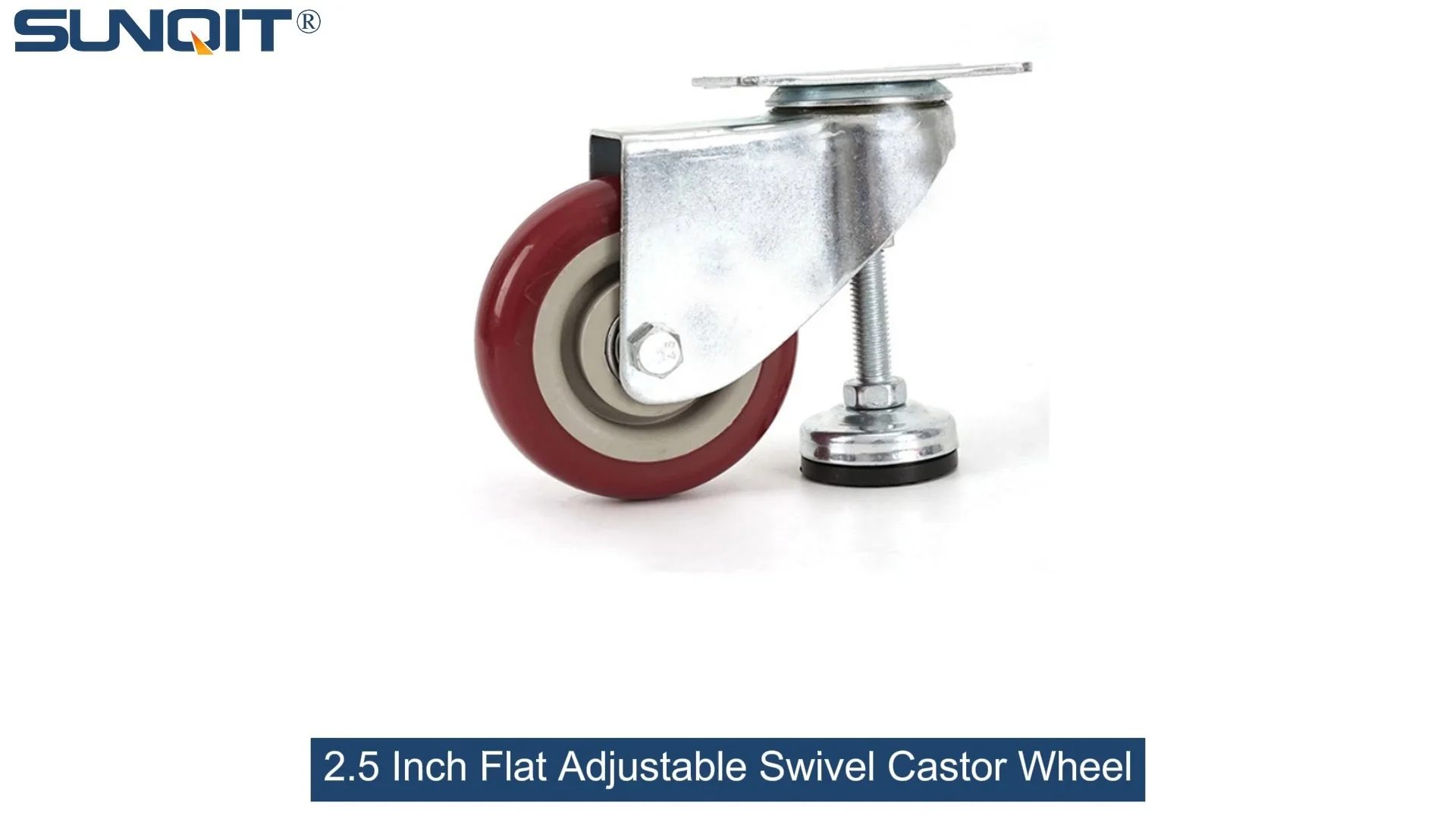
Flat Adjustable Swivel Castor Wheel
Swivel Chair Casters Ball Bearing Wheels Rubber Base with adjustable height function. Resistant to abrasion, impact and corrosion. Heavy payload can hold 80Kgs per pcs,which can make it works at a stable and smooth status.
In the bustling world of manufacturing, warehousing, and workshop operations, every piece of equipment plays a silent but crucial role in keeping the workflow moving. From the largest conveyor systems to the smallest tools, each component contributes to efficiency, safety, and productivity. Among these unsung heroes are castors—those small, wheeled devices that turn static workbenches, trolleys, and racks into mobile assets. But not all castors are created equal. Today, we're shining a spotlight on a game-changer in the industry: the flat adjustable swivel castor wheel. While standard fixed castors have long been a staple, their limitations become glaringly obvious when compared to the versatility and functionality of their adjustable swivel counterparts. Let's dive into why upgrading to flat adjustable swivel castor wheels could be one of the smartest decisions you make for your workspace.
Understanding the Basics: What Are Flat Adjustable Swivel Castor Wheels?
Before we explore their advantages, let's clarify what sets flat adjustable swivel castor wheels apart. Unlike standard fixed castors, which are locked into a single direction (think of a shopping cart wheel that only moves forward and backward), swivel castors feature a rotating joint that allows the wheel to turn 360 degrees. This means the equipment they're attached to can pivot, maneuver, and glide in any direction with minimal effort. Now, add "flat adjustable" to the mix: these castors come with a flat mounting plate for stable attachment and an adjustable height mechanism, often via a threaded stem or a screw, that lets you tweak the height of the wheel to level equipment, compensate for uneven floors, or align with other surfaces. Combine that with the swivel function, and you have a castor that's not just mobile, but adaptable to almost any environment.
To put it simply, imagine a caster wheel that can spin like a top, adjust its height like a telescope, and stay steady like a rock—all while supporting heavy loads. That's the flat adjustable swivel castor wheel in a nutshell. Now, let's compare this to standard fixed castors, which are typically rigid, unidirectional, and non-adjustable. They do the job of moving things in a straight line, but when it comes to navigating tight corners, adapting to uneven terrain, or customizing height for specific tasks, they fall short. It's like comparing a bicycle with training wheels to a mountain bike—both get you from A to B, but one is built for challenges, and the other for simplicity.
Advantage 1: Unmatched Maneuverability in Tight Spaces
One of the most immediate benefits of flat adjustable swivel castor wheels is their superior maneuverability. In busy workshops or warehouses, space is often at a premium. Aisles may be narrow, equipment may be densely packed, and workers need to move tools, materials, or finished products quickly without disrupting the flow. Standard fixed castors, with their fixed direction, turn even simple tasks into a logistical headache. Picture this: you're trying to reposition a heavy lean pipe workbench loaded with components to make room for a new machine. With fixed castors, you'd have to push, pull, and pivot the bench like a refrigerator—zigzagging back and forth, wasting time and energy, and risking damage to the floor or the bench itself. It's frustrating, inefficient, and can even lead to workplace injuries from overexertion.
Enter the flat adjustable swivel castor wheel. Thanks to their 360-degree swivel joint, these castors allow the workbench (or any equipment they're attached to) to glide in any direction with a gentle push. Need to squeeze through a gap between two conveyor systems? No problem—simply rotate the wheel and guide the bench sideways. Want to spin the bench 180 degrees to access the other side? Just a light twist of the handle, and it turns on a dime. This level of agility isn't just about convenience; it's about reclaiming time. Studies have shown that workers spend up to 15% of their day moving equipment—time that could be redirected to more productive tasks if maneuvering were easier. Flat adjustable swivel castor wheels cut that time significantly by reducing the effort and number of steps needed to reposition items.
But maneuverability isn't just about direction—it's also about control. Many flat adjustable swivel castors come with a swivel lock, a simple lever or pedal that locks the wheel into a fixed direction when needed. This means you can switch between "free-spinning mode" for tight spaces and "straight-line mode" for long hauls, giving you the best of both worlds. Standard fixed castors, by contrast, offer no such flexibility—they're either locked in one direction or not, leaving you with no middle ground. Whether you're navigating a crowded production floor or moving a turnover trolley and rack through a warehouse, the ability to toggle between swivel and fixed modes is a game-changer for precision and safety.

Advantage 2: Height Adjustability for Perfect Leveling and Alignment
If maneuverability is the "mobility" advantage, adjustability is the "adaptability" one. Most workspaces aren't perfectly smooth. Concrete floors crack, warehouse surfaces slope, and even newly painted workshops can have uneven patches. Standard fixed castors, which are fixed in height, turn these minor imperfections into major problems. A workbench with fixed castors on an uneven floor will wobble, making it hard to work accurately. A material rack might tilt, risking items sliding off. In extreme cases, uneven weight distribution from unlevel equipment can stress the frame, leading to premature wear or even collapse.
Flat adjustable swivel castor wheels solve this with their height-adjustable design. Let's say you've just installed a new lean pipe workbench in your workshop, but one corner sits slightly higher than the others because the floor dips there. With adjustable castors, you simply grab a wrench, turn the adjustment screw on the problematic castor, and lower it until the bench is perfectly level. No shimming with pieces of wood, no struggling to find a "flat spot"—just precise control over each wheel's height. This isn't just about stability; it's about safety. A level workbench reduces the risk of tools rolling off, materials shifting, or workers straining to compensate for a wobbly surface. It also ensures that equipment like conveyor belts or roller tracks align properly with the workbench, preventing jams or misfeeds in the production line.
Adjustability also shines when you need to align equipment with other surfaces. Imagine you're loading parts from a turnover trolley and rack onto a conveyor. If the trolley sits lower than the conveyor, you have to lift each part, wasting energy and slowing down the process. With adjustable castors, you can raise the trolley's height to match the conveyor exactly, turning a strenuous lifting task into a smooth sliding one. This not only speeds up workflow but also reduces the risk of repetitive strain injuries (RSIs) among workers— a critical benefit in industries where ergonomics is a top priority.
Standard fixed castors offer none of this. Once they're installed, their height is set in stone. If your floor changes (due to settling, repairs, or new installations), your equipment's stability changes with it. Over time, this can lead to costly repairs, decreased productivity, and even safety hazards. Adjustable castors, by contrast, grow with your workspace—adapting to changes instead of fighting against them.

Advantage 3: Versatility Across Applications and Loads
Another key advantage of flat adjustable swivel castor wheels is their versatility. Whether you're outfitting a lightweight workbench in a small workshop or a heavy-duty material rack in a manufacturing plant, there's a flat adjustable swivel castor wheel designed for the job. They come in a range of sizes (from 2-inch wheels for light loads to 8-inch or larger for heavy machinery), materials (rubber for quiet operation, polyurethane for durability, steel for rough surfaces), and load capacities (from 50kg per castor to over 500kg). This means you can mix and match castors to suit different equipment, rather than being stuck with a one-size-fits-all solution.
Take, for example, a workshop that uses both delicate electronic assembly stations and rugged metalworking benches. The electronic station might require non-marking, noise-reducing rubber wheels to avoid damaging sensitive components and keep the workspace quiet. The metalworking bench, on the other hand, needs heavy-duty steel wheels to support the weight of tools and raw materials. Flat adjustable swivel castors come in both varieties, allowing you to customize each workbench's mobility without sacrificing functionality. Standard fixed castors, by contrast, are often limited in load capacity and material options, forcing you to overbuy (and overpay) for heavy-duty castors when you don't need them or underbuy and risk failure with light-duty ones.
This versatility extends to mounting options, too. The "flat" in flat adjustable swivel castor wheels refers to the flat mounting plate, which provides a stable, secure attachment to equipment frames. This plate can be bolted, welded, or clamped onto everything from wooden workbenches to metal racks, making installation straightforward even for those with basic DIY skills. Compare this to some fixed castors, which may require specialized brackets or custom drilling, adding time and cost to the setup process.

Advantage 4: Durability and Longevity That Saves Money
At first glance, flat adjustable swivel castor wheels might seem like a pricier investment than standard fixed castors. It's true—you'll pay more upfront for the swivel mechanism and adjustability features. But when you factor in durability and longevity, they're often the more cost-effective choice in the long run. Here's why: flat adjustable castors are built to withstand the demands of industrial use. Their swivel joints are sealed to keep out dust and debris, preventing jamming. The adjustment mechanisms are made from high-strength materials like hardened steel, resisting stripping or bending even under heavy loads. The wheels themselves are often made from polyurethane, rubber, or steel—materials chosen for their resistance to wear, impact, and chemicals. This means they last longer, require less maintenance, and need to be replaced far less frequently than standard fixed castors, which may use cheaper plastics or thin metal that wears out quickly.
Consider this scenario: A warehouse uses standard fixed castors on its turnover trolley and rack fleet. Within a year, the plastic wheels start cracking from constant use, the fixed joints rust, and the trolleys become hard to push. Replacing all the castors costs hundreds of dollars, not to mention the downtime while the trolleys are out of service. Now, imagine the same warehouse using flat adjustable swivel castors with polyurethane wheels and sealed steel joints. Five years later, those castors are still rolling smoothly, with only minor adjustments needed to keep them level. The initial investment is higher, but the total cost of ownership is far lower.
Durability also translates to safety. A worn-out fixed castor can lock up unexpectedly, causing a trolley to jerk and potentially injure a worker. A cracked wheel might collapse under load, spilling materials or damaging equipment. Flat adjustable swivel castors, with their robust construction, reduce these risks, lowering the chance of workplace accidents and the associated costs (workers' compensation, equipment repair, downtime). In industries where safety is regulated, this alone can make the upgrade worthwhile.
A Side-by-Side Comparison: Swivel vs. Fixed Castors
To truly understand the gap between flat adjustable swivel castor wheels and standard fixed castors, let's put them head-to-head in a comparison table:
| Feature | Flat Adjustable Swivel Castor Wheels | Standard Fixed Castors |
|---|---|---|
| Mobility | 360-degree swivel for omnidirectional movement; can pivot in tight spaces | Fixed direction (forward/backward only); limited maneuverability |
| Height Adjustment | Adjustable height via threaded stem or screw; compensates for uneven floors | Fixed height; cannot adapt to uneven surfaces |
| Load Capacity | High (often 200-1000+ kg per castor); varies by model for versatile use | Limited (often under 200 kg per castor); fewer options for heavy loads |
| Durability | Sealed swivel joints, high-strength materials (steel, polyurethane); long lifespan | Basic construction (plastic, thin metal); prone to wear and rust |
| Applications | Lean pipe workbenches, turnover trolleys, material racks, assembly lines, workshops | Simple carts, static equipment needing occasional straight-line movement |
| Safety | Leveling reduces wobbling; swivel locks prevent unintended movement | Wobbling on uneven floors; risk of tipping or jamming |
Real-World Applications: Where Flat Adjustable Swivel Castors Shine
To bring these advantages to life, let's look at some common scenarios where flat adjustable swivel castor wheels make a tangible difference:
1. Lean Pipe Workbenches in Assembly Lines: Lean manufacturing relies on efficiency, and a wobbly, hard-to-move workbench is the opposite of efficient. A lean pipe workbench with flat adjustable swivel castors can be easily repositioned to align with changing production flows. If a new machine is added, the workbench glides into place. If a worker needs to collaborate with a colleague across the line, it pivots to face the new direction. The height adjustment ensures the bench aligns perfectly with conveyor belts, reducing the need to lift heavy parts. Standard fixed castors would trap the workbench in one spot, forcing workers to walk farther or strain to reach materials.
2. Turnover Trolley and Rack Systems in Warehouses: Warehouses thrive on speed—getting products from storage to shipping quickly. Turnover trolleys loaded with boxes need to navigate narrow aisles, around pallet jacks, and up to loading docks. Flat adjustable swivel castors let workers push these trolleys with one hand, spinning them to avoid obstacles and adjusting heights to match dock levels. Fixed castors would require two workers to maneuver, one pulling and one pushing, wasting labor and slowing down operations.
3. Laboratory and Medical Equipment: In labs, precision is everything. A microscope table or sample cart that wobbles can ruin experiments. Flat adjustable swivel castors allow scientists to level equipment to the millimeter, even on uneven lab floors, while the swivel function lets carts glide silently between workstations without disturbing sensitive equipment. Fixed castors would risk instability and noise, both of which are unacceptable in a lab setting.
Choosing the Right Flat Adjustable Swivel Castor Wheels for Your Needs
Now that you're convinced of the benefits, how do you choose the right flat adjustable swivel castor wheels for your workspace? Start by considering three key factors: load capacity, wheel material, and environment. First, calculate the total weight of the equipment plus the maximum load it will carry, then divide by the number of castors (usually 4-6) to get the required load capacity per castor. It's always smart to overestimate by 20% to account for unexpected weight or impacts. Next, wheel material: polyurethane is ideal for smooth floors (it's quiet and non-marking), rubber for uneven surfaces (it absorbs shocks), and steel for heavy loads or rough terrain (it's tough and heat-resistant). Finally, consider your environment—if you work with chemicals, choose corrosion-resistant materials; if noise is a concern (like in offices or labs), opt for soft rubber or polyurethane wheels.
Don't forget to check the adjustment range, too. Most adjustable castors offer 10-50mm of height adjustment, which is plenty for most floors, but if you have extreme unevenness, look for models with a wider range. And if you need to lock the swivel function, ensure the castor has a reliable swivel lock—preferably a foot-operated one for easy use while moving equipment.
Conclusion: Invest in Mobility, Invest in Productivity
In a world where every second counts, the right tools and equipment can mean the difference between meeting deadlines and falling behind. Flat adjustable swivel castor wheels might seem like a small upgrade, but their impact is anything but minor. They turn static, cumbersome equipment into agile, adaptable assets that move with your workflow, not against it. They level out the bumps in your workspace, literally and figuratively, reducing frustration and improving safety. And they save you money in the long run by lasting longer and requiring less maintenance than standard fixed castors.
Whether you're outfitting a new workshop, upgrading an existing warehouse, or simply looking to make your daily operations smoother, flat adjustable swivel castor wheels are an investment worth making. They're not just caster wheels—they're a tool for efficiency, a safeguard for safety, and a partner in productivity. So the next time you're shopping for castors, don't settle for "good enough." Choose the castor that works as hard as you do: the flat adjustable swivel castor wheel. Your back, your team, and your bottom line will thank you.