- Company Articles
- Products and Technology
- Application Cases
- Aerospace Applications: 3030r EU Standard Aluminum Profile's Lightweight Advantages

Aerospace Applications: 3030r EU Standard Aluminum Profile's Lightweight Advantages
Related Product
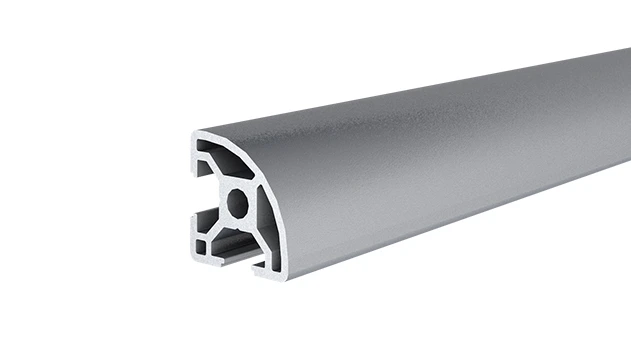
3030R EU Standard Aluminum Profile
3030R is a 3.00 x 3.00CM fractional 30 series square extrusion T-slot profile with four open T-slots, two side with 3.00cm face, the other side with round face. The profile has align-a-grooves to assist in aligning connecting profiles.
Exploring how this innovative material is reshaping aerospace manufacturing and design
The Need for Lightweight Solutions in Aerospace
In the high-stakes world of aerospace engineering, every gram matters. Whether it's a commercial airliner aiming to reduce fuel consumption, a military jet striving for enhanced maneuverability, or a rocket chasing payload efficiency, the weight of components directly impacts performance, cost, and even mission success. For decades, engineers have grappled with the challenge of balancing strength and weight—a dilemma often solved by turning to advanced materials. Among these, aluminum has long been a staple, but recent innovations in aluminum extrusion profiles, particularly the 3030r EU Standard Aluminum Profile, are taking lightweight design to new heights.
Aerospace manufacturing isn't just about building something that flies; it's about building something that flies smarter. Traditional materials like steel, while strong, add unnecessary bulk, increasing fuel costs and limiting payload capacity. Titanium, though lighter than steel, comes with a steep price tag that can inflate production budgets. This is where aluminum extrusion profiles step in, offering a compelling blend of strength, versatility, and most importantly, lightness. And within this category, the 3030r EU Standard Aluminum Profile stands out as a game-changer, thanks to its precise engineering and adaptability to the unique demands of aerospace applications.
Understanding Aluminum Extrusion Profiles: The Backbone of Modern Manufacturing
Before diving into the specifics of the 3030r, it's essential to grasp what makes aluminum extrusion profiles so valuable. Aluminum extrusion is a manufacturing process where raw aluminum is heated and forced through a die, shaping it into complex cross-sectional profiles. This method allows for the creation of custom shapes with consistent dimensions, making it ideal for producing parts that need to be both strong and lightweight. Unlike casting or machining, extrusion minimizes material waste and enables the production of long, continuous lengths—perfect for structural components in aerospace, automotive, and industrial settings.
Aluminum extrusion profiles come in a wide range of sizes and configurations, but what truly sets them apart is their modularity. By combining profiles with compatible accessories—joints, brackets, connectors, and fasteners—engineers can build everything from simple workbenches to intricate structural frames. This modularity is a cornerstone of modern manufacturing, allowing for quick assembly, easy reconfiguration, and cost-effective repairs. In aerospace, where production lines often need to adapt to new aircraft models or component designs, this flexibility is invaluable.
But not all aluminum extrusion profiles are created equal. The EU Standard profiles, including the 3030r, are designed to meet strict quality and performance criteria, ensuring consistency and reliability across applications. These standards cover everything from material composition and mechanical properties to dimensional accuracy, making EU Standard profiles a trusted choice for industries where failure is not an option—like aerospace.

3030r EU Standard Aluminum Profile: Engineering Excellence Defined
The 3030r EU Standard Aluminum Profile is a specific type of extrusion profile characterized by its 30mm x 30mm cross-section and rounded edges (the "r" in its name denotes the radius of these edges). At first glance, its dimensions might seem unassuming, but this profile is a masterclass in efficient design. Let's break down what makes it stand out:
Material Composition
The 3030r is typically made from 6063-T5 aluminum alloy, a popular choice for extrusions due to its excellent combination of strength, corrosion resistance, and formability. This alloy contains magnesium and silicon, which form precipitates during heat treatment, enhancing its mechanical properties. The result is a profile that can withstand the rigors of aerospace manufacturing—from heavy loads on assembly lines to the harsh conditions of aircraft maintenance facilities—without succumbing to wear or corrosion.
Structural Efficiency
The 30mm x 30mm square cross-section is optimized for both strength and weight. The walls of the profile are thick enough to provide rigidity but thin enough to keep weight to a minimum. The rounded edges (r) serve a dual purpose: they reduce stress concentrations, preventing cracks from forming under repeated loads, and they improve safety by eliminating sharp corners—a critical consideration in environments where workers interact with the equipment daily.
Modular Design
Like many aluminum extrusion profiles, the 3030r features T-slots along its length. These slots allow for easy attachment of accessories without the need for drilling or welding. Engineers can slide bolts, nuts, or specialized connectors into the slots, securing components quickly and securely. This not only speeds up assembly but also allows for infinite adjustability—meaning parts can be repositioned with precision, a necessity when aligning aerospace components with tight tolerances.
Compliance and Quality
As an EU Standard profile, the 3030r adheres to strict manufacturing guidelines. This includes rigorous testing for tensile strength, yield strength, and elongation, ensuring it meets the mechanical requirements for aerospace applications. Additionally, EU standards mandate consistent dimensional accuracy, so every 3030r profile is virtually identical—critical for ensuring that assemblies fit together perfectly, whether they're built in a factory in Germany or a facility in France.
Lightweight Advantage: The Core of Aerospace Innovation
At the heart of the 3030r's appeal in aerospace is its lightweight nature. Let's quantify this: aluminum has a density of approximately 2.7 g/cm³, compared to steel's 7.8 g/cm³ and titanium's 4.5 g/cm³. This means that a 3030r profile of the same length and wall thickness as a steel profile would weigh roughly 65% less. In aerospace, where every kilogram saved translates to significant fuel savings or increased payload capacity, this difference is transformative.
Fuel Efficiency in Commercial Aviation
For commercial airlines, fuel is one of the largest operational costs. A single wide-body aircraft can burn over 5,000 gallons of fuel per hour, so reducing weight directly impacts the bottom line. While the 3030r is primarily used in manufacturing and ground support equipment (rather than the aircraft itself), its lightweight properties still play a role. For example, assembly workbenches made from 3030r are easier to move, reducing the energy required to reconfigure production lines. Material handling systems, like flow racks built with 3030r profiles, can carry more components without adding excessive weight to the factory floor, allowing for more efficient movement of parts.
Payload Capacity in Space Exploration
In space exploration, every gram counts. Rockets have strict payload limits, and even small weight savings can mean the difference between launching a satellite with additional instruments or leaving critical equipment behind. While the 3030r isn't used in rocket structures, it's invaluable in the manufacturing of satellite components and rocket assemblies. Workbenches and test fixtures made from 3030r are lightweight enough to be integrated into cleanrooms and assembly facilities with weight restrictions, ensuring that the production process itself doesn't become a barrier to innovation.
Structural Integrity Without Compromise
Critics might argue that lighter materials sacrifice strength, but the 3030r disproves this. Thanks to its alloy composition and engineered cross-section, it offers an impressive strength-to-weight ratio. In aerospace manufacturing, this means that workbenches built with 3030r can support heavy aircraft components—like engine parts or landing gear—without bending or warping. Material racks constructed from 3030r can hold thousands of pounds of avionics equipment, ensuring that parts are stored safely and securely until they're needed on the assembly line.
| Material | Density (g/cm³) | Tensile Strength (MPa) | Weight (per meter, 30x30mm profile) | Corrosion Resistance | Cost (Relative) |
|---|---|---|---|---|---|
| 3030r Aluminum (6063-T5) | 2.7 | 180-220 | ~0.8 kg | Excellent | Moderate |
| Mild Steel | 7.8 | 370-460 | ~2.3 kg | Poor (requires coating) | Low |
| Titanium (Grade 5) | 4.5 | 895-930 | ~1.3 kg | Excellent | Very High |
The table above compares the 3030r aluminum profile with traditional materials, highlighting its in weight and corrosion resistance while maintaining competitive strength. For aerospace applications, where corrosion resistance is critical (especially in coastal manufacturing facilities near saltwater), the 3030r's natural resistance to rust and oxidation is a significant advantage over steel, which requires additional coatings to prevent deterioration.
Aerospace Applications: Where 3030r Shines
Now that we've explored the 3030r's properties, let's look at how it's actually used in aerospace. Its versatility means it finds applications across multiple areas of manufacturing and ground support:
Assembly Workbenches
Aerospace assembly lines rely on sturdy, flexible workbenches to hold components during production. Workbenches made with 3030r profiles are ideal for this. They can be customized with tool holders, LED lighting, and ESD (electrostatic discharge) protection—critical for handling sensitive avionics. The modular design allows for easy adjustment of height and width, ensuring that workers can operate comfortably, reducing fatigue and improving productivity. Additionally, the lightweight nature of the 3030r makes it possible to add casters to the workbenches, allowing them to be moved around the factory floor as needed.
Material Flow Racks
Efficient material handling is essential in aerospace manufacturing, where parts must be delivered to the assembly line exactly when needed. Flow racks built with 3030r profiles and roller tracks (another key accessory) allow components to slide smoothly from storage to the workstation, reducing the need for manual lifting. The lightweight design of the 3030r means these racks can be mounted on mobile bases, making it easy to reposition them as production schedules change. For example, a flow rack holding rivets or fasteners can be moved alongside an aircraft fuselage assembly, ensuring that workers have constant access to the parts they need.
Test Fixtures and Jigs
Before aircraft components are installed, they undergo rigorous testing. Test fixtures and jigs—tools used to hold parts in place during testing—must be precise and stable. The 3030r's dimensional accuracy and rigidity make it an excellent choice for these applications. Engineers can design custom fixtures by combining 3030r profiles with aluminum profile accessories like corner brackets and adjustable feet, ensuring that parts are held in exactly the right position. The modularity of the system also means that fixtures can be reconfigured for different component models, reducing the need to build new fixtures from scratch.
Cleanroom Infrastructure
Many aerospace components, such as semiconductors for avionics or optical systems for satellites, require assembly in cleanrooms with strict contamination controls. The 3030r's smooth surfaces and corrosion resistance make it suitable for cleanroom environments. Racks and workstations built with 3030r can be easily cleaned and sanitized, ensuring that they don't introduce particles into the air. The lightweight design also means they can be installed in cleanrooms with weight restrictions, where heavier materials would be prohibitive.
Aluminum Profile Accessories: Enhancing the 3030r's Capabilities
The 3030r's functionality is greatly enhanced by a range of aluminum profile accessories. These include:
- Joints and Connectors: These allow 3030r profiles to be joined at various angles (90°, 45°, 135°), enabling the construction of complex structures. Internal and external rotatory joints add flexibility, allowing parts of the assembly to pivot or rotate.
- Roller Tracks: When paired with 3030r profiles, roller tracks transform static racks into dynamic flow systems. These tracks, often made from plastic or aluminum, allow materials to move smoothly, reducing friction and manual labor.
- Adjustable Feet and Casters: Feet provide stability for stationary structures, while casters add mobility. Both are essential for workbenches and flow racks, allowing them to be anchored in place or moved as needed.
- Panels and Covers: Aluminum honeycomb panels or acrylic covers can be attached to 3030r frames to create enclosures, protecting sensitive components from dust or damage.
These accessories are designed to work seamlessly with the 3030r, ensuring that the entire system is strong, reliable, and easy to assemble. For example, a 90° aluminum profile connector can join two 3030r profiles in seconds, requiring only a hex key—no welding or drilling needed. This speed of assembly is a major advantage in aerospace manufacturing, where production timelines are often tight.
Lean System Integration: Reducing Waste, Increasing Efficiency
Aerospace manufacturing is increasingly adopting lean principles, which focus on minimizing waste and maximizing value. The 3030r EU Standard Aluminum Profile aligns perfectly with these principles, thanks to its modularity and adaptability.
Lean manufacturing emphasizes the elimination of seven types of waste: overproduction, waiting, transportation, overprocessing, inventory, motion, and defects. The 3030r helps address several of these:
- Transportation Waste: Lightweight workbenches and flow racks are easier to move, reducing the time and energy spent transporting equipment.
- Motion Waste: Customizable workbenches and flow racks position tools and materials within easy reach of workers, reducing unnecessary movement.
- Inventory Waste: Modular flow racks allow for just-in-time delivery of parts, ensuring that inventory levels are kept low without risking stockouts.
- Defects: The precision of the 3030r and its accessories ensures that assemblies are accurate, reducing the likelihood of defects that require rework.
By integrating 3030r profiles into lean systems, aerospace manufacturers can create more efficient, responsive production lines. For example, a lean cell built with 3030r profiles can be reconfigured in hours to accommodate a new component design, whereas a traditional steel-based cell might take days or weeks to modify. This agility is key in an industry where innovation cycles are constantly accelerating.
Challenges and Solutions: Making the Most of 3030r
While the 3030r offers numerous advantages, it's not without challenges. Here are some common concerns and how they're addressed:
Cost Compared to Steel
Aluminum profiles are generally more expensive than steel on a per-kilogram basis. However, this higher upfront cost is offset by lower installation and maintenance costs. Steel requires welding, which is labor-intensive and expensive, while 3030r assemblies can be put together by workers with minimal training. Additionally, aluminum's corrosion resistance means less frequent replacement, reducing long-term costs.
Compatibility with Other Materials
Aerospace manufacturing often uses a mix of materials, including steel, titanium, and composites. The 3030r can be integrated with these materials using specialized connectors and adapters. For example, steel brackets can be attached to 3030r profiles using T-slot nuts, ensuring a secure connection without galvanic corrosion (a common issue when dissimilar metals are joined).
Load Capacity for Extreme Applications
While the 3030r is strong, it may not be suitable for extremely heavy loads (e.g., supporting an entire aircraft wing). In these cases, larger aluminum profiles (like 4080 or 5050) can be used, or the 3030r can be reinforced with cross-bracing or thicker-walled profiles.
The Future of 3030r in Aerospace
As aerospace continues to push the boundaries of innovation—with electric aircraft, reusable rockets, and hypersonic travel on the horizon—the demand for lightweight, flexible manufacturing solutions will only grow. The 3030r EU Standard Aluminum Profile is well-positioned to meet this demand. Its modular design aligns with the industry's shift toward agile production, and its lightweight properties support the push for more efficient aircraft and launch vehicles.
Looking ahead, we can expect to see advancements in the 3030r's material science, with new alloys offering even better strength-to-weight ratios. We may also see increased integration with smart manufacturing technologies, such as sensors embedded in the profiles to monitor load stress or temperature in real time. Additionally, as sustainability becomes a greater priority, the 3030r's recyclability (aluminum is 100% recyclable with no loss of quality) will make it an even more attractive choice for eco-conscious aerospace companies.
Conclusion: A Lightweight Revolution in Aerospace
The 3030r EU Standard Aluminum Profile may seem like a simple component, but its impact on aerospace manufacturing is profound. By combining lightweight design, modularity, and strength, it enables manufacturers to build more efficient, flexible, and cost-effective production systems. From assembly workbenches to material flow racks, it's a versatile solution that addresses the unique challenges of aerospace—where every gram saved and every second optimized can lead to groundbreaking advancements.
As the aerospace industry continues to evolve, the 3030r will undoubtedly play a key role in shaping its future. It's a testament to how innovative materials can transform not just what we build, but how we build it—proving that sometimes, the smallest components can make the biggest difference.