- Company Articles
- Products and Technology
- Application Cases
- Aluminum Profile 3 Way Connector Applications in Mechanical Engineering

Aluminum Profile 3 Way Connector Applications in Mechanical Engineering
Related Product
Aluminum Profile 3 Way Connector
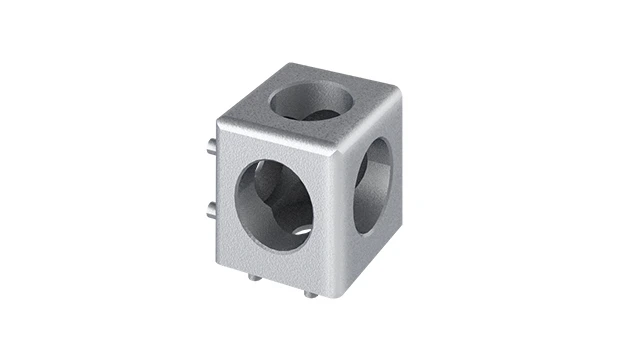
The 3 way - squared corner connector is an external fastening method that is typically used to create a corner connection between three profiles. It is a heavy-duty connection that is simple to use and provides a polished look.
Walk into any modern manufacturing facility, and you'll likely notice a common thread: sleek, modular structures that seem to adapt and evolve with the needs of the production line. From workbenches where technicians assemble delicate components to material racks stacked with inventory, these setups aren't just built for looks—they're engineered for efficiency. At the heart of this flexibility lies a humble yet powerful component: the aluminum profile 3 way connector. Often overlooked, this small piece plays a giant role in turning rigid metal frames into dynamic, customizable systems that drive today's mechanical engineering projects. Let's dive into how these connectors work, why they matter, and the countless ways they're shaping the future of manufacturing.
Understanding Aluminum Profile 3 Way Connectors: More Than Just a "Joint"
First, let's clarify what we're talking about. Aluminum profiles—those extruded, T-slot aluminum beams you see in workshops and factories—are the building blocks of modular systems. They're lightweight, strong, and designed to be easily modified. But profiles alone are just pieces of metal; it's the connectors that bring them to life. And among the many types of connectors, the 3 way connector stands out for its unique ability to link three profiles at once, creating sturdy, multi-directional joints.
Think of it like a three-armed puzzle piece. A typical aluminum profile 3 way connector has three openings, each sized to fit standard aluminum profiles (like 2020, 3030, or 4040 series). These openings are often threaded or fitted with set screws, allowing them to clamp tightly onto the profiles without welding or drilling. Made from durable aluminum or steel, they're built to handle the vibrations, weight, and wear of daily industrial use. What makes them special? Unlike a simple T-joint (which connects two profiles in a "T" shape) or a 90° corner connector (which links two profiles at a right angle), the 3 way connector adds a third dimension. Suddenly, you're not just building a flat frame—you're creating a structure with depth, support, and the ability to branch out in multiple directions.
Why Mechanical Engineers Swear By Them: Key Benefits
To understand their popularity, let's break down the advantages that make 3 way connectors a staple in mechanical engineering:
1. Versatility: One Connector, Endless Designs
In mechanical engineering, no two projects are the same. A workbench for electronics assembly needs to be low and stable, while a material rack for heavy parts requires height and load-bearing strength. 3 way connectors adapt to both. Need to build a corner with a shelf? Use two connectors to join vertical, horizontal, and shelf profiles. Want to add a diagonal brace for extra stability? The third arm of the connector can anchor the brace without extra hardware. This flexibility means engineers don't need to stock dozens of specialized parts—just a handful of 3 way connectors and profiles can solve most framing challenges.
2. Speed: From Blueprint to Build in Hours (Not Days)
Traditional manufacturing setups often involve welding, drilling, or custom fabrication—processes that take time and skilled labor. 3 way connectors eliminate that. With a hex key and a few minutes, a technician can assemble a sturdy frame. This speed is a game-changer for prototyping, repairs, or facility reconfigurations. Imagine a factory needing to shift production lines to meet a sudden order: instead of waiting for a welder, the team can disassemble the old setup and rebuild with connectors in a fraction of the time.
3. Reusability: Reduce Waste, Cut Costs
Mechanical engineering isn't just about building—it's about building smart. In an industry pushing for sustainability, 3 way connectors shine. Unlike welded frames, which are permanent and often end up in landfills when outdated, modular systems with connectors can be taken apart, reconfigured, and reused. A workbench that's no longer needed? Disassemble it and use the profiles and connectors to build a material rack. This not only reduces waste but also lowers long-term costs, making it a favorite for small businesses and large manufacturers alike.
4. Strength: Don't Let Their Size Fool You
You might think a small connector can't handle heavy loads, but that's far from the truth. High-quality 3 way connectors, paired with thick-walled aluminum profiles, can support hundreds of pounds. Take the 4040 aluminum profile series, for example—when joined with a steel 3 way connector, it can easily hold the weight of toolboxes, machinery, or stacked inventory. Engineers test these connectors rigorously, ensuring they withstand not just static loads but also the dynamic stress of moving parts, vibrations from equipment, and daily wear and tear.

Applications in Mechanical Engineering: Where 3 Way Connectors Shine
Now, let's get practical. Where exactly are these connectors making a difference? From the factory floor to the lab, their applications are as diverse as the projects they support. Here are some of the most common (and innovative) uses:
Building Custom Workbenches: The Heart of the Workshop
Every workshop needs a reliable workbench, but "reliable" means different things to different teams. A mechanic might need a bench with tool hooks and a vice, while an electronics technician requires a static-free surface (like an ESD workbench) with built-in cable management. 3 way connectors make it easy to tailor these setups.
Consider a workbench e (single deck-without caster) —a simple, stationary bench often used in assembly lines. To build this, engineers start with four vertical aluminum profiles for legs. At the top, 3 way connectors join the front, back, and side profiles, creating a rectangular frame. Then, a shelf halfway up? Add two more horizontal profiles, secured with 3 way connectors that attach to the legs and the shelf supports. Want to add a tool rack on the side? Use a 3 way connector to branch off from the leg, adding a horizontal profile for hanging tools. The result? A bench that's sturdy enough for heavy work but easy to modify if the team needs extra shelves or a different height later.
Material Racks: Organizing Inventory Without the Headache
In warehouses and factories, keeping materials organized is half the battle. A disorganized rack means wasted time searching for parts, while a flimsy one risks damage (or worse, accidents). 3 way connectors are the secret to building racks that are both strong and adaptable—like the material rack b (3 row and 3 floor) , a common setup for storing small to medium parts.
Let's visualize this: A material rack with three vertical columns on each side. Between these columns, horizontal profiles form three rows (front, middle, back) and three floors (top, middle, bottom). To connect the vertical columns to the horizontal rows, 3 way connectors are used at each intersection. For example, a vertical column might have a 3 way connector at the 3-foot mark, attaching to the front horizontal profile, the middle horizontal profile, and the vertical column itself. This creates a grid-like structure that's stable even when loaded with boxes or bins. And if the team starts storing taller items? Simply remove the middle floor's profiles and connectors, and suddenly you have two taller floors instead of three. No need to buy a new rack—just reconfigure the existing one.
Production Line Support Structures: Keeping Things Moving
Modern production lines are a symphony of moving parts—conveyors, robotic arms, sensors, and workers all collaborating to build products. Behind the scenes, aluminum profiles and 3 way connectors are the stage that holds this symphony together. They're used to build guardrails around machinery, support frames for conveyor belts, and even mounting brackets for sensors and lights.
Take a roller conveyor system, for instance. The conveyor belt needs to be supported at a precise height, with side rails to keep parts from falling off. Engineers use 3 way connectors to build the frame: vertical legs support horizontal profiles that hold the conveyor, while additional profiles (attached via 3 way connectors) form the side rails. If the conveyor needs to be raised or lowered, the connectors make it easy to adjust the leg height. Or, if a new robotic arm is added to the line, 3 way connectors can quickly extend the support frame to mount the arm, ensuring it's positioned exactly where it needs to be.
Lean Manufacturing Systems: Reducing Waste, Boosting Efficiency
Lean manufacturing is all about eliminating waste—whether it's time, materials, or space. 3 way connectors align perfectly with this philosophy by enabling "just-in-time" setups. Instead of building permanent structures that take up space when not in use, teams can create temporary workstations, mobile carts, or storage racks that can be disassembled when the project ends.
For example, during a short-term production run, a team might need an extra assembly station. Using 3 way connectors, they can build a lightweight but sturdy cart with a work surface, tool hooks, and storage bins—all in a few hours. When the run is over, the cart is taken apart, and the profiles and connectors are stored for the next project. No waste, no clutter, just efficient use of resources.

How 3 Way Connectors Compare to Other Connector Types
To truly appreciate 3 way connectors, it helps to see how they stack up against other common connectors. Let's compare them in a quick table:
| Connector Type | Connection Points | Best For | Assembly Time | Reusability |
|---|---|---|---|---|
| Aluminum Profile 3 Way Connector | 3 profiles (multi-directional) | Workbenches, material racks, 3D frames | 5-10 minutes (with set screws) | High (easily disassembled/reused) |
| 90° Aluminum Profile Connector | 2 profiles (right angle) | Corner joints, simple frames | 3-5 minutes | High |
| T-Joint Connector | 2 profiles (T-shape) | Shelves, single-branch extensions | 3-5 minutes | High |
| 45° Reinforce Aluminum Pipe Joint | 2 profiles (45° angle) | Diagonal braces, sloped surfaces | 5-7 minutes | Medium (may require repositioning) |
As you can see, 3 way connectors aren't the fastest to assemble, but their ability to connect three profiles at once makes them irreplaceable for complex structures. They're the Swiss Army knife of connectors—versatile, reliable, and ready for whatever the project throws at them.
Custom Machinery Frames: Building the "Oddly Shaped" Stuff
Not all mechanical engineering projects involve standard workbenches or racks. Sometimes, teams need to build custom machinery—like a test rig for a new engine part or a prototype assembly station for a unique product. These projects often require "odd" shapes: frames with angles, curves, or unexpected branches. 3 way connectors thrive here.
Imagine building a frame for a small conveyor that needs to turn 90° halfway through. The straight sections are easy with T-joints, but the turn requires a more complex structure. Engineers can use 3 way connectors to create a triangular support at the corner, connecting the incoming conveyor, the outgoing conveyor, and a diagonal brace for stability. Or, for a test rig that needs to hold a part at multiple angles, 3 way connectors allow the frame to branch out in three directions, each holding a clamp or sensor. The beauty is that if the test design changes, the connectors make it easy to adjust the frame—no need to start from scratch.
Choosing the Right 3 Way Connector: Tips for Engineers
Not all 3 way connectors are created equal. To get the most out of them, engineers need to consider a few key factors:
- Profile Size: Connectors are designed for specific profile sizes. A 2020 profile needs a 20mm connector, while a 4040 profile requires a 40mm one. Mixing sizes will lead to loose joints and instability.
- Load Capacity: Check the connector's load rating. A plastic connector might work for light shelves, but heavy machinery needs steel or thick aluminum connectors.
- Environment: Will the connector be exposed to moisture, chemicals, or extreme temperatures? Look for corrosion-resistant options (like anodized aluminum) for harsh environments.
- Accessories: Some connectors work with additional aluminum profile accessories like end caps, gaskets, or locking nuts. These can add stability or protect against sharp edges.
The Future of 3 Way Connectors: Innovations on the Horizon
As mechanical engineering evolves, so too do the tools that drive it. 3 way connectors are no exception. Manufacturers are experimenting with new materials, like carbon fiber-reinforced plastics, to make connectors even lighter without sacrificing strength. Others are adding quick-release mechanisms, allowing for tool-free assembly and disassembly—perfect for teams that need to reconfigure setups multiple times a day.
There's also a trend toward smarter connectors. Imagine a 3 way connector with built-in sensors that monitor temperature, vibration, or load—alerting the team if a joint is loosening or a rack is overloaded. While this is still in the prototype stage, it's a sign of how connectors could become integral to the "smart factories" of the future.
Conclusion: The Unsung Hero of Modular Manufacturing
Aluminum profile 3 way connectors might not get the same attention as high-tech robots or cutting-edge software, but they're the unsung heroes of modern mechanical engineering. They turn static frames into dynamic systems, reduce waste, save time, and give teams the freedom to innovate without being limited by rigid structures. Whether it's building a simple workbench, a complex material rack, or a custom production line, these small but mighty connectors are proof that sometimes, the most important innovations are the ones that hold everything together.
So the next time you walk through a factory or workshop, take a closer look at those aluminum frames. Chances are, you'll spot a 3 way connector—and now you'll know just how much work it's doing behind the scenes. In a world where flexibility and efficiency are everything, these connectors aren't just parts—they're the backbone of the future of manufacturing.