- Company Articles
- Products and Technology
- Product knowledge
- Aluminum Profile 3 Way Connector Compatibility with Different Profile Sizes

Aluminum Profile 3 Way Connector Compatibility with Different Profile Sizes
Related Product
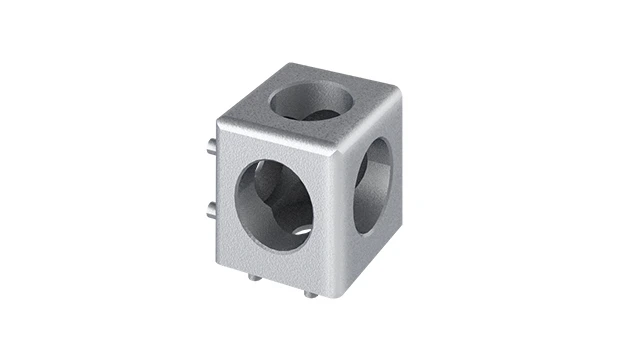
Aluminum Profile 3 Way Connector
The 3 way - squared corner connector is an external fastening method that is typically used to create a corner connection between three profiles. It is a heavy-duty connection that is simple to use and provides a polished look.
Introduction: The Backbone of Modern Manufacturing
In the world of manufacturing, assembly lines, and industrial workspaces, aluminum profiles have quietly become the unsung heroes. These versatile, lightweight structures form the skeleton of everything from workbenches and material racks to automated machinery guards and production cells. But what truly brings these aluminum extrusion profiles to life—turning simple tubes into functional, customizable systems—is the humble connector. Among the many types of connectors, the aluminum profile 3 way connector stands out for its ability to create branching structures, enabling designers to build multi-directional frameworks with ease.
Whether you're a small workshop owner building a custom workstation or an engineer designing a large-scale production line, understanding how 3 way connectors interact with different aluminum profile sizes is critical. A mismatched connector can lead to wobbly structures, safety hazards, or costly rework. In this article, we'll dive deep into the world of aluminum profiles, explore the nuances of 3 way connectors, and break down their compatibility with the most common profile sizes used today. We'll also touch on how aluminum profile accessories like end caps play a supporting role in ensuring a seamless, durable build.
Understanding Aluminum Profile Sizes: More Than Just Numbers
Aluminum profiles are defined by their cross-sectional dimensions, typically expressed as width x height in millimeters. For example, a 2020 profile measures 20mm by 20mm, while a 4080 profile is 40mm wide and 80mm tall. But these numbers aren't arbitrary—they're carefully engineered to balance strength, weight, and functionality for specific applications. Let's take a closer look at the most widely used sizes:
- 2020 Aluminum Profiles: Compact and lightweight, these are ideal for small-scale projects like electronics workbenches, display stands, or lightweight machine guards. Their narrow T-slots (the grooves running along the length) make them perfect for tight spaces.
- 3030 Aluminum Profiles: A step up in size, 3030 profiles strike a balance between strength and versatility. They're commonly found in medium-duty workbenches, shelving units, and automated guided vehicle (AGV) frames. Their larger T-slots accommodate more robust fasteners.
- 4040 Aluminum Profiles: The workhorse of industrial settings, 4040 profiles are used in heavy-duty workbenches, conveyor supports, and production line structures. Their thicker walls and wider T-slots handle higher loads, making them a favorite for manufacturing environments.
- 4080 Aluminum Profiles: Designed for large-scale applications, 4080 profiles are often used in machine bases, large material racks, and structural frameworks. Their increased height provides extra rigidity for supporting heavy machinery or long spans.
Each size has its own unique T-slot dimensions, wall thickness, and load-bearing capacity—factors that directly impact which 3 way connectors will work with them. Understanding these differences is the first step in ensuring compatibility.

What Is an Aluminum Profile 3 Way Connector?
At its core, an aluminum profile 3 way connector is a hardware component designed to join three aluminum profiles at a single junction, typically at 90-degree angles (though some can be adjusted for other angles). Think of it as the "cornerstone" of a three-branched structure, like the legs of a workbench or the intersecting beams of a material rack.
These connectors come in various designs, but most share a few key features: a central body with three arms (or ports) that fit into the T-slots of the profiles, and fastening mechanisms (like set screws or bolts) that secure the connector to the profiles. Some are "internal" connectors, meaning they fit inside the profile's T-slot, while others are "external," clamping around the outside of the profile. Materials range from aluminum (for lightweight, corrosion-resistant applications) to steel (for maximum strength).
The design of a 3 way connector is (precise)—every millimeter of its dimensions is engineered to match specific profile sizes. A connector made for a 2020 profile, for example, will have narrower arms and smaller set screws than one designed for a 4040 profile. This precision is what makes compatibility so crucial: even a slight mismatch in size can lead to a loose connection or, worse, a failed structure.

Key Compatibility Factors: What Makes a Connector "Fit"?
Compatibility between a 3 way connector and an aluminum profile isn't just about "does it physically fit?" It's about ensuring a secure, stable connection that can withstand the stresses of daily use. Here are the critical factors that determine compatibility:
T-Slot Dimensions
The T-slot—the groove running along the length of the profile—is where the connector's arms or fasteners sit. T-slots are defined by their width and depth. For example, a 2020 profile might have a T-slot width of 6mm, while a 4040 profile could have an 8mm or 10mm slot. A connector's arms must match this width exactly to create a tight fit; too narrow, and it will slide around; too wide, and it won't fit at all.
Profile Wall Thickness
Thicker-walled profiles (common in 4040 and 4080 sizes) require connectors with longer set screws or bolts to reach through the T-slot and grip the profile securely. A connector with short screws might not fully engage with a thick-walled profile, leading to a loose connection.
Connector Material
Most connectors are made from aluminum or steel. Aluminum connectors are lightweight and corrosion-resistant, making them ideal for 2020 or 3030 profiles in dry environments. Steel connectors, on the other hand, offer higher strength for 4040 or 4080 profiles in heavy-duty applications. Mixing materials (e.g., a steel connector with a thin-walled aluminum profile) can cause issues like galvanic corrosion if not properly insulated.
Load-Bearing Capacity
Even if a connector physically fits a profile, it must also match the profile's load-bearing capacity. A small aluminum connector might fit a 4040 profile, but it won't be able to support the weight that the profile itself can handle, leading to premature failure.
Compatibility with Specific Profile Sizes: A Closer Look
Now that we understand the factors driving compatibility, let's explore how 3 way connectors work with the most common aluminum profile sizes. We'll break down each size, discuss the challenges and solutions, and even touch on how aluminum profile accessories like end caps can enhance the final assembly.
1. 2020 Aluminum Profiles
2020 profiles are the smallest and most lightweight of the common sizes, often used in DIY projects, small workbenches, or electronics assembly stations. Their T-slots are typically 6mm wide, with wall thicknesses around 1.5mm to 2mm. For these profiles, 3 way connectors must be compact to fit within the narrow T-slot.
Most 2020-compatible 3 way connectors are internal, with small aluminum or plastic bodies and M3 or M4 set screws. They're designed to be unobtrusive, allowing for clean, minimalist structures. One common challenge with 2020 profiles is ensuring the connector doesn't add too much weight; plastic connectors are a popular choice here for their lightweight properties. When assembling with 2020 profiles, it's also common to use 2020 aluminum profile end caps to cover exposed ends, preventing snags and giving the structure a polished look.
2. 3030 Aluminum Profiles
3030 profiles are a step up in size, with T-slot widths of 8mm and wall thicknesses of 2mm to 3mm. They're used in medium-duty applications like shelving, small conveyor supports, and workbench frames. For these profiles, 3 way connectors are slightly larger, with beefier arms and M5 or M6 set screws.
Many 3030-compatible 3 way connectors are external, clamping around the outside of the profile for added stability. Internal connectors are also available, fitting snugly into the T-slot. A key consideration here is ensuring the connector's arms are long enough to reach through the profile's wall thickness—too short, and the set screw won't bite into the profile, leading to a loose connection. After assembly, adding 3030 aluminum profile end caps not only protects the ends of the profiles but also helps distribute stress at the connector junctions, improving overall durability.
3. 4040 Aluminum Profiles
4040 profiles are the heavyweights of the standard sizes, with T-slot widths of 8mm to 10mm and wall thicknesses up to 4mm. They're used in industrial workbenches, production line supports, and machine bases—applications where strength and rigidity are non-negotiable. 3 way connectors for 4040 profiles are built to match this robustness.
These connectors are often made of steel or thick aluminum, with large arms and M6 or M8 set screws. Some feature "reinforced" designs, with extra material around the central body to prevent bending under load. External clamping connectors are common here, as they can exert more force on the profile, creating a tighter bond. When working with 4040 profiles, it's also important to consider the 4040 aluminum profile end cap: these accessories not only finish the profile but can also protect the T-slot from debris, ensuring the connector remains secure over time.
4. 4080 Aluminum Profiles
4080 profiles are the largest of the common sizes, with T-slot widths of 10mm to 12mm and wall thicknesses up to 5mm. They're used in large-scale applications like machine bases, heavy material racks, and structural frameworks. For these profiles, 3 way connectors are specialized, designed to handle the high loads and stresses of industrial use.
4080-compatible 3 way connectors are almost always steel, with massive arms and M8 or M10 set screws. Some even use bolts instead of set screws for maximum clamping force. Due to the profile's height (80mm), these connectors often have extended arms to reach the T-slots on the vertical sides. Compatibility here is less about size and more about strength—using a connector rated for 4040 profiles on a 4080 structure is a recipe for failure, even if it physically fits.
| Profile Size | Typical T-Slot Width | Wall Thickness | Common Connector Type | Set Screw Size | Recommended Accessories |
|---|---|---|---|---|---|
| 2020 | 6mm | 1.5-2mm | Internal (aluminum/plastic) | M3/M4 | 2020 aluminum profile end cap |
| 3030 | 8mm | 2-3mm | Internal/external (aluminum) | M5/M6 | 3030 aluminum profile end cap |
| 4040 | 8-10mm | 3-4mm | External (steel/aluminum) | M6/M8 | 4040 aluminum profile end cap |
| 4080 | 10-12mm | 4-5mm | Heavy-duty external (steel) | M8/M10 | Heavy-duty end caps |
Common Compatibility Issues and How to Solve Them
Even with careful planning, compatibility issues can arise when working with 3 way connectors and aluminum profiles. Here are some of the most common problems and their solutions:
Loose Connections
A loose connection is often caused by a mismatch between the connector's set screw size and the profile's wall thickness. For example, using an M5 set screw with a 3mm wall thickness might not provide enough bite. The solution? Always check the connector's specifications to ensure the set screw length matches the profile's wall thickness. If the connection still feels loose, applying a small amount of thread locker to the set screw can help prevent it from vibrating loose over time.
Misalignment
Misalignment occurs when the connector's arms don't line up with the profile's T-slots, making it impossible to insert the connector properly. This is usually due to using a connector designed for a different profile size (e.g., a 3030 connector on a 4040 profile). To avoid this, double-check the connector's product description to ensure it's rated for your specific profile size. Many manufacturers label connectors with compatible profile sizes (e.g., "For 4040 Profiles") for clarity.
Material Mismatch
Using a steel connector with an aluminum profile can lead to galvanic corrosion, especially in humid or wet environments. When two dissimilar metals are in contact, an electrochemical reaction occurs, eating away at the aluminum. To prevent this, choose aluminum connectors for aluminum profiles, or use plastic washers to insulate steel connectors from the aluminum.
Overloading
Even if a connector fits a profile, it might not be rated for the load you're placing on it. A 2020 connector, for example, can't support the same weight as a 4040 connector, even if it's physically compatible with a 4040 profile. Always check the connector's load rating and ensure it matches or exceeds the expected load of your structure.
The Role of Aluminum Profile Accessories
While 3 way connectors are the stars of the show when it comes to joining profiles, aluminum profile accessories play a supporting role in ensuring compatibility and durability. End caps, for example, are small but mighty—they protect the ends of profiles from damage, prevent debris from entering T-slots (which can interfere with connector fit), and even add a finished look to the structure.
Take the 3030 aluminum profile end cap: designed to snap into the end of a 3030 profile, it covers the exposed T-slot and prevents sharp edges from causing injury. Similarly, the 4040 aluminum profile end cap is thicker and more robust, matching the heavy-duty nature of 4040 profiles. By keeping T-slots clean and profiles protected, end caps help maintain the integrity of the connector connection over time.
Other accessories, like angle brackets and gussets, can reinforce 3 way connector junctions, especially in high-load applications. While not directly related to compatibility, these accessories enhance the overall strength of the structure, ensuring the connectors can perform as intended.
Best Practices for Ensuring Compatibility
To ensure your 3 way connectors work seamlessly with your aluminum profiles, follow these best practices:
- Stick to One Brand (When Possible): Different manufacturers may have slight variations in profile dimensions (e.g., T-slot width). Using connectors from the same brand as your profiles reduces the risk of compatibility issues.
- Read the Fine Print: Always check the connector's product specifications for compatible profile sizes, load ratings, and material compatibility.
- Test Before Building: If you're unsure about compatibility, test the connector with a single profile before assembling your entire structure. This saves time and money in the long run.
- Use the Right Tools: Over-tightening set screws can strip the T-slot or damage the connector, while under-tightening leads to loose connections. Use a torque wrench to ensure set screws are tightened to the manufacturer's recommended torque.
- Invest in Quality: Cheap, generic connectors may not meet the same precision standards as name-brand options, increasing the risk of compatibility issues. It's worth spending a little more for reliable hardware.
Conclusion: Building Better Structures with Compatibility in Mind
Aluminum profiles and 3 way connectors are the building blocks of modern manufacturing and industrial design, offering endless possibilities for customization and innovation. But to unlock their full potential, compatibility between these components is non-negotiable. From the compact 2020 profile to the heavy-duty 4080, each size requires a connector tailored to its unique dimensions and load-bearing needs.
By understanding the key factors of compatibility—T-slot dimensions, wall thickness, material, and load rating—you can choose the right 3 way connectors for your project. And by pairing them with aluminum profile accessories like end caps, you'll ensure your structure is not only functional but also durable and professional-looking.
Whether you're building a small workbench or a large production line, remember: compatibility isn't just about "does it fit?" It's about creating a structure that's safe, reliable, and built to last. With the right knowledge and tools, you'll be well on your way to assembling structures that stand the test of time.