- Company Articles
- Products and Technology
- Product knowledge
- Aluminum Profile 3 Way Connector Design: Innovation in Lean Systems

Aluminum Profile 3 Way Connector Design: Innovation in Lean Systems
Related Product
Aluminum Profile 3 Way Connector
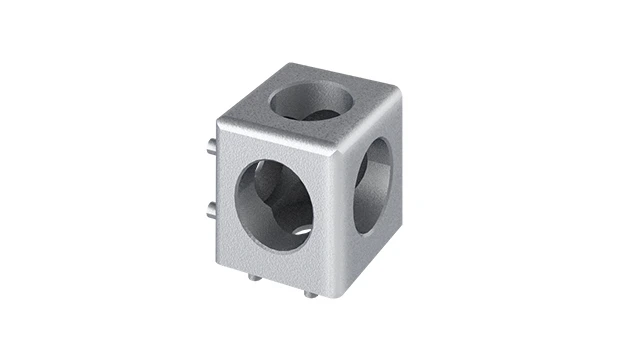
The 3 way - squared corner connector is an external fastening method that is typically used to create a corner connection between three profiles. It is a heavy-duty connection that is simple to use and provides a polished look.
Introduction: The Heartbeat of Lean Manufacturing
In the fast-paced world of manufacturing, where efficiency is king and waste is the enemy, lean systems have emerged as the backbone of successful operations. At its core, lean manufacturing is about creating more value with less resources—eliminating unnecessary steps, reducing downtime, and adapting quickly to changing demands. But here's the thing: lean isn't just a philosophy; it's a practice that relies heavily on the tools and systems that bring it to life. And in that toolbox, few components are as quietly revolutionary as the aluminum profile 3 way connector.
Imagine walking into a modern factory floor. You'll likely see workbenches tailored to specific tasks, flow racks carrying components seamlessly from one station to the next, and material handling systems that adjust on the fly as production needs shift. What you might not notice is the unsung hero holding it all together: connectors. Specifically, the aluminum profile 3 way connector—a small but mighty piece that turns rigid structures into flexible, adaptable ecosystems. In this article, we'll dive deep into the design, functionality, and impact of this unassuming component, exploring how it's redefining what's possible in lean systems.
Aluminum Profiles: The Backbone of Modular Systems
Before we zoom in on the 3 way connector, let's take a step back and appreciate the foundation it builds upon: aluminum profiles. These extruded aluminum rails, with their T-slot design and sleek, lightweight build, have become the gold standard for constructing everything from workstations to industrial machinery. Why aluminum? For starters, it's a marvel of engineering: strong enough to support heavy loads, yet light enough to be easily maneuvered. Its corrosion resistance ensures longevity even in harsh factory environments, and its malleability allows for intricate extrusion designs—like the T-slots that make customization a breeze.
Aluminum profiles come in a range of sizes and configurations, from the compact 2020 (20mm x 20mm) used in small workbenches to the robust 4080 (40mm x 80mm) for heavy-duty material racks. But what truly sets them apart is their modularity. Unlike traditional steel frames, which require welding or drilling to modify, aluminum profiles can be assembled and reconfigured using nothing more than connectors and fasteners. This modularity is the secret sauce that aligns perfectly with lean principles: it minimizes waste (no need to scrap an entire structure when needs change), reduces setup time (no waiting for welders), and empowers teams to iterate quickly.
But even the best aluminum profiles are only as good as the connectors that hold them together. Enter the 3 way connector—a component designed to solve a critical challenge in modular design: how to connect three profiles at once, opening up a world of structural possibilities.

The 3 Way Connector: Design That Drives Flexibility
What Is an Aluminum Profile 3 Way Connector?
At its simplest, an aluminum profile 3 way connector is a joining component that allows three aluminum profiles to be connected at a single point. Think of it as the intersection where three paths meet—whether forming a T-junction, a cross, or a corner with an additional branch. This might sound straightforward, but the engineering behind it is anything but. A well-designed 3 way connector must balance strength, precision, and ease of use, all while maintaining the modular spirit of aluminum profile systems.
Most 3 way connectors are made from high-grade aluminum alloy (often 6063-T5, a material prized for its strength-to-weight ratio and corrosion resistance). They're typically anodized to create a smooth, durable surface that resists scratches and wear, ensuring they stand up to the daily grind of factory life. The design itself varies by manufacturer, but common features include threaded holes for bolts, recessed areas to fit T-slot nuts, and precision-machined surfaces that align perfectly with the profiles they connect.
Key Design Features That Matter
Let's break down the design elements that make the 3 way connector a game-changer:
- Multi-Angle Compatibility: A quality 3 way connector isn't limited to 90-degree angles. Many models allow for connections at 45°, 90°, or even custom angles, giving designers the freedom to create structures that fit unique spaces. For example, a T-junction might connect a vertical profile to two horizontal ones, while a cross-shaped connector could link profiles in four directions (though technically a 4 way, some 3 way designs can be adapted for this with accessories).
- Tool-Free or Tool-Less Assembly: In lean systems, time is money. The best 3 way connectors use quick-release bolts or spring-loaded pins that allow for assembly and disassembly in minutes, no welding or specialized tools required. This is a far cry from traditional steel connectors, which often need wrenches, drills, or even torches to adjust.
- Load-Bearing Capacity: Don't let their small size fool you—these connectors are built to handle weight. A standard 3 way connector for 4040 aluminum profiles can typically support loads of 50-100 kg per connection, depending on the design. This makes them suitable for everything from light-duty workbenches to medium-weight flow racks.
- Integration with Accessories: The T-slot design of aluminum profiles means connectors can work alongside a host of accessories—like end caps, rubber strips for noise reduction, or cable management clips. A 3 way connector with threaded holes, for example, can easily accommodate a shelf bracket or a tool holder, turning a basic frame into a fully functional workstation.
Why Three Ways? The Power of Branching Structures
You might be wondering: why focus on 3 way connectors when 2 way (straight) or 90-degree connectors are more common? The answer lies in the complexity of real-world lean systems. In a factory,. Workbenches need shelves above and tool racks to the side; flow racks require multiple levels for different components; material trolleys need handles, baskets, and wheels—all of which demand branching connections.
A 3 way connector solves this by allowing a single profile to split into two directions, or two profiles to merge into one. For example, imagine a workbench where the main frame is a rectangular 4040 profile. Using 3 way connectors, you could add a vertical support in the middle, then attach a horizontal shelf to that support—creating a stable, multi-level workspace without compromising on strength. Or consider a flow rack: 3 way connectors make it easy to add a third level of rollers, increasing storage capacity without rebuilding the entire rack.

Lean Systems in Action: How 3 Way Connectors Make a Difference
To truly understand the impact of the 3 way connector, let's look at how it transforms common lean applications:
Workbenches: From One-Size-Fits-All to Tailored Precision
Workbenches are the workhorses of manufacturing—where assembly happens, tools are stored, and quality checks are performed. In a lean setup, a workbench shouldn't just be a flat surface; it should be an extension of the operator, designed to minimize movement and maximize efficiency. This is where 3 way connectors shine.
Consider a electronics assembly workbench. The operator needs space for a circuit board, access to hand tools, and a place to store components. With 3 way connectors, the workbench can be customized with:
- A vertical post in the back, connected via 3 way connectors to two horizontal arms—one holding a tool rail for screwdrivers and pliers, the other supporting a LED light to illuminate the workspace.
- Side shelves (connected via 3 way T-junctions) for bins of resistors, capacitors, and other small parts, keeping them within arm's reach.
- A lower shelf (using a 3 way cross connector) for a power strip or a bin for waste, ensuring the main surface stays clutter-free.
The beauty? If the assembly line switches to a larger circuit board next month, the workbench can be reconfigured in an hour: remove the side shelves, adjust the vertical post, and add a wider top—no need to buy a new bench. This adaptability reduces waste (no old benches collecting dust) and keeps operators productive.
Flow Racks: Streamlining Material Flow with Modular Design
Flow racks are the arteries of lean manufacturing, ensuring materials move smoothly from storage to production. A well-designed flow rack uses gravity to feed components to the operator, reducing the need for manual handling. But flow racks come in all shapes and sizes, depending on the product—from small plastic parts to heavy metal components. 3 way connectors make it possible to build flow racks that adapt to these varying needs.
Take a automotive parts manufacturer, for example. They might need a flow rack for transmission components—large, heavy parts that require sturdy supports. Using 4080 aluminum profiles and 3 way connectors, they can build a rack with three levels: the bottom for the heaviest parts, the middle for medium components, and the top for small hardware. Each level is connected via 3 way T-junctions to vertical posts, with roller tracks (another key accessory) attached to the horizontal profiles. If next quarter they start producing a new, bulkier transmission, they can easily add a fourth level by inserting 3 way connectors into the existing vertical posts—no welding, no cutting, just a few bolts and a new set of roller tracks.
This flexibility isn't just about saving time; it's about saving space. In a factory where floor space is prime real estate, being able to expand a flow rack vertically (rather than horizontally) is a game-changer. And because 3 way connectors allow for quick disassembly, old flow racks can be broken down and repurposed into something else—like a material trolley or a temporary storage rack—when they're no longer needed.
Material Trolleys: Mobile Solutions for Dynamic Floors
In lean systems, stagnant materials are a form of waste. Material trolleys keep components moving, ensuring operators have what they need, when they need it. But not all trolleys are created equal. A trolley for small parts might need multiple shelves, while one for large assemblies needs a flat, sturdy surface. 3 way connectors make it easy to build trolleys that fit the job.
For instance, a pharmacy might use a trolley to transport medication bins. Using 2020 aluminum profiles and 3 way connectors, they can create a trolley with three vertical posts, each connected via 3 way cross connectors to horizontal shelves. The shelves can be spaced to fit different bin sizes, and caster wheels (another accessory) can be added to the bottom posts for mobility. If the pharmacy starts carrying larger medical supplies, they can remove the middle shelf and replace it with a wider one—all without buying a new trolley.
Comparing Connectors: Why 3 Way Stands Out
To put the 3 way connector's value into perspective, let's compare it to other common aluminum profile connectors. The table below highlights key differences in design, applications, and lean benefits:
| Connector Type | Primary Use | Load Capacity (Typical) | Assembly Time | Lean Benefit |
|---|---|---|---|---|
| 2 Way (Straight) | Connecting two profiles end-to-end | High (100-200 kg) | 5-10 minutes | Creates long, straight runs (e.g., conveyor frames) |
| 90° Angle | Connecting two profiles at a right angle | Medium-High (80-150 kg) | 10-15 minutes | Builds square/rectangular frames (e.g., workbench bases) |
| 45° Angle | Connecting two profiles at a diagonal | Medium (50-100 kg) | 15-20 minutes | Creates triangular bracing for stability |
| 3 Way | Connecting three profiles at a single point | Medium (50-100 kg) | 10-15 minutes | Enables branching structures (e.g., multi-level shelves, T-junctions) |
The 3 way connector's strength lies not in raw load capacity (though it's more than enough for most applications), but in its versatility. While 2 way and 90° connectors are essential for basic frames, the 3 way opens the door to more complex, functional structures—exactly what lean systems need to adapt and grow.
Aluminum Profile Accessories: Completing the System
A 3 way connector is powerful on its own, but it truly shines when paired with the right aluminum profile accessories. These add-ons turn a basic frame into a fully functional system, and they're designed to work seamlessly with connectors:
- T-Slot Nuts and Bolts: These small but critical accessories lock the connector to the profile. Inserted into the T-slot, they slide into place and tighten with a hex key, creating a secure connection that can be easily loosened when reconfiguration is needed.
- End Caps: Placed on the ends of aluminum profiles, end caps protect workers from sharp edges and give structures a clean, finished look. They're often color-coded (e.g., blue for workbenches, yellow for flow racks) to aid in visual management—another lean principle.
- Rubber Strips: Inserted into T-slots, these strips reduce noise (important in busy factories) and prevent small parts from falling into the slots. They also add a layer of grip, keeping tools or bins from sliding around on shelves.
- Roller Tracks: As mentioned earlier, roller tracks are essential for flow racks. They're attached to horizontal profiles using brackets, which can be secured to 3 way connectors to create multi-level flow paths.
The beauty of aluminum profile accessories is their standardization. Most manufacturers use compatible T-slot sizes, so a 3 way connector from one brand can work with nuts, bolts, or roller tracks from another. This interoperability reduces supplier lock-in and makes it easier to source parts—a win for lean supply chain management.
Sustainability: Lean Systems Meet Green Manufacturing
In today's world, lean manufacturing isn't just about efficiency—it's about sustainability. Reducing waste, minimizing energy use, and extending the life of equipment are all part of the modern lean mindset. Here, the 3 way connector plays a surprisingly important role.
Aluminum itself is highly recyclable—nearly 75% of all aluminum ever produced is still in use today. When a 3 way connector or aluminum profile reaches the end of its life, it can be melted down and reused with minimal energy loss. Compare that to steel, which requires more energy to recycle, or plastic connectors, which often end up in landfills.
But the sustainability benefit goes beyond materials. Because 3 way connectors enable reconfiguration, structures have longer lifespans. A workbench that might be scrapped after a year in a traditional setup can be repurposed into a flow rack, a trolley, or a storage shelf in a modular system—reducing the need for new materials. This "circular" approach aligns perfectly with lean's focus on eliminating waste, making the 3 way connector a tool for both efficiency and environmental responsibility.
The Future of 3 Way Connectors: Innovation on the Horizon
As manufacturing continues to evolve—with trends like Industry 4.0, automation, and customization driving change—the 3 way connector is poised to evolve with it. Here are a few innovations we might see in the coming years:
- Smart Connectors: Imagine 3 way connectors embedded with sensors that monitor load capacity, vibration, or temperature. These "smart" connectors could alert maintenance teams if a structure is overloaded or if a connection is loosening—preventing downtime and improving safety.
- Lightweight Composites: While aluminum is already light, future connectors might use carbon fiber or glass-reinforced composites to reduce weight even further, making structures easier to move and reconfigure.
- 3D-Printed Customization: For niche applications, 3D printing could allow for on-demand, custom 3 way connectors—designed to fit unique profile sizes or angles without the cost of tooling.
No matter how they evolve, one thing is clear: the 3 way connector will remain a cornerstone of lean systems, enabling the flexibility and adaptability that modern manufacturing demands.
Conclusion: Small Component, Big Impact
In the grand scheme of manufacturing, the aluminum profile 3 way connector might seem like a small detail. But as we've explored, it's the details that make lean systems work. It's the connector that turns a pile of aluminum profiles into a custom workbench, a flexible flow rack, or a mobile trolley. It's the component that allows teams to adapt to new products, scale up production, or reconfigure a factory floor in hours instead of weeks. And in doing so, it's not just a tool—it's a catalyst for innovation.
So the next time you walk through a factory, take a moment to look closer at the structures around you. Chances are, you'll spot a 3 way connector holding it all together—quietly, efficiently, and relentlessly driving the lean revolution forward. Because in the world of manufacturing, the best innovations aren't always the flashiest. Sometimes, they're the ones that simply connect the dots—literally.