- Company Articles
- Products and Technology
- Product knowledge
- Aluminum Profile 3 Way Connector Durability: Testing and Certification

Aluminum Profile 3 Way Connector Durability: Testing and Certification
Related Product
Aluminum Profile 3 Way Connector
The 3 way - squared corner connector is an external fastening method that is typically used to create a corner connection between three profiles. It is a heavy-duty connection that is simple to use and provides a polished look.
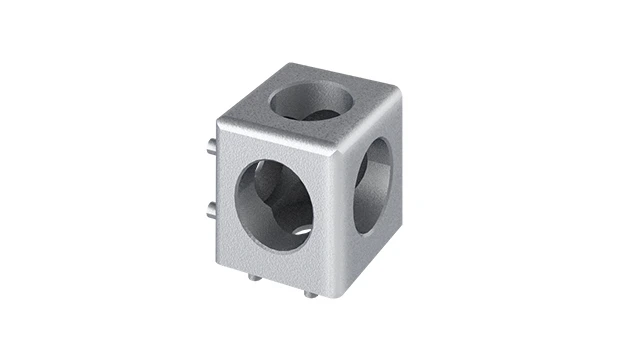
The Unsung Backbone of Modern Industry
Walk through any manufacturing plant, warehouse, or even a high-tech lab, and you'll see them: sleek, modular structures that seem to adapt effortlessly to their surroundings. Workbenches that adjust to different tasks, material racks that organize inventory with precision, conveyor systems that keep production flowing—these setups aren't just assembled from random parts. They're built on a foundation of aluminum profiles and the connectors that hold them together. Among these connectors, the aluminum profile 3 way connector stands out as a quiet workhorse, enabling the creation of stable, multi-directional structures that form the backbone of efficient operations.
But what makes these small, often overlooked components so critical? Imagine a scenario where a 3 way connector fails mid-production. A workbench might wobble, a material rack could collapse, or a conveyor track might misalign—all leading to downtime, damaged goods, or even safety hazards. That's why durability isn't just a nice-to-have feature for these connectors; it's a non-negotiable requirement. In this article, we'll dive deep into the world of aluminum profile 3 way connectors, exploring how their durability is tested, certified, and why it matters for industries that rely on them every day.
First, let's clarify what we're talking about. Aluminum profiles, often called aluminum extrusion profiles, are lightweight, rigid structural elements made by forcing heated aluminum through a die to create specific cross-sectional shapes. These profiles come in various sizes and designs, but their real versatility comes from the accessories that join them—like the 3 way connector. Unlike simpler 90° aluminum profile connectors or 45° aluminum profile connectors, which join two profiles at fixed angles, a 3 way connector allows three profiles to meet at a single point, opening up endless possibilities for building complex, three-dimensional structures. Whether it's a T-junction, a corner with an additional support arm, or a branching material rack, the 3 way connector is the key to unlocking modular flexibility.
Why Durability Can't Be Compromised
To understand why durability testing is so vital, let's start with the consequences of a weak connector. In industrial settings, aluminum profile structures are rarely static. A workbench might support heavy machinery or tools day in and day out. A material rack could hold hundreds of pounds of inventory, with workers loading and unloading items multiple times an hour. A conveyor system might run 24/7, with the connector absorbing constant vibrations and stress. Over time, even small flaws in a connector's design or material can escalate into major issues.
Consider the cost of failure. For a small manufacturer, an hour of downtime due to a collapsed rack might mean losing thousands of dollars in missed production. For a medical device plant, a wobbly workbench could lead to imprecise assembly, resulting in faulty products and regulatory penalties. And in worst-case scenarios, a connector failure could cause a structure to collapse, injuring workers and leading to lawsuits. Durability isn't just about product longevity—it's about protecting people, profits, and reputations.
But durability isn't a one-size-fits-all trait. A connector used in a climate-controlled electronics factory faces different challenges than one in a humid food processing plant or an outdoor warehouse in a coastal area. That's why testing goes beyond just "how strong is it?" to "how strong is it under the specific conditions it will face?" This is where rigorous testing and certification come into play—they ensure that a connector isn't just tough in theory, but reliable in the real world.

The Science Behind Durability: Materials and Design
Before we jump into testing, let's take a step back and look at what makes a high-quality aluminum profile 3 way connector durable in the first place. It starts with the material: aluminum. Aluminum extrusion profiles are chosen for their unique blend of strength, lightness, and corrosion resistance. But the connector itself—often made from die-cast aluminum or aluminum alloy—needs to match or exceed the profile's properties. Manufacturers carefully select alloys with high tensile strength, good impact resistance, and the ability to withstand environmental stressors like moisture or temperature fluctuations.
Design is equally important. A well-engineered 3 way connector doesn't just "hold" profiles together; it distributes weight and stress evenly across all three connected profiles. Compare this to a basic 90° aluminum profile connector, which only needs to handle force along two axes. A 3 way connector must manage tension, compression, and shear forces from three directions simultaneously. This requires precision in the shape of the connector's sockets, the thickness of its walls, and the placement of screws or bolts that secure the profiles. Even small details, like rounded edges to reduce stress concentration or reinforced corners at load-bearing points, can make a big difference in long-term durability.
Another factor is compatibility with aluminum profile accessories. A 3 way connector isn't used in isolation; it works with end caps, gussets, and mounting brackets to create a cohesive system. If the connector's design doesn't align with these accessories—for example, if the screw holes are misaligned or the socket depth doesn't match the profile's thickness—it can create weak points in the structure. That's why reputable manufacturers test connectors not just on their own, but as part of a complete system with the profiles and accessories they're intended to work with.

Testing Durability: Putting Connectors Through Their Paces
Durability testing is where theory meets reality. Manufacturers and third-party labs subject aluminum profile 3 way connectors to a battery of tests designed to simulate years of real-world use in just weeks or months. These tests are rigorous, standardized, and often tailored to the specific environments the connectors will face. Let's break down the most critical ones.
Static Load Testing: How Much Weight Can It Bear?
Static load testing is the most straightforward durability test: it measures how much weight a connector can support without deforming or failing. Here's how it works: A 3 way connector is mounted to three aluminum extrusion profiles in a typical configuration (e.g., one vertical and two horizontal profiles forming a T-shape). A controlled weight is then applied to the end of one of the horizontal profiles, mimicking the load of tools, materials, or equipment on a workbench or rack. The weight is increased gradually, and sensors monitor for deformation—like bending, cracking, or slipping of the connector.
But it's not just about maximum weight. Many tests also include a "sustained load" phase, where the connector is subjected to 70-80% of its maximum load for an extended period (often 1000 hours or more). This simulates long-term use, where the connector isn't just handling occasional heavy loads, but constant pressure day in and day out. For example, a connector rated for 500kg might be tested with 400kg for a month to ensure it doesn't creep (slowly deform over time) or loosen.
Results matter: A quality 3 way connector should withstand static loads well above the typical demands of its intended use. For industrial applications, this often means ratings of 300kg or more per connected profile, with no permanent deformation under sustained loads.
Dynamic Load Testing: Handling the Unexpected
In the real world, loads aren't always static. A worker might place a heavy box on a rack with a sudden thud, or a conveyor might start and stop, creating jolts. Dynamic load testing simulates these sudden, variable forces. Using hydraulic or pneumatic systems, labs apply rapid, repeated loads to the connector—think of it as "shaking" or "jerking" the structure to see how the connector holds up.
One common dynamic test is the "fatigue test," where the connector is subjected to millions of load cycles (e.g., 10,000 cycles of 100kg applied and released). This mimics the wear and tear of daily use, where even small, repeated stresses can weaken materials over time. If a connector fails during fatigue testing—say, a crack forms after 5,000 cycles—it's a sign that its design or material isn't suited for high-traffic environments.
Corrosion Resistance: Battling the Elements
Aluminum is naturally resistant to corrosion thanks to its oxide layer, but connectors often have exposed metal parts (like screws or internal components) or are used in harsh environments. A food processing plant with frequent washdowns, a coastal warehouse with salt-laden air, or a chemical lab with spills—all these can corrosion. To test for this, connectors undergo salt spray testing, one of the most rigorous corrosion resistance assessments.
In a salt spray test, the connector is placed in a chamber where a fine mist of saltwater (typically 5% sodium chloride solution) is sprayed continuously at 35°C (95°F). The goal? To see how long it takes for rust, pitting, or other signs of corrosion to appear. For industrial-grade connectors, passing this test means showing no significant corrosion after 500-1000 hours—far longer than the average connector would be exposed to harsh conditions in the field. Some manufacturers also test with other corrosive agents, like acids or alkalis, depending on the target industry.
Temperature and Humidity Extremes: Testing Environmental Resilience
From freezing cold warehouses to sweltering factory floors, connectors must perform in a wide range of temperatures. Thermal cycling tests expose connectors to extreme heat and cold, often alternating between -40°C (-40°F) and 80°C (176°F) over 100+ cycles. This tests how well the connector's material and design handle expansion and contraction. If the plastic components (like insulators or gaskets) crack in the cold or melt in the heat, or if metal parts loosen due to repeated expansion, the connector fails.
Humidity testing is similar but focuses on moisture. Connectors are placed in chambers with 95% relative humidity at high temperatures (e.g., 60°C/140°F) for weeks. This simulates tropical climates or humid industrial settings, where moisture can seep into cracks, cause rust, or degrade adhesives used in the connector's assembly.
Impact Testing: Surviving Accidental Knocks
Even the most careful workers make mistakes. A forklift might bump into a material rack, or a heavy tool could fall onto a workbench. Impact testing ensures connectors can handle these sudden, high-force collisions without failing. The test involves dropping a weighted pendulum or hammer onto the connector at a specified speed and angle, mimicking the impact of a typical accident. After impact, the connector is inspected for cracks, deformation, or loss of holding strength. A passing connector might show minor cosmetic damage, but it must still securely hold the profiles in place.
| Test Type | Purpose | Standard Method | Typical Pass Criteria |
|---|---|---|---|
| Static Load Testing | Measure maximum weight capacity and resistance to deformation under constant load | ISO 898-1 (for fasteners), DIN 50106 (for structural components) | No permanent deformation after 1000 hours at 80% of max load; max load ≥ 300kg per profile |
| Dynamic Load (Fatigue) Testing | Assess resistance to repeated, variable loads over time | ASTM E466 (for fatigue testing), ISO 13003 (for conveyor components) | Withstands 10,000+ load cycles without cracking or loss of clamping force |
| Salt Spray Corrosion Testing | Evaluate resistance to saltwater corrosion | ASTM B117, ISO 9227 | No red rust or pitting after 500 hours; minor surface oxidation acceptable |
| Thermal Cycling Testing | Test performance under extreme temperature changes | IPC-TM-650 2.6.7 (for electronics), DIN EN 60068-2-14 | No cracking, melting, or loss of holding strength after 100 cycles (-40°C to 80°C) |
| Impact Testing | Simulate accidental collisions and assess damage resistance | ASTM D256 (Izod impact), ISO 179 | Withstands 10J impact (equivalent to 1kg weight dropped from 1m) without structural failure |
Certification: What the Labels Really Mean
Testing is only half the story. For a connector to be trusted, its test results need to be verified by independent, accredited organizations. This is where certification comes in. Certifications are like a stamp of approval, telling buyers that the connector meets strict industry standards for quality and durability. Let's look at the most recognized certifications and what they entail.
ISO 9001: Quality Management Systems
ISO 9001 isn't specific to connectors, but it's a fundamental certification for any manufacturer serious about quality. It ensures that the company has a documented quality management system (QMS) in place, covering everything from raw material sourcing to production processes to final testing. For buyers, an ISO 9001 certification means the manufacturer is committed to consistency—so the connector you buy today will be as durable as the one you buy next year.
DIN Standards: German Engineering at Its Finest
DIN (Deutsches Institut für Normung) is a German standards organization known for its rigorous engineering benchmarks. DIN 69050, for example, specifically covers aluminum profiles for machine frames and similar structures, including requirements for connectors. A 3 way connector certified to DIN 69050 has been tested to meet strict criteria for load capacity, dimensional accuracy, and material quality. This is especially important for industries like automotive or aerospace, where precision and reliability are non-negotiable.
ASTM International: Global Recognition for Performance
ASTM International (formerly the American Society for Testing and Materials) develops standards used worldwide. For aluminum profile connectors, ASTM standards like ASTM B221 (for aluminum alloys) and ASTM F1554 (for structural connectors) set benchmarks for material composition, mechanical properties, and testing methods. A connector certified to ASTM standards is recognized in North America, Europe, and Asia, making it a safe choice for global supply chains.
Industry-Specific Certifications
Some industries have unique needs that require specialized certifications. For example, connectors used in cleanrooms (like those in semiconductor manufacturing) might need ISO 14644 certification for particle emission, ensuring they don't contaminate sensitive environments. In the food and beverage industry, connectors may need FDA approval if they come into contact with food, verifying that their materials are non-toxic and resistant to bacteria growth. These certifications go beyond basic durability to address safety and compliance in niche applications.
Real-World Impact: Case Studies in Durability
Numbers and standards tell part of the story, but real-world performance is the ultimate test. Let's look at two case studies where aluminum profile 3 way connector durability made a tangible difference for businesses.
Case Study 1: Automotive Parts Manufacturer Reduces Downtime by 40%
A mid-sized automotive parts manufacturer in Michigan was struggling with frequent breakdowns in their assembly line workbenches. The workbenches, built with generic, uncertified connectors, would often loosen or deform under the weight of heavy tools and components, leading to 2-3 hours of downtime per week for repairs. After switching to certified 3 way connectors (tested to DIN 69050 and ASTM B221 standards), the manufacturer saw a dramatic improvement. Over six months, downtime dropped by 40%, and the workbenches required only routine maintenance (like tightening screws) instead of full repairs. The plant manager noted, "We used to replace connectors every few months; now, they're still going strong after a year. The initial cost was higher, but the savings in downtime and replacement parts have more than paid for it."
Case Study 2: Coastal Warehouse Survives Hurricane Season
A logistics company in Florida operates a warehouse just miles from the coast, where high humidity and occasional saltwater spray are part of daily life. Their material racks, originally built with standard steel connectors, were constantly rusting and failing, especially after hurricane season when storm surges brought saltwater into the facility. The company switched to aluminum extrusion profiles with corrosion-resistant 3 way connectors (certified to 1000 hours of salt spray testing per ASTM B117). Two hurricane seasons later, the racks showed no signs of rust or degradation. Even after a minor flood that submerged the lower connectors for 24 hours, the racks remained stable. "We used to replace entire sections of racking after every storm," said the warehouse manager. "Now, we just hose them down and they're good to go. It's been a game-changer for our resilience."
Choosing the Right Connector: What to Look For
With so many options on the market, how do you choose a durable aluminum profile 3 way connector? Here are the key factors to consider:
Certifications Matter: Always look for connectors with third-party certifications (like DIN, ASTM, or ISO). A manufacturer's "own testing" is a start, but independent certification ensures unbiased results.
Material Quality: Opt for connectors made from high-grade aluminum alloys (e.g., 6061 or 6063, common in aluminum extrusion profiles). Avoid cheap, low-density alloys that bend or crack easily.
Design Details: Inspect the connector's design for reinforced load-bearing points, smooth internal surfaces to avoid damaging profiles, and compatibility with your existing aluminum profile accessories. If possible, ask for a sample to test with your profiles before buying in bulk.
Supplier Reputation: Choose a supplier with a track record of quality. Read reviews, ask for references, and inquire about their testing processes. A reputable supplier will be transparent about their certifications and happy to share test reports.
Environment Fit: Match the connector to your environment. If you're in a humid or coastal area, prioritize corrosion-resistant coatings and salt spray certification. For high-temperature settings, look for thermal cycling test results.
The Future of Durability: Innovation in Connector Technology
As industries evolve, so do the demands on aluminum profile 3 way connectors. Manufacturers are constantly innovating to make connectors stronger, lighter, and more adaptable. One emerging trend is the use of computer-aided design (CAD) and finite element analysis (FEA) to optimize connector shapes, ensuring even better stress distribution. Another is the development of hybrid materials, like aluminum connectors with reinforced plastic components, which reduce weight without sacrificing strength.
Smart connectors are also on the horizon. Imagine a connector with built-in sensors that monitor load, temperature, or vibration, sending alerts to maintenance teams before failure occurs. While still in the prototype stage, these "intelligent" connectors could revolutionize predictive maintenance, making industrial systems even more reliable.
Conclusion: Durability as a Foundation for Success
Aluminum profile 3 way connectors may be small, but their impact on industrial efficiency and safety is enormous. They're the silent partners that enable the modular, flexible structures modern businesses rely on. Durability testing and certification ensure that these connectors don't just work—they work reliably, even under the toughest conditions.
For businesses, investing in certified, durable connectors isn't just about avoiding downtime or repairs; it's about building a foundation for growth. When your structures are stable, your operations are efficient. When your connectors last, your costs go down. And when your workers trust the equipment they use, morale and productivity soar.
So the next time you walk through a factory or warehouse, take a moment to appreciate the aluminum profile 3 way connectors holding everything together. They may not grab headlines, but they're the unsung heroes keeping the world of industry moving forward—one durable connection at a time.