- Company Articles
- Products and Technology
- Product knowledge
- Aluminum Profile 3 Way Connector: Key Features for Lean Manufacturing

Aluminum Profile 3 Way Connector: Key Features for Lean Manufacturing
Related Product
Aluminum Profile 3 Way Connector
The 3 way - squared corner connector is an external fastening method that is typically used to create a corner connection between three profiles. It is a heavy-duty connection that is simple to use and provides a polished look.
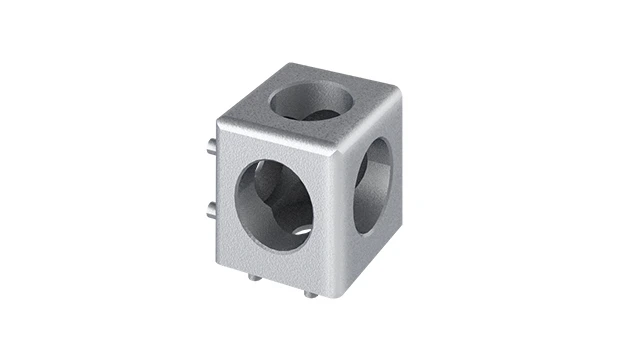
In the fast-paced world of manufacturing, where efficiency and adaptability can make or break a business, lean principles have become more than just a buzzword—they're a survival strategy. At the heart of lean manufacturing lies the relentless pursuit of waste reduction, continuous improvement, and the ability to pivot quickly to meet changing demands. But here's the thing: lean systems don't run on alone. They rely on tools and components that can keep up with the pace of innovation. Enter the unsung hero of modular manufacturing: the Aluminum Profile 3 Way Connector. This small but mighty component is quietly revolutionizing how factories, warehouses, and production lines are built, reconfigured, and optimized—all while staying true to lean ideals. Let's dive into why this connector matters, its key features, and how it's becoming indispensable for modern lean systems.
What Even Is an Aluminum Profile 3 Way Connector?
Before we get into the nitty-gritty of its features, let's start with the basics. If you've ever walked through a well-organized workshop or a sleek production line, you've probably seen aluminum profiles in action. These are the lightweight, durable, T-slot extruded aluminum rails that form the backbone of workbenches, material racks, conveyor systems, and even machine guards. They're popular because they're strong, corrosion-resistant, and infinitely customizable. But aluminum profiles alone are just pieces of metal—they need connectors to turn them into functional structures. That's where the Aluminum Profile 3 Way Connector comes in.
As the name suggests, this connector is designed to join three aluminum profiles at a single junction, typically at 90-degree angles (though some designs allow for adjustability). Picture a corner where a vertical post meets two horizontal beams, or a T-junction where a shelf connects to a main frame. Instead of welding, drilling, or using messy adhesives, the 3 way connector locks the profiles together securely with simple fasteners, usually a hex key. It's the glue that holds modular systems together—without the mess or permanence.
Quick Example: Imagine a small electronics manufacturer that needs a workbench for assembling circuit boards. They start with 4040 aluminum profiles (a common size) for the frame. At each corner of the bench's base, they use 90-degree connectors. But when they want to add a side shelf for tools, they reach for a 3 way connector: one arm attaches to the vertical leg of the bench, and the other two extend horizontally to support the shelf. An hour later, the shelf is up—and if they need to move it tomorrow? They just loosen the connector, reposition, and tighten. No welding, no waiting for a contractor, no wasted materials. That's the power of modularity.
Key Feature 1: Modular Flexibility—The Cornerstone of Lean Adaptability
Lean manufacturing thrives on flexibility. Production lines need to shift from making Product A to Product B overnight. Workstations need to adjust to new ergonomic standards. Material flows need to reroute when a new machine is added. Rigid, fixed structures—like welded steel frames—are the enemies of this flexibility. They take time to build, cost a fortune to modify, and often end up in the scrap heap when needs change. The Aluminum Profile 3 Way Connector flips this script with its modular design.
Here's how it works: Unlike traditional connectors that lock profiles into a single, unchangeable position, the 3 way connector is engineered for quick reconfiguration. Most models feature slotted holes or adjustable clamping mechanisms that let you loosen the fasteners, rotate or reposition the profiles, and retighten—all in minutes. Need to raise a shelf by 6 inches to fit taller bins? Loosen the connector, slide the profile up, and lock it. Want to angle a conveyor track slightly to improve material flow? Adjust the connector's orientation. This isn't just convenience; it's lean in action. By reducing the time and effort needed to adapt structures, the connector cuts down on downtime and eliminates the waste of building new systems from scratch.
Take the example of a automotive parts supplier I visited last year. They used to build custom steel racks for each new part they produced. When a part design changed, the racks became obsolete, and they'd spend weeks (and thousands of dollars) welding new ones. Then they switched to aluminum profiles and 3 way connectors. Now, when a part's dimensions change, their team grabs a hex key, adjusts the connectors, and the rack is repurposed in an afternoon. "We used to have a whole corner of the warehouse full of old steel racks," the plant manager told me. "Now? We just reconfigure what we have. It's like Legos for adults—but for manufacturing."

Key Feature 2: Durability That Stands Up to the Grind
Flexibility is great, but if a connector bends, breaks, or loosens under pressure, it's worse than useless—it's dangerous. Manufacturing environments are tough: heavy loads, constant vibration, occasional bumps from forklifts or pallet jacks. A flimsy connector can compromise the integrity of an entire structure, leading to damaged materials, downtime, or even workplace injuries. That's why the Aluminum Profile 3 Way Connector is built to last, with durability that matches the demands of industrial settings.
Most high-quality 3 way connectors are made from high-grade aluminum alloy (often 6061 or 6063, the same stuff used in aircraft parts) or reinforced with steel components for added strength. Aluminum is ideal here because it's lightweight (so structures are easier to move) and naturally corrosion-resistant (important for humid warehouses or clean rooms). The connector's design also plays a role: precision-machined clamping surfaces ensure a tight grip on the aluminum profile's T-slots, preventing slippage even under heavy loads. Many models also feature knurled or serrated contact points that bite into the profile, creating a mechanical lock that won't loosen over time—even with vibration from nearby machinery.
Let's talk numbers. A standard Aluminum Profile 3 Way Connector (for 4040 aluminum profiles) can typically support static loads of 200-300 kg per connection, depending on the design. That's enough to hold heavy toolboxes, stacks of metal sheets, or even small assembly equipment. And because the connector distributes weight evenly across the profile's T-slot, there's less stress on any single point—meaning the structure stays stable longer. Compare that to plastic connectors, which can warp under heat or crack under heavy loads, or cheap steel connectors that rust and seize up. The Aluminum Profile 3 Way Connector is built to outlast the structures it helps create.

Key Feature 3: Compatibility—Plays Well With Others (and That Matters)
In manufacturing, no component exists in a vacuum. A connector is only as useful as the profiles and accessories it can work with. The best Aluminum Profile 3 Way Connectors aren't one-trick ponies—they're team players, designed to integrate seamlessly with a wide range of aluminum profiles, aluminum profile accessories, and even other connector types. This compatibility is a game-changer for lean systems, where mixing and matching components can lead to endless customization.
First, profile compatibility. Aluminum profiles come in all shapes and sizes: 2020 (20mm x 20mm), 3030, 4040, 4080, and so on. A good 3 way connector is available in versions tailored to these sizes, with clamping surfaces that match the profile's T-slot dimensions. For example, a 3030 connector won't work on a 4040 profile, but most suppliers offer a range of sizes, so you can stick with one connector brand across different projects. Some advanced connectors even have adjustable jaws, letting them fit multiple profile sizes—a boon for shops that use a mix of rail widths.
Then there are aluminum profile accessories. The T-slots in aluminum profiles are designed to accept everything from shelves and brackets to lights and tool holders. The 3 way connector doesn't block these slots; instead, it complements them. For example, you might use a 3 way connector to build the frame of a workbench, then slide a tool rail into the T-slot of one of the profiles (held in place by the connector) to hang wrenches and screwdrivers. Or attach a caster wheel bracket to the bottom of a vertical profile, connected via a 3 way connector, to make the entire structure mobile. This compatibility means you're not limited to "connector-only" designs—you can mix in other accessories to create truly custom solutions.
Even better, many 3 way connectors work with other connector types. Need to add a diagonal brace for extra stability? Use a 45-degree aluminum profile connector alongside the 3 way. Want to create a corner with a curved profile? Pair it with a swivel connector. This interoperability lets you design structures that are as simple or complex as needed—without being locked into a single brand or system.
Key Feature 4: Assembly That Anyone Can Master (No Welding Degree Required)
One of the biggest barriers to lean systems is complexity. If setting up or modifying a structure requires specialized skills (like welding) or expensive tools, it becomes a bottleneck. Teams have to wait for maintenance crews or external contractors, which slows down improvements and kills momentum. The Aluminum Profile 3 Way Connector eliminates this barrier with assembly so simple, even someone with no technical training can do it.
Here's a typical assembly process: Slide the connector onto the end of one aluminum profile. Position the second profile at the desired angle (usually 90 degrees). insert the third profile into the remaining slot. Tighten the set screws with a hex key (most connectors use standard 4mm or 5mm keys). Done. No welding, no drilling, no measuring with a level (though a level helps for precision). It's intuitive enough that new employees can be trained to assemble basic structures in 15 minutes. This democratizes the ability to build and modify systems, putting the power of improvement directly into the hands of the people who use the workspace every day—line workers, supervisors, and team leads.
Real-World Win: A food packaging plant I consulted with had a problem: their packaging line workstations were built by contractors, and even small adjustments (like raising a conveyor by 2 inches) required a service call and a $500 bill. Employees had ideas for improvements, but they'd given up suggesting them because "nothing ever changes." Then the plant switched to aluminum profiles and 3 way connectors. Within a month, the line workers themselves had reconfigured their workstations to reduce reaching, added side shelves for packaging materials, and even built a custom cart for waste disposal—all using connectors and profiles they kept in a small parts bin. "It's like we unlocked a new level of ownership," the operations manager said. "People care more about their workspace when they can shape it themselves."
This ease of assembly also cuts down on lead times. Traditional steel structures can take weeks to design, fabricate, and install. With aluminum profiles and 3 way connectors, a basic workbench or material rack can be built in a morning. Need a temporary staging area for a rush order? Grab some profiles, a handful of connectors, and you're up and running by lunch. It's lean manufacturing at its finest: rapid response to demand, with minimal waste of time or resources.
Key Feature 5: Cost-Effectiveness That Adds Up (in a Good Way)
Let's talk money. At first glance, aluminum profiles and 3 way connectors might seem pricier than, say, welded steel or wooden frames. A single connector can cost $5-$15, and aluminum profiles are more expensive per foot than raw steel. But lean manufacturing is about looking at the total cost of ownership—not just the upfront price tag. When you factor in reusability, durability, and the ability to avoid custom fabrication, the Aluminum Profile 3 Way Connector becomes one of the most cost-effective investments a facility can make.
Consider reusability: When a welded steel structure is obsolete, it's scrap. You might get a few dollars for recycling the steel, but you've lost the time and money you invested in building it. With aluminum profiles and 3 way connectors? You just take it apart and rebuild it into something else. The connectors, profiles, and accessories can be reused dozens of times over decades. A 3 way connector bought today might build a workbench this year, a material rack next year, and a machine guard the year after. That's not just cost savings—that's asset maximization.
Then there's the cost of downtime. When you need to reconfigure a production line, every hour the line is down costs money. Traditional methods (welding, custom fabrication) can mean days of downtime. With 3 way connectors? Reconfiguration happens in hours, or even minutes. A pharmaceutical manufacturer I worked with once had to shift production from 500ml bottles to 1000ml bottles overnight. Their old glass-reinforced plastic conveyors couldn't handle the larger bottles, so they'd planned for 48 hours of downtime to install new ones. Instead, they used aluminum profiles and 3 way connectors to build a temporary conveyor extension in 3 hours. The line was back up by morning, and they fulfilled the rush order. The savings from avoiding downtime alone paid for the connectors and profiles ten times over.
Finally, there's the cost of customization. In traditional manufacturing, if you need a "one-off" structure—a special rack for a unique part, a custom workbench for a tall employee—you pay a premium for custom fabrication. With modular connectors, customization is the norm, not the exception. You don't need to hire an engineer or a welder; you just mix and match profiles and connectors to get exactly what you need. It's mass customization at no extra cost.
How Does It Stack Up? A Quick Comparison
To really appreciate the Aluminum Profile 3 Way Connector, it helps to see how it compares to other common connectors. Let's break it down in a table:
| Connector Type | Flexibility (1=Low, 5=High) | Max Load Capacity (kg per joint) | Profile Compatibility | Assembly Time (minutes per joint) | Best For |
|---|---|---|---|---|---|
| Aluminum Profile 3 Way Connector | 5 | 200-300 | Most T-slot aluminum profiles (2020, 3030, 4040, etc.) | 2-5 | Modular structures, reconfigurable workbenches, material racks |
| 90° Fixed Steel Connector | 1 | 300-400 | Only compatible with specific steel tubes | 15-20 (requires drilling/welding) | Permanent, heavy-load structures (rarely used in lean systems) |
| Plastic 3 Way Connector | 4 | 50-100 | Limited to lightweight plastic profiles | 1-3 | Light-duty use (e.g., retail displays, home workshops) |
| 45° Adjustable Aluminum Connector | 4 | 150-250 | Specific aluminum profile sizes | 5-8 | Angled structures (e.g., sloped conveyors, ramps) |
As you can see, the Aluminum Profile 3 Way Connector strikes a sweet spot: high flexibility, strong load capacity, broad compatibility, and fast assembly. It's not the only connector out there, but for lean systems that need to balance durability and adaptability, it's hard to beat.
Real-World Applications: Where the Rubber Meets the (Aluminum) Road
Enough theory—let's look at how the Aluminum Profile 3 Way Connector is being used in real lean systems today. These examples show just how versatile this component can be:
1. Workbenches That Grow With Your Team
Workbenches are the heart of any production line, and one-size-fits-all models rarely work. With aluminum profiles and 3 way connectors, workbenches become fully customizable. Need a longer surface for a new assembly process? Add two more profiles and a connector. Want to add a shelf underneath for bins? Attach it with a 3 way connector. Even accessories like LED task lights, tool holders, or ESD mats can be mounted directly to the profiles via the T-slots, with the connector ensuring the structure stays stable. A electronics manufacturer in Texas, for example, uses 3 way connectors to build workbenches with adjustable heights (to accommodate workers of different statures) and modular tool panels that can be rearranged as production steps change. "Ergonomics used to be an afterthought," their safety manager told me. "Now, with these connectors, we can tweak a workbench in 10 minutes to prevent strain. It's reduced our injury rates by 30%."
2. Material Racks That Adapt to Inventory
Warehouses and stockrooms are constantly dealing with changing inventory: seasonal products, new part numbers, or bulk orders that require more storage space. Fixed shelving can't keep up, leading to wasted space or overcrowding. Enter modular material racks built with aluminum profiles and 3 way connectors. Need to add a shelf? Slide a connector onto the vertical posts and insert a horizontal profile. Need to widen the spacing between shelves for taller boxes? Loosen the connectors, adjust, and retighten. A clothing distributor I visited uses these racks to store everything from small accessories (in shallow bins on narrow shelves) to bulk shipments (on wide, reinforced shelves). "During peak season, we reconfigure 20% of our racks in a weekend," their warehouse manager said. "No more renting extra storage space—we just use what we have more efficiently."
3. Conveyor Systems That Keep Up With Demand
Conveyors are the arteries of production lines, moving materials from point A to point B. But when production needs change—say, a new machine is added or a process is rearranged—fixed conveyors become obstacles. Modular conveyors, built with aluminum profiles, roller tracks, and 3 way connectors, solve this problem. The connectors join the aluminum frame, while roller track placon mounts (another type of aluminum profile accessory) attach the rollers to the frame. Need to extend the conveyor? Add more profiles and connectors. Need to redirect it around a new machine? Adjust the connectors to angle the frame. A beverage bottler used this setup to switch from a straight-line conveyor to a zig-zag layout (to fit a new labeling machine) in just a day. "We used to think conveyors were permanent," their plant engineer said. "Now they're just another part of our lean toolbox—easy to change when we need to."
Why Lean Systems Can't Afford to Ignore This Connector
At the end of the day, the Aluminum Profile 3 Way Connector isn't just a piece of hardware—it's a lean enabler. It embodies the core principles of lean manufacturing:
- Waste Reduction: Eliminates waste from overproduction (no need to build custom structures), waiting (fast assembly/reconfiguration), and unnecessary inventory (reusable components).
- Continuous Improvement: Empowers teams to experiment with better layouts and processes, since changes are low-cost and reversible.
- Respect for People: Gives workers control over their environment, boosting engagement and ownership.
- Just-In-Time Production: Allows for rapid retooling to meet sudden demand changes, without the lead time of traditional fabrication.
In a world where customer demands shift overnight and competition grows fiercer by the day, lean systems need tools that can keep up. The Aluminum Profile 3 Way Connector isn't just keeping up—it's leading the charge. It's proof that sometimes, the smallest components can have the biggest impact on a company's bottom line and ability to thrive.
Final Thoughts: Small Connector, Big Results
So, there you have it. The Aluminum Profile 3 Way Connector might not have the flash of a new robot or the excitement of a cutting-edge software system, but it's quietly transforming how lean manufacturing works. Its modular flexibility, durability, compatibility, ease of assembly, and cost-effectiveness make it a must-have for any facility looking to stay competitive in today's fast-paced market. Whether you're building a simple workbench or a complex conveyor system, this connector is the key to creating structures that can grow, adapt, and improve—just like your lean system should.
The next time you walk through a well-run factory or warehouse, take a closer look at the frames, racks, and workbenches. Chances are, you'll spot the Aluminum Profile 3 Way Connector hard at work—holding things together, while keeping lean principles moving forward. And that, in a nutshell, is the power of smart, simple tools in the world of manufacturing.