- Company Articles
- Products and Technology
- Product knowledge
- Aluminum Profile 3 Way Connector Load Capacity: What You Need to Know

Aluminum Profile 3 Way Connector Load Capacity: What You Need to Know
Related Product
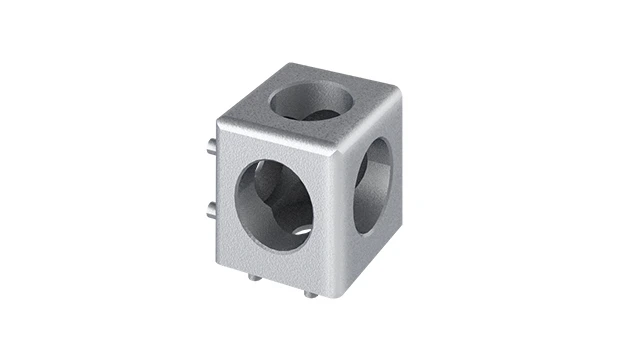
Aluminum Profile 3 Way Connector
The 3 way - squared corner connector is an external fastening method that is typically used to create a corner connection between three profiles. It is a heavy-duty connection that is simple to use and provides a polished look.
Introduction: The Unsung Heroes of Modular Systems
Walk into any modern factory, workshop, or warehouse, and you'll likely spot a maze of sleek, silver structures: workbenches cluttered with tools, material racks stacked with components, and conveyor systems zipping products along. These aren't just random metal frames—they're precision-engineered setups built from aluminum extrusion profiles, held together by small but mighty parts called connectors. Among these, the aluminum profile 3 way connector stands out as a quiet workhorse, enabling the creation of stable, multi-directional structures that power daily operations.
But here's the thing: not all connectors are created equal. Imagine this scenario: A team in a electronics assembly plant notices their material rack—loaded with circuit boards and delicate components—has started to wobble. A quick inspection reveals the 3 way connectors joining the vertical and horizontal aluminum extrusion profiles are bent, their once-tight grips loosened by the weight they're bearing. The culprit? Underestimating load capacity. That's why understanding what these connectors can handle isn't just a technical detail—it's a cornerstone of safety, efficiency, and avoiding costly downtime.
In this article, we'll dive deep into aluminum profile 3 way connector load capacity: what it is, what affects it, how to test it, and why it matters for your operations. Whether you're building a workbench, setting up a material rack, or designing a custom conveyor system, this guide will help you make informed choices that keep your structures standing strong.
What Are Aluminum Profile 3 Way Connectors, Anyway?
Let's start with the basics. Aluminum extrusion profiles are those versatile, T-slot Aluminum Profile pieces you've seen—hollow, lightweight, and designed to interlock with accessories like brackets, panels, and yes, connectors. They're popular because they're modular: you can assemble, disassemble, and reconfigure them endlessly without welding or heavy tools. And at the heart of this flexibility are connectors.
A 3 way connector, as the name suggests, is a component that joins three aluminum extrusion profiles at once. Think of it as a three-armed hub: one arm connects to a vertical profile, another to a horizontal one, and the third to a diagonal or perpendicular piece, forming stable joints at angles like 90°, 45°, or even 135°. These connectors are the "glue" that turns individual aluminum extrusion profiles into functional structures—from a simple workbench to a complex material rack b (3 row and 3 floor) that holds hundreds of pounds of inventory.
But why 3 way connectors specifically? Unlike 2 way (straight) or 4 way (cross) connectors, 3 way models excel at creating branching structures. Need a workbench with a side shelf? A material rack with dividers? A conveyor system that splits into two paths? You'll reach for a 3 way connector. Their ability to distribute weight across three directions makes them indispensable for balanced, sturdy builds.

Design and Materials: The Building Blocks of Load Capacity
Not all 3 way connectors look the same, and those differences directly impact how much weight they can handle. Let's break down the key design and material factors that influence load capacity.
Materials: Aluminum Alloys and Beyond
Most 3 way connectors are made from aluminum alloys, with 6063-T5 being the industry standard. Why? This alloy offers a winning combo of strength, lightweight, and corrosion resistance—perfect for indoor industrial settings. For harsher environments (like outdoor use or chemical plants), you might find stainless steel connectors, which add durability but also extra weight and cost.
The quality of the aluminum matters, too. Connectors made from high-purity alloys with consistent heat treatment will have more predictable load capacities than those with impurities or shoddy manufacturing. Look for suppliers who specify their material grades—this transparency is a good sign of reliability.
Design Features That Boost Strength
Take a close look at a 3 way connector, and you'll notice small design details that punch above their weight:
- Ribbed interiors: Many connectors have internal ribs or gussets that reinforce the arms, preventing bending under load.
- Thick walls: Thicker metal at the joints (where stress is highest) adds rigidity. A connector with 2mm walls will outperform one with 1mm walls in most cases.
- Clamping mechanisms: Most connectors use set screws or bolts to grip the aluminum extrusion profile's T-slot. Larger screws (like M8 vs. M6) and deeper thread engagement mean a tighter, more secure hold—critical for preventing slippage under heavy weight.
- Symmetrical design: Balanced arm lengths and equal wall thickness across all three arms ensure weight is distributed evenly, reducing strain on any single arm.
For example, a connector with a "Y" shape (where all three arms meet at a central point) might distribute load more evenly than a "T" shape (with one arm perpendicular to the other two). The latter could put extra stress on the vertical arm, limiting its maximum capacity.

Factors That Influence Load Capacity: It's Not Just About the Connector
Load capacity isn't a fixed number stamped on a connector. It's a dynamic metric influenced by a mix of connector-specific traits and external factors. Let's unpack the key variables that determine how much weight your 3 way connector can safely handle.
1. Aluminum Extrusion Profile Size and Thickness
Your connector is only as strong as the aluminum extrusion profile it's attached to. A beefy 4040 aluminum extrusion profile (40mm x 40mm) with 2mm walls can transfer far more load to a connector than a flimsy 2020 profile (20mm x 20mm) with 1mm walls. Mismatching a heavy-duty connector with a lightweight profile is like putting a race car engine in a bicycle—you won't get the performance you expect, and the profile itself might bend or warp first.
Always pair connectors with profiles of compatible sizes. Most manufacturers label connectors by series (e.g., 20-series for 2020 profiles, 30-series for 3030 profiles) to make this easy.
2. Installation Quality: Tightness Matters
Even the best connector will fail if installed poorly. Overtightening set screws can strip the T-slot threads or crack the connector, while undertightening leaves gaps that let the profile shift under load—both scenarios drastically reduce effective load capacity. Aim for "snug but not excessive" when tightening: use a torque wrench if possible (most suppliers recommend 3-5 Nm for aluminum connectors) and check for play after installation.
Also, ensure the connector is fully seated on the profile. A connector that's only partially inserted into the T-slot has less contact area, weakening the joint.
3. Environmental Conditions
Heat, humidity, and chemicals can all degrade connector performance over time. In high-temperature environments (like near ovens or furnaces), aluminum alloys may lose some strength. Humidity or corrosive substances (oils, solvents) can cause rust (in steel connectors) or pitting (in aluminum), weakening the metal. If your workspace is harsh, opt for stainless steel connectors or aluminum ones with protective coatings, and inspect them more frequently.
4. Load Direction: Static vs. Dynamic, Vertical vs. Horizontal
Load capacity isn't one-size-fits-all—it varies by direction and type of load:
- Static load: A steady, unmoving weight (e.g., boxes sitting on a material rack) is easier to handle than…
- Dynamic load: A moving or vibrating weight (e.g., parts sliding down a roller track on a conveyor). Dynamic loads exert extra stress as they shift, so connectors need a higher safety margin here.
- Vertical load: Weight pushing down (e.g., a workbench holding tools) is generally easier for connectors to manage than…
- Horizontal load: Sideways force (e.g., a material rack being bumped by a forklift). Horizontal loads test a connector's shear strength and can cause bending if not accounted for.
Manufacturers often list "max static vertical load" as a baseline, but always factor in your specific load type when choosing a connector.
Testing Load Capacity: How Manufacturers Determine Limits
When you see a connector labeled "max load: 500 lbs," how was that number calculated? Manufacturers don't just guess—they rely on rigorous testing to establish safe load limits. Let's peek behind the curtain at the common tests that determine a 3 way connector's load capacity.
Static Load Testing: The Gold Standard
Static load testing is the most straightforward method: mount the connector to aluminum extrusion profiles in a typical configuration (e.g., a T-joint), then gradually apply weight until the connector deforms or fails. The "rated load" is usually 25-50% of the failure load (this safety factor ensures you don't push the connector to its breaking point in real use).
For example, if a connector fails at 1000 lbs during testing, its rated load might be 500 lbs—giving you a 2:1 safety margin. This buffer accounts for variables like installation errors, material inconsistencies, and unexpected dynamic loads.
Shear and Bending Tests
Shear testing measures how well the connector resists forces parallel to the joint (e.g., a sideways push on a material rack). Bending tests apply force perpendicular to the connector arms to simulate sagging or flexing. Both are critical for ensuring the connector can handle real-world stresses beyond simple vertical weight.
Dynamic Fatigue Testing
For connectors in high-movement applications (like conveyor systems), dynamic fatigue testing is key. This involves repeatedly applying and releasing a load (e.g., 10,000 cycles of 300 lbs) to check for wear, loosening, or metal fatigue. Connectors that pass this test are better suited for environments with constant vibration or movement.
Keep in mind: Manufacturer ratings are based on ideal conditions (perfect installation, room temperature, no corrosion). Your actual load capacity might be lower, so always add an extra safety margin (we recommend 20-30%) when designing your structure.
Real-World Applications: Load Requirements in Action
Load capacity numbers mean little without context. Let's look at common applications where 3 way connectors shine and the typical load requirements you'll encounter.
Workbenches: Where Stability Meets Daily Use
A workbench is the backbone of any workshop, and its 3 way connectors take a constant beating—from tools being slammed down to heavy parts being set on the surface. A standard workbench e (single deck-without caster) might need to support 200-500 lbs, depending on whether it's used for light assembly or heavy machining. For example, an electronics workbench with small components might max out at 200 lbs, while an automotive workbench holding engine parts could need 500 lbs or more.
Here, 3 way connectors are critical at the corners (joining legs, top, and side rails) and any shelf supports. They must handle both vertical load (the weight on the bench) and horizontal load (when someone leans on the bench or pushes against it).
Material Racks: Stacking Safely
Material racks—like the popular material rack b (3 row and 3 floor)—are workhorses for storage, holding everything from raw materials to finished products. Each shelf in a 3-row, 3-floor rack might need to support 100-300 lbs, depending on the items stored (e.g., plastic parts vs. metal components). Multiply that by 9 shelves, and the total load on the frame (and its 3 way connectors) adds up fast.
Connectors in material racks face vertical loads (from the shelves above) and horizontal loads (when items are slid in/out or the rack is bumped). A poorly rated connector here could lead to shelf collapse, risking damage to inventory and injury to workers.
Conveyor Systems: Moving Loads with Confidence
Conveyor systems use 3 way connectors to build frames that support roller tracks, motors, and guides. These connectors must handle not just the weight of the conveyor itself but also the dynamic load of products moving along the rollers—think boxes bouncing slightly as they travel, or sudden stops that create inertia forces. For a small parts conveyor, this might mean 50-100 lbs per linear foot; for heavier goods (like automotive parts), it could exceed 200 lbs per foot.
Vibration from motors adds another layer of stress, making fatigue resistance (tested via dynamic load tests) a must for conveyor connectors.
Choosing the Right 3 Way Connector: A Practical Guide
With so many options on the market, how do you pick the right 3 way connector for your project? Follow these steps to ensure you get a connector that matches your load needs and budget.
Step 1: Calculate Your Required Load Capacity
Start by estimating the maximum weight your structure will bear. For a workbench, add up the heaviest tools, parts, and equipment that will sit on it. For a material rack b (3 row and 3 floor), calculate the weight per shelf (item weight x quantity) and multiply by the number of shelves. Don't forget to include the weight of the aluminum extrusion profiles and other accessories (like panels or bins) in your total.
Once you have this number, add your safety margin (20-30% for static loads, 50% for dynamic loads) to get your target load capacity.
Step 2: Match Connector Series to Aluminum Extrusion Profile Size
As we mentioned earlier, connectors are sized to fit specific aluminum extrusion profile series. A 30-series connector (for 3030 profiles) won't work with 4040 profiles, and vice versa. Check your profile's dimensions (width x height) and choose a connector labeled for that series.
Step 3: Check Manufacturer Load Ratings
Reputable suppliers will list static load ratings for their connectors (e.g., "max static vertical load: 600 lbs"). Compare this to your target capacity (calculated in Step 1). If your target is 500 lbs, a connector rated for 600 lbs gives you a comfortable safety buffer.
Don't hesitate to ask for test reports or certification documents—transparent suppliers will happily share this info.
Step 4: Consider the Environment
Indoor, dry environments? Standard aluminum connectors are fine. Outdoor or corrosive settings? Opt for stainless steel or anodized aluminum. Cleanrooms (like in pharmaceuticals or electronics)? Look for connectors with smooth surfaces to avoid dust buildup.
Step 5: Factor in Cost vs. Performance
Premium connectors with higher load capacities and better materials cost more—but skimping on a connector to save $5 could lead to a $500 repair later. Balance your budget with the criticality of the structure: a workbench for light use might get by with a mid-range connector, but a material rack holding expensive inventory deserves top-tier hardware.
Maintenance Tips: Preserving Load Capacity Over Time
Even the best connector will degrade over time without proper care. Follow these maintenance tips to keep your 3 way connectors (and the structures they support) strong and safe.
Inspect Regularly
Schedule monthly visual inspections: Look for loose screws, cracks in the connector body, or corrosion. Wiggle the structure gently to check for play in the joints—any movement means the connector is loosening. Pay extra attention to high-stress areas (like workbench corners or material rack shelf supports).
Tighten Connections
Vibration and daily use can loosen set screws over time. Every 3-6 months, retighten all connector screws to the manufacturer's recommended torque. Use a thread locker (like Loctite) on critical joints to prevent loosening in high-vibration applications.
Clean and Protect
Wipe down connectors with a damp cloth to remove dust, oil, or debris that can hide cracks or cause corrosion. For aluminum connectors in humid areas, apply a thin coat of anti-corrosion spray (avoid oil-based sprays if working with electronics, as they can attract dust).
replace Worn Connectors
If you spot cracks, stripped threads, or significant corrosion, replace the connector immediately. Don't try to "fix" it with tape, glue, or extra screws—damaged connectors can fail suddenly, putting your structure and workers at risk.
Common Myths About Load Capacity
Misconceptions about 3 way connector load capacity can lead to unsafe designs. Let's debunk the most common myths.
Myth 1: "Bigger connectors always mean higher load capacity."
Not true! A larger connector might have more material, but if it's poorly designed (e.g., thin walls, weak clamping mechanisms), it could underperform a smaller, well-engineered model. Focus on rated load capacity and material quality, not just size.
Myth 2: "Manufacturer ratings are absolute."
Manufacturers test connectors under ideal conditions—perfect installation, controlled temperatures, no corrosion. Real-world use is messier. Always add a safety margin to account for variables like installation errors or unexpected loads.
Myth 3: "All connectors from the same brand are interchangeable."
Brands often offer multiple connector lines—economy, standard, and heavy-duty—with vastly different load capacities. A "30-series" connector from Brand X might handle 400 lbs, while their premium "30-series Pro" handles 600 lbs. Read the specs carefully.
Myth 4: "Once installed, connectors never need attention."
Connectors loosen over time due to vibration, thermal expansion, and daily use. Neglecting maintenance is a recipe for failure. Regular inspections and tightening are non-negotiable.
Comparison Table: 3 Way Connectors for Common Aluminum Extrusion Profiles
To help you compare options, here's a snapshot of typical 3 way connectors for popular aluminum extrusion profile sizes. Note: Load ratings are approximate and vary by manufacturer—always check the specific product specs!
| Aluminum Extrusion Profile Series | Connector Material | Max Static Vertical Load (lbs) | Suitable Applications | Safety Margin Recommendation |
|---|---|---|---|---|
| 2020 (20mm x 20mm) | Aluminum 6063-T5 | 200-300 | Small workbenches, light shelving, display racks | 20% (target: 160-240 lbs) |
| 3030 (30mm x 30mm) | Aluminum 6063-T5 | 400-600 | Standard workbenches, material rack b (3 row and 3 floor), medium shelving | 25% (target: 300-450 lbs) |
| 4040 (40mm x 40mm) | Aluminum 6063-T5 | 600-900 | Heavy workbenches, industrial material racks, conveyor frames | 30% (target: 420-630 lbs) |
| 4040 (40mm x 40mm) | Stainless Steel 304 | 700-1000 | Outdoor racks, corrosive environments, high-humidity areas | 30% (target: 490-700 lbs) |
Conclusion: Small Part, Big Impact
Aluminum profile 3 way connectors may be small, but their role in building safe, efficient structures is enormous. From workbenches to material racks to conveyor systems, these unassuming components determine whether your setup stands strong or falters under pressure. By understanding load capacity—what influences it, how to test it, and how to choose the right connector—you can design structures that not only meet your needs today but also stand the test of time.
Remember: Load capacity isn't just a technical specification. It's a promise of safety for your workers, protection for your inventory, and reliability for your operations. So the next time you reach for a 3 way connector, take a moment to consider its load rating. Your future self (and your bottom line) will thank you.