- Company Articles
- Products and Technology
- Product knowledge
- Aluminum Profile 3 Way Connector vs. Steel: Which Is Better for Your Line?

Aluminum Profile 3 Way Connector vs. Steel: Which Is Better for Your Line?
Related Product
Aluminum Profile 3 Way Connector
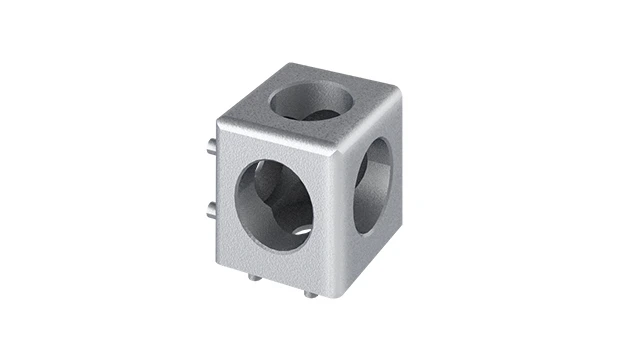
The 3 way - squared corner connector is an external fastening method that is typically used to create a corner connection between three profiles. It is a heavy-duty connection that is simple to use and provides a polished look.
Walk into any manufacturing plant, warehouse, or assembly facility, and you'll notice something that often goes unnoticed but keeps everything running: the quiet heroes holding the operation together. They're not the big machines or the high-tech software—they're the small, unassuming components like 3-way connectors. These little pieces are the glue of your production line, linking aluminum profiles or steel pipes to build workbenches, roller tracks, material racks, and the backbone of your lean system. But here's the question that keeps plant managers up at night: when it comes to 3-way connectors, should you go with aluminum or steel? It's a decision that sounds simple on the surface, but it ripples through every part of your operation—from setup time and daily efficiency to long-term costs and adaptability. Let's dive in and unpack this dilemma, because the right choice could be the difference between a production line that hums and one that struggles to keep up.
First Things First: What Even Is a 3-Way Connector?
Before we start comparing materials, let's make sure we're all on the same page. A 3-way connector is exactly what it sounds like: a component designed to join three pieces of material at a single point. Think of it as a traffic intersection for your industrial structure—instead of two pipes meeting, three come together, often at 90-degree angles or custom configurations. These connectors are the unsung architects of modular setups. Whether you're building a workbench where tools, parts, and assembly stations converge, a roller track that splits materials to different lines, or a material rack with multiple levels and branches, 3-way connectors are what make those complex, multi-directional structures possible.
In the world of aluminum profiles, these connectors are often part of a broader ecosystem of aluminum profile accessories—think brackets, end caps, and hinges—that turn basic aluminum extrusion profiles into fully functional workspaces. For steel systems, they might be heavier, bulkier, and designed to withstand higher loads, but their core job remains the same: to create strong, stable joints that can handle the chaos of daily operations.
Material Showdown: Aluminum vs. Steel—What Makes Them Tick?
At the heart of the aluminum vs. steel debate is the material itself. Let's break down what each brings to the table, starting with the basics. Aluminum, by nature, is a lightweight metal with a silver-white finish. It's known for being corrosion-resistant (thanks to a natural oxide layer that forms on its surface), non-magnetic, and highly malleable—meaning it can be shaped into intricate designs without breaking. Steel, on the other hand, is an alloy of iron and carbon, prized for its raw strength and durability. It's heavier, denser, and often magnetic, with a reputation for holding up under extreme pressure.
But here's where things get interesting: when we talk about aluminum profile 3-way connectors, we're usually referring to connectors made from aluminum alloys (like 6061 or 6063), which are engineered to be stronger than pure aluminum. These alloys balance lightweight properties with enough tensile strength to handle most industrial loads. Steel connectors, meanwhile, are often made from carbon steel or stainless steel (for corrosion resistance), with carbon steel being the go-to for heavy-duty applications.
Real Talk: Why Material Matters in Your Lean System
Let's say you're running a lean system focused on minimizing waste and maximizing flexibility. You need your workbenches and material racks to be easy to reconfigure when production needs change. If your connectors are heavy steel, moving them around requires extra labor, maybe even a forklift. But with aluminum, a couple of workers can disassemble and reassemble a section in an hour—no heavy machinery needed. That's the kind of efficiency that makes lean principles actually work on the factory floor.

Durability & Longevity: Which Holds Up Better Over Time?
No one wants to replace connectors every few months. So, how do aluminum and steel stack up when it comes to lasting power? Let's start with corrosion—one of the biggest enemies of industrial components. Aluminum, as we mentioned, forms a natural oxide layer that acts like a shield against rust and corrosion. That makes it a star in environments with humidity, moisture, or even chemicals—think food processing plants, coastal warehouses, or cleanrooms where stainless steel might be overkill but rust is a no-go. Steel, unless it's stainless steel, will rust if exposed to water or moisture over time. Even then, stainless steel is more resistant but not entirely immune, and it's pricier than regular carbon steel.
Then there's impact resistance. Steel wins here, hands down. If you're dealing with heavy parts slamming into a rack or frequent vibrations from nearby machinery, steel connectors are less likely to bend or deform. Aluminum, while tough, can dent or crack under sudden, extreme force. But here's the flip side: aluminum is more flexible. It bends before it breaks, which can be a safety feature. If a load is too heavy, an aluminum connector might warp, giving you a visual warning that something's wrong. Steel, being stiffer, might snap without much warning—risking a collapse.
| Factor | Aluminum Profile 3-Way Connector | Steel 3-Way Connector |
|---|---|---|
| Tensile Strength (Approx.) | 200-300 MPa (alloy-dependent) | 400-800 MPa (carbon steel) |
| Weight (Per Connector, 50mm Size) | 150-200 grams | 400-500 grams |
| Corrosion Resistance | Excellent (natural oxide layer) | Poor (carbon steel); Good (stainless steel) |
| Impact Resistance | Moderate (bends before breaking) | High (strong but may snap under extreme force) |
| Lifespan (Average Industrial Use) | 10-15 years (with minimal corrosion) | 15-20 years (carbon steel, if protected from rust); 20+ years (stainless steel) |
It's also worth mentioning wear and tear from daily use. Aluminum connectors are softer than steel, so they might show more scratches or dents from tools or accidental bumps. But here's the trade-off: those cosmetic imperfections rarely affect performance. Steel connectors, being harder, resist scratches better, but if they do get damaged (like a bent thread), it's harder to fix. You might end up replacing the entire connector instead of just buffing out a scratch.

Installation & Adaptability: Which Makes Your Team's Life Easier?
Let's talk about the day-to-day reality of setting up and maintaining your production line: installation. If you've ever tried to screw a steel connector into a steel pipe, you know it can be a workout. Steel is hard, so you need power tools—drills, wrenches, maybe even a tap to clean the threads. And because steel is heavy, holding a connector in place while someone else tightens the bolts is a two-person job at minimum. Aluminum connectors? They're a breeze by comparison. Their lightweight design means one person can hold the connector and tighten the screws with a regular hex key. No power tools required, and no strained backs from lifting heavy parts.
Adaptability is another big one, especially if you're using a lean system where reconfiguring workspaces is part of the routine. Aluminum profiles and their accessories (like 3-way connectors) are designed with modularity in mind. Most aluminum connectors use T-slot designs, where you can slide bolts into the profile's slots and secure the connector without drilling new holes. That means you can move a connector from one part of the profile to another in minutes—no need to patch holes or re-thread pipes. Steel connectors, especially those for threaded steel pipes, are more permanent. Once you drill a hole or thread a pipe, changing the position means starting over, which wastes time and materials.
Roller Tracks: A Case Study in Adaptability
Let's zoom in on roller tracks—those essential systems that move materials from one station to the next. Roller tracks rely on smooth, precise connections to keep rollers aligned and materials flowing without jams. Aluminum profile 3-way connectors shine here because they're easy to adjust. If a roller is slightly off-kilter, you can loosen the connector, tweak the angle, and tighten it back up—all in 5 minutes. With steel connectors, adjusting alignment often means unbolting everything, which disrupts the entire track. And because aluminum is lighter, the roller track itself is easier to install at the right height, reducing the risk of worker injury during setup.
Cost: Upfront vs. Long-Term Value
Let's get real about money. Steel connectors are almost always cheaper upfront than aluminum ones. A basic carbon steel 3-way connector might cost half as much as an aluminum alloy equivalent. But here's the catch: cost isn't just about the price tag on the connector. You have to factor in installation labor, shipping, maintenance, and replacement costs over time.
Aluminum's lightweight design cuts down on shipping costs—you can fit twice as many aluminum connectors on a pallet as steel ones, lowering transport fees. Installation labor is cheaper too, since you need fewer workers and no heavy equipment. And over time, aluminum's corrosion resistance means you won't be replacing rusted connectors every few years, saving on replacement parts and downtime. Steel, on the other hand, might cost less upfront, but if you're paying workers overtime to move heavy parts or replacing rusted connectors annually, those savings disappear fast.
Crunching the Numbers: A 5-Year Cost Breakdown
Let's say you need 100 3-way connectors for a workbench setup. Steel connectors cost $5 each ($500 total), aluminum cost $10 each ($1000 total). Installation for steel takes 4 hours with 2 workers ($40/hour each = $320). Aluminum takes 2 hours with 1 worker ($80 total). Shipping for steel: $200 (heavy pallets). Shipping for aluminum: $100 (lighter load). Over 5 years, steel needs replacement every 2 years (rust), so 3 sets = $1500. Aluminum lasts 5+ years, no replacement. Total for steel: $500 + $320 + $200 + $1500 = $2520. Total for aluminum: $1000 + $80 + $100 = $1180. Aluminum saves $1340 over 5 years. That's the kind of math that makes CFOs smile.
Which One Should You Choose? It Depends on Your Needs
There's no one-size-fits-all answer, but here's a cheat sheet to help you decide:
Choose Aluminum Profile 3-Way Connectors If:
- You need lightweight, easy-to-install components for frequent reconfiguration (lean system vibes).
- Your workspace has moisture, humidity, or mild chemicals (corrosion resistance is key).
- You want to reduce installation labor and long-term maintenance costs.
- Your loads are moderate (most assembly workbenches, light to medium roller tracks, material racks).
Choose Steel 3-Way Connectors If:
- You're dealing with extreme heavy loads (think automotive manufacturing with engine parts).
- Your environment is dry and free of corrosion risks (indoor warehouses with low humidity).
- Upfront cost is your top priority, and you don't plan to reconfigure often.
- You need magnetic properties (for holding metal tools or parts).
Final Thoughts: It's About Your Line's Unique Story
At the end of the day, aluminum profile 3-way connectors and steel connectors aren't enemies—they're tools, each with their own superpowers. Aluminum is the flexible, efficient sidekick for lean systems and dynamic workspaces. Steel is the tough, no-nonsense hero for heavy loads and static setups. The key is to look at your line's unique needs: What's your daily workflow like? How often do you reconfigure? What's your biggest pain point—downtime, labor costs, or corrosion?
And remember, the best systems often mix the two. Maybe you use steel connectors for the base of a heavy workbench (where load matters most) and aluminum connectors for the upper shelves (where flexibility is key). There's no rule that says you have to pick one and stick with it. The goal is to build a line that works for you —one that's strong when it needs to be, flexible when it has to be, and always ready to adapt to whatever production throws its way.
So, the next time you're staring at a catalog of connectors, think beyond the specs. Think about the workers who'll install them, the teams who'll use the line every day, and the future changes your business might face. That's how you'll choose not just a connector, but a partner in your operation's success.