- Company Articles
- Products and Technology
- Product knowledge
- Aluminum Profile 3 Way Connector vs. Welding: Pros and Cons

Aluminum Profile 3 Way Connector vs. Welding: Pros and Cons
Related Product
Aluminum Profile 3 Way Connector
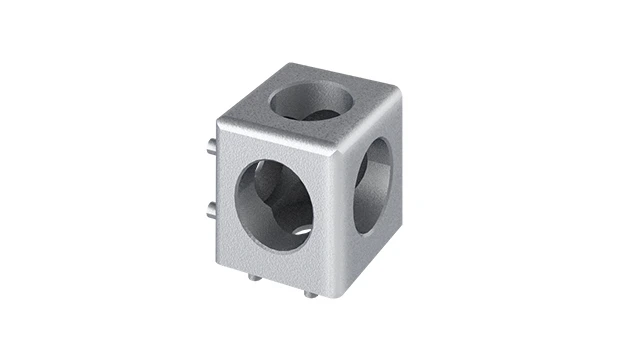
The 3 way - squared corner connector is an external fastening method that is typically used to create a corner connection between three profiles. It is a heavy-duty connection that is simple to use and provides a polished look.
Aluminum has become a cornerstone material in modern manufacturing, construction, and design, prized for its unique blend of light weight, corrosion resistance, and structural strength. At the heart of many aluminum-based projects lies the humble aluminum extrusion profile—a versatile, T-slot-equipped component that serves as the building block for everything from factory workbenches to retail displays. But even the most well-designed extrusion profile is only as useful as the method used to join it to others. When it comes to connecting aluminum profiles, two methods dominate: mechanical fasteners like the aluminum profile 3 way connector and traditional welding. Each approach carries its own set of advantages, drawbacks, and ideal use cases. In this article, we'll dive deep into the world of aluminum profile assembly, comparing these two techniques to help you decide which is right for your next project.
Aluminum Extrusion Profiles: The Backbone of Modern Design
Before we compare joining methods, let's first understand the foundation they're built on: the aluminum extrusion profile. These profiles are created through a process called extrusion, where heated aluminum billets are forced through a die to create consistent, custom cross-sectional shapes. The result? Lightweight, rigid structures with integrated T-slots—longitudinal grooves that run the length of the profile. These T-slots are what make aluminum extrusion profiles so versatile: they allow for easy attachment of accessories, panels, and, crucially, other profiles.
From small-scale DIY projects to large industrial setups, aluminum extrusion profiles are everywhere. Think of the workbench in your garage, the material rack in a warehouse, or the frame of a trade show booth—chances are, they're made from these profiles. Their popularity stems from their adaptability: with the right joining method, they can be configured into almost any shape, making them a favorite for lean system implementations, where flexibility and efficiency are key.
Aluminum Profile 3 Way Connectors: The Mechanical Alternative
Mechanical connectors, and in particular the aluminum profile 3 way connector, have revolutionized how we build with aluminum extrusion profiles. As the name suggests, a 3 way connector is designed to join three profiles at a single junction, typically at 90-degree angles (though some models allow for adjustable angles). These connectors are part of a broader category of aluminum profile accessories—small, specialized components that unlock the full potential of T-slot profiles.
How Do 3 Way Connectors Work?
Most 3 way connectors are made from durable materials like aluminum alloy or steel, ensuring they match the strength of the profiles they join. They're engineered to fit snugly into the T-slots of aluminum extrusion profiles, using bolts, set screws, or spring-loaded pins to secure the connection. For example, a typical 3 way connector might have three arms, each with a channel that aligns with the T-slot of a profile. Once inserted, a bolt is tightened into the T-slot nut, clamping the connector firmly to the profile.
Some connectors are fixed-angle, designed for rigid 90-degree joints, while others are adjustable, allowing for custom angles between 0 and 180 degrees. This flexibility makes them ideal for projects where geometry isn't perfectly orthogonal—think of a sloped roof on a display stand or a diagonal brace in a machine frame.
Pros of Using 3 Way Connectors
- No Heat, No Damage: Unlike welding, which relies on high heat to melt metal, 3 way connectors use mechanical force to join profiles. This means no risk of heat distortion—a critical advantage, as aluminum is highly sensitive to temperature changes. Excessive heat can weaken the metal, warp the profile, or even compromise the integrity of the T-slots, rendering them useless for future accessory additions.
- DIY-Friendly Installation: You don't need to be a certified professional to use a 3 way connector. With basic hand tools (a hex key or wrench), even a novice can assemble a sturdy structure in minutes. This accessibility makes connectors a favorite for small businesses, hobbyists, and startups without access to specialized labor.
- Reusability and Adjustability: One of the biggest perks of mechanical connectors is their reversibility. If you make a mistake or need to reconfigure your project—say, expanding a workbench or repurposing a material rack—simply loosen the bolts, disassemble the connectors, and rebuild. This is a game-changer for lean system setups, where adaptability is essential to responding to shifting production needs.
- Cost-Effective for Small Projects: The upfront cost of connectors is minimal compared to welding equipment. A basic set of 3 way connectors and T-slot nuts costs a fraction of a MIG welder, making them ideal for budget-conscious projects or one-off builds.
- Clean Aesthetics: Well-designed connectors sit flush with the profile's surface, creating a streamlined, professional look. While the joints are visible, they often add a modern, industrial charm—think of the exposed hardware in mid-century furniture or contemporary retail displays.
Cons of Using 3 Way Connectors
- Load Capacity Limits: While connectors are strong enough for most light-to-medium applications, they can't match the sheer tensile strength of a welded joint. In high-load scenarios—like supporting heavy machinery or structural beams—welded connections are often necessary to ensure safety.
- Dependence on Accessory Quality: Not all connectors are created equal. Cheap, poorly made connectors (often made from low-grade plastic or thin metal) can bend, strip, or loosen over time, compromising the stability of the entire structure. Investing in high-quality aluminum or steel connectors is a must.
- Visible Joints (For Some): While many appreciate the industrial look of exposed connectors, others prefer the seamless appearance of welded joints. In applications where aesthetics are paramount—like high-end retail displays or architectural features—visible connectors might be a drawback.
- Potential for Loosening: Over time, vibrations from machinery or regular use can cause connector bolts to loosen. This isn't a dealbreaker—periodic tightening with a wrench solves the problem—but it does require ongoing maintenance, unlike a permanent weld.

Welding Aluminum Profiles: The Permanent Bond
Welding has been a go-to joining method for metalworking for decades, and for good reason: it creates a molecular bond between two pieces of metal, resulting in a connection that's often as strong as the material itself. When it comes to aluminum profiles, welding involves melting the base metal (and sometimes a filler rod) to fuse the profiles together. However, aluminum welding isn't as straightforward as welding steel—its low melting point, high thermal conductivity, and stubborn oxide layer (alumina) require specialized techniques and equipment.
The Challenges of Welding Aluminum
Aluminum's natural oxide layer (alumina) has a higher melting point than the aluminum itself, which means it can't be melted by the heat of a typical welding arc. To overcome this, welders must either mechanically clean the surface (with a wire brush or chemical etchant) or use an AC welding current, which breaks up the oxide layer. This extra step adds complexity, making aluminum welding more skill-intensive than steel welding.
Common aluminum welding methods include TIG (Tungsten Inert Gas) welding, which uses a non-consumable tungsten electrode and inert gas (like argon) to shield the weld pool, and MIG (Metal Inert Gas) welding, which feeds a consumable wire electrode through a gun. TIG welding is prized for precision and clean results, making it ideal for visible joints, while MIG welding is faster and better suited for high-volume production.
Pros of Welding Aluminum Profiles
- Superior Strength: A well-executed weld creates a continuous bond that's stronger than the surrounding material. This makes welded joints ideal for applications with high static or dynamic loads, such as structural supports, heavy machinery frames, or load-bearing shelving in warehouses.
- Seamless Aesthetics: Welded joints, when ground and finished properly, can be made nearly invisible. This is a huge advantage for projects where a clean, monolithic look is desired—think of architectural railings, custom furniture, or high-end retail fixtures.
- Long-Term Durability: Welds are permanent. Once fused, they won't loosen, rattle, or require retightening, even under constant vibration. This makes them a reliable choice for infrastructure that needs to last decades, like factory assembly lines or public transit components.
- Suitable for Large-Scale Projects: For industrial applications with hundreds or thousands of joints, welding (especially with automated systems) can be more efficient than manually tightening connectors. Skilled welders can work quickly, and modern equipment like robotic welders further speed up production.
Cons of Welding Aluminum Profiles
- Heat Distortion: Aluminum's high thermal conductivity means heat spreads quickly, leading to warping or twisting of the profile. Even experienced welders struggle to avoid distortion, especially with thin-walled extrusion profiles. This can ruin the profile's dimensions, making T-slots misalign or panels sit unevenly.
- Skill and Cost Barriers: Welding aluminum isn't a hobby—it requires training, certification, and expensive equipment. A basic TIG setup can cost thousands of dollars, and hiring a skilled welder adds even more to the project budget. For small businesses or DIYers, this upfront investment is often prohibitive.
- No Room for Mistakes: Welds are permanent. If you misalign a profile or change your mind about the design, disassembling a welded structure means cutting through the metal—destroying the profiles in the process. This lack of flexibility is a major downside for projects that might need reconfiguration, like a lean system where workflows evolve over time.
- Post-Processing Hassles: A raw weld is rough, discolored, and far from attractive. To achieve a clean finish, welds must be ground, sanded, and sometimes anodized to match the original profile's coating. This adds time and labor to the project, increasing costs further.

Head-to-Head: 3 Way Connectors vs. Welding
To better visualize the differences between these two methods, let's break them down side by side. The table below compares key factors like strength, cost, and flexibility to help you weigh your options.
| Factor | Aluminum Profile 3 Way Connector | Welding |
|---|---|---|
| Strength | Good for light-to-medium loads; depends on connector quality | Excellent for heavy loads; bond is often stronger than the profile itself |
| Installation Skill | DIY-friendly; requires only basic hand tools | Requires certified welders and specialized training |
| Time Investment | Fast (minutes per joint); no curing or cooling time | Slow (hours per project); includes prep, welding, and post-processing |
| Cost | Low upfront cost (connectors + tools); affordable for small projects | High upfront cost (equipment + labor); better for large, high-budget projects |
| Reusability | Highly reusable; profiles and connectors can be repurposed | Not reusable; disassembly destroys profiles |
| Heat Impact | None; no risk of distortion or weakening | High; risk of warping, T-slot damage, or material weakening |
| Aesthetic Appeal | Visible joints (industrial/modern look); clean with quality connectors | Seamless (if finished); requires grinding to look polished |
| Maintenance | Minimal; periodic bolt tightening | None; permanent once cooled and finished |
| Best For | Lean systems, DIY projects, temporary setups, small businesses | Structural builds, heavy machinery, permanent installations, large-scale production |
Real-World Applications: When to Choose Which
To put this comparison into context, let's look at two common scenarios where aluminum extrusion profiles are used, and see which joining method makes sense.
Scenario 1: A Small Factory Implementing a Lean System
Imagine a small electronics manufacturer looking to optimize its assembly line with a lean system. Their goals: reduce waste, improve workflow, and adapt quickly to changing product designs. They need workbenches, material racks, and component feeders—all built from aluminum extrusion profiles.
For this team, aluminum profile 3 way connectors are the clear choice. Why? Lean systems thrive on flexibility. If a new product requires a longer workbench or a reconfigured material rack, the team can disassemble the connectors, adjust the profiles, and rebuild in hours. Welding would lock them into a fixed layout, making it costly and time-consuming to adapt. Additionally, the factory has a small budget and no in-house welders, so the DIY-friendly nature of connectors keeps costs low.
Scenario 2: A Construction Company Building a Structural Canopy
Now, consider a construction firm tasked with building a lightweight aluminum canopy over a loading dock. The canopy must withstand heavy rain, snow, and high winds—so strength and durability are non-negotiable. The client also wants a sleek, modern look with no visible hardware.
Here, welding is the better option. The canopy's structural supports need to bear significant weight, and a welded joint's strength ensures safety and longevity. Welding also allows for seamless, clean lines that match the client's aesthetic requirements. While the upfront cost is higher (hiring a certified welder and renting equipment), the permanent, low-maintenance nature of the welds justifies the expense for a long-term, outdoor structure.
Conclusion: Choosing the Right Method for Your Project
At the end of the day, the choice between aluminum profile 3 way connectors and welding comes down to your project's specific needs. If you value flexibility, affordability, and ease of installation—especially for lean system setups or small-scale projects—connectors are the way to go. They're the Swiss Army knife of aluminum assembly: adaptable, accessible, and ready to evolve with your needs.
On the other hand, if your project demands maximum strength, permanence, or a seamless aesthetic—think structural builds or high-end designs—welding is worth the investment. It's a time-tested method that delivers unbeatable durability, provided you have the skill and budget to back it up.
No matter which method you choose, one thing is clear: aluminum extrusion profiles, paired with the right joining technique, offer endless possibilities for innovation. Whether you're building a workbench in your garage or a canopy for a commercial space, the key is to align your assembly method with your goals—and let the profiles do the rest.