- Company Articles
- Products and Technology
- Product knowledge
- Aluminum Profile 3 Way Connectors: A Key Component in Lean Management

Aluminum Profile 3 Way Connectors: A Key Component in Lean Management
Related Product
Aluminum Profile 3 Way Connector
The 3 way - squared corner connector is an external fastening method that is typically used to create a corner connection between three profiles. It is a heavy-duty connection that is simple to use and provides a polished look.
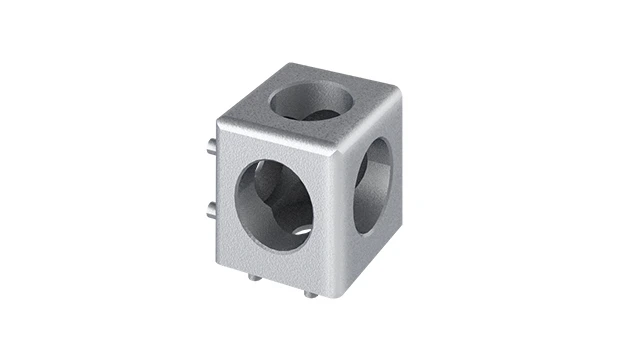
How small, versatile parts are transforming factory floors and driving lean success
The Hidden Cost of Rigidity in Manufacturing
Imagine walking onto a factory floor where every workstation looks the same. The workbenches are bolted to the ground, the material racks are welded into fixed positions, and if a new product line needs a slightly taller table or a wider flow rack? The maintenance team spends two days disassembling and rebuilding—while production grinds to a halt. Sound familiar? For decades, this was the norm in manufacturing. Rigid, one-size-fits-all setups were seen as "reliable," but in reality, they were silently draining efficiency, wasting time, and stifling adaptability.
Then came the era of lean management—a philosophy built on the idea that waste is the enemy. Not just physical waste like scrap material, but also the less obvious kinds: downtime, overproduction, unnecessary movement, and yes, the inflexibility of rigid workspaces. Lean teaches us that to thrive, a production system must be as dynamic as the market it serves. But here's the thing: you can't build a flexible system with inflexible tools. That's where the unsung heroes of lean systems come into play—components like aluminum profiles and their connectors, especially the versatile aluminum profile 3 way connectors.
These small, unassuming parts might not grab headlines, but they're the glue that holds modern lean environments together. They turn static factory floors into adaptable ecosystems where workbenches, flow racks, and assembly lines can be reconfigured in hours (or even minutes) instead of days. In this article, we'll dive into why aluminum profile 3 way connectors are more than just hardware—they're a cornerstone of lean management, enabling the agility and efficiency that today's manufacturers need to stay competitive.
Lean Management 101: Why Flexibility Matters
Before we get into the nuts and bolts of connectors, let's take a step back and understand why lean management has become the gold standard in manufacturing. At its core, lean is about creating more value with less waste. Developed by Toyota in the mid-20th century, the Toyota Production System (TPS)—the foundation of lean—revolutionized manufacturing by focusing on continuous improvement and respect for people . Over time, these principles evolved into what we now call lean management, with five key pillars:
- Value: Define what the customer actually pays for (not what you think they need).
- Value Stream Mapping: Identify every step in the production process and eliminate steps that don't add value.
- Flow: Ensure materials and information move smoothly through the system, without bottlenecks or delays.
- Pull: Produce only what's needed, when it's needed (no overstocking).
- Perfection: Continuously refine the process to eliminate waste, big and small.
Notice that three of these pillars—flow, pull, and perfection—depend heavily on adaptability. If your production line can't adjust to changes in demand (pull), if materials get stuck in a rigid flow rack (flow), or if you can't tweak a workstation to reduce operator movement (perfection), your lean efforts will hit a wall. That's where modular systems, built with aluminum profiles and 3 way connectors, shine. They're designed to evolve with your process, not fight against it.
Case Example: The Cost of Rigidity
A mid-sized electronics manufacturer was struggling with frequent product launches. Each new device required slight changes to their assembly workbenches—extra shelving for tools, taller tables for larger circuit boards, or integrated flow racks to feed components faster. With their old wooden workbenches (bolted to the floor) and steel racks (welded in place), reconfiguring took 16 hours per workstation. For a line of 10 workstations, that's 160 hours of downtime—costing them $40,000 in lost production (based on an average hourly output of $250). Worse, by the time the setup was ready, the product design might change again, requiring another round of modifications. Sound like a lean nightmare? It was—until they switched to aluminum profile systems.

Aluminum Profiles: The Backbone of Modular Lean Systems
Aluminum profiles are exactly what they sound like—extruded aluminum bars with a T-slot design running along their length (and sometimes width). Think of them as industrial-grade building blocks. Lightweight but surprisingly strong, they're corrosion-resistant, easy to clean, and compatible with a wide range of accessories. But their real power lies in their modularity: they can be cut to any length, combined in endless configurations, and—thanks to connectors—assembled and disassembled without welding, drilling, or specialized tools.
While aluminum profiles are the "bones" of these systems, the connectors are the "joints." They're what allow you to attach two profiles at 90 degrees, extend a rack vertically, or create complex structures like workbenches with integrated flow racks. And among all connector types, the aluminum profile 3 way connectors are the most versatile. As the name suggests, they connect three profiles at once, enabling T-shaped or Y-shaped junctions. Need a workbench with a side shelf? A flow rack with a vertical divider? A material trolley with a handlebar and two support legs? A 3 way connector makes it possible—no welding required.
But why aluminum? Why not steel or plastic? Aluminum hits the sweet spot for lean systems: it's lightweight enough to be moved by hand (reducing the need for heavy machinery during reconfigurations), strong enough to support typical manufacturing loads (think 50-200 kg per shelf), and durable enough to withstand the wear and tear of daily use. Plus, its natural resistance to rust means it works in everything from cleanrooms to warehouse environments. When paired with aluminum profile accessories like end caps (to smooth rough edges), rubber strips (to dampen noise), or brackets (to mount tools), aluminum profiles become the ultimate canvas for lean innovation.

Anatomy of an Aluminum Profile 3 Way Connector: More Than Just a "Joint"
Let's take a closer look at what makes aluminum profile 3 way connectors so special. At first glance, they might seem like simple plastic or metal pieces with holes, but their design is surprisingly thoughtful—engineered to solve the specific challenges of modular lean systems.
Most 3 way connectors are made from die-cast aluminum alloy or high-strength nylon (for lighter loads). They feature three connection points, each designed to slide into the T-slot of an aluminum profile. Inside each connection point is a grub screw or a cam lever: tighten the screw, and it presses against the slot, creating a secure, vibration-resistant hold. No bolts, no nuts, no hassle. Need to reposition? Loosen the screw, slide the connector, and retighten. It's that easy.
The key advantages of this design include:
- Tool-less Adjustment: Most connectors can be tightened with a standard hex key (Allen wrench), which every maintenance cart has. No need for welding torches or power drills.
- Reusability: Unlike welded joints or glued connections, these connectors can be disassembled and reused hundreds of times. Change your mind about a design? Just take it apart and start over.
- Load Capacity: Don't let their small size fool you. A high-quality aluminum 3 way connector can support 50-100 kg per connection point, depending on the profile size. That's enough for most manufacturing applications—from tool storage to heavy material racks.
- Precision: The T-slot design ensures profiles align perfectly every time, so your workbench won't wobble, and your flow rack won't tilt. Consistency is key in lean systems—even small misalignments can cause jams or slow down material flow.
But perhaps the biggest benefit is the design freedom they offer. With 3 way connectors, you're not limited to right angles or straight lines. Want a workbench with a diagonal support bar for extra stability? A flow rack that splits into two paths? A mobile trolley with a handlebar and two side rails? Mix and match 3 way connectors with other connector types (like 90-degree or swivel connectors), and you can build almost anything. It's like Legos for adults—but with a purpose.
3 Way Connectors in Action: Building Lean Systems That Work
Enough theory—let's talk about real-world applications. Where do aluminum profile 3 way connectors make the biggest impact in lean systems? Let's explore three common use cases: workbenches, flow racks, and material handling trolleys.
1. Workbenches: From Static to Dynamic
Workbenches are the heart of any assembly line. A well-designed workbench reduces operator fatigue, keeps tools within reach, and integrates seamlessly with material flow. But a poorly designed one? It becomes a source of waste—extra steps to grab tools, awkward postures, and downtime when reconfiguration is needed. Aluminum profile workbenches, built with 3 way connectors, solve all these problems.
Imagine a workbench with a main frame made of 40x40mm aluminum profiles. Using 3 way connectors, you can add:
- A side shelf (T-junction) for frequently used tools.
- Vertical posts (Y-junction) to mount overhead lighting or a parts bin rack.
- A lower shelf (another T-junction) for storing manuals or finished products.
- Integrated flow rack rails (connected via 3 way connectors) along the back, feeding components directly to the operator.
And if the operator needs the shelf higher? Loosen the 3 way connectors, slide the shelf up, retighten. Done in 5 minutes. No downtime, no hassle. That's lean in action.
2. Flow Racks: Smoothing the Material Stream
Flow racks (or gravity racks) are critical for lean material flow. They use gravity to feed components from the back (where stock is replenished) to the front (where operators pick them), ensuring first-in-first-out (FIFO) inventory and reducing walk time. But traditional steel flow racks are heavy, fixed in size, and hard to adjust. Aluminum flow racks, built with 3 way connectors, are different.
Using 3 way connectors, you can build a flow rack with adjustable shelves (to fit different box sizes), variable angles (to control the speed of material flow), and even integrated dividers (to separate parts). For example, a 3 row, 3 floor material rack (sound familiar?) can be built by connecting horizontal rails with vertical posts via 3 way connectors. Need to add a fourth row? Just insert another rail and secure it with a 3 way connector. No welding, no cutting—just quick, easy adjustments.
3. Material Trolleys: Mobility Meets Modularity
Lean systems rely on moving materials to the operator, not the other way around. That's where mobile trolleys come in. But traditional steel trolleys are heavy, hard to customize, and prone to rust. Aluminum profile trolleys, built with 3 way connectors, are lightweight (easy to push), customizable (add shelves, bins, or flow rails), and durable.
A basic trolley frame, made with aluminum profiles and 3 way connectors, can be fitted with casters (via caster mounting brackets), shelves (connected with 3 way T-junctions), and even fold-down sides for easy loading. Need to transport larger parts? Remove a shelf. Need to segregate small components? Add dividers using 3 way connectors. It's a single trolley that adapts to multiple tasks—reducing the need for a fleet of specialized carts (another form of waste: overproduction of equipment).
Traditional vs. Aluminum Profile 3 Way Connectors: A Lean Comparison
Still not convinced that these connectors are worth the investment? Let's put them head-to-head with traditional connection methods—welding, bolts, and plastic zip ties (yes, we've seen it). The table below compares key features through a lean lens: waste reduction, flexibility, cost over time, and ease of use.
| Feature | Traditional Connectors (Welding/Bolts) | Aluminum Profile 3 Way Connectors |
|---|---|---|
| Assembly Time | 2-4 hours per joint (welding requires setup, cooling, and cleanup) | 2-5 minutes per joint (no special tools needed) |
| Reusability | Almost none. Welded joints are permanent; bolted joints strip threads after 2-3 uses. | Unlimited. Can be disassembled and reused indefinitely. |
| Downtime for Reconfiguration | High (hours to days). Requires cutting, welding, or drilling. | Low (minutes to hours). Loosen screws, reposition, retighten. |
| Cost Over Time | High. Initial setup is cheap, but rework and downtime add up. | Low. Higher upfront cost, but no rework costs or downtime losses. |
| Design Flexibility | Very low. Limited to simple shapes; changes require complete redesign. | Very high. T-junctions, Y-junctions, and angles—adapt to any design. |
| Waste Reduction | High waste. Scrap metal from cutting, energy from welding, downtime from rework. | Low waste. No scrap, minimal energy use, no downtime for adjustments. |
When you look at it this way, the choice is clear: aluminum profile 3 way connectors aren't just a "nice-to-have"—they're a lean necessity. They turn fixed infrastructure into a flexible asset that grows with your business, reduces waste, and cuts costs over time.
Beyond the Connector: Building a Complete Lean Ecosystem
Of course, 3 way connectors don't work alone. They're part of a larger ecosystem of aluminum profile accessories that enhance their functionality. Let's explore a few key accessories that, when paired with 3 way connectors, create truly powerful lean systems:
- End Caps: These plastic or rubber caps snap into the ends of aluminum profiles, preventing dust buildup and eliminating sharp edges (a safety win—lean includes worker safety, too!).
- Rubber Strips: Inserted into T-slots, they dampen noise (no more clanging metal) and protect delicate components from scratches.
- Tool Hooks and Holders: These slide into T-slots (secured with 3 way connectors) to keep tools within arm's reach, reducing operator movement (a classic lean waste).
- Flow Rail Rollers: Attached to profiles via connectors, these create gravity-fed flow racks for materials, ensuring a steady stream of components to the workstation.
- Casters: Mounted to the bottom of profile frames (using caster brackets and 3 way connectors), they turn static workbenches into mobile carts—perfect for just-in-time material delivery.
Together, these accessories and 3 way connectors transform aluminum profiles into lean systems —not just pieces of metal. They're designed to work in harmony, each component solving a specific problem: reducing waste, improving flow, enhancing safety, and enabling continuous improvement.
Case Example: The Lean Transformation
Remember that electronics manufacturer we mentioned earlier? After switching to aluminum profile systems with 3 way connectors, their reconfiguration time dropped from 16 hours per workstation to 45 minutes . For 10 workstations, that's 7.5 hours of downtime instead of 160—saving $38,000 per product launch. But the benefits didn't stop there. They also reduced tool retrieval time by 30% (by mounting tools directly to the workbench with T-slot hooks), cut material handling errors by 25% (with flow racks that fed components in FIFO order), and even saw a 15% boost in operator satisfaction (no more awkward bending or reaching). All from upgrading their "joints."
Choosing the Right Connectors: What to Look For
Not all aluminum profile 3 way connectors are created equal. To maximize their lean benefits, you need to choose high-quality components. Here are a few key factors to consider:
- Material: For heavy-duty applications (like material racks or workbenches), opt for die-cast aluminum connectors. For lighter loads (like shelving or display racks), high-strength nylon is a cost-effective choice.
- Load Rating: Check the manufacturer's specs for load capacity. A connector rated for 50kg per joint might not cut it for a rack holding 200kg of parts.
- Compatibility: Ensure the connectors fit your aluminum profiles. T-slot sizes vary (common sizes are 20x20mm, 30x30mm, 40x40mm), so match the connector to your profile's slot width and depth.
- Ease of Adjustment: Look for connectors with ergonomic grub screws or cam levers. The easier they are to tighten/loosen, the faster your team can reconfigure.
- Supplier Reliability: Choose a supplier with a track record of quality. Cheap, poorly made connectors can bend, strip, or fail under load—undoing all your lean gains with downtime and repairs.
Remember, in lean systems, quality is never a waste. Investing in durable, reliable connectors might cost a bit more upfront, but it pays off in reduced downtime, fewer replacements, and a system that actually delivers on the promise of flexibility.
Conclusion: Small Parts, Big Lean Wins
Aluminum profile 3 way connectors might not be the most glamorous part of a lean system, but they're undoubtedly one of the most critical. They turn the abstract principles of lean management—flexibility, waste reduction, continuous improvement—into tangible, everyday reality. They let manufacturers adapt to changing demands, reduce downtime, and build workspaces that work with their teams, not against them.
Think back to that factory floor with rigid workbenches and welded racks. Now imagine it transformed: workstations that adjust in minutes, flow racks that reconfigure with a few turns of a wrench, and material trolleys that adapt to any load. That's the power of modular systems, and at the heart of it all are these small, versatile connectors. They're not just hardware—they're the key to unlocking lean's full potential.
So the next time you walk through a lean factory, take a closer look at the workbenches, the racks, the trolleys. Chances are, you'll spot those aluminum profiles and 3 way connectors—quietly, efficiently, making lean work. And that's the beauty of lean: sometimes the smallest changes lead to the biggest wins.