- Company Articles
- Products and Technology
- Solution
- Aluminum Profile 3 Way Connectors for Custom Material Handling Solutions

Aluminum Profile 3 Way Connectors for Custom Material Handling Solutions
Related Product
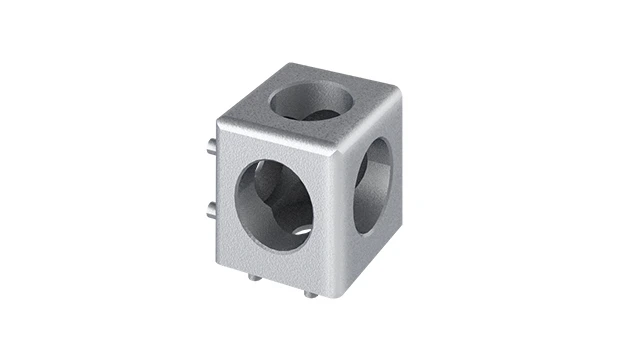
Aluminum Profile 3 Way Connector
The 3 way - squared corner connector is an external fastening method that is typically used to create a corner connection between three profiles. It is a heavy-duty connection that is simple to use and provides a polished look.
Walk into any busy manufacturing facility, warehouse, or assembly line, and you'll quickly spot the heartbeat of productivity: how materials move, where tools are stored, and how workers interact with their stations. A cluttered workspace with mismatched racks, wobbly workbenches, or rigid flow systems doesn't just slow things down—it drains energy. Employees waste time searching for parts, contorting to reach tools, or struggling to adjust setups for new projects. Over time, this friction adds up: missed deadlines, frustrated teams, and a bottom line that feels the strain. But what if there was a way to build material handling systems that adapt as quickly as your business does? That's where aluminum profiles and their unsung heroes—connectors—come into play. And among these connectors, the Aluminum Profile 3 Way Connector stands out as a quiet game-changer, turning generic parts into tailored solutions that fit your workflow like a well-worn glove.
Aluminum Profiles: The Backbone of Modern Material Handling
Before diving into connectors, let's talk about the foundation: aluminum profiles. These aren't your average metal bars. Extruded from high-grade aluminum, they're lightweight yet surprisingly strong—think of them as the building blocks of flexibility. Unlike fixed steel structures or one-size-fits-all plastic racks, aluminum profiles are modular. Their T-slot design (those grooves running along their length) lets you attach accessories, adjust heights, or reconfigure layouts without welding, drilling, or specialized tools. It's like building with giant, industrial-grade Legos, but for grown-ups solving real-world problems.
Why aluminum? For starters, it's corrosion-resistant, so it holds up in damp warehouses or cleanrooms alike. It's also recyclable, aligning with the sustainability goals many businesses now prioritize. But the real magic is in its versatility. Whether you're building a small workbench for a startup's garage or a sprawling flow rack system for a automotive plant, aluminum profiles scale with you. And none of this would matter without the right connectors—the pieces that turn separate profiles into a unified, functional system.
Aluminum Profile 3 Way Connectors: The Swiss Army Knife of Assembly
Connectors are the glue of modular systems, but not all connectors are created equal. Two-way connectors work for straight lines, four-way for intersections, but when you need to build something with angles—say, a workbench with a side shelf, or a flow rack that branches into two directions—you need a 3 way connector. As the name suggests, these little powerhouses join three aluminum profiles at once, usually at 90°, 45°, or even custom angles, depending on the design.
Let's break down what makes Aluminum Profile 3 Way Connectors special. First, their design. Most are made from die-cast aluminum, matching the strength and durability of the profiles they join. They often feature internal threads or set screws that bite into the T-slots of the profiles, creating a tight, wobble-free connection. Some are "internal rotation" joints, letting you adjust the angle slightly before locking it down—perfect for when measurements are just a hair off, or when you need to tweak a setup on the fly.
Take, for example, the internal rotary aluminum joint (a type of 3 way connector). It lets one profile rotate relative to the other two, so you can angle a shelf upward for better visibility or downward for gravity-fed material flow. No need to buy a whole new connector if you change your mind—just loosen the screw, adjust, and lock it again. That kind of adaptability is gold in environments where product lines change monthly, or where a single workspace needs to handle 10 different tasks in a week.

Why 3 Way Connectors Outshine the Rest: A Quick Comparison
To truly appreciate 3 way connectors, let's see how they stack up against other common types. Below is a comparison of 2 way, 3 way, and 4 way connectors, focusing on their most practical uses:
| Connector Type | Best For | Key Advantage | Limitations |
|---|---|---|---|
| 2 Way (Straight) | Extending a straight line (e.g., a long workbench top or linear flow rack) | Simple, low-cost, ideal for basic linear builds | Can't create branches or angles; limited to 180° connections |
| 3 Way | Branching structures (e.g., workbench with side tool rack, flow rack splitting into two lanes) | Creates angles and branches without extra parts; adaptable to 90°, 45°, or custom angles | Not ideal for complex intersections with 4+ profiles |
| 4 Way (Cross) | Central hubs (e.g., a vertical post with horizontal arms in four directions) | Connects four profiles at once; useful for symmetrical structures | Bulky for simple angles; overkill for most small-to-medium builds |
The takeaway? 3 way connectors hit the sweet spot between simplicity and versatility. They're not overly complex, so even someone new to modular systems can use them, but they unlock enough design freedom to build almost anything short of a skyscraper. And because they're made from the same aluminum as the profiles, they blend in visually, creating clean, professional-looking setups that don't scream "rigged together."

Building Real Solutions: Workbenches That Work With You
Let's get concrete. How do 3 way connectors transform a basic idea into a tool that makes a difference? Take the humble workbench—a staple in every shop, but often a source of frustration. Standard workbenches are either too low, too high, too small, or lacking storage. With aluminum profiles and 3 way connectors, you can build one that fits
your
body,
your
tools, and
your
tasks.
Imagine a small electronics manufacturer that assembles circuit boards. Their workers sit for hours, so the workbench height needs to align with their elbows to prevent strain. They also need ESD protection (static control) to avoid frying sensitive components, and storage for tiny screws, tweezers, and testing equipment. Using 3030 or 4040 aluminum profiles (common sizes for workbenches), they start with a frame: two vertical posts on each end, connected by horizontal profiles at the top (for the tabletop) and bottom (for stability). Now, they need a side shelf for tools. Enter the 3 way connector: bolted to the vertical post, it joins the main frame to a short horizontal profile, which then supports the shelf. Want the shelf at a 45° angle so tools roll forward when needed? Use an adjustable 3 way joint. Add a small overhead rack for manuals or monitors? Another 3 way connector at the top of the vertical post.
But it doesn't stop there. Aluminum profile accessories like ESD-safe tabletop panels (to protect circuits), T-slot tool holders (for tweezers and screwdrivers), and even caster wheels (to move the bench for deep cleaning) all attach to the T-slots. If a new employee joins who's taller, loosen the connectors, raise the tabletop, and lock it again—no sawing, no welding, just 10 minutes of adjustment. That's the power of 3 way connectors: they turn a static piece of furniture into a dynamic workspace that evolves with your team.
Flow Racks: Keeping Materials Moving, Without the Headaches
Now, let's shift to flow racks—those sloped shelves where materials glide forward, ensuring first-in-first-out (FIFO) inventory and easy access. In warehouses, these are lifelines for picking orders or feeding assembly lines. But traditional flow racks are often fixed: you buy a 5-foot-wide rack with 3 levels, and that's it. If your new product line requires 4 levels, or needs to curve around a corner, you're out of luck—unless you use 3 way connectors.
Consider a food packaging facility that handles different-sized boxes: cereal cartons, snack bags, and frozen meal boxes. Their old flow rack had fixed shelves, so the small snack bags would get stuck between the rollers, and the frozen boxes (heavier) would slide too fast. With aluminum profiles and 3 way connectors, they build a custom rack. The main frame uses 4080 profiles (sturdier for heavier loads), with vertical posts every 3 feet. Between the posts, they install horizontal profiles at different heights (for multiple levels). Now, for the roller tracks (the part that makes materials flow). Each track is a series of plastic or steel rollers mounted on aluminum guide rails. To attach the rails to the frame, they use 3 way connectors: one arm connects to the horizontal frame profile, another to the roller track, and the third reinforces the joint (adding stability for heavy boxes).
Here's where 3 way connectors shine: branching. The facility needs some tracks to split into two lanes—for example, a main track feeding two packing stations. A 3 way connector at the split point joins the main track to two smaller tracks, each angled toward a station. Adjust the angle with an adjustable joint, and suddenly, materials flow exactly where they're needed. If frozen boxes slide too fast, add brake rollers (another aluminum profile accessory) to the track—they clip into the T-slots. When the snack bag line expands, add a new level using 3 way connectors on the existing vertical posts. No need to buy a whole new rack; just expand the one you have.
Aluminum Profile Accessories: Making 3 Way Connectors Even More Powerful
3 way connectors are stars, but they don't work alone. Aluminum profile accessories are the supporting cast that turns a frame into a finished system. Let's talk about a few that pair especially well with 3 way connectors:
- End Caps: These plastic or aluminum caps snap into the ends of profiles, covering sharp edges and giving a clean look. When building a workbench with 3 way connectors, end caps on the side shelf profiles prevent snags on clothing or materials.
- Gussets: Small triangular brackets that reinforce joints, like the connection between a 3 way connector and a vertical profile. They add rigidity, crucial for heavy loads (think a flow rack holding 50-pound boxes).
- Caster Wheels: Attach these to the bottom of a frame using 3 way connectors (or specialized caster mounts) to make systems mobile. A workbench on casters can follow a worker around the shop; a flow rack can be repositioned for seasonal inventory spikes.
- Handle Grips: For mobile systems like trolleys, handles attached via 3 way connectors make pushing easier. They can be angled for comfort, ensuring workers don't strain their backs.
Take a turnover trolley, for example—used to move materials from the warehouse to the assembly line. The frame is built with 2020 or 3030 profiles, with 3 way connectors at the corners to join the vertical, horizontal, and diagonal braces (for stability). Casters attach to the bottom via caster mounts, and a handle (made from a short profile) is added to the top using a 3 way connector, angled at 30° for a natural grip. Add a shelf halfway up (another 3 way connector) to separate different materials, and you've got a trolley that's sturdy, easy to push, and customized to your load sizes.
Lean System Principles: 3 Way Connectors as Catalysts for Efficiency
If you're familiar with lean manufacturing or lean system principles—think 5S (Sort, Set in Order, Shine, Standardize, Sustain), continuous flow, or waste reduction—you'll recognize why modular systems with 3 way connectors are a perfect fit. Lean is all about eliminating waste, and one of the biggest wastes is "overprocessing" or "non-value-added activity," like spending hours reconfiguring a fixed workbench or buying new racks because the old ones don't fit.
Let's take a small machine shop that embraced lean. Before, they had a dozen fixed steel workbenches, each built for a specific task. When a new job came in requiring a different setup, they'd either cram the work onto an existing bench (causing clutter) or build a new bench from scratch (wasting time and materials). After switching to aluminum profiles and 3 way connectors, they now have 4 modular benches that can be reconfigured in an hour. Need a longer bench for a large part? Disassemble two small ones, connect the profiles with 2 way and 3 way connectors, and you're done. No more storage for unused benches, no more downtime waiting for new builds. That's lean in action: flexibility that reduces waste and keeps focus on value-added work.
Another lean principle is "respect for people," and modular workspaces show workers their comfort and efficiency matter. When a team can adjust their workbench height, add a shelf where they need it, or reangle a flow rack to reduce bending, they feel empowered. Morale goes up, and engaged teams are more productive. It's a ripple effect: better systems lead to happier workers, who then drive better results.
Choosing the Right 3 Way Connector: A Quick Guide
Not all 3 way connectors are the same, so how do you pick the right one? Start with the profile size: 2020 profiles need smaller connectors than 4080. Check the angle: fixed (90°, 45°) or adjustable? Adjustable is better for prototyping or frequently changing setups. Material matters too—die-cast aluminum is standard, but if you need corrosion resistance (e.g., in food processing), look for stainless steel or anodized aluminum connectors. Finally, load capacity: heavier applications (like flow racks for car parts) need beefier connectors with stronger set screws or bolts. Most suppliers list load ratings, so don't guess—ask or check the specs.
Conclusion: Building the Future, One Connector at a Time
Aluminum Profile 3 Way Connectors might not be the flashiest part of your material handling system, but they're the reason you can build something that's uniquely yours. In a world where businesses need to pivot fast—whether to meet new customer demands, adapt to smaller batch sizes, or support remote work setups—rigid systems are liabilities. Modular aluminum profiles, paired with 3 way connectors and aluminum profile accessories, are the antidote. They let you build workbenches that fit your team, flow racks that keep materials moving, and trolleys that go where they're needed—today, tomorrow, and next year.
So the next time you walk through your facility, look at those clunky, fixed structures. Imagine replacing them with something that bends to your needs, not the other way around. That's the promise of 3 way connectors: not just parts, but tools to build a workspace that works
with
you, making every day a little smoother, a little more efficient, and a lot less frustrating. After all, the best systems aren't just about moving materials—they're about moving your business forward.