- Company Articles
- Products and Technology
- Application Cases
- Aluminum Profile 3 Way Connectors for Mechanical Manufacturing: Case Studies

Aluminum Profile 3 Way Connectors for Mechanical Manufacturing: Case Studies
Related Product
Aluminum Profile 3 Way Connector
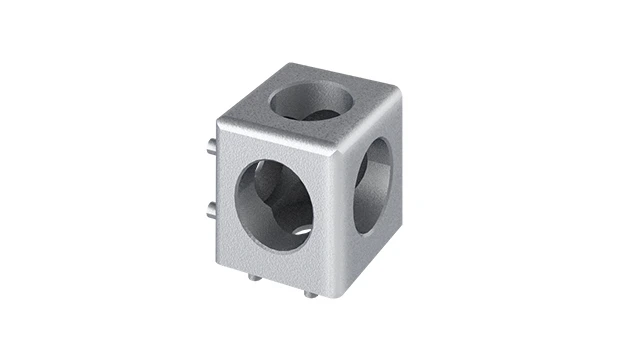
The 3 way - squared corner connector is an external fastening method that is typically used to create a corner connection between three profiles. It is a heavy-duty connection that is simple to use and provides a polished look.
Walk into any modern manufacturing facility today, and you'll notice a quiet revolution happening on the factory floor. Gone are the days of rigid, welded steel structures that take weeks to build and become obsolete the moment production needs change. Instead, there's a shift toward flexibility—workspaces that adapt as quickly as market demands, and systems that grow with your business. At the heart of this transformation lies a humble yet powerful component: the aluminum profile 3 way connector. More than just a piece of hardware, it's the bridge between static processes and dynamic, human-centered manufacturing. Let's explore how this unassuming tool is reshaping workflows, empowering teams, and driving efficiency across industries through real-world stories.
Understanding Aluminum Profile 3 Way Connectors: The Unsung Heroes of Flexibility
Before diving into the case studies, let's take a moment to appreciate what makes aluminum profile 3 way connectors so special. Imagine (oops, scratch that— consider ) a simple, lightweight joint that lets you connect three pieces of aluminum extrusion profile at once, without welding, drilling, or specialized tools. That's the 3 way connector in a nutshell. Made from high-grade aluminum or reinforced plastic, these connectors slide into the T-slots of aluminum profiles (think of those sleek, grooved bars you see in workshops) and lock into place with a hex key. The result? A sturdy, yet framework that can be taken apart, reconfigured, and reused countless times.
But their magic isn't just in assembly. These connectors thrive on compatibility. Pair them with other accessories—caster wheels for mobility, roller tracks for material flow, ESD-safe panels for sensitive electronics—and suddenly you're not just building a structure; you're crafting a system . A system that grows with your needs, adapts to new products, and respects the people who use it every day. Now, let's meet the manufacturers who turned this potential into tangible success.
Case Study 1: Automotive Parts SME – From Welded Woes to Modular Wins
Company Profile: Precision Brackets Inc. (PBI)
Nestled in a suburban industrial park, PBI is a family-owned business with 50 employees, specializing in custom metal brackets for luxury car manufacturers. For decades, their production line relied on welded steel workbenches and material racks—sturdy, but stubbornly inflexible. "Every time a client ordered a new bracket design, we'd have to weld new workbenches or cut apart existing ones," says Maria Gonzalez, PBI's operations manager. "It was like trying to rearrange a brick wall with a hammer. We'd lose 2-3 days of production, and the scrap metal pile kept growing."
The Challenge: High Variability, Tight Deadlines
By 2023, PBI's client base had exploded, with orders for over 200 unique bracket designs annually. Their old setup couldn't keep up. A new bracket might require a workbench with a taller shelf, or a material rack with narrower spacing—changes that meant halting production, hiring a welder, and spending thousands on custom steel parts. "Our team was frustrated," Maria recalls. "Workers would come in excited to build a new part, only to wait days for the workspace to be ready. Morale was dipping, and we were losing bids because our lead times were too long."
The Solution: Aluminum Extrusion Profiles + 3 Way Connectors
After attending a manufacturing expo, Maria stumbled upon a demo of aluminum extrusion profiles and 3 way connectors. "The supplier built a mini workbench right there in 10 minutes—no welding, just clicking pieces together," she says. "I thought, 'Why aren't we doing this?'" PBI partnered with a local aluminum profile supplier to test a pilot project: replacing two steel workbenches and a material rack with aluminum setups using 4040 and 3030 series profiles, paired with 3 way connectors, adjustable feet, and caster wheels.
The first step was designing the workbenches. PBI's engineers collaborated with the supplier to sketch layouts, but instead of sending specs to a welder, they ordered pre-cut profiles and a box of 3 way connectors. "Our lead engineer, Juan, was skeptical at first—he'd spent 20 years working with steel," Maria laughs. "But when he assembled the first workbench in 2 hours flat, using just a hex key, his eyes lit up. He kept saying, 'We could have done this years ago!'"
The material rack followed suit. Using 3 way connectors, they built shelves that could be adjusted by loosening a screw and sliding the bracket up or down. Caster wheels turned the rack into a mobile unit, so parts could be rolled directly to the workbench instead of being carried by hand. "The workers loved it," Maria says. "One of our assemblers, Lina, has a bad back—she used to struggle with heavy bins. Now she just rolls the rack over. She came up to me and said, 'This isn't just a rack. It's respect.'"
The Results: From Days to Hours, and Waste to Wins
Within three months, PBI expanded the aluminum system to 80% of their workspaces. The impact was immediate: setup time for new product lines dropped from 2 days to 4 hours. Retooling a workbench for a different bracket size went from a full-day project to a 30-minute task. "We used to scrap old steel racks when they became obsolete—now we just take them apart and rebuild," Maria notes. "Our waste disposal costs dropped by 40%, and we haven't bought new steel in over a year."
But the biggest win? People. "Juan no longer stays late reworking designs to fit rigid structures. Lina doesn't miss days due to back pain. And our sales team? They're winning bids left and right because we can promise shorter lead times," Maria says. "The 3 way connectors didn't just change our factory—they changed how we think about problem-solving. We're not limited by our tools anymore; we're limited by our imagination." (Okay, maybe a little imagination is allowed here.)

Case Study 2: Electronics Manufacturer – ESD Safety Meets Modular Flow
Company Profile: TechGuard Electronics
TechGuard is a mid-sized firm in the Pacific Northwest, producing circuit boards for medical monitors and diagnostic equipment. Their products demand precision—and strict ESD (electrostatic discharge) safety. Even a tiny static spark can fry a $500 component, so their workspaces must be grounded and non-conductive. For years, they relied on wooden workbenches lined with ESD mats and fixed steel flow racks. It worked, but barely.
The Challenge: Static Risks and Stagnant Workflows
"Wooden benches are porous—they trap dust, which is a nightmare for cleanrooms," explains Raj Patel, TechGuard's production supervisor. "And if a mat wore out or a shelf needed adjusting, we'd have to replace the entire bench. We also had flow racks that couldn't keep up with our growing product line. A new circuit board might be 2 inches wider than the last, and suddenly the rack was useless."
Worst of all was the risk of human error. "Our old steel racks had sharp edges," Raj adds. "Workers would bump into them, creating static. We had 2-3 ESD incidents a month—each costing us thousands in scrapped parts and delayed shipments. We needed a solution that was safe, clean, and flexible. That's when we started looking at aluminum."
The Solution: ESD-Safe Aluminum Profiles with 3 Way Connectors
TechGuard's search led them to ESD-coated aluminum extrusion profiles and 3 way connectors designed for static dissipation. "The supplier explained that the aluminum itself is conductive, so when grounded, it channels static away from components," Raj says. "Pair that with ESD-safe roller tracks and anti-slip feet, and we had a recipe for safe, modular workspaces."
They started with the ESD workstations. Using 3030 aluminum profiles and 3 way connectors, they built U-shaped benches with adjustable monitor arms, tool holders, and built-in grounding strips. The work surfaces were aluminum honeycomb panels—lightweight, non-porous, and easy to sanitize. "The first time we ran a batch of boards on the new bench, our QA team couldn't believe it," Raj recalls. "Zero static readings. One of the inspectors joked, 'It's like the bench is giving the components a hug.'"
Next came the flow racks. Using 3 way connectors, they built multi-tiered racks with roller tracks that guided components from the warehouse to the workstation. The connectors allowed them to angle the tracks for gravity flow, so parts glided smoothly without manual pushing. "We used to have workers standing at the end of the line, stacking boxes," Raj says. "Now the flow rack feeds the bench directly. It's like having an extra pair of hands—quiet, reliable hands."
The Results: Zero Incidents, 40% Faster Flow, and Happy Inspectors
Eight months in, TechGuard has recorded zero ESD incidents—a first in company history. "That alone paid for the investment," Raj says. "But the flow racks? They cut material handling time by 40%. Workers no longer waste steps fetching parts, and the QA team loves how easy the benches are to clean. One inspector told me, 'I used to dread cleaning day—now I just wipe the aluminum surface and go.'"
Flexibility has been a game-changer, too. When a client ordered a larger circuit board last quarter, TechGuard's team reconfigured a flow rack in 20 minutes by adjusting the 3 way connectors to widen the tracks. "No more waiting for a carpenter or welder," Raj says. "We just grab a hex key and adapt. It's not just about speed—it's about dignity. Our team feels trusted to solve problems, and that's priceless."

Case Study 3: Industrial Equipment Giant – Conveying Efficiency with Adjustable Lines
Company Profile: MegaMachinery Corp.
MegaMachinery is a household name in industrial equipment, producing large-scale pumps and valves for oil, gas, and water treatment. With 1,200 employees across three plants, their production lines are massive—but until recently, they were also maddeningly inflexible. "We build 15 different pump models, each with unique dimensions," says Sarah Chen, MegaMachinery's lean system coordinator. "Our old conveyor systems were fixed steel structures. If a new pump was 6 inches longer, we'd have to shut down the line for a week to modify the conveyor. It was like trying to fit a square peg into a round hole—every single time."
The Challenge: Bottlenecks and Downtime in High-Volume Production
The bottlenecks were costing MegaMachinery dearly. A single line changeover could delay 500 units, and with clients demanding faster delivery, Sarah's team was under pressure to find a solution. "We tried temporary fixes—adding plywood extensions to conveyors, using forklifts to bypass sections—but they were unsafe and inefficient," she says. "Our maintenance team was exhausted from constant repairs, and the production managers were tearing their hair out over missed deadlines."
The Solution: Aluminum Extrusion Conveyors with 3 Way Connectors
Sarah's team turned to aluminum extrusion profiles (heavy-duty 4080 series) and industrial-grade 3 way connectors to build adjustable conveyor frames. "We needed something strong enough to handle 500-pound pumps but flexible enough to reconfigure in hours, not weeks," she explains. The plan was bold: replace two entire conveyor lines with modular systems, using 3 way connectors to adjust height, width, and angle on the fly.
The first test line was for their most variable product: a submersible pump that came in 10 sizes. The team worked with their supplier to design a frame where the conveyor rails could be moved inward or outward using 3 way connectors. "We mounted the roller conveyors on sliding brackets attached to the connectors," Sarah says. "Loosen four bolts, slide the bracket, retighten—and boom, the conveyor width changes from 24 inches to 36 inches. It's like adjusting a guitar strap, but for industrial machinery."
They also added turnover trolleys—mobile carts built with aluminum profiles and 3 way connectors—to transport pumps between stations. "The trolleys have adjustable shelves, so they can carry any pump size," Sarah notes. "Before, workers used forklifts, which are slow and risky around tight corners. Now the trolley glides right up to the conveyor. One operator told me, 'This trolley doesn't just move parts—it moves stress.'"
The Results: 60% Faster Changeovers and a Culture of Continuous Improvement
After six months of operation, the results were staggering: line changeover time dropped from 7 days to 2.5 hours. Throughput increased by 25%, and maintenance costs fell by 30% (no more welding repairs on steel frames). "The best part? The team owns the system now," Sarah says. "Last month, a line operator suggested angling the conveyor 5 degrees to reduce product jams. We grabbed the 3 way connectors, adjusted the frame, and it worked. No meetings, no approvals—just problem-solving. That's the lean system we've been chasing for years."
Even the executives took notice. "Our CEO visited the plant and couldn't believe the difference," Sarah laughs. "He kept asking, 'Where are the welders?' I showed him a 3 way connector and said, 'This is our new welder. And it never takes a sick day.'"
Case Study Summary: From Stories to Stats
| Industry | Key Challenge | Aluminum System Components | Tangible Results |
|---|---|---|---|
| Automotive Parts SME | High product variability; rigid welded workbenches and racks | Aluminum extrusion profiles (4040, 3030), 3 way connectors, caster wheels | 75% reduction in setup time; 4-hour reconfigurations; 40% lower waste costs |
| Electronics Manufacturing | ESD sensitivity; static risks with wooden/steel setups | ESD-coated aluminum profiles, 3 way connectors, flow racks, ESD workbench | Zero ESD incidents; 40% faster material flow; improved cleanroom compliance |
| Industrial Equipment | Fixed conveyors; 7-day changeovers for variable product sizes | Heavy-duty 4080 aluminum profiles, 3 way connectors, roller conveyors, turnover trolleys | 60% faster changeovers; 25% higher throughput; 30% lower maintenance costs |
Beyond the Case Studies: Why This Matters for Your Manufacturing Journey
These stories aren't just about aluminum profiles and connectors—they're about people. The SME owner who stopped dreading client orders. The assembler with a bad back who can now work pain-free. The engineer who rediscovered joy in problem-solving. At the end of the day, manufacturing is a human endeavor, and tools like 3 way connectors don't just improve processes—they honor the people behind them.
So, if you're in manufacturing and feeling stuck with rigid systems, ask yourself: What would it look like if your workspace adapted to you ? If reconfiguring a workbench or conveyor took hours instead of weeks? If your team felt empowered to build the tools they need, when they need them? The answer might just be in a box of aluminum profiles and 3 way connectors.
After all, the future of manufacturing isn't about bigger machines or faster robots. It's about flexibility. It's about systems that grow with your business, respect your team, and turn "we can't" into "we just did." And it all starts with a simple question: What will you build first?