- Company Articles
- Products and Technology
- Product knowledge
- Aluminum Profile 3 Way Connectors for Quick Assembly and Disassembly

Aluminum Profile 3 Way Connectors for Quick Assembly and Disassembly
Related Product
Aluminum Profile 3 Way Connector
The 3 way - squared corner connector is an external fastening method that is typically used to create a corner connection between three profiles. It is a heavy-duty connection that is simple to use and provides a polished look.
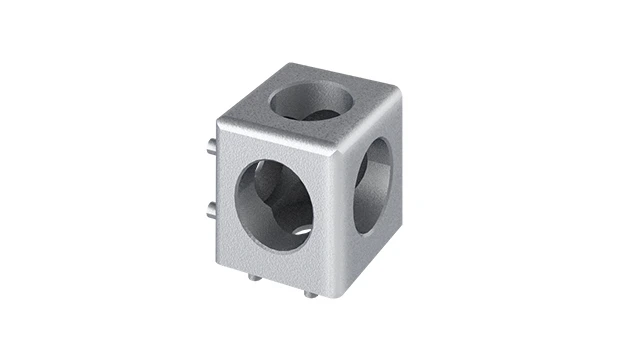
In the fast-paced world of manufacturing, workshops, and even DIY projects, the ability to set up, adjust, and reconfigure workspaces quickly can make all the difference between meeting a tight deadline and falling behind. Whether you're a small business owner trying to optimize your production line, a warehouse manager needing to reorganize storage, or a hobbyist building a custom workbench, the tools and components you use to assemble your structures play a critical role in how efficiently you can adapt. One component that's been quietly revolutionizing this space is the aluminum profile 3 way connector. These unassuming little pieces might not look like much at first glance, but they're the unsung heroes behind some of the most flexible, durable, and easy-to-assemble structures in modern workspaces. Let's dive into why these connectors matter, how they work, and why they might just be the missing piece in your next project.
The Frustration of Traditional Assembly: Why Flexibility Matters
Think about the last time you tried to build something that needed to be sturdy but also adjustable. Maybe it was a shelving unit for your garage, or a workbench for your workshop. If you went the traditional route, you probably reached for tools like welders, heavy bolts, or even glue. Welding, for all its strength, is permanent—once those pieces are fused, changing your mind means starting over. Bolts and nuts? They require wrenches, take time to tighten, and if you need to disassemble later, you're left with stripped threads or lost hardware. Even wooden structures, while familiar, warp over time and can't handle the wear and tear of industrial environments. The problem with these methods isn't just that they're time-consuming; it's that they lock you into a single design. In today's world, where production lines shift, storage needs change, and workspaces evolve, rigidity is the enemy.
Take a typical manufacturing facility, for example. A few months ago, they might have been producing small electronic components, requiring low workbenches and narrow material racks. Now, they've shifted to larger machinery parts, and suddenly those workbenches are too short, and the racks can't hold the heavier loads. With traditional assembly, reconfiguring would mean cutting new metal, re-welding frames, or buying entirely new furniture—costing time, money, and resources. That's where flexibility becomes a game-changer. What if you could take apart that workbench in an hour, adjust the height, add a shelf, and put it back together just as securely? That's the promise of aluminum profile systems, and at the heart of that promise are connectors—specifically, 3 way connectors.
So, What Exactly Are Aluminum Profile 3 Way Connectors?
Let's start with the basics. Aluminum profiles are those sleek, lightweight, and incredibly strong extruded aluminum bars you've probably seen in workshops, factories, or even retail displays. They come in various shapes and sizes, with grooves (called T-slots) running along their length that allow accessories to slide in and lock into place. But profiles alone are just pieces of metal—you need a way to connect them. That's where connectors come in. A 3 way connector, as the name suggests, is a component designed to join three aluminum profiles at once, typically at 90-degree angles, forming a stable, three-pronged structure.
Imagine a T-shape or a Y-shape: one profile as the vertical "stem," and two profiles branching off horizontally. The 3 way connector sits at the intersection, holding all three pieces securely. Unlike welding, which melts metal to bond pieces, or bolts that clamp from the outside, these connectors are engineered to fit snugly into the T-slots of the profiles, using the slots' design to create a tight, tool-free (or minimal-tool) connection. Most are made from high-grade aluminum alloy, matching the profiles' durability and corrosion resistance, so they don't add unnecessary weight or become brittle over time.
But not all 3 way connectors are created equal. The best ones are designed with precision in mind—their dimensions match standard aluminum profile sizes (like 2020, 3030, or 4040, referring to the profile's width in millimeters), ensuring a seamless fit. They might have built-in locking mechanisms, like spring-loaded pins or set screws, that bite into the T-slot and hold the profiles in place without slipping. Some even have rotating parts, allowing for slight angle adjustments if you need something other than a perfect 90 degrees. The key here is that they turn individual aluminum profiles into a modular system—one where you can mix, match, and reconfigure as needed, without sacrificing stability.

The Secret Sauce: Key Features of a Great 3 Way Connector
What makes a 3 way connector worth investing in? Let's break down the features that set the best ones apart from the cheap knockoffs. First, material matters. Aluminum alloy is the gold standard here—not only is it lightweight (so your finished structure isn't a hassle to move), but it's also resistant to rust and corrosion, which is crucial if you're working in damp environments or handling chemicals. Avoid plastic connectors unless you're building something very lightweight; they tend to crack under stress. Second, precision engineering. The connector should slide into the T-slots of your aluminum profiles without gaps. A loose fit means wobbling structures, which isn't just annoying—it's dangerous, especially if you're using the structure to hold heavy tools or materials.
Tool-free assembly is another big one. The best 3 way connectors can be installed with just your hands, or at most a hex key (Allen wrench) for a final tighten. This cuts down assembly time dramatically—no more fumbling with wrenches or searching for the right socket. Reusability is also a must. If you take apart a structure, the connector should pop out easily and be ready to use again in a new configuration. Look for connectors with smooth edges and no sharp parts that could wear down the T-slots over multiple uses. Finally, versatility. Some 3 way connectors are designed for specific profile sizes, while others are adjustable to fit multiple dimensions. If you work with different profile sizes (say, 3030 for heavy-duty racks and 2020 for lighter workbenches), an adjustable connector might save you from buying separate parts.

From Pieces to Structure: How 3 Way Connectors Enable Quick Assembly
Let's walk through a real example to see how these connectors turn chaos into order. Suppose you want to build a workbench—a sturdy, adjustable one that can grow with your needs. You've picked out 4040 aluminum profiles for the frame (they're strong enough for power tools but still lightweight), and you need to connect the legs, the top frame, and the lower shelf. Here's how 3 way connectors make this a breeze:
- 1. Start with the legs: Cut four aluminum profiles to your desired height (say, 36 inches for a standing workbench). Slide a 3 way connector onto the top of each leg—these will connect the legs to the horizontal frame.
- 2. Build the top frame: Cut four more profiles for the top (two for the length, two for the width). Take one length profile and slide it into the horizontal slot of two leg connectors (one on the left, one on the right). Do the same with the other length profile on the opposite side. Now you have two parallel length profiles, each connected to two legs—like the sides of a rectangle.
- 3. Connect the width: Take the two width profiles and slide them into the remaining slots of the 3 way connectors, closing the rectangle. Now you have a basic frame with four legs and a top perimeter. Tighten the connectors (if needed) with a hex key—done in minutes, no welding required.
- 4. Add a shelf: Want a lower shelf for storage? Cut four more short profiles and use 3 way connectors to attach them halfway up the legs, then add horizontal profiles between them. Since the connectors are already on the legs, you just slide the new profiles into place. Need the shelf higher? Loosen the connectors, slide them up, and retighten.
The beauty here is that every step is reversible. If next year you decide you need a taller workbench, you can swap out the leg profiles for longer ones. If you move to a smaller space, disassemble the whole thing into a pile of profiles and connectors that fit in the back of a truck. Compare that to a wooden workbench, where adjusting the height would mean sawing new legs, or a welded metal one, where you'd need a grinder to take it apart. With 3 way connectors, assembly becomes less about "building" and more about "configuring"—and that's a huge difference.
Beyond Workbenches: Real-World Uses for 3 Way Connectors
While workbenches are a common example, 3 way connectors shine in almost any scenario where you need to build a frame, rack, or support structure. Let's look at a few more applications where these connectors make a tangible difference:
Material Racks for Warehouses
Warehouses deal with constant changes in inventory—one month it's boxes of small parts, the next it's large pallets. A static rack system can't keep up. With aluminum profiles and 3 way connectors, you can build racks that adjust in height, width, and depth. Need to add a new shelf? Slide in a few connectors and profiles. Moving the rack to a new location? Disassemble it in 20 minutes and rebuild it elsewhere. The T-slots in the profiles even let you add accessories like dividers or hooks, keeping inventory organized without extra tools.
Production Line Workstations
In manufacturing, production lines are rarely set in stone. A car parts manufacturer might need to retool for a new model, requiring workstations to be repositioned or resized. 3 way connectors let teams quickly adjust the layout: lower a conveyor here, add a testing station there, or widen a packing area—all without shutting down production for days. Since the connectors are lightweight, even a small team can rearrange heavy-duty structures safely.
Retail Displays
Retailers know that visual merchandising changes with seasons, holidays, or new product launches. A clothing store might need a rack for summer dresses one month and heavy coats the next. Aluminum profile displays with 3 way connectors can be reconfigured overnight: add hanging rods, adjust shelf heights, or even change the shape of the display to fit a new store layout. And since aluminum is sleek and modern-looking, it fits right in with high-end retail environments.
In each of these cases, the common thread is adaptability. 3 way connectors turn rigid structures into flexible systems that grow, shrink, and change with your needs. They're not just tools for building—they're tools for problem-solving.
Working in Harmony: 3 Way Connectors and Aluminum Profile Accessories
A great connector is only as useful as the system it's part of, and aluminum profiles are designed to work with a wide range of accessories that take your projects to the next level. Think of 3 way connectors as the "hubs" that bring everything together, while accessories like end caps, rubber strips, and brackets add the finishing touches. Let's talk about a few key accessories and how they complement 3 way connectors:
| Accessory | What It Does | How It Works with 3 Way Connectors |
|---|---|---|
| Aluminum Profile End Caps | Plastic or aluminum caps that fit over the ends of profiles, covering sharp edges and preventing dust/debris from entering T-slots. | Once your structure is assembled with 3 way connectors, end caps snap into place on any exposed profile ends, making the structure safer and more polished. |
| T-Slot Rubber Strips | Soft rubber strips that line the T-slots, reducing noise, preventing scratches, and adding grip for accessories. | Strips are inserted into the T-slots before adding connectors, ensuring a tighter fit between profiles and connectors and reducing rattling during use. |
| Adjustable Feet | Threaded feet that screw into the bottom of profiles, leveling uneven surfaces and adding stability. | Screw feet into the bottom of leg profiles (connected via 3 way connectors) to level workbenches or racks on uneven floors—no need for shims or extra tools. |
The point is, 3 way connectors don't work in isolation—they're part of an ecosystem of parts that make building easier, safer, and more effective. When you choose a quality connector, you're not just buying a single piece; you're investing in a system that can grow with your needs, thanks to compatible accessories.
The Bottom Line: Why Businesses (and Hobbyists) Love These Connectors
At the end of the day, the reason 3 way connectors have become so popular is simple: they save time, money, and stress. Let's break down the benefits in concrete terms:
- Time Savings: Traditional assembly methods can take hours (or days) for complex structures. With 3 way connectors, a team of two can build a large workbench in under an hour. Disassembly is even faster—no more wrestling with bolts or cutting metal.
- Cost Efficiency: While aluminum profiles and connectors have an upfront cost, they're reusable. Instead of buying a new workbench every time your needs change, you reuse the same profiles and connectors. Over time, this drastically reduces material costs.
- Flexibility: As we've covered, the ability to reconfigure structures means you can adapt to new projects, spaces, or demands without starting from scratch. This is especially valuable for small businesses and startups that need to pivot quickly.
- Safety: Aluminum is lightweight, reducing the risk of injury during assembly/disassembly. The T-slot design and secure connectors also mean structures are less likely to wobble or collapse, unlike some bolted or welded structures that loosen over time.
- Professional Finish: Aluminum profiles have a clean, modern look that beats the rusty welded frames or splintered wood of traditional setups. This matters for customer-facing spaces (like retail) or workshops where a tidy environment boosts morale.
For hobbyists, the benefits are just as clear. Whether you're building a home workshop, a garage storage system, or a custom shelf for your collection, 3 way connectors let you experiment without fear of wasting materials. Make a mistake? Take it apart and try again. Want to add a new feature? Just grab a few extra profiles and connectors. It's building with training wheels, but for grown-ups—with all the strength of a permanent structure, minus the commitment.
How to Choose the Right 3 Way Connector for Your Project
Not all 3 way connectors are created equal, so it's important to pick the right one for your needs. Here are a few questions to ask before buying:
What Size Aluminum Profiles Are You Using?
Connectors are designed to fit specific profile sizes (e.g., 2020, 3030, 4040). Using a connector that's too small or too large will result in a loose fit, which is unsafe. Check the product specs to ensure compatibility.
How Much Weight Will the Structure Hold?
Heavier loads require sturdier connectors. Look for connectors made from thick-walled aluminum alloy and with reinforced locking mechanisms. If you're unsure, ask the supplier for weight ratings—reputable brands will provide this info.
Will You Need to Disassemble Often?
If you plan to reconfigure frequently, opt for connectors that are tool-free or require minimal tools (like a hex key). Avoid connectors with permanent adhesives or one-time-use locking mechanisms.
Is Corrosion Resistance Important?
If your project will be in a damp environment (like a garage with high humidity or a food processing facility), choose connectors made from anodized aluminum, which resists rust and corrosion better than untreated metal.
It's also worth buying a few extra connectors and profiles to test before committing to a large project. Assemble a small frame, test its stability, and see how easy it is to take apart. This trial run can save you from frustration later.
Caring for Your Connectors: Simple Maintenance Tips
Aluminum profile systems are low-maintenance, but a little care goes a long way in keeping your connectors working smoothly for years:
- Keep Them Clean: Dust and debris can build up in the T-slots and connector locking mechanisms. Wipe profiles and connectors with a dry cloth before assembly to ensure a tight fit.
- Lubricate Moving Parts: If your connectors have adjustable or rotating parts, a drop of light machine oil (like 3-in-1 oil) can prevent squeaking and keep them moving freely.
- Store Properly: When not in use, store connectors in a dry place away from direct sunlight. Avoid tossing them in a toolbox where they can get banged up—use a small container or bag to keep them organized.
- Check for Wear: Over time, the locking mechanisms (like set screws) can wear down. If a connector starts to feel loose, replace it—don't risk a unstable structure.
With these simple steps, your connectors should last for decades, even with heavy use. That's the beauty of aluminum—tough, resilient, and ready to work as hard as you do.
The Future of Building: Flexible, Fast, and Focused on You
Aluminum profile 3 way connectors might not be the flashiest tools in your workshop, but they represent a shift in how we think about building and creating. In a world that values adaptability, efficiency, and sustainability, these small components punch way above their weight. They turn the frustration of rigid, permanent structures into the freedom of flexible, reconfigurable systems. Whether you're a business owner looking to optimize your production line, a warehouse manager needing to organize inventory, or a hobbyist ready to build your dream workspace, these connectors offer a better way to build—one that's faster, smarter, and centered on your changing needs.
So the next time you're staring at a pile of materials and wondering how to turn them into something sturdy yet adaptable, remember: the solution might be smaller than you think. A few aluminum profiles, a handful of 3 way connectors, and a little creativity are all it takes to build something that grows with you. After all, the best structures aren't just built to last—they're built to evolve.