- Company Articles
- Products and Technology
- Product knowledge
- Aluminum Profile 3 Way Connectors for Telecommunication Equipment Assembly

Aluminum Profile 3 Way Connectors for Telecommunication Equipment Assembly
Related Product
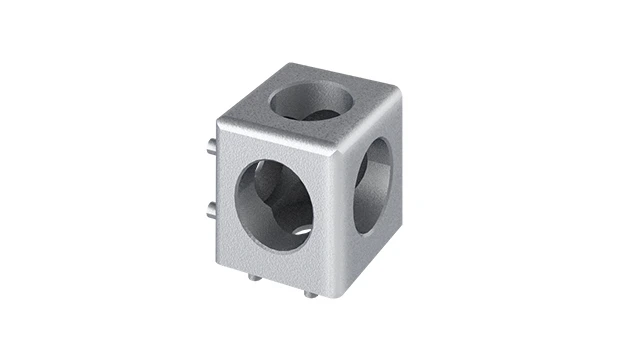
Aluminum Profile 3 Way Connector
The 3 way - squared corner connector is an external fastening method that is typically used to create a corner connection between three profiles. It is a heavy-duty connection that is simple to use and provides a polished look.
The Hidden Challenge in Telecommunication Equipment Assembly
Walk into any telecom equipment assembly facility, and you'll likely see a hive of activity: technicians hunched over workbenches, carefully wiring intricate circuit boards; forklifts gliding past stacks of server racks; and teams huddling around blueprints, debating the best way to configure a new 5G router frame. What you might not notice, though, is the silent frustration that often simmers beneath the surface—the kind that comes from working with rigid, one-size-fits-all assembly tools that resist the constant changes telecom manufacturing demands.
Telecom equipment isn't static. From bulky legacy routers to sleek, compact 5G antennas, the industry evolves at a breakneck pace. A facility might assemble a high-capacity server one week and shift to a lightweight outdoor transceiver the next. This variability means assembly lines, workbenches, and material racks can't stay fixed. They need to adapt—quickly. Yet for years, many manufacturers relied on welded steel frames or custom-machined parts that took days (or weeks) to reconfigure. "We'd spend more time adjusting our workstations than actually building the equipment," says Maria Gonzalez, a production supervisor with 15 years in telecom manufacturing. "If a new router design was 2 inches taller than the last, we'd have to order new brackets, wait for them to arrive, and then weld them into place. By the time we were ready, the design might have changed again."
This rigidity isn't just a time-suck; it's a drain on morale. Technicians, whose expertise lies in precision assembly, end up bogged down in logistics—scavenging parts from old setups, improvising with duct tape or zip ties to make a square peg fit a round hole. "It's demotivating," Gonzalez admits. "You join this field to build cutting-edge tech, not to fight with a rusted steel frame that won't budge."
The solution, it turns out, wasn't in reinventing the wheel—but in reimagining how the "wheels" (or, more accurately, the frames and structures that hold everything together) connect. Enter aluminum profile systems and their unsung heroes: aluminum profile 3 way connectors. These unassuming components are quietly revolutionizing telecom assembly, turning once-frustrating workflows into models of flexibility and efficiency. Let's take a closer look at how they work, why they matter, and how they're becoming indispensable in an industry that can't afford to stand still.
Aluminum Profiles: The Backbone of Modern Assembly
Before diving into 3 way connectors, it's worth understanding the foundation they're built on: aluminum extrusion profiles. If you've ever assembled a modular bookshelf or a DIY garage organizer, you might be familiar with the concept—lightweight, hollow aluminum bars with grooves (called T-slots) running along their length. These T-slots allow for easy attachment of brackets, panels, or other profiles using simple fasteners. But in industrial settings, aluminum profiles are a game-changer.
Unlike steel, aluminum is lightweight enough to be moved by hand (no forklift required) but strong enough to support heavy loads—think 500+ pounds for a well-built rack. It's also corrosion-resistant, which is critical in telecom facilities where humidity or occasional spills can damage metal components. And because it's extruded (pushed through a die to create uniform shapes), aluminum profiles come in standardized sizes—20x20mm, 30x30mm, 40x40mm, and so on—making them easy to source and replace.
But what truly sets aluminum profiles apart is their modularity. "With steel, you're locked into a fixed structure once it's welded," explains James Chen, an engineer at a leading aluminum profile supplier. "Aluminum profiles? They're like building blocks. You can take them apart, rearrange them, and put them back together in minutes. That's why they've become the go-to for industries that need agility—like telecom."
Of course, even the best building blocks need connectors to hold them together. And while basic connectors (like 90° angle brackets or straight couplers) handle simple joins, telecom assembly often demands more complex configurations. Imagine building a workstation where a vertical support needs to connect to both a horizontal shelf and a diagonal brace, or a material rack where three profiles meet at a corner to support a heavy load. For these scenarios, a standard two-way connector just won't cut it. That's where the aluminum profile 3 way connector steps in.

What Are Aluminum Profile 3 Way Connectors—And Why Do They Matter?
At first glance, an aluminum profile 3 way connector looks deceptively simple: a small, often T-shaped or Y-shaped piece of die-cast aluminum with threaded holes or pins that fit into the T-slots of aluminum profiles. But don't let its size fool you. This little component is engineered to solve a big problem: joining three profiles at once, at angles that adapt to the specific needs of the assembly task.
Let's break down the design. Most 3 way connectors are made from high-strength aluminum alloy (the same material as the profiles themselves), ensuring they match the profiles' load capacity and resistance to wear. They feature multiple connection points—typically three, as the name suggests—each designed to slide into the T-slot of a profile. Once in place, a bolt or set screw tightens the connector against the slot, creating a secure, rattle-free joint. Some models even allow for rotation, letting technicians adjust angles slightly (say, 45° or 135°) before locking the connector in place. "It's like having a universal joint for your assembly line," Chen says. "You're not limited to 90° angles anymore. If the blueprint calls for a 120° tilt on a cable management arm, you can set it and forget it—no custom machining required."
But why is this flexibility so critical for telecom? Let's consider a common scenario: building a test bench for a new 5G base station. The bench needs a vertical frame to hold power supplies, a horizontal shelf for the base station unit, and a diagonal brace to stabilize the structure (since the unit vibrates during testing). A 3 way connector at the corner where these three elements meet eliminates the need for separate brackets or welded joints. "We used to need three different parts for that corner," Gonzalez recalls. "A 90° bracket for the vertical and horizontal, a separate diagonal brace, and then a clamp to hold it all together. Now, one 3 way connector does the job. And if we need to adjust the angle of the brace later? Just loosen the screws, move it, and retighten. Done in 2 minutes."
Beyond versatility, 3 way connectors also shine in their simplicity. Unlike welded joints, which require specialized skills and equipment, anyone on the assembly line can install them with basic hand tools—a hex key or a screwdriver. This democratizes the reconfiguration process. "I don't need to call the maintenance team every time I want to adjust my workstation," says Raj Patel, a senior technician. "If I need more space for a large motherboard, I can grab a few 3 way connectors, add an extra profile to the shelf, and be back to work in 10 minutes. It makes me feel in control of my space."

The Benefits of 3 Way Connectors: More Than Just "Flexible"
Flexibility is the headline benefit of aluminum profile 3 way connectors, but their impact runs deeper. Let's unpack how they transform telecom assembly workflows—from reducing downtime to boosting team morale.
1. Slashing Reconfiguration Time from Days to Minutes
In telecom, time is money. When a new product design hits the floor, every hour spent reconfiguring workstations is an hour of delayed production. With 3 way connectors, that delay disappears. "Last year, we had a rush order for 200 outdoor 5G antennas," Gonzalez says. "The antenna housing was taller than our existing racks, so we needed to raise the shelves by 6 inches. With our old steel racks, that would have meant ordering new steel brackets and welding them on—3 days, minimum. With aluminum profiles and 3 way connectors? We had the entire line reconfigured by lunch. We finished the order a day early."
This speed isn't just about meeting deadlines; it's about staying competitive. In a market where 5G rollouts and IoT expansion drive constant demand, the ability to pivot quickly can mean the difference between winning a contract and losing it to a rival with a more agile setup.
2. Cutting Costs by Eliminating "Waste"
Lean system principles teach us to eliminate waste—whether it's excess inventory, waiting time, or unnecessary motion. 3 way connectors align perfectly with this ethos. By replacing custom-machined parts (which often end up collecting dust once a product line ends) with reusable connectors, facilities reduce waste in two ways: first, by avoiding the cost of one-off parts, and second, by minimizing storage clutter. "We used to have a whole room full of old steel brackets and custom joints," Patel says. "Half of them were for products we don't even make anymore. Now, we have a few boxes of 3 way connectors, 90° brackets, and T-slots. They work for everything. We've saved thousands on storage alone."
There's also the cost of labor. Welding or machining custom parts requires skilled tradespeople, whose time is expensive. With 3 way connectors, assembly technicians—who are already on the floor—can handle reconfigurations, freeing up specialists for more critical tasks.
3. Reducing Errors and Rework
Telecom equipment is precise. A misaligned shelf or a wobbly workbench can lead to mistakes—scratched circuit boards, loose connections, or even damaged components. 3 way connectors, with their secure, adjustable joints, minimize these risks. "The old steel frames would loosen over time, especially with the vibration from testing," Gonzalez notes. "A shelf might sag by a quarter inch, and suddenly, a technician is struggling to plug in a cable, bending pins on the motherboard. With aluminum profiles and 3 way connectors? The joints stay tight. We haven't had a single component damaged from a wobbly shelf in two years."
4. Boosting Morale by Putting Control in Technicians' Hands
Perhaps the most underrated benefit of 3 way connectors is their impact on workplace satisfaction. When technicians can adapt their tools to their needs, they feel empowered. "There's a sense of ownership," Patel says. "If I'm assembling a delicate fiber-optic module, I can adjust my workbench height using 3 way connectors so I'm not hunched over. If I need more light, I can add a small shelf for a lamp. These little tweaks make the job feel less like a chore and more like a craft."
Gonzalez has noticed the difference in retention, too. "Techs used to get frustrated and leave for jobs with better working conditions. Now, they talk about how much they love the flexibility. Our turnover rate has dropped by 30% since we switched to aluminum profiles and 3 way connectors."
How 3 Way Connectors Compare to Other Assembly Solutions
To truly appreciate 3 way connectors, it helps to see how they stack up against traditional assembly tools. Let's compare them to three common alternatives: welded steel frames, custom-machined plastic brackets, and basic two-way aluminum connectors.
| Feature | Welded Steel Frames | Custom-Machined Plastic Brackets | Basic Two-Way Aluminum Connectors | Aluminum Profile 3 Way Connectors |
|---|---|---|---|---|
| Reconfigurability | None (permanent welds) | Low (designed for one product) | Moderate (joins two profiles at fixed angles) | High (joins three profiles at adjustable angles) |
| Assembly Time | Slow (requires welding equipment/skills) | Slow (wait time for custom parts) | Moderate (simple, but limited angles) | Fast (install with basic tools in minutes) |
| Load Capacity | High (steel is strong but heavy) | Low (plastic bends under heavy loads) | Moderate (supports typical loads for two profiles) | High (matches aluminum profile strength; up to 500+ lbs with reinforced models) |
| Cost Over Time | High (custom parts, welding labor, storage of old frames) | High (one-off costs, no reuse) | Moderate (lower upfront cost, but limited use cases) | Low (reusable, no custom parts, minimal storage) |
| Best For | Static, long-term setups (rare in telecom) | Lightweight, single-product lines | Simple, two-profile joints (e.g., straight shelves) | Dynamic, multi-product assembly (telecom's sweet spot) |
The table tells a clear story: for telecom's fast-paced, variable environment, 3 way connectors offer the best balance of flexibility, strength, and cost-effectiveness. They're not just an upgrade—they're a necessity.
Real-World Impact: A Telecom Manufacturer's Success Story
To put these benefits into context, let's look at a real example. In 2023, a mid-sized telecom manufacturer in Texas (we'll call them "TexCom") was struggling to keep up with demand for small-cell 5G antennas. Their assembly line relied on welded steel workbenches and custom plastic racks, which took 48 hours to reconfigure between product runs. Turnover among technicians was high, and they were missing delivery deadlines by an average of 3 days.
TexCom's operations manager, Carlos Mendez, decided to invest in an aluminum extrusion profile system with 3 way connectors. The transition wasn't without growing pains—technicians needed a few hours of training to get comfortable with the new tools—but the results were immediate. "Within the first month, we cut reconfiguration time from 48 hours to 2 hours," Mendez reports. "We went from missing deadlines to finishing orders 1–2 days early. And the technicians? They started suggesting better workstation layouts on their own. One team even reconfigured their material rack using 3 way connectors to reduce the number of steps they took to grab parts—cutting walking time by 20%."
Six months later, TexCom's turnover rate dropped by 40%, and they landed a major contract with a national telecom provider—thanks in part to their ability to promise quick turnaround times. "The 3 way connectors weren't the only change we made, but they were the foundation," Mendez says. "They turned our assembly line from a rigid obstacle course into a flexible space that adapts to us, not the other way around."
Looking Ahead: The Future of 3 Way Connectors in Telecom
As telecom equipment continues to shrink in size and grow in complexity, the demand for flexible assembly tools will only increase. 3 way connectors are evolving to meet these needs. Suppliers are already experimenting with "smart" connectors embedded with RFID tags, which track usage and alert maintenance teams when parts need tightening or replacement. "Imagine a connector that sends a notification to your phone if it starts to loosen during vibration testing," Chen says. "That could prevent costly errors before they happen."
There's also a push toward miniaturization. As telecom components get smaller (think IoT sensors or micro base stations), 3 way connectors are being designed for thinner aluminum profiles—15x15mm or even 10x10mm—to support delicate assemblies. And eco-friendly materials are on the horizon, with some suppliers exploring recycled aluminum alloys to reduce the carbon footprint of production.
But perhaps the most exciting development is the way 3 way connectors are empowering smaller manufacturers. "You don't need a huge budget to adopt these systems anymore," Mendez notes. "Smaller shops can buy a few profiles and connectors, start small, and scale up as they grow. It levels the playing field."
Final Thoughts: Why 3 Way Connectors Deserve a Spot in Your Assembly Line
Telecom equipment assembly is a dance between precision and adaptability. To thrive, manufacturers need tools that keep up with the industry's relentless pace—tools that don't fight change but embrace it. Aluminum profile 3 way connectors do exactly that. They're not flashy, and they won't make headlines in tech magazines. But for the technicians on the floor, the supervisors managing deadlines, and the manufacturers competing for contracts, they're nothing short of transformative.
"At the end of the day, it's about respecting the people who build the equipment," Gonzalez says. "Give them tools that make their jobs easier, and they'll build better products faster. 3 way connectors do that. They turn frustration into pride, and rigid systems into flexible, human-centered workspaces."
So the next time you walk through a telecom assembly facility, take a closer look at those unassuming aluminum frames. Chances are, there's a 3 way connector holding them together—quietly, reliably, and ready to adapt to whatever the future of telecom brings.