- Company Articles
- Products and Technology
- Product knowledge
- Aluminum Profile 3 Way Connectors in Computer Peripheral Production Lines

Aluminum Profile 3 Way Connectors in Computer Peripheral Production Lines
Related Product
Aluminum Profile 3 Way Connector
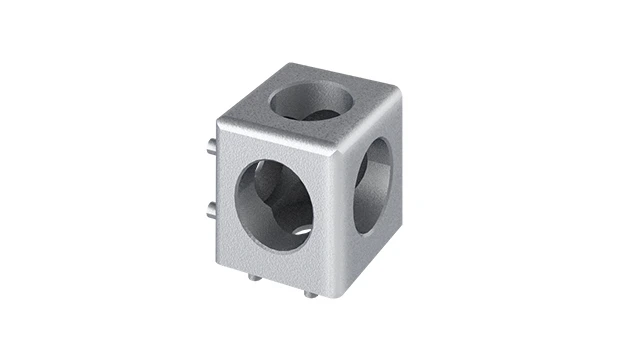
The 3 way - squared corner connector is an external fastening method that is typically used to create a corner connection between three profiles. It is a heavy-duty connection that is simple to use and provides a polished look.
Walk into any computer peripheral production facility, and you'll quickly notice the rhythm of precision: tiny circuit boards being soldered, plastic casings snapping into place, and workers moving with focused intent to assemble keyboards, mice, monitors, and printers. But behind that rhythm lies a hidden challenge: how to keep up with ever-changing product designs, tight deadlines, and the need for seamless workflow. For years, many factories relied on rigid, one-size-fits-all workbenches and static material racks—setups that worked until a new product line required a taller table, or a bottleneck emerged in the assembly process. That's where aluminum profile systems, and specifically aluminum profile 3 way connectors , have quietly revolutionized the game.
These unassuming connectors, often overlooked in the grand scheme of manufacturing, are the unsung heroes of modular production. They're the reason a workbench can be reconfigured in an hour instead of a week, why a roller track can be extended to accommodate longer monitor panels, and how a lean system adapts to the unique quirks of computer peripheral assembly. In this article, we'll dive into how aluminum profile 3 way connectors transform production lines, the key role they play in tools like workbenches and roller tracks, and why they've become indispensable for modern manufacturers.
The Hidden Cost of Rigidity in Computer Peripheral Production
Computer peripherals might seem simple compared to a laptop or smartphone, but their production lines are surprisingly complex. A single keyboard, for example, involves assembling dozens of tiny components: keycaps, switches, PCBs, and frames. Each step demands specific tools, lighting, and workspace—needs that shift when a new model with a slimmer design or wireless functionality hits the drawing board. Traditional production setups, built with fixed steel racks and welded workbenches, struggle here.
Consider the story of a mid-sized factory in Guangdong that specialized in gaming mice. A few years back, they launched a new ergonomic model with extra buttons and RGB lighting. Overnight, their existing workbenches felt cramped: tools for soldering the extra PCBs didn't fit, and the static material racks couldn't angle the mouse shells for easier access. The solution? They had to hire welders to cut and rework the benches—a week-long process that delayed production and cost thousands. "We were losing money every day the line was down," recalls the plant manager. "That's when we started looking for something more flexible."
This is where aluminum profiles and their accessories, like the 3 way connector, shine. Unlike rigid steel, aluminum is lightweight yet strong, resistant to corrosion, and—most importantly—modular. With the right connectors, workers can assemble, disassemble, and reconfigure workbenches, roller tracks, and racks on the fly, without specialized tools or downtime. It's lean manufacturing in action: adapting to change, minimizing waste, and putting control back in the hands of the people on the floor.
Aluminum Profile 3 Way Connectors: Small Part, Big Impact
At first glance, an aluminum profile 3 way connector looks like a simple piece of hardware: a small, often T-shaped or Y-shaped block with holes for screws, designed to join three aluminum profiles at once. But its simplicity is its strength. Let's break down why these connectors are so critical:
1. Flexibility in Every Angle : Whether you need to build a vertical shelf, a horizontal workbench frame, or a diagonal support beam, 3 way connectors pivot and lock into place. Most models allow 360-degree rotation before tightening, so you're not stuck with 90-degree angles—perfect for customizing a workbench to fit a specific tool layout or angling a roller track to guide components around a corner.
2. Tool-Free Assembly (Mostly) : Unlike welding or drilling, assembling with 3 way connectors often requires nothing more than a hex key. Workers can tighten or loosen screws in minutes, making it easy to adjust a setup mid-shift if a new component arrives or a process changes. This is a game-changer for training new staff, too—no need to teach complex machinery operation.
3. Durability That Lasts : Aluminum profiles are already known for their strength-to-weight ratio, but the connectors are built to match. Made from high-grade aluminum alloy (often with anodized finishes to resist scratches), they hold up to daily wear and tear—even in busy production lines where workbenches are loaded with tools and roller tracks see constant use.
4. Compatibility with Accessories : The best 3 way connectors don't just join profiles—they work seamlessly with other aluminum profile accessories. Need to add a roller track to your workbench? Screw a track bracket into the connector. Want to mount a monitor arm above the assembly area? The connector provides a stable base. This compatibility turns a basic frame into a fully functional system.
To put this in perspective: A standard computer peripheral production line might use 3 way connectors to build a workbench with a raised shelf for tools, a lower shelf for component bins, and a side-mounted roller track to slide PCBs from one station to the next. If the next product requires a deeper work surface, workers can simply loosen the connectors, add longer profiles, and re-tighten—no cutting, no welding, no waiting.

From Workbench to Roller Track: Real-World Applications in Peripheral Production
Let's get specific: How exactly do aluminum profile 3 way connectors make a difference in assembling computer peripherals? Let's walk through three common scenarios where these connectors turn chaos into order.
1. Custom Workbenches for Keyboard Assembly
Keyboards are a study in small parts: hundreds of keycaps, springs, and switches that need precise alignment. A one-size workbench might force workers to hunch over or reach across cluttered surfaces, slowing them down and increasing errors. With aluminum profiles and 3 way connectors, factories build workbenches tailored to the task.
Imagine a workbench where the main surface is at elbow height, with a 3 way connector attaching a vertical profile on the left. That vertical profile holds a tray for keycap organizers, angled at 45 degrees (thanks to the connector's rotation) so workers can grab the right key without looking. On the right, another 3 way connector supports a horizontal roller track, sliding completed keyboard frames to the testing station. If the next keyboard model is larger, the connectors loosen, the vertical profiles move outward, and the roller track extends—all in under an hour.
2. Roller Tracks for Smooth Component Flow
In monitor assembly, large LCD panels are fragile and heavy—dropping or jostling them can ruin hours of work. Roller tracks guided by aluminum profiles with 3 way connectors solve this. The connectors ensure the track stays level and stable, even when panels glide over it. For curved production lines (common in factories with limited space), 3 way connectors angle the track segments, creating a gentle bend that moves panels without stress.
A factory in Taiwan, for example, uses roller tracks with 3 way connectors to move monitor backplates from the injection molding machine to the assembly station. The track starts at the machine (high) and slopes downward to the workbench (low), using gravity to move the backplates—no motors, no noise, just smooth motion. If a new backplate design is thicker, workers adjust the track's height by repositioning the 3 way connectors on the vertical support profiles. Simple, effective, and energy-efficient.
3. Material Racks That Grow with Demand
Computer peripheral production often involves seasonal spikes—back-to-school season, holiday shopping, or new product launches. During these times, factories stockpile more components, and static racks quickly run out of space. Aluminum profile racks with 3 way connectors solve this by expanding vertically or horizontally. Add a new shelf by attaching profiles to existing connectors, or extend the rack's length by joining more sections. When demand drops, disassemble the extra parts and store them—no wasted space.

Traditional vs. Aluminum Profile Systems: The Numbers Speak
Still on the fence about switching to aluminum profiles with 3 way connectors? Let's compare traditional setups (steel racks, welded workbenches) with modern modular systems. The difference in efficiency and cost becomes clear quickly:
| Aspect | Traditional Steel/Welded Setup | Aluminum Profile System with 3 Way Connectors |
|---|---|---|
| Assembly Time | 1-2 weeks (requires welding, cutting, painting) | 1-2 days (tool-free, modular assembly) |
| Reconfiguration Time | 3-5 days (requires dismantling, re-welding) | 1-2 hours (adjust connectors, add/remove profiles) |
| Durability | Medium (prone to rust if not painted; welds weaken over time) | High (aluminum resists rust; connectors lock securely for long-term use) |
| Cost Over 5 Years | High (needs replacement every 2-3 years; rework costs add up) | Low (modular parts reusable; minimal rework costs) |
| Worker Satisfaction | Low (fixed setups cause discomfort; slow processes lead to frustration) | High (customizable workspaces reduce strain; faster workflows boost morale) |
The data speaks for itself: aluminum profile systems with 3 way connectors save time, reduce costs, and make the production floor a more adaptable, worker-friendly space. For computer peripheral manufacturers, where product cycles are short and customization is key, this isn't just an upgrade—it's a necessity.
Beyond Connectors: The Role of Aluminum Profile Accessories
3 way connectors are the backbone of a modular system, but they're even more powerful when paired with the right aluminum profile accessories . These add-ons turn a basic frame into a fully functional production tool, tailored to the unique needs of computer peripheral assembly. Let's explore a few must-have accessories and how they work with 3 way connectors:
Roller Track Guides
These plastic or aluminum rails attach to profiles via connectors, creating a smooth path for components. Yellow or grey guides (like the "plastic roller track guide rail yellow" from many suppliers) are easy to see, reducing misalignment errors.
Workbench Decks
Plywood, aluminum, or anti-static ESD decks mount to profile frames using connectors, creating stable surfaces for assembly. Some models (like "workbench e (single deck-without caster)") are pre-cut to fit standard profile sizes.
Casters and Leveling Feet
Add mobility with swivel casters or stability with adjustable feet—both attach to profile bases via connectors. Useful for moving workbenches to new locations or leveling racks on uneven floors.
Swivel Roller Balls
These 0.5-inch or 1-inch balls (like "stainless steel swivel roller balls 1 inch") mount to workbench surfaces via connectors, letting workers slide heavy components with minimal effort.
The beauty of these accessories is their modularity. A lean system supplier can provide a starter kit with profiles, 3 way connectors, and basic accessories, then let you add more as needed. This scalability means you don't have to invest in a full system upfront—start with a few workbenches and roller tracks, then expand as your production grows.
Choosing the Right Lean System Supplier: What to Look For
Not all aluminum profile systems are created equal, and the same goes for suppliers. When shopping for 3 way connectors, workbenches, roller tracks, and other accessories, keep these factors in mind:
1. Quality of Materials : Ask about the aluminum grade (6063-T5 is standard for profiles, offering a good balance of strength and flexibility) and connector finish (anodized is better for scratch resistance). A reputable supplier will share material certifications.
2. Range of Accessories : Look for suppliers that carry not just profiles and connectors, but also roller tracks, casters, workbench decks, and ESD-safe options (critical for computer peripherals, where static electricity can damage components). The more accessories they offer, the easier it is to build a cohesive system.
3. Customization Support : Even modular systems sometimes need tweaks. Does the supplier offer custom profile lengths or connector designs? Can they help you design a workbench or roller track layout tailored to your production line? Avoid suppliers that only sell "one-size-fits-all" kits.
4. Lead Times and Inventory : In manufacturing, delays cost money. Choose a supplier with local warehouses or large inventories to ensure you can get replacement connectors or new accessories quickly—no waiting weeks for parts to ship from overseas.
5. After-Sales Service : What happens if a connector breaks or a roller track jams? A good supplier offers warranties, replacement parts, and even on-site support to help you troubleshoot. Read reviews or ask for references to gauge their service quality.
Remember the Guangdong gaming mouse factory we mentioned earlier? They switched to a local lean system supplier that offered custom workbench designs and same-day delivery on roller track accessories. Within three months, their production time per mouse dropped by 15%, and worker complaints about cramped workspaces vanished. "It wasn't just the connectors—it was the supplier's willingness to listen to our needs," the plant manager says. "That's the difference between a vendor and a partner."
The Future of Production: Where Aluminum Profiles and 3 Way Connectors Go Next
As computer peripherals become smarter (think wireless keyboards with touchscreens, or mice with haptic feedback), production lines will only grow more complex. Aluminum profile systems with 3 way connectors are poised to keep up, thanks to ongoing innovations:
- Smart Connectors : Some suppliers are testing connectors with built-in sensors that track usage (e.g., how often a workbench is reconfigured) or alert maintenance when screws loosen. This could prevent breakdowns before they happen.
- Eco-Friendly Materials : Recycled aluminum profiles and biodegradable plastic accessories are on the rise, appealing to manufacturers focused on sustainability.
- AI-Designed Layouts : Imagine uploading your production line specs to a tool that suggests the optimal workbench and roller track layout, then automatically generates a list of profiles and connectors needed. Early versions of this technology are already in use by large manufacturers.
Final Thoughts: Building a Production Line That Grows With You
At the end of the day, aluminum profile 3 way connectors are more than just hardware—they're a mindset shift. They represent a move away from "this is how we've always done it" and toward "how can we make this better?" For computer peripheral manufacturers, this shift translates to faster production, happier workers, and a bottom line that's more resilient to change.
Whether you're assembling your first batch of wireless keyboards or scaling up to meet global demand, the right tools matter. And in today's fast-paced manufacturing world, few tools are as essential as a modular system built on aluminum profiles, 3 way connectors, and a commitment to lean efficiency. The next time you pick up a computer mouse or type on a keyboard, take a moment to appreciate the invisible work of the production line—and the connectors that made it all possible.